The Chemistry Under Your Floor: LFP vs NMC/NCA Explained
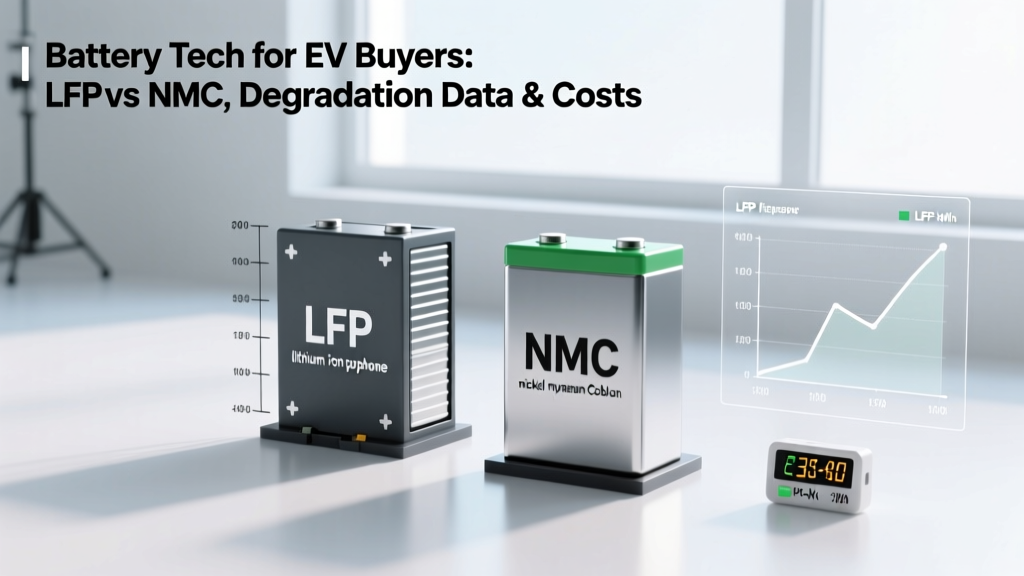
Every EV sold today runs on lithium-ion cells, but not all lithium-ion packs are built the same. The two dominant cathode chemistries in 2026 are lithium iron phosphate (LFP) and nickel manganese cobalt / nickel cobalt aluminum (NMC/NCA). The chemistry choice affects your range, how long the pack lasts, how it handles winter, and what you pay at the dealership.
Here's a direct trade-off comparison before we get into the nuance:
| Attribute | LFP (LiFePO₄) | NMC / NCA |
|---|---|---|
| Energy density (cell-level) | ~160–180 Wh/kg | ~220–260 Wh/kg |
| Typical cycle life | 3,000–5,000+ cycles | 1,000–2,500 cycles |
| Cold-weather performance | Greater range loss below 32°F; slower charge acceptance | Better low-temp discharge and preconditioned charging |
| Cost per kWh (pack-level, 2026) | ~$90–$110 | ~$120–$145 |
| Cobalt/nickel content | None (iron + phosphate) | Significant (supply-chain & ethical sourcing concerns) |
| State-of-charge daily use | Manufacturer recommends 100% charge regularly for BMS calibration | Recommended daily limit ~80%; 100% only before trips |
| Common in (2026 models) | Tesla Model 3/Y RWD, Ford Mustang Mach-E Select, standard-range BYD, Rivian Standard | Long-range / performance trims: Hyundai Ioniq 5 LR, BMW iX, Lucid Air, Tesla LR/Performance |
What this means practically: If you buy a standard-range EV for commuting and can charge at home every night, LFP is a cost-effective, longevity-friendly choice. If you need 300+ miles of EPA range, tow frequently, or live in sub-freezing climates, NMC/NCA packs deliver more usable energy per pound and better cold-weather behavior. Neither chemistry is universally "better" — they solve different ownership profiles.
One nuance many buyers miss: LFP cells have a very flat voltage curve, which makes it harder for the battery management system (BMS) to estimate remaining range accurately. That's why Tesla and Ford recommend charging LFP packs to 100% at least weekly — it recalibrates the BMS. Ignore this, and your "guess-o-meter" will drift. NMC packs, by contrast, have a sloped voltage curve that the BMS reads more easily, but they degrade faster if routinely held at 100%.
How Long Do EV Batteries Actually Last?
The short answer from a decade of fleet data: most modern liquid-cooled EV packs will outlast the vehicle they're installed in. That's not marketing — it's what we see in Recurrent's fleet data spanning 15,000+ vehicles.
Typical degradation curve (liquid-cooled NMC packs, 2020–2026 models):
- Year 1 / 15,000 mi: 2–4% capacity loss (initial "break-in" drop)
- Year 3 / 45,000 mi: 5–8% total loss
- Year 5 / 75,000 mi: 7–11% total loss
- Year 8 / 120,000 mi: 10–15% total loss
- Year 10+ / 150,000+ mi: 12–20% total loss (varies heavily by climate and charging habits)
LFP packs in comparable duty cycles show 1–2% less total degradation at each milestone, primarily because owners routinely charge to 100% (keeping cells balanced) and because the chemistry is inherently more stable across cycles.
For context, a 2026 Hyundai Ioniq 5 Long Range with its 77.4 kWh NMC pack (EPA 305 mi) would typically retain roughly 270–280 miles of range at 75,000 miles. That's noticeable but not debilitating. The pack isn't "dead" at any of these milestones — it simply holds fewer kWh than when new.
Early-generation EVs from 2011–2017 (Nissan Leaf with passive air cooling, first-gen Chevy Bolt) degraded far faster — sometimes 20–30% in five years — because their thermal management was inadequate. Every major 2026 EV uses active liquid cooling/heating, which is the single biggest factor in modern pack longevity.
Battery Warranty: What's Actually Covered
Federal law mandates a minimum 8-year / 100,000-mile warranty on EV battery packs (10 years / 150,000 miles in California and states that follow CARB rules). Most manufacturers exceed this floor. Here's how the major ones stack up for 2026 models:
| Manufacturer | Battery Warranty | Capacity Retention Threshold |
|---|---|---|
| Tesla (Model 3/Y RWD — LFP) | 8 yr / 120,000 mi | 70% |
| Tesla (Model 3/Y LR & Performance) | 8 yr / 120,000 mi | 70% |
| Hyundai / Kia | 10 yr / 100,000 mi | 70% (some trims 65%) |
| Ford (Mustang Mach-E, F-150 Lightning) | 8 yr / 100,000 mi | 70% |
| General Motors (Ultium-based) | 8 yr / 100,000 mi | 70% |
| BMW | 8 yr / 100,000 mi | 70% |
| Rivian | 8 yr / 175,000 mi (Commercial: 10 yr / 175,000 mi) | 70% |
| Volkswagen (ID.4) | 8 yr / 100,000 mi | 70% |
Read the fine print. These warranties cover the pack falling below the stated retention threshold — not a specific range number. If your 300-mile EPA vehicle drops to 210 miles (70% of original capacity), that's a warranty claim. A drop to 225 miles (75%) is not, even though it's frustrating. Warranties also exclude damage from accidents, flooding, improper charging equipment, or unauthorized modifications.
Worth noting: the IRS §30D federal tax credit requires battery components and critical minerals to meet domestic-sourcing thresholds that tighten each year through 2029. This doesn't affect your warranty, but it does determine whether you qualify for up to $7,500 at point of sale — and the battery's supply chain is the variable most likely to disqualify a model. Always confirm current-year eligibility on the IRS Clean Vehicle Credit page before purchasing.
Replacement Cost: The Number That Scares People (and the Context That Shouldn't)
Yes, a full EV battery replacement is expensive. No, you almost certainly won't need one during typical ownership. Here's what the numbers look like in 2026:
| Model / Pack Size | Estimated Replacement Cost (Parts + Labor) | Typical Replacement Trigger |
|---|---|---|
| Tesla Model 3 RWD (~60 kWh LFP) | $8,000 – $12,000 | Rare; most packs exceed 200K mi |
| Hyundai Ioniq 5 LR (77.4 kWh NMC) | $12,000 – $16,000 | Post-warranty, high-mileage fleet use |
| Ford F-150 Lightning Extended (131 kWh NMC) | $18,000 – $25,000 | Extreme use cases; very rare |
| Chevy Bolt EV/EUV (65 kWh NMC) | $10,000 – $14,000 | Post-recall replacement packs are updated chemistry |
| BMW iX xDrive50 (111.5 kWh NMC) | $20,000 – $28,000 | Luxury-segment pricing; rare need |
Several realities soften this sticker shock:
- Module-level repair is increasingly common. Many shops can replace individual modules (a pack contains 4–20+ modules) for $2,000–$5,000 rather than swapping the entire pack.
- Most packs outlive the car. The average US vehicle age is 12.6 years. Data from Recurrent and fleet operators shows the median 2020+ EV pack retains 85%+ capacity at year 10.
- Used/remanufactured packs are a growing market, typically 40–60% cheaper than new OEM packs.
- Costs are declining. Pack-level pricing has fallen from ~$1,200/kWh in 2010 to roughly $100–$145/kWh in 2026. This trend continues.
The honest framing: battery replacement is a real cost, but it's analogous to an engine or transmission rebuild on an ICE vehicle — a late-life event that most original owners never face.
What Kills an EV Battery Early (and What Doesn't)
Not all miles are equal when it comes to pack health. Here's what actually accelerates degradation, ranked by impact:
Highest-impact factors:
- Routine DC fast charging without preconditioning. Slamming 150+ kW into a cold pack causes lithium plating on the anode — permanent capacity loss. Always use the vehicle's navigation-based preconditioning (it warms the pack before you arrive at the charger).
- Sustained high State of Charge in hot climates. Sitting at 100% SoC in 95°F+ ambient temps is the worst combination for NMC cells. If you live in Arizona or Texas, set your daily charge limit to 80% and park in shade when possible.
- Deep discharges to 0% and storage at low SoC. Letting the pack sit near-empty for days stresses the chemistry. If storing the vehicle, leave it at ~50% SoC.
Moderate-impact factors:
- Exclusive DC fast charging (no Level 2). Drivers who fast-charge 3+ times per week see ~1–2% additional degradation over 5 years vs. primarily L2 home charging, per Recurrent data.
- Frequent 100% charges on NMC packs. Save 100% for road trips. LFP packs are exempt from this concern.
Low-impact (myth-busting):
- Regenerative braking set to max. Regen puts energy back into the pack at modest rates — this does not meaningfully accelerate degradation.
- Cold-weather driving. You lose range temporarily (20–30% below 20°F), but the BMS protects the pack from damage. Cold is a range problem, not a longevity problem.
- Using the car while plugged in (preconditioning, cabin heating). This actually reduces pack cycles.
Monitoring Your Battery's State of Health
State of Health (SoH) is the percentage of original capacity your pack currently holds. A new pack is 100% SoH; at 70% SoH, you'd trigger most warranty claims. Here's how to check it:
- OEM apps: Tesla, Hyundai, Ford, BMW, and Rivian all surface SoH or detailed energy-usage data in their companion apps. Tesla doesn't show a direct SoH percentage, but you can infer it from the "rated range at 100%" vs. original EPA figure.
- OBD-II dongles + apps: Tools like OBDeleven (VW/Hyundai/Kia), LeafSpy (Nissan), or Scan My Tesla pull raw BMS data including SoH, cell voltages, and pack temperature.
- Third-party services: Recurrent offers a free battery health report that compares your pack to their fleet dataset. Several dealerships now include SoH printouts in certified-pre-owned inspections.
- Manual calculation: Charge to 100%, note the displayed range, and compare to the original EPA number. Adjust for ambient temperature (cold inflates the apparent loss).
Check SoH quarterly, not obsessively. Battery degradation is a slow process — week-to-week fluctuations are noise, not signal.
Beyond Lithium-Ion: Solid-State, Silicon Anodes, and What's Real
Every few months a headline promises that solid-state batteries will "change everything next year." Here's the honest 2026 landscape:
- Silicon-dominant anodes (from companies like Sila Nanotechnologies and Group14) are shipping in limited production vehicles now, replacing some graphite in NMC cells to boost energy density 10–20%. This is real, incremental, and expanding.
- Semi-solid-state cells (hybrid liquid/solid electrolyte) are in early production from suppliers like WeLion (supplying NIO) and are being validated by several OEMs. Expect limited availability in high-end 2027–2028 models.
- True solid-state batteries (Toyota, Samsung SDI, QuantumScape) remain in pilot production. Toyota's announced timeline targets 2027–2028 for initial deployment, but at very low volume and high cost. Mass-market solid-state at price parity with current NMC is realistically a 2030+ proposition.
- Sodium-ion batteries (CATL, BYD) are entering production for low-cost, short-range city EVs. They sacrifice energy density for cheap, abundant materials and excellent cycle life. Expect them in sub-$25,000 compact EVs within 2–3 years.
If you're buying in 2026, today's LFP and NMC packs are mature, well-understood, and warrantied. Waiting for solid-state is like waiting for the next iPhone — there's always something better on the horizon, but the current generation is already excellent.
Frequently Asked Questions
How long do EV batteries last in years and miles?
Modern liquid-cooled packs (2020 and newer) routinely reach 150,000–200,000+ miles while retaining 80–85% of original capacity. In years, that's typically 12–15+ years of average use (13,500 mi/yr). The pack isn't "dead" at this point — it just holds less energy, similar to an older smartphone battery.
How much does an EV battery cost to replace in 2026?
Full pack replacement ranges from roughly $8,000 for a compact LFP pack (Tesla Model 3 RWD) to $25,000+ for a large NMC pack (F-150 Lightning Extended Range). Module-level repairs are $2,000–$5,000. Most owners never need either during their ownership.
What does the battery warranty actually cover?
The federal minimum is 8 years / 100,000 miles against the pack dropping below a stated capacity threshold (usually 70% of original). Some manufacturers offer 10 years. The warranty covers defects and abnormal degradation — not accident damage, improper charging, or normal wear above the threshold.
How do I check my EV battery health?
Use your vehicle's companion app, an OBD-II reader with EV-specific software (OBDeleven, LeafSpy, Scan My Tesla), or a free report from Recurrent. Compare your 100% charge range to the original EPA figure, accounting for temperature. Check quarterly.
Is LFP or NMC better for me?
Choose LFP if: you mostly commute, charge at home, want maximum cycle life, and don't need 300+ miles of range. Choose NMC/NCA if: you need long range, tow, live in very cold climates, or buy a performance trim. LFP is cheaper and longer-lasting; NMC packs more energy into less weight and handles cold better.
Does fast charging damage my EV battery?
Occasional DC fast charging is fine. The risk comes from exclusive fast charging (never using Level 2), charging without preconditioning a cold pack, and consistently charging at 250+ kW rates. Fleet data shows exclusive fast-charging adds roughly 1–2% extra degradation over 5 years — noticeable but not catastrophic. Use L2 at home whenever possible.
Should I charge my EV to 100% every night?
For NMC/NCA packs: no — set a daily limit of 80% and charge to 100% only before long trips. For LFP packs: yes, manufacturers recommend regular 100% charges to keep the BMS calibrated. Check your owner's manual for your specific chemistry.
The battery remains the most expensive single component in any EV, and understanding its chemistry, degradation behavior, and care requirements is the highest-leverage knowledge an EV buyer can have. The data in 2026 is reassuring: modern packs are lasting longer, degrading slower, and costing less than early EV skeptics predicted. Buy the chemistry that fits your driving pattern, follow a few simple care habits, and the pack will likely be the least of your worries over a decade of ownership.