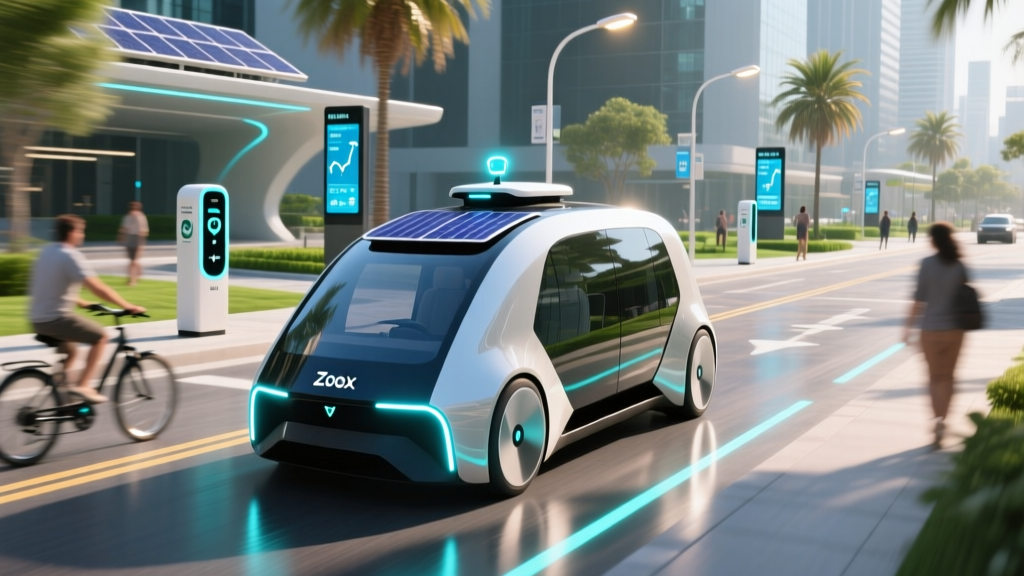
Zoox, the autonomous vehicle company acquired by Amazon in 2020, has been steadily expanding its driverless ride-hail service across a handful of US cities. Unlike consumer EVs with Level 2 driver-assist features, Zoox operates a purpose-built, steering-wheel-free carriage at SAE Level 4 — meaning no human driver is present, and the system handles all driving tasks within its approved operational design domain (ODD). But where can you actually hail a Zoox ride today, and what should you expect?
This guide maps every confirmed Zoox location as of early 2026, breaks down the real pricing, safety record, technology, and the hard limitations that still constrain robotaxi availability.
Where Can You Use Zoox Right Now?
Zoox has taken a measured, city-by-city rollout approach — prioritizing dense urban grids with favorable weather and regulatory environments over rapid geographic sprawl. As of 2026, confirmed commercial or late-stage public pilot operations are live in the following areas:
| City | Status | Service Area Notes | Approx. Geofence Size |
|---|---|---|---|
| Las Vegas, NV | Commercial service | Las Vegas Strip corridor, downtown, Convention Center loop | ~6 sq mi core zone |
| San Francisco, CA | Commercial service (limited hours) | SoMa, Financial District, Mission Bay; avoids steepest hills | ~8 sq mi |
| Foster City, CA | Public pilot / employee rides | Suburban office-park and arterial roads near Zoox HQ | ~4 sq mi |
| Austin, TX | Late-stage testing, invite-only rides | Downtown, South Congress, East Austin corridors | ~5 sq mi (expanding) |
| Seattle, WA | Testing (no public rides yet) | South Lake Union, Capitol Hill mapping and validation | N/A — not open |
Key caveat: Zoox's geofences are precise. A ride that starts inside the zone cannot end outside it, and the vehicle will not enter unmapped or unapproved streets. If your destination falls 200 feet outside the ODD boundary, the app will suggest the nearest valid drop-off point.
Zoox Pricing: How Does It Compare to Uber and Lyft?
Zoox has positioned its service as cost-competitive with standard rideshare, not a premium product. In Las Vegas — the market with the longest commercial track record — pricing follows this general structure:
| Metric | Zoox | UberX | Lyft Standard |
|---|---|---|---|
| Base fare | $0 (promo period) / ~$3.50 standard | ~$2.80 | ~$2.50 |
| Per-mile rate | ~$1.15 | ~$1.30 | ~$1.25 |
| Per-minute rate | ~$0.28 | ~$0.32 | ~$0.30 |
| Typical 3-mile ride | $7–$9 | $9–$13 | $8–$12 |
| Surge pricing | Not currently implemented | 1.5x–3x common | 1.3x–2.5x common |
| Tips | Not applicable (no driver) | Expected ($2–$5) | Expected ($2–$5) |
During promotional periods in Las Vegas and San Francisco, Zoox has offered free or heavily discounted rides to build rider familiarity. Standard pricing, once promos end, undercuts UberX by roughly 15–25% on comparable routes — a function of eliminating the driver payout, which typically represents 60–70% of a rideshare fare.
How to ride: Download the Zoox app (iOS/Android), create an account, set your pickup and drop-off within the geofence, and confirm. The vehicle arrives, unlocks its doors automatically, and you select a seat. An in-cabin screen confirms your route and provides a live support button connected to a remote fleet attendant.
SAE Level 4: What "Driverless" Actually Means Here
Zoox vehicles operate at SAE Level 4 within their geofenced ODD. This means the system performs all driving tasks — steering, acceleration, braking, route navigation, and edge-case handling — with no human driver present and no expectation of human takeover. If the system encounters a scenario it cannot resolve, it executes a minimal-risk maneuver (pull over, stop safely) and contacts a remote fleet attendant.
This is fundamentally different from SAE Level 2 systems like Tesla Autopilot, GM Super Cruise, or Ford BlueCruise, which require an attentive human driver at all times. Consumer Level 2 vehicles have steering wheels and pedals; Zoox's purpose-built carriage has neither.
| Level | Name | Who Drives? | Examples |
|---|---|---|---|
| 0 | No Automation | Human | Legacy vehicles |
| 1 | Driver Assistance | Human (system assists one axis) | Adaptive cruise control |
| 2 | Partial Automation | Human (must supervise) | Tesla Autopilot, BlueCruise, Super Cruise |
| 3 | Conditional Automation | System (human on standby) | Mercedes Drive Pilot (limited markets) |
| 4 | High Automation | System (no human needed in ODD) | Waymo, Zoox, Cruise (pre-suspension) |
| 5 | Full Automation | System (everywhere, all conditions) | None commercially available |
Safety Record: What the Data Shows
- Total autonomous miles driven: ~3+ million miles across test and commercial fleets (per NHTSA AV reporting and Zoox disclosures)
- At-fault collisions: Very low single digits reported; no fatal incidents involving Zoox vehicles in autonomous mode as of this writing
- Disengagement rate: Zoox does not publish a per-thousand-mile disengagement figure in the same format as California DMV reports (its primary commercial operations are in Nevada); however, remote-assist interventions are understood to occur roughly once per 5,000–8,000 miles in complex urban zones
- Incident context: Reported minor contacts have predominantly involved low-speed scenarios (parked vehicles, construction-zone cones) where the vehicle initiated a cautious stop but was contacted by another road user
Source: NHTSA Standing General Order on ADS crashes, Zoox safety transparency reports.
For context, the US human-driver fatality rate is approximately 1.35 deaths per 100 million vehicle miles (NHTSA). Robotaxi fleets operate at far lower speeds in geofenced urban areas, making direct comparison imperfect — but the absence of serious injuries across Zoox's operational history is a meaningful data point.
Zoox's safety architecture includes redundant braking, steering, and compute systems. If a primary sensor or computer fails, a backup system can bring the vehicle to a controlled stop. The carriage's symmetric, four-wheel-steering design also allows lateral "crab" maneuvers to avoid obstacles in ways conventional vehicles cannot.
Technology Stack: Sensors, Compute, and the Purpose-Built Carriage
Unlike Waymo, which retrofits Jaguar I-PACE SUVs with aftermarket sensor suites, Zoox designed its vehicle from the ground up for autonomous operation. This purpose-built approach shapes the entire tech stack:
Sensor Suite
- LiDAR: Multiple solid-state and spinning LiDAR units providing 360° 3D point-cloud mapping out to ~150+ meters. LiDAR is the primary depth-sensing modality, unaffected by lighting conditions.
- Cameras: A redundant array of high-resolution cameras covering all directions, used for object classification, traffic-light state detection, signage reading, and lane-marking identification.
- Radar: Forward and corner-mounted radar units for velocity detection of moving objects (vehicles, cyclists), especially useful in rain where LiDAR and camera performance degrade.
- Microphones: External microphones detect emergency-vehicle sirens and trigger yielding behavior before the siren source is visible.
Compute and Software
Zoox runs a proprietary perception-prediction-planning stack on custom onboard compute. The system processes sensor fusion in real time, predicting the trajectories of pedestrians, cyclists, and vehicles up to several seconds ahead, then generating safe, comfortable motion plans at high frequency. Remote fleet attendants can intervene via teleoperation for edge cases the onboard system flags as uncertain.
The Carriage Itself
The Zoox vehicle seats four passengers face-to-face (no forward-facing "driver" seat), has bidirectional driving capability (it can travel equally well in either direction), and features four-wheel steering for tight urban maneuvers. Top speed is governed to approximately 75 mph, though it rarely exceeds 45 mph in its current urban ODDs. The battery pack is estimated at ~75–80 kWh (LFP chemistry for longevity and safety), supporting a full day of stop-and-go urban operations before returning to a depot for charging.
Regulatory Landscape: Who Approves Robotaxi Operations?
Robotaxi deployment in the US requires navigating a patchwork of state and local regulations. There is no single federal "robotaxi license." Here's how the approval chain works for Zoox:
- Nevada (Las Vegas): The Nevada DMV and the state's AV testing/commercial deployment framework granted Zoox permits for driverless testing and, subsequently, commercial passenger service. Nevada has been among the most permissive states for AV deployment.
- California (San Francisco, Foster City): The California DMV issues testing permits, while the California Public Utilities Commission (CPUC) issues commercial passenger-service permits. Zoox holds both, though San Francisco operations have faced periodic restrictions tied to broader city concerns about AV congestion and emergency-vehicle interactions.
- Texas (Austin): Texas passed AV-enabling legislation that allows driverless operation without a special state permit, provided the vehicle meets federal safety standards and carries appropriate insurance. Austin operations are currently in the testing/invite-only phase.
- Federal (NHTSA): The National Highway Traffic Safety Administration sets vehicle safety standards (FMVSS). Zoox received a notable exemption from certain FMVSS requirements (like having a steering wheel and mirrors) because its carriage has no human driver position. NHTSA also mandates crash reporting under its Standing General Order for all ADS-equipped vehicles.
Current Limitations: Where Zoox Cannot Go
Level 4 autonomy is powerful but bounded. Zoox's service has real, physics-driven limitations that riders should understand before booking:
- Geofence boundary: Rides cannot start, end, or traverse outside the approved ODD. No airport runs (yet), no suburban highway trips beyond the mapped zone.
- Weather restrictions: Heavy rain, fog, or snow can trigger service suspension. LiDAR performance degrades in heavy precipitation, and the system defaults to caution — pulling over or returning to depot — rather than pushing through low-visibility conditions. Las Vegas's dry climate is a strategic advantage here.
- Construction zones: Major, unmapped road construction can cause the vehicle to stop and request remote-assist rerouting. Expect longer travel times in areas with active lane shifts.
- No highway driving: Current ODDs are surface-street only. The vehicle is governed to 75 mph and is not approved for freeway operation in commercial service.
- Limited hours: In some cities (notably San Francisco), Zoox operates during restricted hours rather than 24/7, partly due to regulatory conditions and partly due to fleet-size constraints.
- Accessibility: The carriage design includes wheelchair-accessible configurations, but availability of accessible vehicles may be limited by fleet size. Riders requiring ADA accommodations should confirm availability in the app.
- No stops mid-route: Unlike a human-driven Uber, you cannot ask the Zoox to "stop at the pharmacy." The vehicle follows its planned route and does not accept ad-hoc detour requests.
Zoox vs. Waymo: How the Two Level 4 Services Compare
| Attribute | Zoox | Waymo One |
|---|---|---|
| Vehicle | Purpose-built carriage (no steering wheel) | Jaguar I-PACE (retrofitted SUV) |
| SAE Level | Level 4 | Level 4 |
| Commercial cities | Las Vegas, San Francisco | Phoenix, San Francisco, Los Angeles, Austin |
| Fleet size (est.) | ~250–400 vehicles | ~1,000+ vehicles |
| Highway capable | No (surface streets only) | Limited freeway segments (Phoenix) |
| Avg. wait time | 8–15 min (varies by zone) | 5–10 min |
| Pricing vs. UberX | ~15–25% cheaper | Comparable to UberX |
| Parent company | Amazon | Alphabet (Google) |
Waymo currently has broader geographic coverage and a larger fleet. Zoox differentiates with its purpose-built vehicle design (bidirectional, four-wheel steering, face-to-face seating) and Amazon's logistical infrastructure for fleet management and depot charging. Both are Level 4; neither operates outside geofenced urban zones.
Frequently Asked Questions
Where can I ride a Zoox robotaxi today?
As of 2026, Zoox offers commercial rides in Las Vegas (Strip and downtown corridor) and San Francisco (SoMa, Financial District, Mission Bay). Foster City operates as a public pilot, and Austin is in invite-only testing. Seattle is in the mapping/testing phase with no public rides.
Is Zoox truly self-driving, or is there a remote driver?
Zoox is SAE Level 4 — fully driverless within its geofence. There is no human in the vehicle. Remote fleet attendants can assist via teleoperation if the system encounters an edge case it cannot resolve, but they do not continuously drive the vehicle. This is categorically different from Level 2 systems like Tesla FSD (Supervised), which require an attentive human behind the wheel at all times.
How much does a Zoox ride cost?
A typical 3-mile ride in Las Vegas costs approximately $7–$9 at standard pricing, which is roughly 15–25% less than an equivalent UberX trip. Zoox has also run promotional free-ride periods in new markets. There is no surge pricing currently, and no tip (since there is no driver).
How safe are Zoox robotaxis?
Zoox has accumulated over 3 million autonomous miles with no reported fatalities and very few at-fault collisions. Minor incidents have typically involved low-speed contacts initiated by other road users. The vehicle carries redundant braking, steering, and compute systems. For comparison, the US human-driver fatality rate is ~1.35 per 100 million miles (NHTSA). Full crash data is reported to NHTSA under the Standing General Order for ADS vehicles.
Can Zoox drive on the highway or to the airport?
Not currently. Zoox's operational design domain is limited to surface streets within its geofenced zones. The vehicle is governed to 75 mph and is not approved for freeway or airport service. If your destination falls outside the geofence, the app will not allow the booking.
What happens if the Zoox encounters an emergency vehicle?
The vehicle's external microphones detect sirens, and the system is programmed to pull over and yield — often before the emergency vehicle is visually detected by cameras or LiDAR. This behavior has been validated in both testing and commercial operations.
Does Zoox operate in bad weather?
Zoox may suspend service during heavy rain, fog, or other low-visibility conditions. LiDAR and camera performance degrade in precipitation, and the system's safety-first philosophy means it will pull over rather than operate in conditions that exceed its sensor confidence thresholds. Las Vegas's arid climate minimizes this issue; San Francisco fog can occasionally trigger pauses.
How do I get started with Zoox?
Download the Zoox app from the iOS App Store or Google Play, create an account with payment information, and check whether your pickup and drop-off locations fall within the active geofence. If they do, request a ride as you would with Uber or Lyft. Wait times vary by zone and time of day but typically range from 8 to 15 minutes.