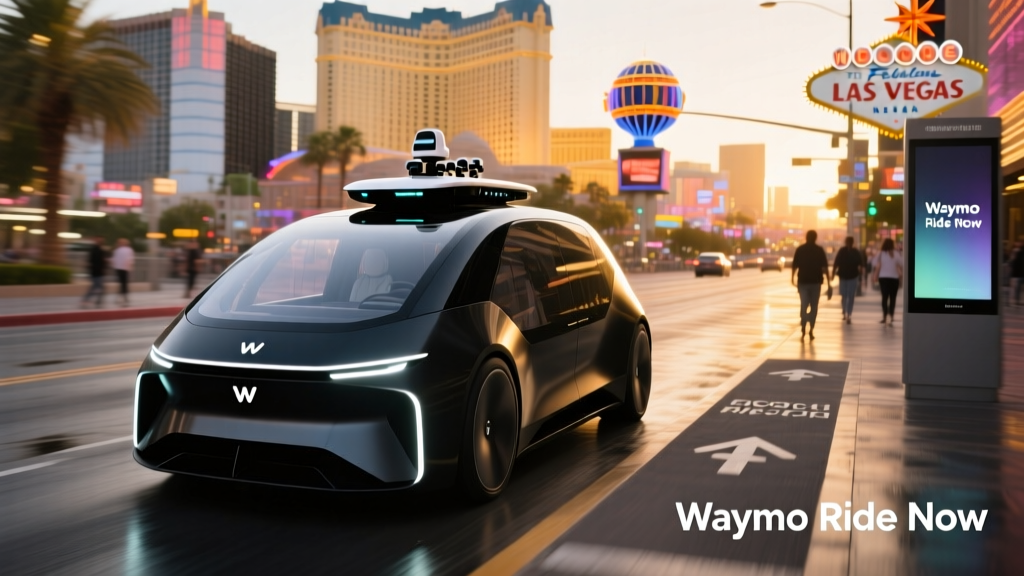
If you've visited Phoenix or San Francisco and watched a white Jaguar I-PACE cruise through traffic with no one behind the wheel, you've probably asked: does Waymo operate in Las Vegas? The short answer as of early 2026 is that Waymo has tested extensively on Las Vegas roads but does not yet offer a fully open, on-demand commercial robotaxi service to the general public in the city the way it does in its core launch markets. However, Las Vegas remains one of Waymo's most active testing and expansion-target cities, and the regulatory groundwork is largely in place.
This guide covers exactly where Waymo's driverless service is live right now, what Las Vegas visitors and residents can expect, how the technology works, real safety data, and how robotaxi pricing compares to traditional rideshare.
Where Can You Actually Ride a Waymo Robotaxi Right Now?
Waymo One — the company's commercial, app-based, fully driverless ride-hailing service — is operational in a limited set of US metro areas. These are cities where you can download the Waymo One app, enter a destination within the geofenced service zone, and be picked up by a vehicle with no human driver present.
| City | Service Status (2026) | Service Area Notes | Vehicle |
|---|---|---|---|
| Phoenix, AZ | Fully operational | Greater Phoenix metro including Scottsdale, Tempe, Mesa; ~225+ sq mi geofence | Jaguar I-PACE (5th-gen) |
| San Francisco, CA | Fully operational | Most of SF proper; expanded to include SFO airport rides | Jaguar I-PACE (5th-gen) |
| Los Angeles, CA | Fully operational | Santa Monica, Hollywood, Downtown LA, and expanding corridors | Jaguar I-PACE (5th-gen) |
| Austin, TX | Operational (expanding) | Central Austin corridors; partnership with Uber for in-app hailing | Jaguar I-PACE (5th-gen) |
| Las Vegas, NV | Testing / limited access | Mapped and tested on major corridors; no open commercial Waymo One service yet | Jaguar I-PACE (5th-gen) |
For Las Vegas specifically, Waymo has been mapping and testing on city streets since at least 2023, accumulating autonomous miles on the Strip-adjacent grid, suburban arterials, and highway segments. Nevada's regulatory environment is permissive — the state has allowed autonomous vehicle testing and deployment under NRS Chapter 482A since 2011, with amendments enabling commercial driverless operations. But Waymo has prioritized scaling its four core markets before flipping Las Vegas to a full public launch.
Las Vegas Robotaxi Landscape: Who Else Is Operating?
Las Vegas isn't a robotaxi desert — it just isn't a Waymo One city yet. Other autonomous-vehicle players have operated on Las Vegas streets:
- Motional (Hyundai/Aptiv JV): Previously ran Ioniq 5-based robotaxi rides on the Strip via Lyft, though the partnership has been scaled back as Motional restructured operations in 2024-2025.
- Zoox (Amazon): Has tested its purpose-built bidirectional robotaxi vehicle in Las Vegas, including on public roads near the Strip. Zoox operates under a different regulatory framework and has been running limited employee and invited-rider programs.
- Waymo: Active testing presence, mapping, and validation miles — but no open Waymo One service as of this writing.
The Las Vegas Convention and Visitors Authority and the Nevada Department of Motor Vehicles (which issues autonomous vehicle testing and deployment permits) both track these operations. If you're visiting Vegas hoping to hail a driverless ride today, your options remain limited to specific pilot programs rather than on-demand public availability.
How Much Does a Waymo Ride Cost vs. Uber or Lyft?
In cities where Waymo One is live, pricing is designed to compete directly with UberX and Lyft standard rides — not premium tiers. Based on fare data from Phoenix and San Francisco riders in late 2025 and early 2026:
| Fare Component | Waymo One | UberX (Comparable) | Lyft Standard |
|---|---|---|---|
| Base fare | $5.00–$5.50 | $3.50–$5.00 | $3.50–$4.50 |
| Per-mile rate | $1.25–$1.75 | $1.10–$1.60 | $1.00–$1.50 |
| Per-minute rate | $0.20–$0.30 | $0.18–$0.28 | $0.17–$0.25 |
| Typical 5-mile ride | $13–$18 | $11–$17 | $10–$16 |
| Surge pricing | Rare; limited demand-based pricing | Common during peak hours | Common during peak hours |
| Tipping | Not expected (no driver) | Expected ($2–$5 typical) | Expected ($2–$5 typical) |
The key economic difference: Waymo fares don't include a driver tip, which effectively makes the total cost comparable to or slightly cheaper than a tipped UberX ride. In Austin, Waymo rides can also be requested through the Uber app, with pricing integrated into Uber's checkout flow. Waymo has also run introductory promotional pricing in newer markets, which could apply when Las Vegas eventually launches commercially.
SAE Automation Levels: Why Waymo Is Not the Same as Tesla FSD
This is where consumer confusion runs deepest. Waymo's robotaxi and a Tesla running FSD (Supervised) are not the same category of technology, even though both involve a vehicle driving itself in certain conditions.
| SAE Level | Definition | Who's Responsible | Examples |
|---|---|---|---|
| Level 0 | No automation | Human driver | Basic cruise control |
| Level 1 | Driver assistance (steering OR speed) | Human driver | Adaptive cruise, lane-keeping |
| Level 2 | Partial automation (steering AND speed) | Human driver must monitor | Tesla Autopilot/FSD (Supervised), GM Super Cruise, Ford BlueCruise |
| Level 3 | Conditional automation (system drives in specific scenarios) | System when engaged; human must take over on request | Mercedes DRIVE PILOT (limited markets) |
| Level 4 | High automation (no driver needed in defined ODD) | System is fully responsible within its operational domain | Waymo One, Zoox |
| Level 5 | Full automation (all conditions, all locations) | System always responsible | Does not exist commercially |
How Waymo's Technology Stack Actually Works
Waymo's 5th-generation Driver system, fitted to the Jaguar I-PACE fleet, uses a multi-sensor fusion approach that is fundamentally different from camera-only systems (like Tesla's vision-based FSD). Here's the hardware and software stack:
Sensor Suite (5th-Gen)
- LiDAR: Multiple spinning and solid-state LiDAR units providing 360° 3D point-cloud mapping up to ~500 meters. LiDAR works independently of ambient light — critical for nighttime and glare conditions.
- Cameras: 29+ cameras covering 360° visual field, including long-range telephoto for distant object classification and near-field cameras for close-proximity maneuvering.
- Radar: 6 radar units for velocity detection of moving objects, functioning in rain, fog, and other conditions where LiDAR and cameras can degrade.
- External audio receivers: Microphones to detect sirens from emergency vehicles.
Software & Mapping
- HD Maps: Waymo pre-maps every inch of its service area at centimeter-level precision. The vehicle doesn't just "see" the road — it knows the road, including lane geometry, curb heights, speed limits, and traffic signal positions.
- Geofencing: The system only operates within its mapped, validated ODD. If a destination falls outside the geofence, the ride simply cannot be requested.
- ML Perception Stack: Neural networks classify objects (pedestrians, cyclists, construction cones, plastic bags vs. rocks) and predict their behavior trajectories.
The reliance on HD maps and geofencing is both Waymo's greatest strength and its scaling constraint. The system is extraordinarily capable within its known territory but cannot simply be deployed to an unmapped city overnight. Every new market requires months of mapping, validation, and regulatory approval before commercial rides begin.
Waymo Safety Record: What the Real Data Shows
Safety is the most scrutinized aspect of robotaxi operations, and Waymo has published more transparent data than most competitors. As of late 2025, Waymo reported:
- Cumulative autonomous miles: Over 30 million fully driverless miles driven across all markets (Waymo's own reporting, updated periodically at waymo.com/safety).
- Injury-causing crash rate: Waymo's published analysis, benchmarked against NHTSA national crash data, showed a ~85% reduction in injury-causing crashes per million miles compared to human-driven vehicle baselines in comparable urban environments.
- Contact rate: Any physical contact (including minor scrapes with stationary objects) reported at rates significantly below human driver averages for dense urban driving.
- NHTSA Standing General Order: Waymo reports all Level 4 incidents under NHTSA's Standing General Order for crash reporting, providing a public regulatory record.
Important context: Waymo's data covers its specific ODD — geofenced, mapped urban/suburban environments in fair to moderate weather. It does not represent performance in unmapped areas, extreme weather, or off-road conditions. The comparison baseline (human drivers) includes all driving environments, so direct equivalence should be interpreted carefully. That said, the data consistently shows that within its operational domain, Waymo's collision and injury rates are meaningfully lower than human benchmarks.
Notable incidents have occurred — including collisions with pedestrians who stepped into the vehicle's path at speed and encounters with improperly parked or reversing vehicles. Waymo's response to these has typically involved software updates to improve prediction models and, in some cases, temporary operational pauses pending review.
Regulatory Landscape: Who Approves Robotaxi Operations?
Robotaxi deployment in the US is governed by a patchwork of state-level regulations rather than a unified federal framework:
- Federal (NHTSA): Sets vehicle safety standards (FMVSS) and requires crash reporting via Standing General Order. NHTSA does not currently "approve" robotaxi services but can investigate and issue recalls. Waymo has received exemptions for certain FMVSS requirements (e.g., no steering wheel or pedals in future vehicle designs).
- State DMVs and PUCs: In California, both the DMV (testing permits) and the California Public Utilities Commission (commercial deployment permits) must approve operations. In Arizona, the regulatory environment is notably permissive — the state issued executive orders enabling driverless testing and commercial operations with minimal permitting friction, which is why Phoenix was Waymo's first market.
- Nevada: Under NRS 482A, Nevada has been an AV-friendly state since 2011. The Nevada DMV issues testing and operation permits. Las Vegas does not have a city-level ban on robotaxis, meaning the regulatory pathway for Waymo to launch commercially exists — the timing is a business and operational decision, not a legal barrier.
- Texas: Austin's regulatory environment allowed Waymo to expand there, with state law (Texas Transportation Code Chapter 545) providing the framework for autonomous vehicle operation.
Current Limitations of Waymo's Robotaxi Service
What Waymo Cannot Do (as of 2026)
- Heavy rain and flooding: While the sensor suite handles light rain, heavy downpours degrade LiDAR and camera performance. Waymo may pause service or restrict geofence zones during severe weather.
- Snow and ice: Waymo does not currently operate commercially in snow-belt cities. Snow occludes sensors, obscures lane markings, and creates road conditions outside the validated ODD.
- Unmapped areas: The vehicle will not drive outside its HD-mapped geofence. If your destination is even one block outside the zone, the app will not let you request the ride.
- Highway driving at high speeds: Waymo's 5th-gen system handles some highway segments (e.g., Phoenix freeway merges), but sustained high-speed Interstate driving in complex multi-lane configurations remains a developing capability.
- Construction zones with major rerouting: While the system handles minor construction cones and lane shifts, major unplanned road closures or complex detour scenarios can trigger a remote-assistance pause.
- Off-road or unpaved roads: Strictly a paved-road, urban/suburban system.
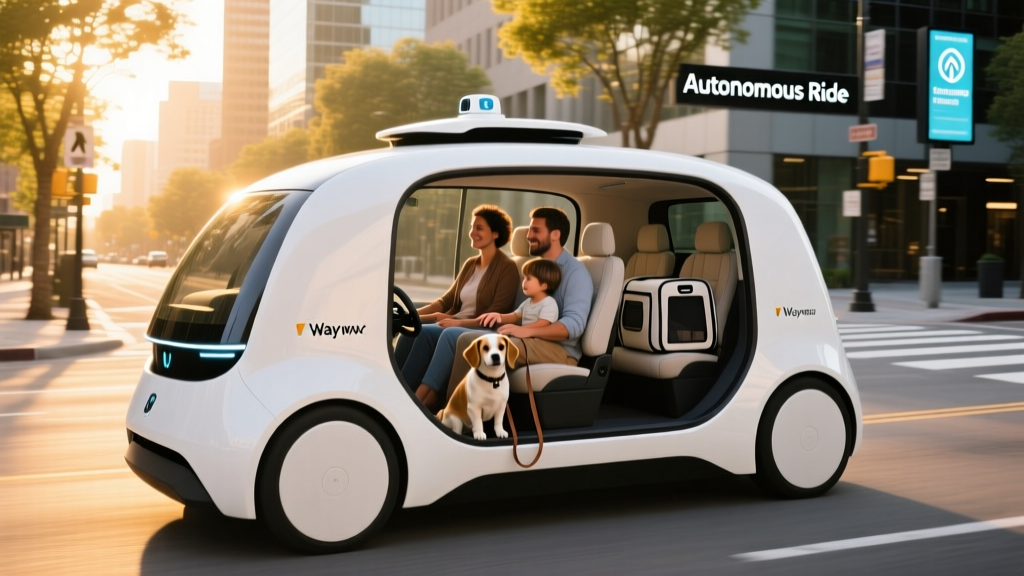
- Pets and unaccompanied minors: Waymo One requires riders to be 18+ (some markets allow accompanied minors). Pets are not permitted unless in carriers, and policies vary by market.
These limitations aren't unique to Waymo — they apply broadly to all Level 4 robotaxi services operating today. The "operational design domain" concept exists precisely because full Level 5 autonomy (any road, any condition, any weather) does not exist and is not close to commercial viability.
When Will Waymo Launch in Las Vegas?
Waymo has not announced a specific date for commercial Waymo One service in Las Vegas. What we know:
- Waymo has been mapping and testing on Las Vegas roads, accumulating validation miles.
- Nevada's regulatory framework already permits commercial autonomous vehicle operations.
- Waymo's expansion strategy has followed a pattern: extensive testing → limited rider programs (often employees and invited users) → controlled commercial launch → gradual geofence expansion.
- The company's 6th-generation Driver hardware, announced for future fleet integration, is designed to reduce per-vehicle cost and accelerate city launches.
Based on Waymo's historical city-launch cadence (Phoenix testing began ~2016, commercial launch 2020; San Francisco testing accelerated 2021, commercial launch 2022-2023; Los Angeles and Austin followed in 2024), a Las Vegas commercial launch in the 2026-2027 window is plausible but not confirmed. The Las Vegas tourism economy — dense, predictable corridors, high ride volume, and a population accustomed to rideshare — makes it a strategically compelling market.
Frequently Asked Questions
Does Waymo operate in Las Vegas right now?
Waymo has tested extensively in Las Vegas but does not currently offer open, on-demand Waymo One commercial robotaxi rides to the general public in the city. Testing and mapping activity is ongoing.
How do I hail a Waymo robotaxi?
In cities where Waymo One is operational (Phoenix, San Francisco, Los Angeles, Austin), you download the Waymo One app, create an account, enter your pickup and dropoff within the service area, and a driverless vehicle is dispatched. In Austin, you can also request Waymo rides through the Uber app.
Is Waymo really self-driving with no driver?
Yes. Waymo One is a SAE Level 4 service. There is no human driver in the vehicle, no steering wheel interaction from passengers. The vehicle handles the entire driving task within its geofenced operational area. This is fundamentally different from Level 2 driver-assist systems like Tesla Autopilot, which require constant human supervision.
How much does a Waymo ride cost?
Waymo One pricing is comparable to UberX or Lyft standard rides, typically $13–$18 for a 5-mile urban trip. Because there is no driver, tipping is not expected, which makes the effective total cost competitive with or slightly lower than a tipped rideshare.
Is a robotaxi safer than a human driver?
Waymo's published safety data shows an approximately 85% reduction in injury-causing crash rates per million miles compared to human-driven vehicle benchmarks in comparable urban settings, based on over 30 million driverless miles. This data applies within Waymo's specific geofenced operational domain and should not be extrapolated to all driving conditions.
What vehicle does Waymo use?
Waymo's current commercial fleet uses the Jaguar I-PACE electric SUV equipped with the 5th-generation Waymo Driver sensor suite (LiDAR, cameras, radar). The I-PACE has a 75 kWh usable battery (NMC chemistry), EPA-estimated 234-mile range when new, and supports DC fast charging — though Waymo's fleet vehicles charge at dedicated depots rather than public stations.
Will Waymo come to Las Vegas in 2026?
Waymo has not confirmed a specific launch date for Las Vegas. The city has active testing, a favorable regulatory environment, and strong market fundamentals, but a commercial launch date has not been publicly announced. Check Waymo's official channels for updates.