The Great Autonomous Divergence: Hardware vs. Software
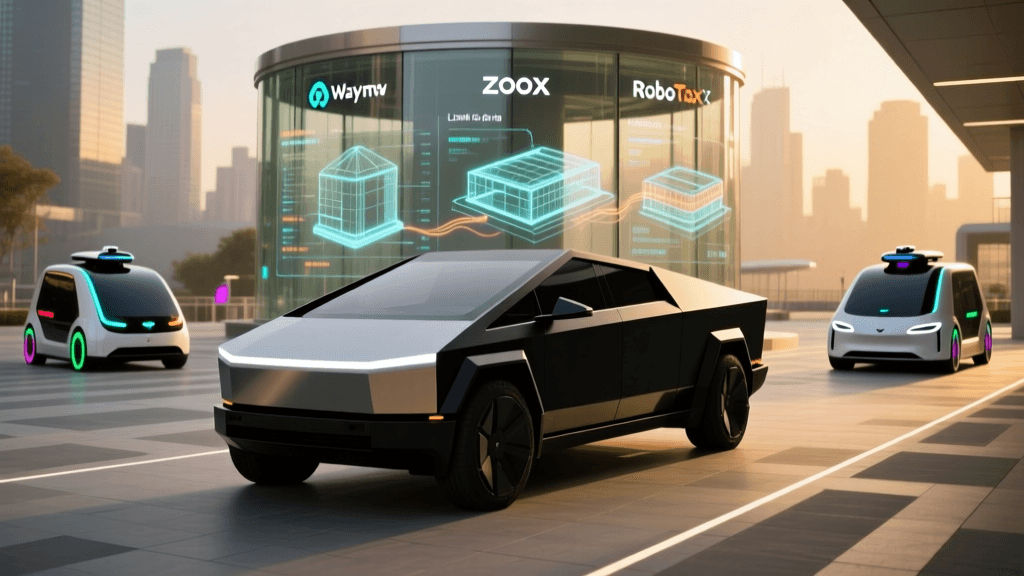
The race to achieve scalable, fully autonomous ride-hailing is no longer a single-track sprint; it has evolved into a complex triathlon of fundamentally different engineering philosophies. As we look toward the future of mobility, three industry giants have emerged with distinct technological approaches to solving the Level 4 and Level 5 autonomy puzzle. Waymo, Zoox, and Tesla represent three unique bets on how robots will eventually navigate our chaotic urban environments.
For consumers, investors, and automotive enthusiasts, understanding these divergent paths is critical. Will the future belong to heavily sensor-fused, geofenced vehicles? Or will mass-market, vision-only neural networks conquer the globe? In this comprehensive analysis, we break down the technology stacks, operational strategies, and future outlooks for the Waymo, Zoox, and Tesla robotaxi ecosystems.
Waymo: The LiDAR and HD Mapping Vanguard
Waymo, born out of Google’s Self-Driving Car Project, has long been the gold standard for commercial robotaxi operations. Their approach is defined by a heavy reliance on high-fidelity sensor fusion and ultra-precise High-Definition (HD) mapping.
The 6th Generation Waymo Driver
Waymo’s current 6th-generation hardware suite represents a massive leap in cost-reduction and performance. It utilizes a combination of 5 LiDAR sensors, 29 high-resolution cameras, and 6 radar units. This redundancy ensures that the vehicle can perceive its environment accurately in blinding sun, heavy rain, and pitch-black darkness. By combining LiDAR’s precise 3D spatial mapping with the semantic understanding of cameras, Waymo achieves a highly reliable perception layer.
However, this hardware is deeply intertwined with Waymo’s reliance on HD maps. Before a Waymo vehicle can operate autonomously in a new city or neighborhood, a mapping fleet must first scan the area to create a centimeter-accurate digital twin of the roads, curbs, and traffic light placements. While this guarantees an exceptional safety record within their Operational Design Domain (ODD), it inherently limits how quickly Waymo can scale to new, unmapped cities.
According to Waymo's official safety documentation, their methodical, map-dependent approach has resulted in a significant reduction in injury-causing crashes compared to human benchmarks in cities like Phoenix and San Francisco. Their strategy is one of slow, methodical, and highly regulated expansion.
Zoox: The Purpose-Built Urban Shuttle
Acquired by Amazon in 2020, Zoox has taken a radically different approach: rather than retrofitting existing consumer cars with autonomous gear, they designed a vehicle from the ground up specifically for mobility-as-a-service (MaaS).
Symmetrical Design and Bi-Directional Travel
The Zoox vehicle is a carriage-style, fully electric pod with no steering wheel or pedals. Its most striking feature is its four-wheel steering and bi-directional capability, allowing it to drive forward and backward with equal agility. This is a game-changer for dense urban environments, enabling the vehicle to easily navigate narrow alleys, perform complex pull-outs, and execute seamless U-turns without multi-point turns.
Zoox’s sensor suite is integrated directly into the vehicle’s chassis corners, providing a 360-degree field of view with overlapping LiDAR, radar, and camera coverage. Because the vehicle is symmetrical, the sensor layout is perfectly balanced, eliminating the blind spots inherent in traditional front-facing vehicle designs.
Zoox is currently navigating the complex regulatory landscape of the National Highway Traffic Safety Administration (NHTSA). Because their vehicle lacks traditional manual controls, they had to secure specific exemptions from Federal Motor Vehicle Safety Standards (FMVSS). Their strategy is to dominate high-density urban cores and airport campuses where low-speed, high-comfort, and bi-directional agility are more valuable than highway cruising speeds.
Tesla: The Vision-Only Neural Network Gambit
Tesla’s approach to autonomy is the most polarizing and ambitious of the three. Under the guidance of its AI division, Tesla has stripped away LiDAR, radar, and ultrasonic sensors, betting everything on a pure vision-only architecture powered by advanced neural networks.
FSD v12 and End-to-End AI
With the rollout of Full Self-Driving (FSD) v12, Tesla transitioned to an end-to-end neural network architecture. Instead of relying on tens of thousands of lines of human-written C++ heuristic code to dictate driving rules, the system processes raw camera inputs and outputs driving commands directly, having learned from billions of miles of real-world driving data collected from Tesla’s massive consumer fleet.
This ‘shadow mode’ data advantage is Tesla’s greatest asset. While Waymo and Zoox rely on thousands of test vehicles, Tesla leverages millions of customer-owned vehicles to train its AI on edge cases. The upcoming Tesla Cybercab concept is designed to capitalize on this, utilizing the next-generation AI5 hardware to process vision data with unprecedented compute efficiency.
As highlighted by Tesla’s AI and robotics division, the goal is to create a generalized real-world AI that can drive anywhere, without the need for HD maps or geofencing. The trade-off is a higher reliance on software perfection, leading to intense scrutiny from regulators regarding the safety validation of vision-only systems in adverse weather conditions where cameras can be obscured.
Head-to-Head Technology Comparison
To understand how these three titans stack up against one another, we must look at their core technological and operational differences. The table below outlines the primary distinctions in their robotaxi strategies.
| Feature | Waymo (6th Gen) | Zoox (Purpose-Built) | Tesla (Cybercab / FSD) |
|---|---|---|---|
| Primary Sensors | LiDAR, Radar, Cameras | LiDAR, Radar, Cameras | Cameras Only (Vision) |
| Mapping Reliance | Heavy (HD Maps required) | Moderate (HD Maps for core zones) | None (Generalized Neural Nets) |
| Vehicle Form Factor | Retrofitted (Jaguar I-PACE, Zeekr) | Purpose-Built Pod (No steering wheel) | Purpose-Built Cybercab (No steering wheel) |
| Operational Domain | Geofenced Urban/Suburban | Dense Urban Cores & Campuses | Global (Unrestricted ODD Goal) |
| Data Source | Proprietary Test & Rider Fleet | Proprietary Test Fleet | Millions of Consumer Vehicles |
| Scaling Strategy | City-by-City Mapping & Launch | Hub-and-Spoke Urban Deployment | Over-the-Air Global Software Update |
Future Trends and Actionable Outlook
As we look toward the 2030 horizon, the autonomous vehicle industry will likely not see a single winner-take-all outcome. Instead, the market will segment based on use-case and geography.
What This Means for Consumers and Riders
If you are looking to utilize autonomous ride-hailing today, Waymo is your only viable, scaled option in select major metropolitan areas. Their passenger experience is highly refined, offering a predictable, smooth, and heavily monitored ride. For those living in dense urban centers or near major transit hubs, Zoox’s future deployment will likely offer a more comfortable, lounge-like experience optimized for short, congested hops.
Tesla’s robotaxi network remains a future promise. Consumers who purchase Tesla vehicles today are effectively beta-testing the vision-only stack. If Tesla achieves regulatory approval for unsupervised FSD, it will instantly become the most ubiquitous ride-hailing network in the world, available in rural and suburban areas where Waymo and Zoox will never map.
Regulatory Hurdles and Standardization
The ultimate bottleneck for all three companies is not just technology, but regulation. The National Highway Traffic Safety Administration (NHTSA) continues to evaluate how to standardize safety reporting and validate the safety claims of AI-driven systems. Waymo’s deterministic, map-based approach is currently easier for regulators to audit and approve. Tesla’s ‘black box’ neural network approach faces a steeper climb in proving to federal and state regulators that a vision-only system can reliably handle the infinite edge cases of human driving without LiDAR redundancy.
The Bottom Line
The future of autonomous transportation will be defined by a convergence of these strategies. We may see Waymo and Zoox dominate the regulated, high-density urban cores with their sensor-heavy, purpose-built fleets, operating essentially as automated public transit. Meanwhile, Tesla’s vision-only approach could unlock the vast, unstructured suburban and highway networks, creating a decentralized, peer-to-peer autonomous transit web. For industry watchers, the key metrics to monitor in the coming years are not just miles driven, but the cost-per-mile of sensor degradation, the speed of municipal mapping approvals, and the evolving federal frameworks for AI safety validation.