The Engineering Reset: Understanding the Cruise Relaunch
The autonomous vehicle industry has faced intense scrutiny over the past year, with the Cruise robotaxi service grounding in late 2023 serving as a watershed moment for safety protocols and software validation. Following a severe pedestrian incident in San Francisco, Cruise paused all driverless operations nationwide, triggering a comprehensive internal and external review of its entire technology stack. Now, the General Motors-backed autonomous vehicle company is executing a meticulous, technology-driven relaunch strategy. This deep dive explores the engineering overhauls, sensor stack updates, teleoperations architecture, and the phased timeline for the Cruise robotaxi return to public roads.
The Hardware Pivot: Why the Bolt EUV Replaced the Origin
Initially, the future of the Cruise robotaxi service was heavily tied to the Cruise Origin, a purpose-built, steering-wheel-less electric shuttle designed specifically for ride-hailing. However, in mid-2024, General Motors made a massive strategic pivot, halting the Origin program to focus capital on the Chevrolet Bolt EUV and next-generation consumer EV platforms. From a technology and regulatory perspective, this was a pragmatic decision. Deploying vehicles without manual controls requires complex and time-consuming exemptions from Federal Motor Vehicle Safety Standards (FMVSS). By pivoting back to the Bolt EUV, retrofitted with the latest Cruise AV sensor suite, the company bypasses the steepest regulatory hurdles. This allows Cruise to accelerate its relaunch timeline while maintaining a robust, proven hardware foundation that has already logged millions of autonomous miles.
Sensor Stack and Perception Upgrades
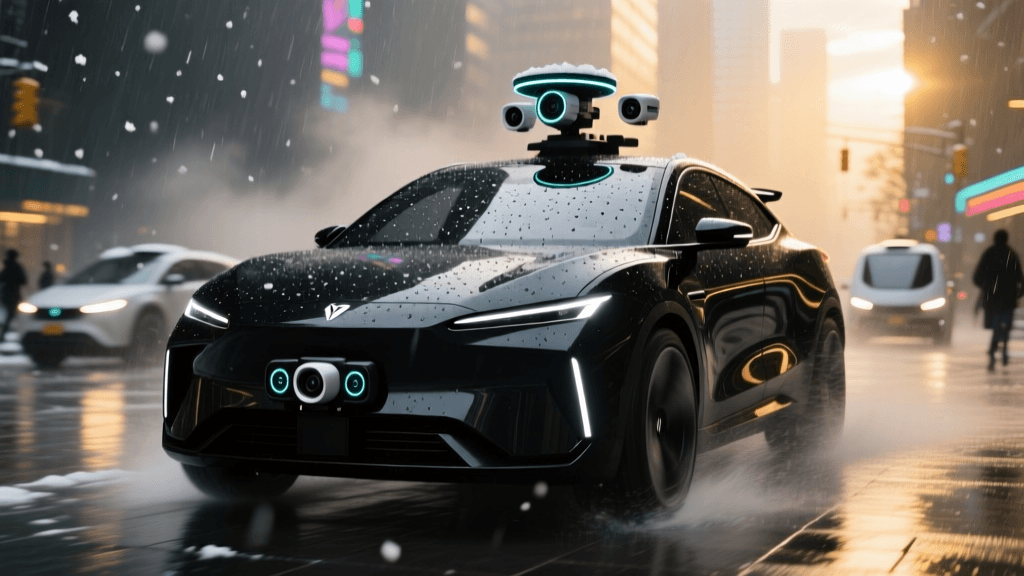
The relaunched Bolt EUV test fleet utilizes a heavily revised sensor array designed to eliminate the blind spots and edge-case failures that plagued earlier iterations. The perception stack relies on a multi-modal sensor fusion approach, ensuring redundancy across all lighting and weather conditions.
- LiDAR Array: The roof-mounted pod houses multiple high-resolution, solid-state and spinning LiDAR units, providing 360-degree depth mapping up to 250 meters. This creates a real-time, high-fidelity point cloud essential for detecting low-reflectivity objects and mapping complex urban geometry.
- Optical Cameras: A network of overlapping, high-dynamic-range (HDR) cameras handles semantic segmentation, traffic light state classification, and lane boundary detection. The latest software update improves temporal alignment between the camera feeds and LiDAR point clouds, reducing ghosting artifacts in high-speed scenarios.
- Radar Modules: Corner-mounted 4D imaging radars provide high-velocity object tracking and are critical for adverse weather penetration, such as heavy rain or fog, where optical sensors and LiDAR experience signal degradation.
According to frameworks outlined by the U.S. Department of Transportation's AV guidelines, redundant perception systems are critical for ensuring that a single sensor failure does not compromise the vehicle's ability to achieve a minimum risk condition. Cruise's updated hardware suite is explicitly designed to meet and exceed these federal redundancy recommendations.
Overhauling the Planning Stack and Edge Case Logic
The most critical software changes in the Cruise relaunch are not in perception, but in the planning and control modules—specifically regarding post-collision logic and edge case handling. The October 2023 San Francisco incident highlighted a severe flaw in the vehicle's post-impact trajectory generation. While the perception system correctly identified the pedestrian and initiated emergency braking, the subsequent planning logic failed to account for the pedestrian's trajectory after being struck by a third-party vehicle, resulting in a dangerous curb-pull maneuver.
To rectify this, Cruise engineers have overhauled the planning stack with several key software improvements:
- Strict Semantic Constraints for MRC: The Minimum Risk Condition (MRC) protocols now include hard-coded spatial constraints. If a collision or near-miss is detected, the vehicle's planning algorithm is restricted from executing lateral movements (like pulling to the curb) until the surrounding occupancy grid is verified as completely static and clear of vulnerable road users.
- End-to-End Trajectory Prediction: Cruise is increasingly moving away from modular, rule-based planning pipelines toward end-to-end neural networks. These models are trained on millions of miles of human driving data, allowing the AV to better predict the nuanced, non-linear behaviors of pedestrians and cyclists in dense urban environments.
- Enhanced Vector Space Mapping: The localization stack now relies on dynamic vector maps that update in real-time, allowing the vehicle to better understand temporary construction zones and altered traffic patterns without relying solely on pre-mapped HD data.
Teleoperations and Remote Assistance Architecture
A major focus of the relaunch is improving the teleoperations stack. Remote assistance is not about remote-control driving; rather, it involves human supervisors approving high-level routing decisions or resolving ambiguous edge cases (e.g., a double-parked delivery truck blocking a narrow lane). Cruise has heavily invested in reducing network latency and improving the UI/UX of the remote supervisor dashboard. By leveraging 5G connectivity and edge computing, the latency between the vehicle's camera feed and the remote operator's screen has been reduced to milliseconds. The goal is to improve the 'miles-per-intervention' metric, ensuring that remote supervisors can manage larger fleets of vehicles simultaneously without compromising safety.
Simulation, Validation, and the CI/CD Pipeline
Before any new software build is deployed to the physical fleet, it must pass through Cruise's rigorous Continuous Integration and Continuous Deployment (CI/CD) pipeline. Every code commit triggers thousands of simulation runs using a physics-based engine. Crucially, Cruise utilizes 'log replay' and 'edge case injection.' Engineers take real-world data logs from the San Francisco and Phoenix fleets, and artificially inject edge cases—such as a pedestrian stepping out from behind a visual occlusion or a sudden tire blowout—to test how the new planning algorithms respond. Data reported to the National Highway Traffic Safety Administration (NHTSA) under the standing general order for ADS crash reporting underscores the necessity of this rigorous simulation, as real-world testing alone cannot expose an AV to the sheer volume of rare, long-tail events required to prove statistical safety.
Phased Relaunch Timeline and City Rollout
Cruise is not flipping a switch and immediately launching fully driverless, unsupervised robotaxis across multiple cities. The relaunch is governed by a strict, phased Operational Design Domain (ODD) expansion. The initial phases utilize human safety drivers in the front seat to monitor the system, log disengagements, and validate the new software stack in real-world traffic before removing the human element.
| Phase | Target City | Vehicle Platform | Operational Design Domain (ODD) | Autonomy Status |
|---|---|---|---|---|
| Phase 1 | Phoenix, AZ | Chevy Bolt EUV | Daytime, low-speed, restricted geofence, clear weather | Supervised (Human Safety Driver) |
| Phase 2 | Dallas, TX | Chevy Bolt EUV | Expanded hours (including night), highway speeds, complex intersections | Supervised (Human Safety Driver) |
| Phase 3 | Houston, TX | Chevy Bolt EUV | Full urban ODD, adverse weather testing, high pedestrian density | Transitioning to Unsupervised |
| Phase 4 | Miami, FL | Next-Gen EV / Bolt | Full commercial robotaxi service area | Unsupervised (Commercial Launch) |
This phased approach ensures that the perception and planning stacks are validated against diverse geographic and meteorological challenges. Phoenix offers predictable grid layouts and clear weather, making it the ideal sandbox for initial software validation. Dallas and Houston introduce complex highway merges, unpredictable weather, and sprawling suburban-to-urban transitions. Miami will serve as the ultimate testbed for high-density pedestrian traffic and heavy precipitation before any unsupervised commercial deployment is considered.
What This Means for the Autonomous Industry
The Cruise relaunch is a critical case study for the entire autonomous vehicle sector. It demonstrates that achieving Level 4 autonomy is not merely a hardware problem that can be solved by adding more LiDAR or compute power; it is fundamentally a software validation and edge-case management challenge. Competitors like Waymo and Zoox are closely monitoring Cruise's phased rollout and teleoperations metrics. If Cruise can successfully prove that its overhauled planning stack and rigorous simulation pipeline have eliminated the long-tail edge cases that led to its 2023 grounding, it will reaffirm the viability of the robotaxi business model. However, the margin for error remains razor-thin. The technology deep dive into Cruise's relaunch reveals a company that has traded rapid expansion for methodical, data-driven engineering—a necessary evolution for the future of autonomous transportation.