Searches for "Waymo hits child" spiked after a high-profile incident in San Francisco involving a Waymo robotaxi and a young pedestrian. The event raised urgent questions about the safety of Level 4 autonomous vehicles operating on public roads near schools, crosswalks, and residential neighborhoods. This article examines the specific incident, Waymo's broader safety record with concrete data, how robotaxi technology handles vulnerable road users, and what current limitations mean for families living in robotaxi service zones.
The Incident: What Happened When a Waymo Struck a Child
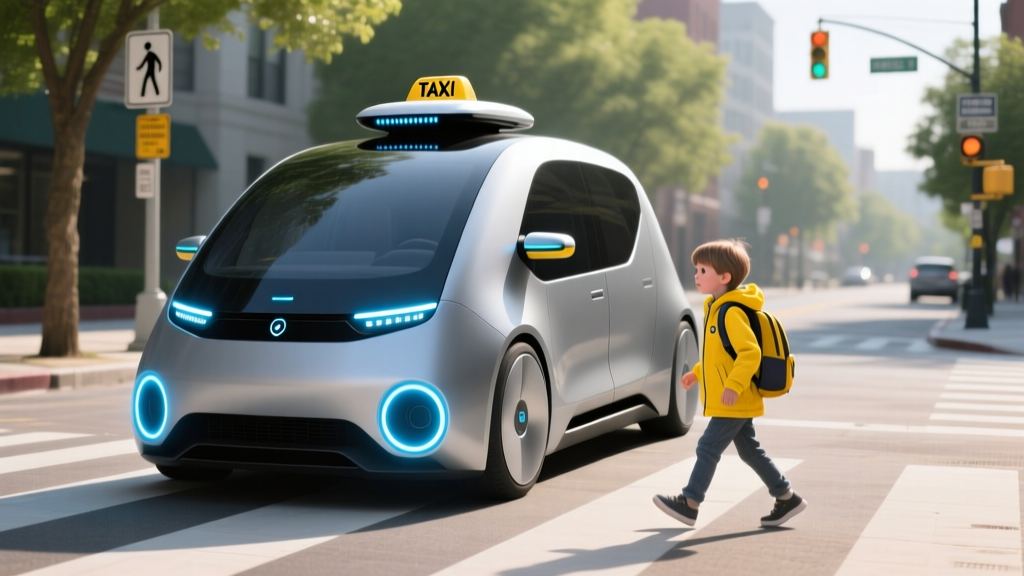
In early 2024, a Waymo Jaguar I-PACE operating in autonomous mode in San Francisco struck a child who darted into the street from between parked vehicles. The National Highway Traffic Safety Administration (NHTSA) opened an investigation into the crash. According to NHTSA filings and police reports, the child sustained minor injuries. Waymo's onboard data showed the vehicle detected the pedestrian but was unable to stop in time given the vehicle's speed and the child's sudden emergence from a visual occlusion created by parked cars.
The incident became a flashpoint in the autonomous vehicle debate. Critics pointed to it as evidence that robotaxis cannot reliably handle edge cases involving unpredictable pedestrians — especially small children, whose movements are harder to predict and whose shorter stature can challenge sensor detection. Waymo and its supporters noted that the vehicle's response time was faster than a typical human driver's reaction and that the impact speed was significantly lower than it would have been without automatic emergency braking intervention.
Waymo operates as a SAE Level 4 service — the vehicle performs all driving tasks within a defined operational design domain (geofenced area) without any human driver behind the wheel. This is fundamentally different from Level 2 systems like Tesla Autopilot, GM Super Cruise, or Ford BlueCruise, which require continuous driver supervision. In a Level 4 robotaxi, there is no steering wheel accessible to a passenger and no expectation that a rider will intervene. If the system encounters a scenario it cannot handle, it is designed to pull over safely rather than hand control to an unprepared occupant.
Waymo's Safety Record: Miles Driven, Interventions, and Crash Data
Evaluating robotaxi safety requires looking beyond any single incident. Waymo has published cumulative safety data and submitted crash reports to NHTSA under the Standing General Order requiring automated driving system operators to report crashes.
- Total autonomous miles driven: Over 40 million fully driverless miles across all markets
- Total trips completed: Over 15 million paid rider trips
- NHTSA-reported crashes: Dozens of minor-contact incidents reported under the Standing General Order; the vast majority involved the Waymo vehicle being rear-ended or sideswiped by human drivers, not initiating contact
- Pedestrian-involved incidents: A small number of pedestrian contacts investigated, including the San Francisco child incident; most resulted in minor or no injuries
- Remote assistance rate: Waymo vehicles request remote guidance roughly once every several thousand miles for edge cases like construction zones or unusual road configurations
Source: Waymo safety reports, NHTSA Standing General Order filings, and NHTSA AV safety data.
For context, human drivers in the United States experience approximately 1.35 fatalities per 100 million vehicle miles traveled, according to NHTSA data. Waymo's driverless fleet has not recorded a pedestrian fatality as of early 2026. However, direct statistical comparison is difficult: Waymo's fleet operates primarily in dense urban environments at moderate speeds (typically under 45 mph), while the national fatality rate includes rural highways, nighttime driving, and impaired driving scenarios that robotaxis largely avoid through geofencing and operational restrictions.
A study published by the Insurance Institute for Highway Safety (IIHS) and independent researchers found that Waymo vehicles were involved in police-reported crashes at a lower rate per million miles than human drivers in comparable urban settings — but researchers cautioned that the sample size and operational constraints make definitive conclusions premature. The child-pedestrian incident underscores that "lower rate" does not mean "zero risk."
How Waymo's Technology Detects Children and Vulnerable Pedestrians
Understanding how a Waymo vehicle could strike a child requires examining the sensor suite and its limitations.
| Component | Specification |
|---|---|
| LiDAR | Custom-designed 360° LiDAR with range exceeding 500 meters; detects object shape and distance regardless of lighting |
| Cameras | High-resolution camera array covering 360° with improved low-light and high-dynamic-range performance |
| Radar | External radar units for velocity detection and all-weather object tracking |
| Audio sensors | External microphones to detect emergency vehicle sirens |
| Compute | Custom AI processing hardware running Waymo's perception, prediction, and planning stack in real time |
| HD Maps | Centimeter-precision pre-mapped routes within geofenced operational area |
The LiDAR-camera-radar fusion approach gives Waymo a significant advantage over camera-only systems (like Tesla's FSD) in detecting small objects and pedestrians in challenging lighting. LiDAR creates a 3D point cloud that can identify a child-sized object even when partially occluded. However, physics imposes hard limits: if a child emerges from behind a solid visual barrier (a parked SUV, a delivery truck) at a distance shorter than the vehicle's stopping distance at its current speed, no sensor suite can prevent contact entirely. The system can only reduce impact speed through emergency braking.
Waymo has stated that its software includes specific prediction models for child pedestrians, accounting for their less predictable movement patterns and tendency to dart into streets. Following the San Francisco incident, Waymo updated its prediction models and reduced speed limits in certain school-zone-adjacent areas within its geofence.
Where You Can Ride a Waymo Right Now
| City | Status | Service Area Notes |
|---|---|---|
| San Francisco, CA | Fully operational, 24/7 | Most of SF proper including downtown, Sunset, Richmond; airport service to SFO available |
| Phoenix, AZ (Metro) | Fully operational, 24/7 | Chandler, Tempe, Mesa, Scottsdale, Phoenix Sky Harbor Airport; largest continuous geofence |
| Los Angeles, CA | Fully operational | Downtown LA, Hollywood, West LA, Santa Monica, LAX airport service |
| Austin, TX | Operational (expanding) | Downtown and central Austin; South Austin expansion ongoing |
| Other markets | Announced / testing | Additional cities in testing phases; commercial launch dates TBD |
Service areas are geofenced — the vehicle will not operate outside its approved zone. If you request a ride that crosses the geofence boundary, the app will inform you that the trip is unavailable or will route only to the edge of the service area. Waymo's operational footprint has expanded steadily but remains limited to specific mapped corridors in these metro areas.
Waymo Pricing vs. Uber and Lyft: What a Ride Actually Costs
Robotaxi rides are not cheaper than rideshare in most current scenarios. Waymo prices its rides competitively with Uber and Lyft, sometimes slightly higher during peak periods, with the value proposition centered on the novelty and consistency of a driverless experience rather than cost savings.
| Service | Typical Fare (5 mi) | Surge Pricing | Tipping |
|---|---|---|---|
| Waymo One | $12–$18 | Limited dynamic pricing; generally more stable than rideshare surge | No tip expected (no driver) |
| UberX | $10–$16 | Frequent surge multipliers (1.5x–3x+) | 15–20% customary |
| Lyft | $10–$15 | Prime Time surges common | 15–20% customary |
When you factor in that tipping is not expected on Waymo, the total out-of-pocket cost can be comparable to or slightly lower than a tipped UberX ride. Waymo also offers promotional credits for new riders and periodic discount programs. However, during periods when Uber and Lyft are not surging, a human-driven ride is often cheaper on the base fare.
Current Robotaxi Limitations: What Waymo Cannot Do
Despite the sophistication of Level 4 autonomy, Waymo robotaxis have significant operational constraints that riders and residents should understand — especially families evaluating safety near schools and parks.
- Geofence boundaries: The vehicle cannot operate outside its pre-mapped, approved zone. If your destination falls outside the geofence, the ride is unavailable.
- Heavy weather restrictions: Waymo vehicles may pull over or refuse to dispatch during heavy rain, fog, or conditions that degrade sensor performance. In Phoenix, monsoon storms can temporarily halt service. In San Francisco, dense fog can cause delays.
- Construction zones: Unmapped road changes, lane closures, and temporary traffic patterns can confuse the system. Waymo vehicles may stop and request remote guidance, causing delays.
- School zones and high-pedestrian areas: While Waymo operates near schools, the system follows speed limits and may exhibit extra-cautious behavior (frequent stops, slower travel) in these areas. Post-incident updates have made the system more conservative near crosswalks and school zones.
- No highway driving in most markets: Waymo's service is primarily surface-street focused. Limited highway segments are approved in some markets (e.g., Phoenix freeway trips to the airport), but most rides avoid high-speed roads.
- Emergency vehicle interaction: While Waymo vehicles detect sirens and pull over, there have been documented instances of robotaxis stopping in travel lanes rather than fully clearing the road, occasionally impeding emergency response.
- Passenger assistance: There is no driver to help with car seats, wheelchair loading, or assisting children or elderly passengers. Riders must be self-sufficient.
The Regulatory Landscape: Who Approves Robotaxi Operations
Robotaxi deployment in the United States involves a layered regulatory framework that varies significantly by state. Understanding this framework is essential for interpreting how incidents like a Waymo striking a child are investigated and what recourse exists.
In California, the California Public Utilities Commission (CPUC) issues permits for commercial robotaxi service, while the California Department of Motor Vehicles (DMV) issues testing and deployment permits. The CPUC can suspend or revoke permits — as it briefly considered following high-profile incidents involving Cruise (GM's robotaxi subsidiary) in late 2023, which led to Cruise suspending all nationwide operations. Waymo, as a separate operator, was not directly affected but faced increased regulatory scrutiny.
At the federal level, NHTSA requires all automated driving system operators to report crashes under the Standing General Order. NHTSA can open defect investigations and mandate recalls — Waymo has issued voluntary software recalls (over-the-air updates) to address identified safety concerns. NHTSA does not "approve" robotaxi services before deployment; its role is post-market oversight, similar to how it regulates human-driven vehicles.
In Arizona, regulation is lighter. The state has taken a permissive approach since Governor Doug Ducey's 2018 executive order, with minimal state-level permitting requirements beyond standard vehicle registration and insurance. Texas passed legislation allowing autonomous vehicle operation with specific insurance and registration requirements.
The patchwork regulatory environment means that a Waymo vehicle operating in San Francisco faces far more oversight and reporting requirements than one operating in Phoenix — and that public data availability differs by jurisdiction.
What the Child-Pedestrian Incident Means for Robotaxi Safety Going Forward
The "Waymo hits child" incident did not result in a service shutdown or regulatory suspension for Waymo, in contrast to the Cruise incident in San Francisco where a pedestrian was dragged after being struck by a human-driven vehicle and then run over by a Cruise robotaxi. The key differences: Waymo's vehicle made a single, lower-speed contact, stopped immediately, and the system's response was deemed consistent with physical limitations rather than a software failure.
However, the incident prompted several changes:
- Software updates: Waymo refined its pedestrian prediction models, particularly for occluded scenarios where a person emerges from behind a visual barrier.
- Speed management: The company implemented more conservative speed profiles in areas adjacent to schools, parks, and high-pedestrian-density zones.
- Transparency commitments: Waymo expanded its public safety reporting and increased engagement with city officials and community groups in operational areas.
For families living in Waymo service zones, the practical takeaway is not that robotaxis are categorically unsafe around children, but that the technology has known limitations in occlusion scenarios — the exact situation that causes the majority of child-pedestrian crashes with human drivers as well. The difference is that society has normalized human-driver crashes while holding autonomous systems to a higher standard of perfection.
That higher standard is appropriate. A machine that replaces human drivers should be demonstrably safer, not merely equivalent. The data so far suggests Waymo is trending in that direction, but the sample size of fully driverless miles, while growing rapidly, is still a fraction of the trillions of miles driven annually by humans.
Frequently Asked Questions
Is a Waymo robotaxi truly self-driving, or is there a human monitoring remotely?
Waymo is a SAE Level 4 autonomous system — there is no human driver in the vehicle, and passengers are not expected to take control. However, Waymo employs remote fleet specialists who can provide guidance when a vehicle encounters an unusual situation (like a complex construction zone). These specialists do not "drive" the car remotely via joystick; they provide high-level routing or confirmation decisions while the vehicle's onboard system handles all real-time driving tasks.
How does Waymo's camera-and-LiDAR approach compare to Tesla's camera-only FSD for pedestrian detection?
Waymo's multi-sensor fusion (LiDAR + cameras + radar) provides redundant detection that camera-only systems lack, particularly in low-light conditions, direct sun glare, and partial occlusion scenarios. LiDAR generates a 3D point cloud independent of visible light, which is a meaningful advantage for detecting a child stepping out from behind a parked vehicle at dusk. Tesla's FSD Supervised, by contrast, is a Level 2 system that requires the driver to remain fully engaged and ready to intervene — it is not a driverless system and should not be compared directly to a Level 4 robotaxi in terms of operational responsibility.
Can I use Waymo to take my child to school?
Waymo's terms of service require riders to be at least 18 years old. Unaccompanied minors cannot ride alone. An adult can ride with a child, but Waymo vehicles do not provide car seats, and riders are responsible for securing children appropriately. The vehicle has no driver to assist with child safety seat installation or to supervise children during the ride.
What happens if a Waymo is involved in a crash with a pedestrian?
The vehicle is designed to stop immediately, contact emergency services if needed, and report the incident to Waymo's operations center and NHTSA under the Standing General Order. Riders in the vehicle are uninjured in most pedestrian-contact incidents because the Waymo vehicle is braking, not accelerating. Waymo's insurance covers liability. The incident data is reviewed by NHTSA and state regulators to determine whether a systemic defect exists.
How does the cost of regular Waymo rides compare to owning a car in a city like San Francisco?
For a resident taking 3-4 Waymo rides per week at $12-$18 each, monthly costs run approximately $200-$300. Compare that to San Francisco car ownership — insurance, parking ($200-$400/month for a garage spot), gas, maintenance, and depreciation — which easily exceeds $600-$900 per month. For urban dwellers who don't need a car for weekend trips or highway commuting, robotaxi service can be cost-competitive with ownership, especially when parking costs are factored in. However, robotaxi service is not yet reliable enough to be a sole transportation option due to weather delays, geofence limitations, and availability during peak demand.
Where can I find official safety data on Waymo and other robotaxis?
NHTSA's Automated Vehicles Safety page provides Standing General Order crash data. Waymo publishes its own safety reports on its website. The Insurance Institute for Highway Safety (IIHS) has published independent analyses of robotaxi crash rates. California DMV disengagement reports (for testing-phase vehicles) are also publicly available, though these apply to test operations rather than commercial driverless service.