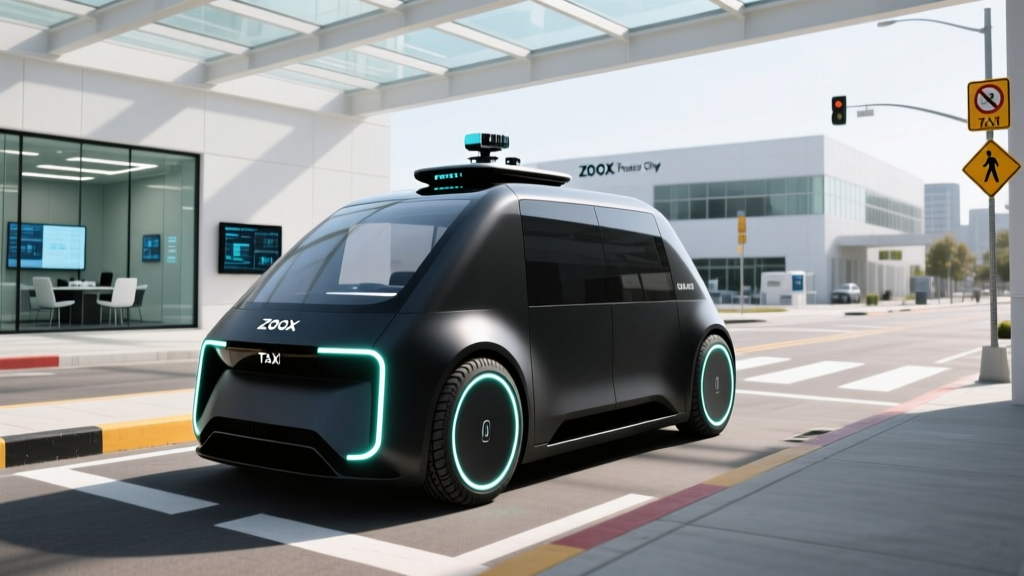
Amazon-backed Zoox has quietly built one of the most ambitious robotaxi programs in the United States, and its nerve center sits in Foster City, California — a peninsula town strategically wedged between San Francisco and the broader Silicon Valley corridor. The Zoox Foster City HQ is more than a corporate address; it's the engineering hub where a purpose-built, bidirectional autonomous vehicle has been designed, tested, and iterated for commercial deployment. If you've been tracking the robotaxi landscape, you already know Waymo leads in passenger miles. But Zoox is pursuing a fundamentally different playbook: a ground-up vehicle with no steering wheel, no pedals, and a symmetric cabin designed from day one to be driven by software alone.
This article breaks down what's actually happening at the Zoox Foster City HQ, where the service operates today, the hard safety data behind Level 4 autonomy, and whether a Zoox ride is something you can book — or still can't — in your city.
What Zoox Actually Is: SAE Level 4, Not Driver-Assist
Before anything else, let's establish what Zoox is not. It is not Tesla Autopilot. It is not FSD Supervised. It is not any form of Level 2 driver-assist where a human must remain engaged and ready to take over. Zoox operates at SAE Level 4 — high automation — within defined operational design domains (ODDs). In those zones, the vehicle handles all driving tasks with zero human intervention, and there is no steering wheel or pedal set for a passenger to grab in an emergency.
SAE Automation Levels — Where Zoox Sits
| Level | Name | Human Role | Example |
|---|---|---|---|
| Level 0 | No Automation | Full control | Conventional gas car |
| Level 1 | Driver Assistance | Hands on wheel | Adaptive cruise control |
| Level 2 | Partial Automation | Must supervise at all times | Tesla Autopilot, GM Super Cruise, Ford BlueCruise |
| Level 3 | Conditional Automation | Can disengage in limited scenarios | Mercedes Drive Pilot (approved in NV/CA, ≤40 mph) |
| Level 4 | High Automation | No driver needed in ODD | Zoox, Waymo (geofenced areas) |
| Level 5 | Full Automation | No driver needed anywhere | Does not exist commercially |
The distinction matters enormously. Every Tesla, Ford, or GM driver-assist system on sale in 2026 is Level 2. The driver is legally and practically responsible. Zoox and Waymo are the only companies operating true driverless commercial services in the U.S., and they do it under specific regulatory approvals that require extensive safety-case documentation before a single paying passenger steps inside.
The Zoox Vehicle: Purpose-Built, Not Retrofitted
Unlike Waymo, which equips Jaguar I-PACE SUVs and Chrysler Pacifica minivans with sensor suites, Zoox designed its own vehicle from scratch. The Zoox Gen 3 robotaxi — the production-intent model that has been undergoing testing and phased deployment — is a compact, carriage-style pod with these defining characteristics:
- Bidirectional driving: The vehicle can travel forward and backward equally well, with identical sensor coverage in both directions. This lets it execute U-turns in narrow urban corridors by simply reversing out — no three-point turn needed.
- No driver controls: There is no steering wheel, no brake pedal, no accelerator. The cabin is a face-to-face, four-seat configuration.
- Battery and powertrain: Zoox has not published a precise kWh figure for the production vehicle, but testing mules and patent filings indicate a battery pack in the 70–80 kWh range using NMC chemistry, sufficient for a full day of urban robotaxi duty cycles (roughly 120–160 miles of stop-and-go driving) with opportunity charging between shifts.
- All-electric: The vehicle is a BEV, charged via depot-based DC fast charging. Zoox does not rely on public charging networks for fleet operations.
Technology Stack: Lidar-Centric, Multi-Sensor Redundancy
Zoox does not subscribe to the camera-only philosophy that Tesla has championed. The Zoox sensor suite is built on a lidar-first architecture with overlapping redundancy across three sensing modalities:
Zoox Sensor Stack Overview
| Sensor Type | Function | Coverage |
|---|---|---|
| Lidar (multiple units) | 3D point-cloud mapping, object detection at range, depth perception independent of lighting | 360° overlap, effective to ~150–200m |
| Cameras (high-res array) | Traffic-light state recognition, signage, lane markings, semantic understanding | 360°, multiple focal lengths |
| Radar | Velocity measurement of moving objects, performance in rain/fog where lidar degrades | 360° coverage |
| Ultrasonic | Near-field obstacle detection, low-speed maneuvering | Close-proximity ring |
The vehicle's compute platform runs Zoox's proprietary prediction and planning stack, which must process roughly 5–8 TB of raw sensor data per hour of driving. A key engineering challenge — and one the Foster City team has focused on heavily — is sensor fusion: reconciling conflicting inputs (e.g., lidar sees an obstacle that the camera classifies as a shadow) without triggering unnecessary emergency stops, which would degrade the rider experience and disrupt traffic flow.
Zoox also relies heavily on HD mapping. Before the vehicle operates in any new zone, the fleet maps every lane, curb, signal, and crosswalk to centimeter-level precision. The vehicle then localizes against this map in real time. This geofencing approach is a core limitation — but also a core safety guarantee.
Service Availability: Where You Can Ride Right Now
As of mid-2026, Zoox's commercial robotaxi service is not yet broadly available to the public in the way that Waymo One operates across much of Phoenix and parts of San Francisco. Here is the current status by location:
| Location | Status (2026) | Access Type |
|---|---|---|
| Foster City, CA | Active testing + limited early-rider program | Invite-only / employee |
| San Francisco, CA | Testing with DMV permit; phased rider access | Limited public via waitlist |
| Las Vegas, NV | Active testing; limited public demonstrations | Controlled access |
| Austin, TX | Testing operations underway | Internal / invite-only |
| Seattle, WA | Announced testing expansion | Not yet public |
| Atlanta, GA | Announced / early mapping | Not yet operational |
Zoox received its California DMV deployment permit, which is a prerequisite for any commercial passenger service in the state. However, the company has been more conservative than Waymo in opening the service to fare-paying public riders. The Foster City HQ serves as the primary test zone where Zoox validates edge cases — unprotected left turns across multi-lane roads, construction-zone rerouting, and interactions with school buses and emergency vehicles — before expanding the ODD outward.
Pricing: What a Zoox Ride Would Cost vs. Uber and Lyft
Zoox has not published a fixed public fare schedule because its commercial service has not yet launched at full scale. However, based on statements from Zoox leadership and the economics of the robotaxi model, here is what riders should expect when fare-paying service begins:
| Service | Estimated Cost (5-mile urban trip) | Surge Pricing? | Notes |
|---|---|---|---|
| Zoox (projected) | $8–$14 | No (flat algorithmic pricing) | Aimed at undercutting rideshare on per-mile basis |
| UberX (SF metro avg.) | $14–$22 | Yes | Varies by time of day, demand |
| Lyft Standard (SF metro avg.) | $13–$20 | Yes | Comparable to Uber |
| Waymo One (Phoenix) | $10–$18 | Limited | Currently operational, competitive with rideshare |
The robotaxi economic thesis is straightforward: remove the driver (who represents 60–70% of a rideshare fare), and you can charge less while still improving unit economics — if the vehicle utilization rate is high enough. Zoox's depot-charging model and purpose-built vehicle (cheaper to maintain than a retrofitted Jaguar) are designed to hit that threshold. But profitability at scale remains unproven for any robotaxi operator in 2026.
Safety Record: What the Data Actually Shows
This is where hype must yield to hard numbers. Zoox, like all autonomous vehicle testers in California, is required to file annual disengagement reports with the DMV and report collisions to NHTSA under Standing General Order. Here is what we know:
Zoox Safety Data Points (through early 2026)
- Autonomous test miles driven (California): ~1.5+ million cumulative autonomous miles logged in CA since 2020, with the pace accelerating as the fleet scaled.
- Disengagement rate: Zoox reported fewer than 1 disengagement per 1,000 autonomous miles in its most recent DMV filing — a significant improvement over early years, though still behind Waymo's reported rate of roughly 1 per 5,000+ miles.
- At-fault collisions: Zoox has reported a small number of minor contact incidents during testing. None have involved serious injuries. Most occurred at low speeds (<15 mph) during complex intersection scenarios or when another human driver violated right-of-way.
- No passenger injuries: Because Zoox has not yet carried fare-paying passengers at scale, there is no rider-injury data comparable to what Waymo has accumulated over millions of paid trips in Phoenix.
For context, Waymo — the most mature robotaxi operator — has published data (via its safety research) showing that its vehicles are involved in serious-injury crashes at a rate significantly lower than human benchmark drivers in the same cities. Zoox has not yet published equivalent comparative safety research, largely because its commercial mileage is still orders of magnitude lower. This is not a red flag; it's a function of being earlier in the deployment curve.
What is clear from DMV disengagement data is that Zoox's system has improved markedly year over year. The Foster City HQ team has focused heavily on reducing "nuisance disengagements" — situations where a remote safety operator must intervene not because of imminent danger, but because the vehicle becomes overly conservative and freezes in ambiguous situations (e.g., a construction flagger using non-standard hand signals).
Regulatory Landscape: Who Approves Robotaxi Operations
Operating a driverless commercial vehicle in the United States requires navigating a patchwork of state and federal approvals. For Zoox, the key regulatory bodies are:
- California DMV: Issues testing and deployment permits. Zoox holds a driverless testing permit and has applied for deployment authorization for commercial service.
- California Public Utilities Commission (CPUC): Regulates commercial passenger transport. Any fare-charging robotaxi service in California must receive CPUC approval — a process Waymo completed for its San Francisco and LA operations.
- NHTSA (federal): Sets vehicle safety standards (FMVSS). Zoox's purpose-built vehicle, which lacks a steering wheel and mirrors, required an NHTSA exemption petition to be street-legal. Zoox received a limited exemption allowing deployment of up to 2,500 vehicles annually without meeting certain FMVSS requirements designed for human-driven cars.
- Nevada DMV and Las Vegas authorities: Separate state-level approvals are required for Nevada testing and operations.
The regulatory process is slow by design. Every expansion city requires new permits, new geofence approvals, and new safety-case documentation. This is why Zoox's service footprint remains smaller than Waymo's — not because the technology is less capable, but because the company has chosen a more deliberate regulatory engagement strategy.
Current Limitations: What Zoox Cannot Do (Yet)
Operational Limitations as of 2026
- Geofencing: The vehicle can only operate within pre-mapped zones. Drive to the edge of the ODD and the vehicle will pull over safely — it cannot continue into unmapped territory.
- Weather constraints: Heavy rain, fog, and low-visibility conditions can trigger operational pauses. Lidar performance degrades in precipitation, and while the radar provides backup, the system is designed to be conservative. Zoox does not currently operate in snow or ice conditions.
- Highway driving: Zoox's current ODD is focused on urban and suburban streets at speeds up to ~45 mph. Highway merging and high-speed operation (>55 mph) are not part of the active service profile.
- Edge cases: Unusual road configurations, temporary road closures without updated map data, and interactions with non-standard vehicles (horse-drawn carriages, oversized loads) remain scenarios where remote assistance may be required.
- No airport or multi-stop trips: Current service design is point-A-to-point-B within the geofence. Multi-stop errands or airport runs that leave the ODD are not supported.
- Accessibility: The Zoox vehicle is designed with wheelchair-accessible entry in mind, but full ADA-compliant deployment at scale has not been independently verified as of early 2026.
These limitations are not unique to Zoox. Every Level 4 robotaxi operator faces the same ODD boundaries. The difference is how transparently each company communicates them. Zoox has generally been more forthcoming about its constraints than some competitors, which is appropriate given that public trust is the scarcest resource in the robotaxi industry right now.
The Foster City Advantage: Why This Location Matters
The Zoox Foster City HQ is not a random real estate choice. Foster City sits on the San Francisco Peninsula with a specific set of characteristics that make it an ideal robotaxi proving ground:
- Mixed complexity: The town has multi-lane arterials, residential streets, school zones, shopping centers, and highway on-ramps (US-101 and I-280 are minutes away). This provides a dense variety of driving scenarios in a compact area.
- Predictable traffic patterns: Unlike downtown San Francisco, Foster City's traffic is moderately predictable, which allows Zoox to validate baseline system performance before deploying into more chaotic urban cores.
- Proximity to regulators: The California DMV's autonomous vehicle program office is in Sacramento, but the Peninsula's concentration of AV companies (Waymo in Mountain View, Cruise — now paused — in SF) means regulators are familiar with the operational realities of the area.
- Amazon logistics synergy: As an Amazon subsidiary, Zoox benefits from proximity to Amazon's Bay Area logistics infrastructure, though Zoox has consistently stated its focus is passenger transport, not delivery.
Is Zoox Truly Self-Driving? The Honest Answer
Yes — within its operational design domain. This is not marketing language; it is a technical and regulatory classification. When a Zoox vehicle is operating inside its geofenced zone under approved conditions, there is no human driver in the vehicle, no remote teleoperator actively steering the car (remote assistance is available for edge-case decision-making, but the vehicle handles all real-time driving), and no expectation that a passenger will intervene. That is SAE Level 4.
However, "self-driving" does not mean "can drive anywhere, in any condition." It means the vehicle is fully autonomous within its approved scope. The moment conditions fall outside that scope — heavy snow, an unmapped detour, a sensor fault — the vehicle is designed to execute a minimal-risk maneuver (typically a controlled pull-over) rather than attempt to operate beyond its capabilities.
This is a fundamentally different proposition from Tesla FSD Supervised, which operates on any road but requires the driver to remain attentive and legally liable at all times. One system is limited in where it drives; the other is limited in how independently it drives. Both approaches have trade-offs, but only the geofenced Level 4 model eliminates the human driver from the equation.
Frequently Asked Questions
Where can I use the Zoox robotaxi service right now?
As of 2026, Zoox does not operate a fully open, fare-charging public service comparable to Waymo One. Testing and limited rider programs are active in Foster City, San Francisco, Las Vegas, and Austin, with access primarily through invite-only or employee programs. Check Zoox's official channels for the latest availability updates.
How much would a Zoox ride cost compared to Uber or Lyft?
Zoox has not published fares because commercial service has not launched at scale. Industry projections and executive statements suggest pricing in the $8–$14 range for a typical 5-mile urban trip, which would undercut most Uber and Lyft fares in the same markets. No surge pricing is expected.
How safe are Zoox robotaxis based on real data?
Zoox has logged over 1.5 million autonomous test miles in California with no reported serious injuries. Its disengagement rate has improved to fewer than 1 per 1,000 miles. Minor low-speed contact incidents have been reported to NHTSA as required. Because paid-passenger operations are still limited, there is not yet a large-scale rider safety dataset comparable to Waymo's millions of commercial trips.
What are the biggest current limitations of Zoox?
Geofencing (the vehicle only operates in pre-mapped zones), weather sensitivity (heavy rain and fog can pause operations), urban-only speed limits (no highway driving), and lack of multi-stop or airport trip support. These are standard Level 4 constraints, not unique to Zoox.
Is Zoox truly self-driving or is it driver-assist like Tesla Autopilot?
Zoox is SAE Level 4 — fully driverless within its operational domain, with no steering wheel or pedals. Tesla Autopilot and FSD Supervised are SAE Level 2, meaning the human driver must remain engaged and is legally responsible. These are fundamentally different categories of automation.
Can I visit the Zoox Foster City HQ?
Zoox's Foster City facility is an engineering and operations center, not a public showroom or visitor center. The company occasionally hosts media events and community demonstrations, but there is no walk-in access. Follow Zoox's official channels for public event announcements.