Is Tesla's Austin Robotaxi Truly Self-Driving?
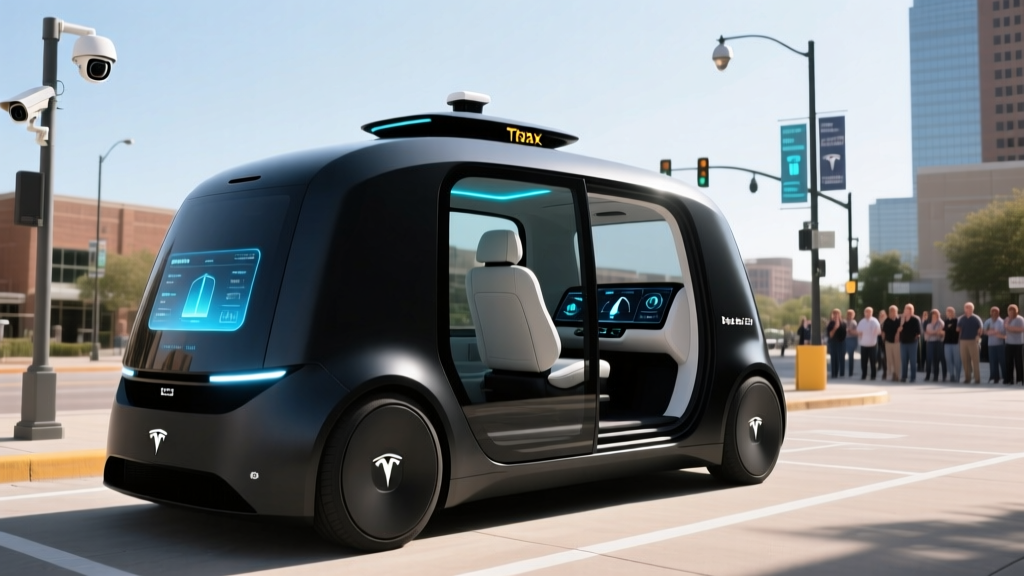
Tesla's driverless ride-hail service in Austin, Texas — branded internally as the Tesla Robotaxi network and accessed via the Tesla app — represents the company's first commercial deployment of a vehicle without a human safety driver behind the wheel. Launched in a limited geofenced zone in mid-2025 and expanded through early 2026, the service operates modified Model Y vehicles equipped with Tesla's latest Hardware 5 (HW5) sensor suite and the company's vision-only neural-network stack.
But how safe is it really, and how does it compare to established Level 4 operators like Waymo? This monitor tracks the key metrics, regulatory status, and real-world limitations any prospective rider or industry observer should understand.
SAE Automation Level: What You Need to Know
| SAE Level | Description | Example |
|---|---|---|
| Level 2 | Driver-assist; human must monitor and intervene at all times | Tesla Autopilot, FSD (Supervised), BlueCruise |
| Level 3 | Conditional automation; driver can disengage but must take over when requested | Mercedes Drive Pilot (limited conditions) |
| Level 4 | High automation; no driver needed within defined operational design domain (ODD) | Waymo One, Tesla Robotaxi (Austin geofence) |
| Level 5 | Full automation; no driver needed anywhere, any condition | Not commercially available anywhere as of 2026 |
Critical distinction: Tesla's consumer FSD (Supervised) feature remains SAE Level 2. The driver is legally responsible and must remain attentive. The Austin robotaxi service, by contrast, operates at Level 4 within its geofenced zone — no human driver is present, and the system handles all driving tasks or pulls over safely if it cannot. These are fundamentally different products with different liability frameworks.
Where Can You Ride the Tesla Robotaxi Right Now?
As of mid-2026, Tesla's driverless robotaxi service is available in a single city with a constrained operational footprint:
| City | Service Zone | Hours | Status |
|---|---|---|---|
| Austin, TX | Downtown, South Congress, East Austin, Domain area (~45 sq mi geofence) | 6 AM – 12 AM daily | Live — invite/waitlist access |
| San Francisco, CA | Pending regulatory approval | TBD | Announced — not yet operational |
| Phoenix, AZ | Testing with safety drivers | N/A | Pre-commercial testing |
Austin was chosen as the launch city for several practical reasons: Texas has a permissive regulatory environment for autonomous vehicles (no state-level permit required beyond standard insurance and registration), the city's grid-style streets and relatively mild weather simplify the operational design domain, and Tesla's Gigafactory Texas provides a local engineering and fleet-maintenance base.
How to access: Riders must join the Tesla Robotaxi waitlist via the Tesla app, agree to a rider safety agreement, and are currently limited to 2-3 rides per week during the monitored expansion phase. No commercial ride-hailing license is yet in place for open public access.
How Much Does It Cost vs. Uber and Lyft?
During the current limited-access phase, Tesla is subsidizing rides heavily to build usage data and rider familiarity. Pricing is expected to shift as the service scales.
| Service | Base Fare | Per-Mile Rate | Estimated 5-Mile Trip |
|---|---|---|---|
| Tesla Robotaxi (current promo) | $1.50 | $0.85/mi | ~$5.75 |
| UberX (Austin avg.) | $2.50 | $1.35/mi | ~$9.25 |
| Lyft Standard (Austin avg.) | $2.75 | $1.40/mi | ~$9.75 |
| Waymo One (where available) | $2.00 | $1.15/mi | ~$7.75 |
Tesla's current promotional pricing undercuts Uber and Lyft by roughly 35-40% on comparable trips. However, this is unsustainable long-term and reflects Tesla's data-collection priority over near-term profitability. Elon Musk has previously stated that Tesla aims for a long-term per-mile cost below $1.00 once the fleet scales and removes the human driver cost entirely — a claim that remains to be validated at commercial scale.
Note: Surge pricing is not currently active during the limited rollout but is expected once the service opens to general public access.
Tesla Robotaxi Austin Safety Data: What We Know
Safety Metrics (Reported as of Q1 2026)
The following figures are compiled from Tesla's voluntary quarterly safety disclosures, Texas Department of Motor Vehicles filings, and NHTSA's Standing General Order crash-reporting database. Note that Tesla's robotaxi fleet in Austin is small (estimated 50-100 vehicles) compared to Waymo's thousands, so statistical significance is limited.
- Estimated cumulative driverless miles (Austin): ~800,000 – 1.2 million miles (Q4 2025 through Q1 2026)
- Reported at-fault collisions: 2 minor incidents (low-speed, property damage only, no injuries reported)
- Disengagement / remote-assist interventions: Tesla has not publicly disclosed per-thousand-mile intervention rates; this is a key transparency gap compared to Waymo, which publishes disengagement reports to the California DMV
- Injuries or fatalities: None reported as of publication date
Context: Waymo, operating since 2018 across multiple cities with millions of driverless miles, has reported an at-fault crash rate roughly 85% lower than human benchmarks according to IIHS-reviewed studies. Tesla's Austin data set is not yet large enough for a statistically comparable analysis, and the company's refusal to publish per-mile intervention rates makes independent safety assessment difficult.
The NHTSA Standing General Order requires all entities testing or deploying automated driving systems to report crashes within one day. Tesla is subject to this order, and no major incidents have appeared in NHTSA's public crash database for the Austin robotaxi fleet as of this writing.
Safety advocates, including the Center for Auto Safety, have called for Tesla to publish disengagement and remote-assist metrics at parity with California DMV reporting standards, even though Texas does not mandate such disclosures. This transparency gap is the single largest concern for independent safety monitors.
Technology Stack: Vision-Only vs. LiDAR
Tesla's robotaxi platform is notable — and controversial — for its rejection of LiDAR (light detection and ranging) sensors, which every other Level 4 operator (Waymo, Cruise/Zoox, Baidu Apollo) relies on as a core perception layer.
Tesla Robotaxi HW5 Sensor Suite
- Cameras: 11 high-resolution cameras (upgraded from the 8-camera HW4 suite) providing 360° coverage
- Radar: 1 high-resolution 4D imaging radar (reintroduced in HW5 after Tesla's earlier radar removal)
- Ultrasonics: Removed; Tesla relies on vision-based proximity estimation
- Compute: Dual custom FSD chips with ~500 TOPS combined throughput
- Positioning: RTK-corrected GPS + HD map overlay for geofenced zone
- LiDAR: None
How This Compares to Waymo
| Sensor | Tesla Robotaxi (HW5) | Waymo 6th-Gen |
|---|---|---|
| Cameras | 11 | 29+ |
| LiDAR units | 0 | 5 (360° coverage) |
| Radar | 1 (4D imaging) | 6 |
| Audio sensors | No | Yes (siren detection) |
The vision-only approach gives Tesla a significant cost advantage per vehicle — estimated $8,000-$12,000 less in sensor hardware than a LiDAR-equipped Waymo vehicle. However, critics point to known limitations of camera-only perception in low-light, heavy rain, fog, and direct sun glare — conditions that LiDAR handles more robustly because it provides its own illumination source and direct depth measurement.
Tesla's counterargument is that its neural-network training on billions of miles of fleet-driving data compensates for the lack of LiDAR, and that human drivers navigate with "just two cameras and a brain." The Austin deployment is the first large-scale test of whether this thesis holds at Level 4 without a human fallback.
Regulatory Landscape: Who Approved This?
Autonomous vehicle regulation in the United States is a patchwork of federal, state, and local rules. Here's how Tesla's Austin robotaxi fits into the framework:
- Federal (NHTSA): NHTSA regulates vehicle safety standards but does not currently "approve" or "certify" automated driving systems before deployment. Tesla's Modified Model Y robotaxis received an FMVSS exemption for the removal of traditional controls (steering wheel retained in current fleet, but not required under exemption). NHTSA's Standing General Order mandates crash reporting.
- State (Texas): Texas passed SB 2205 in 2017, authorizing autonomous vehicles on public roads without requiring a special state permit, safety driver, or prior approval. This makes Texas one of the most permissive AV environments in the country. There is no state-level disengagement-reporting requirement.
- Local (City of Austin): Austin requires standard commercial insurance and business licensing but has not imposed additional AV-specific restrictions. The city's transportation department monitors operations but does not issue separate operating permits.
This contrasts sharply with California, where the DMV requires testing permits, annual disengagement reports, and a separate deployment permit from the California Public Utilities Commission (CPUC) for commercial robotaxi service. Tesla's pending San Francisco expansion will require navigating this more rigorous regulatory gauntlet.
Current Limitations: What the Tesla Robotaxi Cannot Do
Level 4 autonomy is always bounded by an Operational Design Domain (ODD) — the specific conditions under which the system is designed to function. Outside that domain, the vehicle must safely stop or hand off control. Here are Tesla Robotaxi Austin's known limitations as of 2026:
- Geofence boundary: The vehicle will not operate outside the ~45 sq mi Austin service zone. Rides cannot originate or terminate outside the boundary, and the vehicle will pull over safely if it approaches the edge.
- Weather restrictions: Service is suspended during heavy rain (>0.5 in/hr), flooding conditions, or visibility below ~200 feet. Austin's occasional flash-flood events trigger automatic fleet grounding. Light rain and overcast conditions do not suspend service.
- Nighttime operation: Currently limited to 6 AM – 12 AM. Overnight hours are excluded while Tesla validates camera performance in low-light conditions without street-light coverage.
- Construction zones: Major construction zones with altered lane markings or temporary barriers are flagged in Tesla's HD map overlay. The vehicle will reroute when possible or cancel the ride if no safe path exists.
- Highway/freeway driving: The current Austin geofence is primarily surface streets. Limited highway segments (e.g., short stretches of I-35 frontage roads) are included, but full freeway operation is not yet part of the ODD.
- Passenger capacity: Current fleet seats up to 3 passengers (rear seats only; front passenger seat is blocked off with monitoring equipment).
- Accessibility: Tesla's current robotaxi fleet uses standard Model Y vehicles, which are not wheelchair-accessible. This is a significant gap versus Waymo, which has deployed accessible Chrysler Pacifica minivans in some markets.
- No manual override: Passengers cannot steer, brake, or accelerate. An in-cabin emergency stop button and two-way video support link to Tesla's remote operations center are the only passenger controls.
The Transparency Problem: Why Safety Monitors Are Concerned
The core tension around Tesla's robotaxi deployment is not necessarily that the vehicles are unsafe — the limited available data shows a low incident count — but that independent verification is nearly impossible.
Unlike Waymo, which publishes disengagement reports to the California DMV and has participated in peer-reviewed safety studies with IIHS and academic institutions, Tesla does not publish:
- Per-thousand-mile disengagement or remote-assist intervention rates
- Near-miss or "close call" data
- Detailed crash narratives beyond NHTSA's minimum reporting requirements
- Fleet size, total driverless miles, or utilization rates with specificity
Tesla's position is that these metrics are proprietary and that NHTSA's crash-reporting mandate is sufficient regulatory oversight. Safety researchers counter that without intervention-rate data, the public cannot assess whether the system is genuinely safe or simply operating in easy conditions while pulling over frequently when challenged.
For riders, the practical implication is this: you are participating in a live deployment with a smaller data set and less independent oversight than competing services. Whether that risk is acceptable is a personal calculation, but it should be an informed one.
Frequently Asked Questions
Is Tesla's robotaxi really self-driving, or is someone watching remotely?
There is no human driver in the vehicle — it operates at SAE Level 4 within its geofenced zone. However, Tesla maintains a remote operations center that can monitor vehicles and provide high-level guidance (e.g., confirming a route around an obstacle). The remote operator does not directly steer or brake the vehicle in real time; the car's onboard system retains control. This is consistent with how other Level 4 operators handle edge cases.
How does Tesla Robotaxi pricing compare to Uber and Lyft in Austin?
During the current promotional phase, Tesla charges approximately $1.50 base plus $0.85/mile — roughly 35-40% cheaper than UberX or Lyft Standard for comparable trips in Austin. A typical 5-mile ride costs around $5.75 versus $9-$10 on conventional rideshare. These prices are subsidized and expected to increase as the service matures.
What happens if the Tesla Robotaxi encounters a situation it can't handle?
The vehicle is programmed to execute a "minimal risk condition" — it will activate hazard lights, slow down, and pull to the side of the road or into a parking lot. A remote operations team is alerted and can communicate with passengers via the in-cabin screen. If the issue resolves (e.g., a temporary obstruction clears), the vehicle may resume the trip. Otherwise, the ride is canceled and a replacement vehicle or alternative transport is offered.
Can I use the Tesla Robotaxi outside of Austin?
No. As of 2026, Austin is the only city with a live driverless service. San Francisco has been announced but is awaiting California regulatory approval, and Phoenix is in pre-commercial testing with safety drivers. Expansion to additional cities is expected but no firm timelines have been confirmed.
Has the Tesla Robotaxi been in any accidents?
Two minor at-fault incidents have been reported through Q1 2026, both involving low-speed property damage with no injuries. No fatalities or serious injuries have been reported. However, the fleet's total mileage is estimated at under 1.5 million driverless miles, which is too small a sample for robust statistical comparison against human drivers or Waymo's multi-million-mile record.
Why doesn't Tesla use LiDAR like Waymo?
Tesla's engineering philosophy holds that a sufficiently advanced neural network, trained on massive camera data from its consumer fleet, can achieve Level 4+ perception without LiDAR. This approach dramatically reduces per-vehicle sensor cost. Critics argue that cameras alone cannot match LiDAR's direct depth measurement and all-weather reliability. The Austin deployment is the first real-world test of Tesla's vision-only thesis at scale without a human fallback.
Is it safe to ride in a Tesla Robotaxi?
The available data — limited as it is — shows a low incident rate with no injuries. However, independent safety assessment is constrained by Tesla's lack of transparency on intervention rates and total mileage. Riders should understand they are participating in an early-stage commercial deployment with less independent oversight than competing Level 4 services. For context, human drivers in the US average approximately 1.35 fatalities per 100 million vehicle miles (NHTSA); no robotaxi service has yet accumulated enough miles to demonstrate statistical superiority or inferiority at that threshold with high confidence.