If you have been searching for information on the Zoox car Austin rollout, you are not alone. Amazon's autonomous vehicle subsidiary has been expanding its purpose-built robotaxi beyond its initial test markets, and Austin's tech-forward population and relatively wide road grid make it a natural target city. But there is a wide gap between what Zoox has demonstrated in controlled testing and what riders can actually hail on a Tuesday evening. This guide separates confirmed operational facts from announced intentions, giving you the data you need to understand exactly where Zoox stands in Austin and how it compares to the robotaxi alternatives already running on Texas roads.
What the Zoox Robotaxi Actually Is: SAE Level 4 Explained
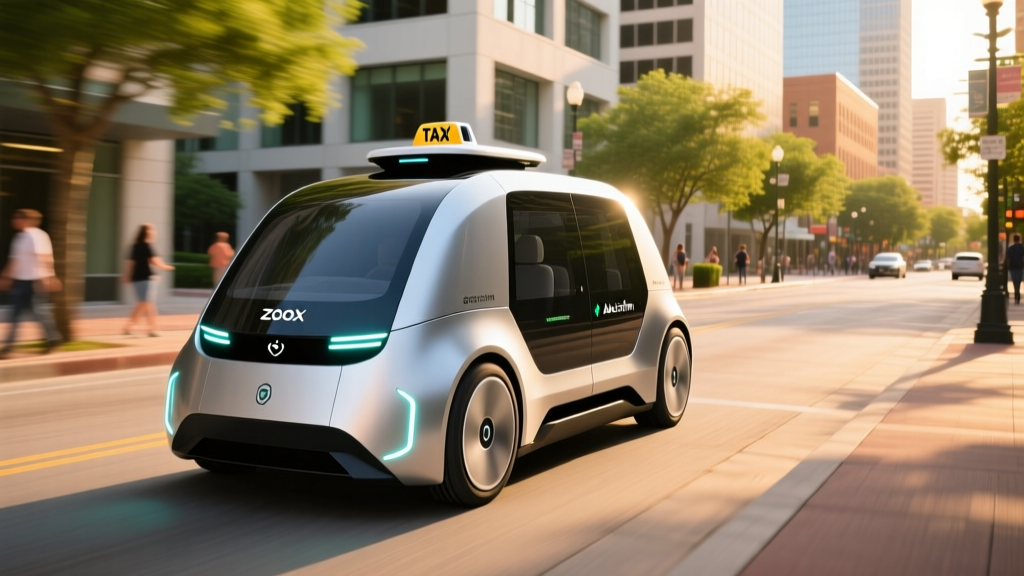
Before discussing Austin availability, it is critical to understand what Zoox is building — because it is fundamentally different from any consumer vehicle you can buy. The Zoox vehicle is a purpose-built, bidirectional robotaxi with no steering wheel, no pedals, and no driver's seat. It is designed exclusively for ride-hailing, not personal ownership.
The Zoox robotaxi operates at SAE Level 4, meaning it can handle all driving tasks within its defined operational design domain (ODD) — specific geofenced areas under specific conditions — without any human intervention. This is categorically different from Level 2 driver-assist systems like Tesla Autopilot, GM Super Cruise, or Ford BlueCruise, which require continuous driver supervision. At Level 4, there is no driver to supervise. The vehicle either completes the trip autonomously or pulls over safely if it encounters a scenario beyond its capabilities.
| SAE Level | Name | Driver Required? | Example |
|---|---|---|---|
| Level 2 | Partial Automation | Yes — full-time supervision | Tesla Autopilot, Ford BlueCruise |
| Level 3 | Conditional Automation | Yes — must take over on request | Mercedes Drive Pilot (limited markets) |
| Level 4 | High Automation | No — within geofenced ODD | Zoox, Waymo One |
| Level 5 | Full Automation | No — anywhere, any condition | Does not yet exist commercially |
The distinction matters enormously for buyers evaluating autonomous options. A Level 2 system in a Tesla or a Mercedes is a driver-assist feature in a car you own. Zoox is a driverless service you hail. You cannot buy a Zoox; you can only ride in one where the company has regulatory approval to operate.
Zoox Car Austin: Where Can You Actually Ride It?
As of early 2026, Zoox's commercial rider service availability in Austin remains limited. Here is what is confirmed versus what is in testing:
| City | Status | Service Type | Public Access |
|---|---|---|---|
| Las Vegas, NV | Commercial operations | Rider service on public roads | Invite-based, expanding |
| San Francisco, CA | Commercial operations | Rider service on public roads | Invite-based/waitlist |
| Foster City, CA | Testing & limited service | Mixed testing and employee rides | Limited |
| Austin, TX | Testing phase | Public-road testing with safety protocols | Not yet open to general public |
| Seattle, WA | Testing phase | Mapping and validation | No |
| Atlanta, GA | Testing phase | Mapping and validation | No |
Zoox has been testing vehicles on Austin roads, and the company has obtained the necessary Texas Department of Transportation permissions and local approvals required for autonomous vehicle testing. However, testing on public roads is not the same as offering rides to the public. In Austin, Zoox vehicles have been spotted in areas including downtown, the Domain, and parts of South Austin, but these are mapping, validation, and safety-driver-supervised test runs — not a ride-hailing service you can summon through an app.
For context, Zoox's most mature commercial service operates in Las Vegas, where riders can request trips within a defined geofenced corridor. San Francisco followed with a more limited rollout. Austin is widely expected to be among the next cities to receive commercial service, but Zoox has not announced a firm public-launch date for Austin as of this writing.
Zoox Vehicle Specs and Technology Stack
The Zoox vehicle is unlike anything else on the road. It is a compact, carriage-style pod designed from the ground up as a robotaxi — not a modified production car. Here are the key specifications and technology details:
| Specification | Detail |
|---|---|
| Vehicle type | Purpose-built bidirectional robotaxi (no steering wheel/pedals) |
| Seating | 4 passengers, face-to-face configuration |
| Battery capacity | Estimated ~75 kWh usable (NMC chemistry) |
| Range | Up to ~16 hours of continuous operation on a single charge |
| Top speed | 75 mph (software-limited) |
| Charging | DC fast charging capable; bidirectional |
| Sensor suite | LiDAR (multiple units), cameras, radar — redundant perception |
| Redundancy | Dual-compute, dual-power, dual-braking, dual-steering systems |
| Dimensions | Compact footprint — shorter than a Toyota Camry |
Sensor Architecture: LiDAR + Camera + Radar
Unlike Tesla's camera-only approach (which powers its Level 2 FSD Supervised system), Zoox uses a multi-modal sensor stack combining LiDAR, cameras, and radar. This is the same sensor philosophy used by Waymo and most other Level 4 operators. The redundancy is intentional: LiDAR provides precise 3D depth mapping regardless of lighting, cameras offer rich semantic understanding (reading signs, detecting colors), and radar handles adverse weather conditions where optical sensors degrade. The vehicle carries multiple LiDAR units positioned to provide overlapping 360-degree coverage with no blind spots.
Zoox also builds in hardware-level redundancy across compute, power, braking, and steering — meaning if any single system fails, a backup can bring the vehicle to a safe stop without human intervention. This is a requirement for Level 4 operation where no driver is present to take over.
Pricing: Zoox vs. Uber and Lyft in Austin
Because Zoox has not yet launched commercial rider service in Austin, there is no public per-ride pricing for the Austin market. However, we can look at how Zoox has structured pricing in its active markets and project what Austin riders might expect:
| Service | Base Fare | Per-Mile Rate | Per-Minute Rate | Estimated 5-Mile Trip |
|---|---|---|---|---|
| UberX (Austin avg.) | $2.50 | $1.15 | $0.22 | $12–$16 |
| Lyft Standard (Austin avg.) | $2.25 | $1.10 | $0.20 | $11–$15 |
| Waymo One (Phoenix/SF) | $3.00 | $1.20 | $0.25 | $13–$17 |
| Zoox (Las Vegas, estimated) | Comparable to rideshare | Comparable to rideshare | Comparable to rideshare | $12–$16 |
Zoox has indicated that its pricing model aims to be competitive with traditional rideshare services — not premium-priced. In Las Vegas, early rider programs have offered promotional pricing to build adoption. The long-term economic thesis is that by eliminating the driver (the largest cost in rideshare), robotaxi operators can offer lower per-mile costs while still achieving profitability. However, this advantage depends on fleet utilization rates, vehicle cost amortization, and remote-assistance overhead.
For Austin specifically, expect Zoox to launch with introductory pricing at or slightly below Uber/Lyft rates to attract riders, with pricing normalizing over 12–18 months. Surge pricing models may differ from rideshare, since there is no driver pool to incentivize — instead, availability is constrained purely by fleet size.
Safety Record: What the Data Shows
Safety is the single most scrutinized aspect of robotaxi operations, and rightly so. Here is what we know about Zoox's safety performance based on publicly available data and regulatory filings:
Zoox Safety Data Snapshot
- Testing miles: Zoox has accumulated hundreds of thousands of autonomous testing miles across multiple cities, with a significant portion in Las Vegas and San Francisco.
- NHTSA Standing General Order: Under NHTSA's Standing General Order (SGO), all ADS-equipped vehicles must report crashes. Zoox has reported minor incidents consistent with low-speed urban testing — primarily contact with stationary objects or other vehicles at very low speeds. No fatalities or serious injuries involving Zoox vehicles have been publicly reported as of early 2026.
- Disengagement rate: California DMV disengagement reports (required for testing in California) show Zoox's miles-per-disengagement has improved year over year, though it has historically trailed Waymo's figures. Disengagement rates are an imperfect metric — they depend heavily on testing ODD complexity — but they provide directional signal.
- Incident context: Most reported robotaxi incidents industry-wide (Zoox, Waymo, Cruise) involve low-speed, low-severity events such as being rear-ended at stoplights or contacting construction-zone barriers. The more serious incidents in the robotaxi industry have involved Cruise vehicles in San Francisco in 2023, which led to that company's permit suspension — a cautionary tale that Zoox and Waymo have referenced in their own safety protocols.
It is worth noting that comprehensive, apples-to-apples safety comparisons between robotaxi operators and human drivers remain difficult. Human drivers in the U.S. experience approximately 1.35 fatalities per 100 million vehicle miles traveled (NHTSA data). Robotaxi fleets have not yet accumulated enough miles at the hundreds-of-millions scale to produce statistically equivalent fatality-rate data. What the data does show is that robotaxis in geofenced urban environments have very low rates of serious incidents — but the operational domain is narrow and well-mapped.
Regulatory Landscape: Who Approves Zoox in Austin?
Operating a driverless vehicle on public roads requires navigating a patchwork of federal, state, and local regulations. For Zoox in Austin, the relevant regulatory bodies include:
- Texas Department of Transportation (TxDOT): Texas passed autonomous vehicle legislation (SB 2205, effective 2017) that allows ADS-equipped vehicles to operate on public roads without a human driver, provided the vehicle is registered and insured. Texas does not require a special permit for testing or deployment, making it one of the more permissive states for AV operations.
- NHTSA (Federal): At the federal level, NHTSA regulates vehicle safety standards. Zoox received a notable exemption from certain Federal Motor Vehicle Safety Standards (FMVSS) that assume a human driver (e.g., requirements for a steering wheel, mirrors, and a traditional dashboard). This exemption was critical for Zoox to legally deploy its purpose-built vehicle without conventional controls.
- City of Austin: While Texas state law preempts many local AV restrictions, Austin's transportation department coordinates with AV operators on road-use logistics, curb management, and incident reporting.
- Insurance requirements: Texas requires AV operators to carry minimum liability insurance. Zoox, as an Amazon subsidiary, carries substantial coverage exceeding state minimums.
Texas's relatively open regulatory environment is one reason Austin is attractive to multiple AV companies. Unlike California, which requires specific DMV permits for testing and deployment and publishes detailed disengagement data, Texas allows broader operational flexibility — though this also means less public transparency into operator safety metrics.
Current Limitations of the Zoox Robotaxi
Even when Zoox launches commercially in Austin, the service will have significant constraints. These are inherent to current Level 4 technology, not unique failings of Zoox:
Known Operational Limitations
- Geofencing: Service will be restricted to a mapped, approved zone — likely central Austin, the airport corridor, and major commercial districts. You will not be able to hail a Zoox to suburban areas like Round Rock, Pflugerville, or Cedar Park at launch.
- Weather constraints: Heavy rain, flooding (a real Austin concern during flash-flood events), and dense fog can degrade sensor performance and may trigger service suspension. The Zoox vehicle's LiDAR handles rain better than camera-only systems, but extreme precipitation still limits operational capability.
- Construction zones: Austin's perpetually evolving road construction — particularly along I-35, MoPac, and US 183 — creates dynamic environments that can challenge even advanced ADS. Expect Zoox to route around active construction or temporarily restrict service in heavily disrupted corridors.
- No highway operation initially: While the Zoox vehicle is capable of 75 mph, initial commercial service will likely be limited to surface streets and lower-speed arterials. Highway merging and high-speed lane changes remain edge cases that operators approach cautiously.
- Pickup/dropoff precision: Unlike a human Uber driver who can pull into a specific driveway or parking garage level, Zoox will use designated virtual stops — typically curbside locations pre-mapped and validated for safe boarding.
- Limited cargo and accessibility: The 4-seat pod configuration means no trunk space for large luggage, limited room for mobility devices beyond standard wheelchairs, and no option for child seats (a regulatory gray area for driverless vehicles).
- Wait times: With a finite fleet and no driver repositioning incentives, wait times during peak demand may exceed rideshare — at least until fleet density increases.
Zoox vs. Waymo: The Austin Robotaxi Comparison
Austin riders will likely have choices when it comes to robotaxi services. Waymo (Alphabet's autonomous driving unit) has been expanding its Waymo One service and has indicated Austin as a target market. Here is how the two compare:
| Attribute | Zoox | Waymo One |
|---|---|---|
| Vehicle | Purpose-built pod (no steering wheel) | Modified Jaguar I-PACE (production SUV) |
| SAE Level | Level 4 | Level 4 |
| Sensor stack | LiDAR + camera + radar | LiDAR + camera + radar (5th-gen) |
| Parent company | Amazon | Alphabet (Google) |
| Most mature market | Las Vegas | Phoenix, San Francisco |
| Austin status (2026) | Testing | Testing / early access |
| Seating capacity | 4 passengers | Up to 3 passengers (I-PACE cabin) |
| Highway capable | Yes (75 mph) | Yes (65+ mph in approved areas) |
| Public safety data | NHTSA SGO reports, CA DMV disengagements | NHTSA SGO reports, CA DMV disengagements, published safety framework |
Waymo has a significant head start in commercial operations, with millions of paid rider trips completed across Phoenix and San Francisco. Zoox's advantage is its purpose-built vehicle, which offers a more spacious, face-to-face passenger experience and is optimized for the ride-hailing use case rather than adapted from a consumer SUV. For Austin riders, the practical question is simply which service launches commercially first and covers the areas they actually need to travel.
Frequently Asked Questions About Zoox in Austin
Can I hail a Zoox ride in Austin right now?
No. As of early 2026, Zoox is in the testing phase in Austin. The vehicles are on public roads for mapping and validation, but commercial rider service is not yet available to the general public. Las Vegas and San Francisco are the primary markets with active rider programs.
Is the Zoox car truly self-driving or does it have a safety driver?
The Zoox purpose-built vehicle is designed for fully driverless (SAE Level 4) operation with no steering wheel or pedals. However, during testing phases — including in Austin — vehicles may operate with a safety operator or remote-assistance capability. Once commercial service launches, rides will be fully driverless within the approved geofence.
How much will a Zoox ride cost compared to Uber in Austin?
Zoox has indicated its pricing will be competitive with traditional rideshare. Based on operations in Las Vegas, expect per-trip costs in the $12–$16 range for a typical 5-mile urban trip — comparable to UberX or Lyft Standard in Austin. Promotional pricing is likely at launch.
What happens if the Zoox vehicle encounters a situation it cannot handle?
The vehicle is programmed to execute a minimal risk condition (MRC) — essentially pulling over to a safe location and stopping. Zoox also employs remote assistance, where a human operator can provide guidance to the vehicle's planning system (without directly steering or controlling the vehicle in real-time) to help it resolve ambiguous situations.
How does Austin's weather affect Zoox operations?
Austin's primary weather challenges for autonomous vehicles are heavy rain events and flash flooding. The Zoox sensor suite (LiDAR + radar) handles moderate rain better than camera-only systems, but severe weather will likely trigger service suspension. Extreme summer heat is managed through the vehicle's thermal management system for both battery and compute hardware.
Will Zoox be available at Austin-Bergstrom International Airport?
Airport service is a high-value use case for robotaxis, and Zoox is likely to pursue Austin-Bergstrom access eventually. However, airport pickup/dropoff involves specific coordination with airport authorities, designated staging areas, and complex traffic patterns. This is typically a later-phase expansion, not a launch-day feature.
How does Zoox's safety record compare to human drivers?
Direct statistical comparison is not yet possible — robotaxi fleets have not accumulated enough miles to produce equivalent fatality-rate data to the U.S. human-driving average of ~1.35 fatalities per 100 million miles. What available data shows is that robotaxis operating in geofenced urban areas have very low rates of serious crashes, with most reported incidents being low-speed, low-severity events. For detailed crash data, consult NHTSA's Standing General Order reports.
The Bottom Line on Zoox in Austin
The Zoox car represents one of the most ambitious approaches to autonomous ride-hailing — a purpose-built, driverless pod backed by Amazon's resources and engineering depth. For Austin residents and visitors, the question is not whether the technology is impressive (it is), but when it will be practically available as a transportation option. Testing on Austin roads is underway, the regulatory pathway in Texas is favorable, and the city's grid layout and tech-savvy population make it a strong fit. But until Zoox moves from testing to commercial launch — with a defined geofence, public pricing, and open rider access — Austin's robotaxi option remains Waymo's expanding service. We will update this guide as Zoox announces concrete Austin launch timelines and service details.