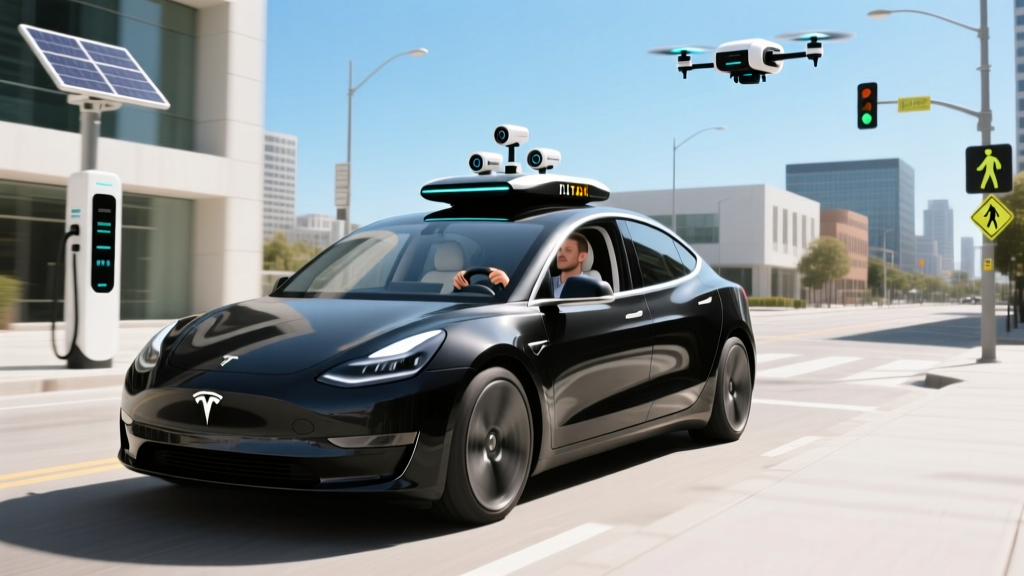
If you have searched for "autopilot driving" hoping to find a car that handles your commute while you scroll your phone, this guide will save you time, money, and potentially your license. Tesla's Autopilot and Full Self-Driving (FSD) are among the most capable consumer driver-assistance systems on the road — and among the most misunderstood. Neither makes the car autonomous. Both require you to stay engaged, eyes on the road, hands available to take over at any moment.
Below, we break down exactly what Tesla's Autopilot driving features do in 2026, what they cost, which models include them, where they fail, and how they stack up against Ford BlueCruise and GM Super Cruise.
What Tesla Autopilot Driving Actually Does
Tesla offers two tiers of driver assistance under the Autopilot umbrella. Understanding the distinction is the first step to avoiding disappointment at delivery.
| Feature | Basic Autopilot (Standard) | FSD Supervised |
|---|---|---|
| Traffic-Aware Cruise Control | ✓ | ✓ |
| Autosteer (lane centering, marked roads) | ✓ | ✓ |
| Auto Lane Change | ✗ | ✓ |
| Navigate on Autopilot (highway on/off-ramp) | ✗ | ✓ |
| Autopark / Smart Summon | ✗ | ✓ |
| Traffic Light & Stop Sign Control | ✗ | ✓ |
| City Street Autosteer | ✗ | ✓ |
| SAE Automation Level | Level 2 | Level 2 |
Basic Autopilot is a competent highway companion: it maintains speed relative to traffic and keeps the car centered in clearly marked lanes. FSD Supervised extends that to highway interchanges, city streets, and some parking maneuvers — but the word "Supervised" is doing heavy lifting. You are the supervisor. The car is not driving itself.
How Tesla's Autopilot Hardware Works in 2026
Tesla's approach diverges sharply from competitors. While Ford, GM, and most legacy automakers fuse cameras with radar and sometimes lidar, Tesla has committed to a vision-only architecture branded as "Tesla Vision."
- Cameras: 8 external cameras providing 360° coverage (front main, front wide, front narrow, left/right repeaters, rear). The current Hardware 4 (HW4) suite uses higher-resolution sensors with improved low-light performance over HW3.
- No radar: Tesla removed ultrasonic sensors (USS) starting in late 2022 and radar before that. Distance estimation and object detection are handled entirely by neural networks processing camera feeds.
- Neural network processing: An onboard computer (HW4) runs Tesla's end-to-end neural network, which processes raw camera data to identify lane lines, vehicles, pedestrians, traffic signals, and road geometry in real time.
- Driver monitoring: A cabin-facing camera tracks eye gaze and head position. If you look away or close your eyes, the system escalates warnings — visual chime, then audio alert, then Autopilot disengagement with a lockout for the remainder of the drive.
The vision-only approach means Tesla relies heavily on software sophistication rather than hardware redundancy. In practice, this yields impressive performance in good conditions but exposes clear vulnerabilities in edge cases — which we will address below.
Real-World Capabilities: Where Autopilot Driving Excels
On well-marked divided highways in clear weather, Tesla's Autopilot is among the smoothest and most confidence-inspiring Level 2 systems available. FSD Supervised on city streets has improved dramatically since its 2024 end-to-end neural network update, handling unprotected left turns, four-way stops, and lane merges with fewer interventions than prior rule-based versions.
Highway driving (Basic Autopilot & FSD): Lane centering is precise even through gentle curves. Traffic-aware cruise control modulates speed smoothly and anticipates slowing traffic ahead. Navigate on Autopilot (FSD) handles highway interchanges competently, including zipper merges and lane selection based on traffic density.
City streets (FSD Supervised only): The system recognizes traffic lights and stop signs, yields to pedestrians at crosswalks, and navigates roundabouts. On suburban roads with clear markings, it performs well. In dense urban cores with construction zones, faded lane markings, or unusual intersections, expect to take over more frequently.
Low-speed maneuvers (FSD Supervised): Smart Summon navigates parking lots to retrieve the car at low speed. Autopark handles parallel and perpendicular parking. These features work adequately but are not dramatically faster or more reliable than doing it yourself.
Limitations and Edge Cases You Must Know
- Drive without supervision — you must remain alert and ready to take over at any second.
- Handle all weather conditions — heavy rain, fog, snow, and direct sun glare can blind cameras and degrade performance.
- Navigate construction zones reliably — temporary barriers, shifted lanes, and absent markings confuse the system.
- Recognize all emergency vehicles — stationary emergency vehicles with flashing lights have been involved in multiple NHTSA-investigated collisions.
- Operate on unmapped or severely degraded roads — the system depends on both visual lane markings and GPS/map data.
- Replace driver judgment — merging into aggressive traffic, navigating school zones with unpredictable pedestrian behavior, and handling off-road conditions remain your responsibility.
Cold-weather performance deserves special mention. Camera lenses can ice over or fog in freezing conditions, and road markings obscured by snow render Autosteer unreliable. Tesla's cabin camera monitoring can also struggle if you are wearing sunglasses with certain IR-blocking lenses, triggering false "driver inattentive" warnings.
The vision-only architecture means there is no radar backup for scenarios where cameras are compromised. A sudden downpour that obscures the front camera can cause the system to disengage abruptly — sometimes with little warning. This contrasts with systems like GM Super Cruise, which uses lidar and radar redundancy and will maintain function in conditions that would defeat Tesla Vision.
According to NHTSA's Standing General Order crash reporting data, Tesla's Autopilot and FSD have been involved in a significant share of reported Level 2 ADAS collisions. Context matters — Tesla's fleet is large and its data logging is more comprehensive — but the numbers reinforce that this is not a system you can trust blindly.
Cost Breakdown: What Autopilot Driving Costs in 2026
| Package | One-Time Purchase | Monthly Subscription | Included Standard? |
|---|---|---|---|
| Basic Autopilot (TACC + Autosteer) | — | — | Yes, all models |
| Enhanced Autopilot (EAP)* | $6,000 | Not available | No |
| Full Self-Driving (Supervised) | $8,000 | $99/month | No |
*Enhanced Autopilot availability varies by model year and region; as of 2026, Tesla has been consolidating tiers. Verify current trim options on Tesla's configurator before ordering.
The $99/month FSD subscription is the most practical entry point for most buyers. It lets you evaluate the system on your actual commute before committing $8,000. The purchase price only makes financial sense if you plan to keep the vehicle for 7+ years — and only if Tesla does not change the feature set or pricing model, which it has done repeatedly.
Important: FSD does not transfer to a new Tesla purchase automatically. Tesla has occasionally offered promotional transfers, but these are not guaranteed. Factor that into your total cost of ownership calculation.
Which Tesla Models Include Autopilot Driving Features
| Model | Basic Autopilot | FSD Supervised | Hardware |
|---|---|---|---|
| Model 3 (Highland / Juniper) | Standard | Optional ($8K or $99/mo) | HW4 |
| Model Y (Juniper) | Standard | Optional ($8K or $99/mo) | HW4 |
| Model S | Standard | Optional ($8K or $99/mo) | HW4 |
| Model X | Standard | Optional ($8K or $99/mo) | HW4 |
| Cybertruck | Standard | Optional ($8K or $99/mo) | HW4 |
Every current-production Tesla ships with HW4 and Basic Autopilot at no additional cost. FSD Supervised is available as an add-on at purchase or activated later via the Tesla app. The hardware is identical across all trims — there is no "premium sensor package" that unlocks better performance.
Tesla Autopilot vs. Ford BlueCruise vs. GM Super Cruise
| Attribute | Tesla FSD (Supervised) | Ford BlueCruise 1.4 | GM Super Cruise |
|---|---|---|---|
| SAE Level | Level 2 | Level 2 | Level 2 |
| Hands-Free Operation | No (hands-on-wheel or torque required) | Yes (on pre-mapped highways, eyes monitored) | Yes (on pre-mapped highways, eyes monitored) |
| Geographic Coverage | All roads (with limitations) | ~130,000+ miles of pre-mapped divided highways | ~750,000+ miles of pre-mapped roads (US & Canada) |
| City Street Capability | Yes (with supervision) | No | Limited (mapped roads only) |
| Sensor Suite | Cameras only (Tesla Vision) | Cameras + radar | Cameras + radar + lidar |
| Driver Monitoring | Cabin camera (eye gaze) | Cabin camera (eye gaze) | Cabin camera (eye gaze) |
| Cost | $8,000 or $99/mo | $2,100 (one-time, select trims) | $2,500 (one-time) or included on premium trims |
| Lane Change | Automatic (FSD) | Automatic (BlueCruise 1.4) | Automatic (newer versions) |
The core trade-off is geographic breadth versus hands-free comfort. Tesla FSD attempts to work everywhere — highways, city streets, parking lots — but always requires your hands on the wheel (or detectable torque). Ford BlueCruise and GM Super Cruise operate on a curated list of pre-mapped highways but allow genuinely hands-free driving on those roads, with driver monitoring via cabin camera ensuring you are paying attention.
If your primary use case is long highway commutes on interstates, BlueCruise and Super Cruise offer a more relaxed experience. If you want a system that assists on varied road types including surface streets, Tesla FSD has broader coverage — with the understanding that you remain the driver at all times.
GM's lidar-equipped Super Cruise has a hardware redundancy advantage in poor weather and low-visibility scenarios. Ford's radar fusion provides a similar, if less comprehensive, backup. Tesla's camera-only approach is the most software-dependent and the most vulnerable to environmental degradation.
Safety Data and Regulatory Context
Tesla publishes quarterly Vehicle Safety Reports claiming that drivers using Autopilot experience fewer crashes per million miles than the national average. These reports have methodological limitations: they do not isolate Autopilot engagement from other safety features, and Tesla's fleet skews toward newer vehicles with advanced passive safety.
The IIHS has tested multiple Tesla models and awarded high crashworthiness ratings, but has separately criticized all Level 2 systems — including Autopilot — for insufficient driver-monitoring safeguards. The Insurance Institute has advocated for mandatory attention-verification standards that go beyond what most manufacturers currently implement.
NHTSA continues to investigate multiple Autopilot-related incidents, particularly collisions with stationary emergency vehicles. In 2024, Tesla implemented additional driver-attention requirements in response to regulatory pressure, including stricter cabin-camera monitoring and shorter disengagement timeouts.
Frequently Asked Questions
Is Tesla Autopilot actually self-driving?
No. Both Basic Autopilot and Full Self-Driving (Supervised) are SAE Level 2 driver-assistance systems. You must remain fully engaged, monitor the road, and be prepared to take over at any moment. The "Full Self-Driving" name is a product label, not a technical description. No consumer Tesla vehicle can drive itself without human supervision.
Can I use Autopilot on any road?
Basic Autopilot (TACC + Autosteer) works on most roads with visible lane markings. FSD Supervised extends to city streets, but performance varies significantly with road quality, marking visibility, traffic complexity, and weather. Residential streets with faded markings, unmapped roads, and construction zones will require frequent takeovers.
Is the $99/month FSD subscription worth it?
For most buyers, the subscription is the smarter choice. It lets you test the system on your real routes without an $8,000 commitment. If you find yourself disabling FSD within a few months because your commute involves too many edge cases, you have spent $200-300 instead of thousands. Purchase only makes sense for long-term owners who use it daily and are comfortable with Tesla's history of changing pricing and feature availability.
Does Autopilot work in snow and heavy rain?
Performance degrades significantly in heavy rain, fog, snow, and icy conditions. Camera lenses can become obscured, and snow-covered lane markings defeat Autosteer. Tesla's owner manual explicitly warns that Autopilot may not function in adverse weather. In these conditions, you should expect to drive manually.
Will FSD improve over time with software updates?
Tesla regularly pushes over-the-air updates that modify Autopilot and FSD behavior. Some updates bring measurable improvements; others introduce regressions or behavioral changes that some drivers find less predictable. There is no guaranteed timeline for future capability improvements, and Tesla has not committed to any specific SAE Level 3 or Level 4 consumer release date.
How does Tesla's Autopilot compare to Toyota Safety Sense or Honda Sensing?
Toyota Safety Sense and Honda Sensing are more conservative Level 2 systems focused on highway lane-keeping and adaptive cruise control. They lack Tesla's city-street capability and automatic lane-change features, but they are included at no extra cost on virtually every trim. For buyers who want basic highway assistance without subscription fees, these systems are highly effective and reliable within their narrower scope.