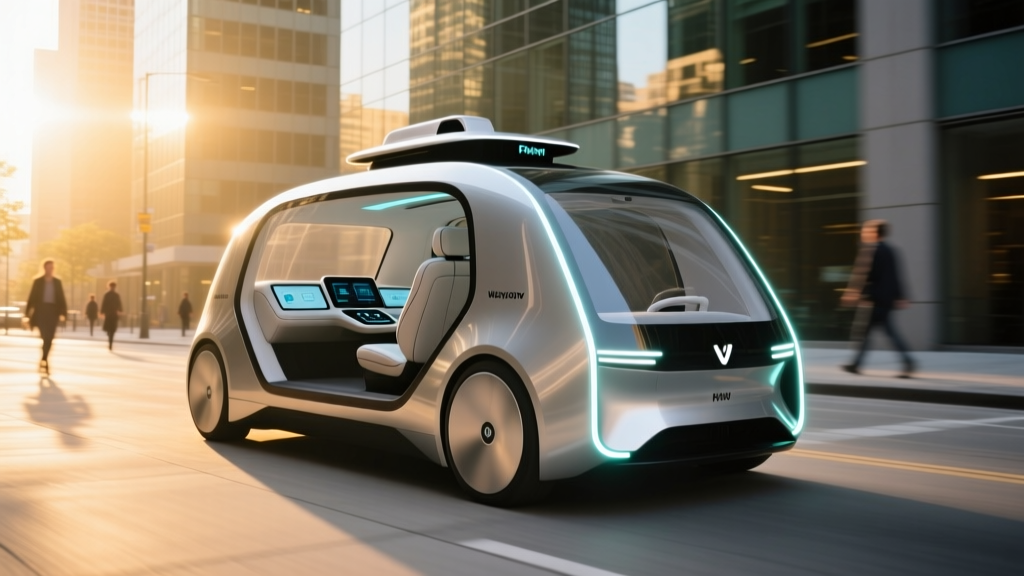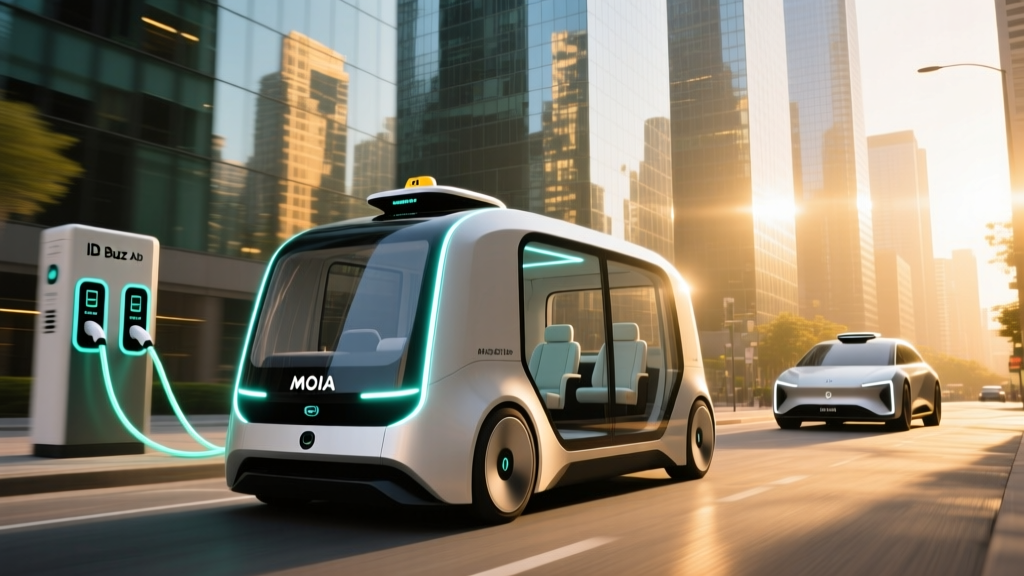
Volkswagen's approach to autonomous driving diverges sharply from Tesla's consumer-focused Full Self-Driving beta. Instead of selling you a car that promises eventual autonomy, VW is building a Level 4 robotaxi service through its mobility subsidiary MOIA, using the purpose-built ID. Buzz AD electric van. If you've been searching for the truth behind "VW self driving" capabilities, the answer involves a commercial fleet operation — not a vehicle you can buy at your local dealer.
Here's exactly where VW's autonomous program stands in 2026, what the technology can and cannot do, and how it compares to Waymo and Cruise in real-world deployment.
SAE Automation Levels: Where VW Self-Driving Actually Sits
Before examining VW's specific technology, it's critical to understand the SAE International automation framework. VW's consumer vehicles and its robotaxi program occupy completely different levels on this scale.
| SAE Level | Description | VW Example |
|---|---|---|
| Level 0 | No automation — driver does everything | Base ID.4 without assist packages |
| Level 1 | Driver assistance — steering OR acceleration (not both) | Adaptive cruise control |
| Level 2 | Partial automation — steering AND acceleration simultaneously; driver must remain engaged | VW Travel Assist (IQ.DRIVE) on ID.4, ID.7 |
| Level 3 | Conditional automation — car drives in specific scenarios; driver must take over when requested | Not currently offered by VW |
| Level 4 | High automation — fully driverless within a defined operational design domain (geofenced area) | ID. Buzz AD / MOIA robotaxi |
| Level 5 | Full automation — no steering wheel, no geofence, any condition | Does not exist commercially anywhere |
The key distinction: When you buy a 2026 VW ID.4 or ID.7, you get Travel Assist — a Level 2 system that requires your hands on the wheel and eyes on the road at all times. The ID. Buzz AD robotaxi, by contrast, operates at Level 4 with no driver present inside the vehicle, but only within tightly controlled urban zones. These are fundamentally different products serving different purposes.
The ID. Buzz AD: VW's Robotaxi Hardware Platform
The autonomous variant of VW's electric van is engineered from the ground up for driverless fleet operations. Unlike consumer EVs where ADAS is an add-on, the ID. Buzz AD integrates a comprehensive sensor suite designed for redundant perception.
Technology Stack Overview
LiDAR: Multiple roof-mounted solid-state LiDAR units providing 360-degree 3D point-cloud mapping. Unlike Tesla's camera-only approach, VW (via its partnership with Mobileye) relies on LiDAR as a primary sensor for depth perception and object classification at range.
Cameras: A surround-view array of high-resolution cameras (front, rear, and corner-mounted) handling lane detection, traffic sign recognition, and traffic light state classification.
Radar: Long-range and short-range radar units for velocity detection of moving objects, particularly useful in rain and fog where camera and LiDAR performance degrades.
HD Maps + Geofencing: The vehicle operates only within pre-mapped corridors using centimeter-accuracy HD maps. If the vehicle approaches the boundary of its operational design domain (ODD), it executes a controlled stop rather than proceeding into unmapped territory.
Compute: Mobileye EyeQ Ultra system-on-chip delivering redundant processing paths — if one compute channel fails, the backup can execute a safe stop maneuver.
This sensor-fusion approach (LiDAR + camera + radar) contrasts with Tesla's vision-only FSD architecture. The trade-off: VW's stack is significantly more expensive per vehicle (estimated $150,000+ in sensor hardware alone), which is why it only makes economic sense in a high-utilization fleet model rather than consumer ownership.
ID. Buzz AD Vehicle Specifications
| Spec | ID. Buzz AD (Long Wheelbase) |
|---|---|
| Battery (usable) | 86 kWh (NMC chemistry) |
| EPA Range (est.) | ~230 miles (fleet ops typically use 60-70% of range before charging) |
| Max DC Fast Charge | 170 kW peak, 10-80% in ~30 min |
| Motor | Rear-mounted, 282 hp (210 kW) |
| 0-60 mph | ~7.9 seconds |
| Passenger Capacity | Up to 6 (configured for ride-hailing) |
| Autonomy Hardware | Mobileye Drive system, 6+ LiDAR, 11 cameras, 5 radar |
| Consumer Availability | Not for sale — fleet-only vehicle |
Where Can You Use VW's MOIA Robotaxi Service?
MOIA, Volkswagen's wholly owned mobility subsidiary, is the operating entity for VW's robotaxi ambitions. As of 2026, the service footprint is deliberately narrow — VW is prioritizing safety validation over rapid geographic expansion.
| City | Status | Service Area | Notes |
|---|---|---|---|
| Hamburg, Germany | Active pilot | Defined urban corridors (~30 sq mi) | Primary testing ground since 2023; expanded ODD in 2025 |
| Munich, Germany | Active pilot | Airport-to-city-center corridor + select districts | Partnership with Munich airport authority |
| Austin, Texas (USA) | Announced / pre-deployment testing | TBD — expected downtown + airport corridor | Targeted commercial launch pending TX DOT approval |
| Other US cities | Not announced | N/A | VW has stated US expansion depends on Austin validation results |
MOIA Robotaxi Pricing vs. Uber and Lyft
VW has structured MOIA as a ride-pooling service (shared rides with dynamic routing) rather than a private robotaxi. This model spreads the high per-vehicle cost across multiple passengers per trip.
| Service | Typical 5-Mile Trip (Hamburg) | Per-Mile Cost | Pooling Available |
|---|---|---|---|
| MOIA Robotaxi (projected commercial rate) | €8–12 (~$8.50–$13) | ~$1.70–$2.60/mi | Yes (default model) |
| UberX (Hamburg) | €10–16 (~$11–$17) | ~$2.20–$3.40/mi | Optional (Uber Pool) |
| Waymo One (Phoenix, USA) | $8–$15 | ~$1.60–$3.00/mi | No (private rides) |
| Lyft (US average) | $9–$16 | ~$1.80–$3.20/mi | Optional (Shared) |
VW's long-term goal is to undercut traditional rideshare on per-mile cost by eliminating the driver — which typically represents 60-70% of a ride-hailing fare. However, the massive upfront hardware cost (the ID. Buzz AD's sensor suite adds well over $100,000 to the vehicle cost) means profitability requires extremely high utilization: 18-20 hours of revenue-generating operation per day. This is why VW targets dense urban corridors with consistent demand rather than suburban sprawl.
Safety Record: What the Data Actually Shows
VW and MOIA have published limited public safety data compared to Waymo's extensive transparency reports. Here's what is known as of early 2026:
Hamburg Pilot Program (cumulative through late 2025):
- Approximately 500,000+ autonomous miles driven in mixed urban traffic
- Operations conducted initially with a safety steward on board, transitioning to fully driverless in expanded zones
- Zero reported at-fault collisions involving pedestrians or cyclists during autonomous operation
- Disengagement rate: VW has not published a specific interventions-per-1,000-miles figure, stating only that it "meets or exceeds the performance benchmarks required by German federal authorities" (Kraftfahrt-Bundesamt)
For comparison, Waymo reported approximately 7.1 million fully driverless miles in California alone through mid-2024, with a property-damage-only crash rate roughly 40% lower than human benchmarks in equivalent urban driving (NHTSA AV reporting data).
The disparity in total autonomous miles between VW/MOIA and Waymo is significant — VW is roughly an order of magnitude behind in real-world driverless validation. This isn't necessarily a negative: VW's more cautious deployment strategy in smaller geographic areas with fewer edge cases may yield a safer initial rollout, but it also means the system has encountered far fewer unusual scenarios.
Regulatory Landscape: Who Approves VW's Robotaxi Operations?
Autonomous vehicle regulation varies dramatically by jurisdiction, and VW's dual-market strategy (Europe first, US second) means navigating two very different approval frameworks.
Germany (Primary Market)
Germany passed the Act on Autonomous Driving (Autonomes Fahren Gesetz) in 2021, creating a legal framework for Level 4 vehicles in defined operational areas. The Kraftfahrt-Bundesamt (KBA) — Germany's federal motor transport authority — grants type approval for autonomous systems. Hamburg and Munich have issued local operating permits for MOIA's pilot under this framework.
United States
The US has no unified federal robotaxi approval process. Instead:
- NHTSA sets vehicle safety standards and requires crash/incident reporting for AVs, but does not "approve" robotaxi services
- State authorities (e.g., California DMV/CPUC, Texas DOT) issue deployment permits
- Local municipalities often have additional requirements (insurance minimums, first-responder coordination, accessibility mandates)
For VW's Austin plans, the company must navigate Texas state law (which permits AV testing and deployment) plus city-level requirements. As of early 2026, MOIA has not received a commercial deployment permit in any US jurisdiction.
Current Limitations of VW's Self-Driving System
The ID. Buzz AD's Level 4 system is powerful within its design envelope but has hard boundaries that riders and observers should understand clearly.
- Geofencing: The vehicle will not operate outside its pre-mapped service area. If a rider requests a destination beyond the ODD boundary, the app will not allow the booking.
- Weather restrictions: Heavy rain, snow, fog, and ice degrade LiDAR and camera performance. MOIA suspends driverless operations during severe weather — the vehicle either returns to base or a remote operator guides it to a safe stop.
- Construction zones: Unexpected lane closures, temporary barriers, and unmapped detours remain challenging. The system will slow down or stop and request remote human guidance rather than improvise.
- Night operations: While LiDAR and radar function in darkness, camera-dependent tasks (reading temporary signage, detecting unlit pedestrians at distance) have reduced confidence margins. Some pilot zones restrict nighttime operation.
- Speed envelope: The system is designed for urban speeds — typically up to 40 mph (60 km/h). Highway operation is not part of the current ODD.
- No consumer purchase: You cannot buy an ID. Buzz AD. The autonomous hardware, software licensing, and fleet management infrastructure make this exclusively a commercial platform.
What VW's Consumer Vehicles Offer Today (Level 2)
If you're shopping for a VW EV and hoping for self-driving capability, here's what's actually available in the 2026 lineup:
VW Travel Assist (IQ.DRIVE) is the brand's most advanced consumer driver-assist system. It combines adaptive cruise control with lane-centering to provide simultaneous steering and speed management on highways. This is SAE Level 2 — you must keep your hands on the wheel (capacitive sensors detect grip) and monitor the road at all times.
Available on the ID.4, ID.7, and ID. Buzz (consumer version), Travel Assist works well for reducing highway fatigue but makes no claim to autonomous operation. It will not navigate intersections, respond to traffic lights, or handle urban driving without continuous driver input. Pricing for the IQ.DRIVE package is typically included on higher trims (Pro S and above on the ID.4, starting around $47,000 MSRP).
Frequently Asked Questions
Where can I use VW's self-driving robotaxi right now?
Fully driverless MOIA service is in pilot phase in Hamburg and Munich, Germany, with limited invited users. Austin, Texas is the planned first US city, but no commercial launch date has been confirmed. You cannot hail an ID. Buzz AD as a member of the general public in 2026.
How much does a MOIA robotaxi ride cost compared to Uber?
Projected commercial pricing targets €8–12 ($8.50–$13) for a typical 5-mile pooled trip in Hamburg, which would be 10-25% cheaper than an equivalent UberX ride. Final US pricing for Austin has not been announced.
Is VW Travel Assist the same as self-driving?
No. Travel Assist is an SAE Level 2 driver-assist system that requires continuous driver engagement — hands on wheel, eyes on road. It is fundamentally different from the Level 4 ID. Buzz AD robotaxi, which operates with no driver present. Never treat Travel Assist as autonomous.
How safe is VW's robotaxi compared to a human driver?
With approximately 500,000+ pilot miles and zero reported at-fault collisions involving vulnerable road users, the early data is promising. However, VW's total autonomous mileage is far below Waymo's 7+ million driverless miles, making direct statistical comparison premature. VW has not published a specific disengagement rate.
Can I buy a VW ID. Buzz AD for personal use?
No. The ID. Buzz AD is a fleet-only vehicle with over $100,000 in additional autonomous sensor hardware. VW sells a consumer ID. Buzz (starting ~$61,000 MSRP) with Level 2 driver-assist features, but the Level 4 robotaxi variant is not available for retail purchase.
What happens if the MOIA robotaxi encounters a situation it can't handle?
The vehicle is programmed to execute a "minimal risk condition" — it slows down, activates hazard lights, and pulls to the curb or stops in place. A remote operations center monitors the fleet and can provide guidance or dispatch roadside assistance. The vehicle will not attempt to navigate scenarios outside its capability envelope.
The Bottom Line on VW Self-Driving in 2026
Volkswagen's autonomous driving strategy is real but deliberately conservative. The ID. Buzz AD and MOIA robotaxi represent genuine Level 4 technology validated in European urban environments, built on a sensor-fusion architecture that prioritizes redundancy over cost reduction. The gap between VW and Waymo is primarily one of scale — hundreds of thousands of miles versus millions — not necessarily of fundamental capability.
For US consumers, the practical reality is that VW self-driving technology will not be accessible in daily life for at least another year or two, even in Austin. And if you're shopping for a VW electric vehicle today, what you'll get is a competent Level 2 driver-assist system — useful for highway comfort, but requiring your full attention at all times. The robotaxi future VW is building is a fleet service you'll summon with an app, not a car you'll park in your garage.