Introduction: The Aftermarket vs. OEM ADAS Dilemma
For years, Tesla has held the undisputed crown in the consumer advanced driver assistance systems (ADAS) market. However, the landscape of semi-autonomous driving is rapidly evolving. Enter comma.ai, the robotics company founded by George Hotz, which has disrupted the market with its open-source OpenPilot software and proprietary hardware. With the release of the comma 3X, the gap between aftermarket solutions and original equipment manufacturer (OEM) systems has narrowed significantly.
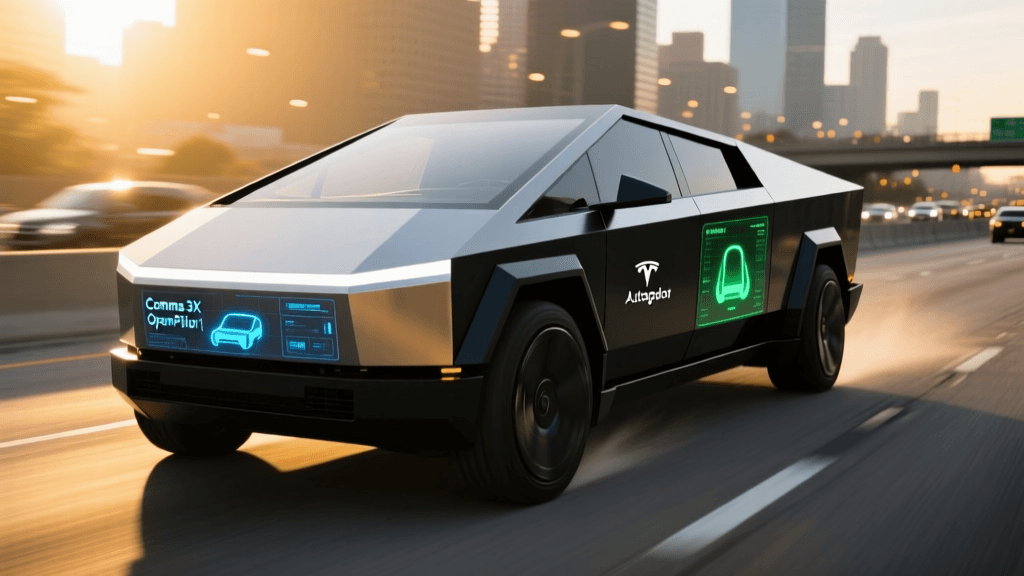
In this head-to-head product showdown, we are pitting the latest aftermarket champion—the comma 3X running OpenPilot—against the industry benchmark—Tesla’s Autopilot (Hardware 3 and 4). Whether you drive a Toyota, Hyundai, Honda, or a Tesla, understanding the nuances of these two systems is critical for anyone looking to maximize their daily commute safety and comfort. We will break down hardware capabilities, installation setups, on-road performance, and total cost of ownership.
Hardware Showdown: Comma 3X vs. Tesla Vision
The physical architecture of an ADAS system dictates its ceiling for performance. Tesla relies on its proprietary HW3 or the newer HW4 computer, processing data from a suite of high-resolution external cameras. Tesla's approach is entirely vision-based, utilizing neural networks trained on billions of miles of fleet data to navigate without LiDAR or radar.
The comma 3X, on the other hand, is a self-contained, windshield-mounted powerhouse. It features the Qualcomm Snapdragon 8 Gen 3 processor, offering massive computational overhead for the open-source OpenPilot neural networks. The device includes a 120-degree field-of-view road-facing camera and an infrared (IR) cabin-facing camera for driver monitoring. While Tesla's multi-camera setup provides 360-degree awareness (essential for its city-street FSD beta), the comma 3X focuses strictly on what matters most for Level 2 highway automation: the road ahead and the driver's attention.
Setup and Installation: Plug-and-Play vs. Factory Integrated
One of the most significant differences between these two systems is the setup experience. Tesla Autopilot comes pre-installed from the factory. The 'setup' merely involves calibrating the cameras by driving roughly 20 to 50 miles on well-marked highways, after which the system is ready to use.
Installing the comma 3X requires a bit more elbow grease, but it is designed to be entirely reversible and non-destructive. Depending on your vehicle, you will need a specific car harness. For modern vehicles with ADAS cameras (like the Toyota RAV4 Prime or Hyundai Ioniq 5), you typically unplug the factory camera, plug in the comma intercept harness, and mount the 3X on your windshield using a custom suction or adhesive mount. For older vehicles or specific models, an OBD-C port harness is used to intercept the CAN bus data. The entire physical installation takes most DIYers between 45 and 90 minutes. Once mounted, you connect the device to Wi-Fi, pair your phone, and begin your first calibration drive.
On-Road Performance: Highway, City, and Edge Cases
How do these systems actually handle the chaos of real-world driving? Below is a structured comparison of their core Level 2 automation capabilities on divided highways and interstates.
| Feature | Comma 3X (OpenPilot) | Tesla Autopilot (Basic/EAP) |
|---|---|---|
| Lane Centering | Exceptional; uses neural net for smooth, human-like micro-adjustments. | Very Good; occasionally ping-pongs in wide or faded lanes. |
| Adaptive Cruise Control | Smooth braking/acceleration; integrates with stock car radar or vision. | Aggressive at times; phantom braking can occur in heavy rain or shadows. |
| Auto Lane Change | Available via community forks or experimental stock branches. | Native and highly capable (requires EAP or FSD purchase). |
| Stop and Go Traffic | Flawless; handles complete stops and resume without driver input. | Flawless; handles complete stops and resume seamlessly. |
| Driver Monitoring | IR eye-tracking; highly accurate, allows hands off the wheel. | Steering wheel torque nags (HW3) or Cabin Camera (HW4). |
On the highway, OpenPilot's lane centering is widely considered by enthusiasts to be smoother and more 'human-like' than Tesla's basic Autopilot. OpenPilot reads the road geometry using its neural network rather than just hugging painted lines, meaning it handles construction zones and faded lines with remarkable grace. However, Tesla wins in the automated lane change department, as OpenPilot's stock branch prioritizes conservative, single-lane safety over aggressive multi-lane maneuvers.
Safety, Monitoring, and Disengagement Rates
Safety in Level 2 automation hinges entirely on the driver monitoring system (DMS). If a system allows you to look away, it is no longer a safe Level 2 system. According to the Insurance Institute for Highway Safety (IIHS), robust driver monitoring is the single most critical factor in preventing automation complacency and reducing crashes involving partial automation.
Tesla's older HW3 relies on steering wheel torque sensors, which are easily fooled by weighted rings and do not actually verify if the driver is looking at the road. While HW4 introduces a cabin camera, its software implementation can sometimes be overly sensitive or fail to register eye contact in polarized sunglasses. The comma 3X utilizes a dedicated infrared camera that tracks your eyelids and gaze direction in real-time. It knows exactly when you are looking at your phone versus checking your mirrors, providing a much more intuitive and less intrusive nagging experience. As noted by the National Highway Traffic Safety Administration (NHTSA), maintaining driver engagement is paramount, and comma's IR implementation sets the gold standard for aftermarket DMS.
'OpenPilot's strict but fair eye-tracking ensures that you remain the pilot in command, drastically reducing the risk of the 'automation paradox' where drivers tune out completely.'
Cost Breakdown: Is the Comma 3X Worth the Investment?
When evaluating these systems, the financial commitment is starkly different. Tesla's Basic Autopilot is included in the price of the car. However, to unlock features that compete with high-end aftermarket setups (like Auto Lane Change or Navigate on Autopilot), you must purchase Enhanced Autopilot (EAP) for $6,000 or Full Self-Driving (FSD) for $8,000 (or a monthly subscription).
The comma 3X hardware retails for $1,250. You will also need a vehicle-specific harness, which typically costs between $100 and $150. Optional comma Prime cloud services cost $24 a month, offering off-road cloud storage and remote management. Even fully loaded, the comma setup costs under $1,500. Furthermore, because OpenPilot is open-source (as detailed on the official comma.ai OpenPilot GitHub repository), you are not locked into a single corporate ecosystem. If you sell your Tesla, the Autopilot software stays with the car. If you sell your Toyota or Hyundai, you simply unplug the comma 3X, buy a new harness for your next supported vehicle, and take your $1,250 investment with you.
Supported Vehicles and Harness Compatibility
It is vital to note that the comma 3X is not a universal plug-and-play device for every car on the road. It currently supports over 250 specific car models, heavily favoring Toyota (Lexus), Honda, Hyundai, Kia, and Subaru models equipped with factory ADAS. Before purchasing, buyers must consult the official compatibility list to ensure their specific trim level and factory camera hardware are supported. Tesla vehicles are notably not supported by comma.ai, as Tesla's closed CAN bus architecture prevents third-party interceptors from safely injecting steering commands.
Final Verdict: Which System Wins?
The winner of this showdown depends entirely on what vehicle you drive and what you value most. If you are a Tesla owner, sticking with the OEM Autopilot ecosystem is the only logical choice, and upgrading to EAP provides a robust, factory-integrated experience that handles lane changes beautifully.
However, if you drive a supported Toyota, Hyundai, or Honda, the comma 3X running OpenPilot is the undisputed champion. It transforms a standard, often jerky OEM lane-keeping system into a buttery-smooth, highly intelligent co-pilot. The IR driver monitoring is vastly superior to torque-based nags, the hardware is portable between vehicles, and the price point is a fraction of Tesla's premium software packages. For the non-Tesla EV and hybrid owner, the comma 3X is the ultimate aftermarket ADAS upgrade available today.