The Evolution of Automated Parking Assist
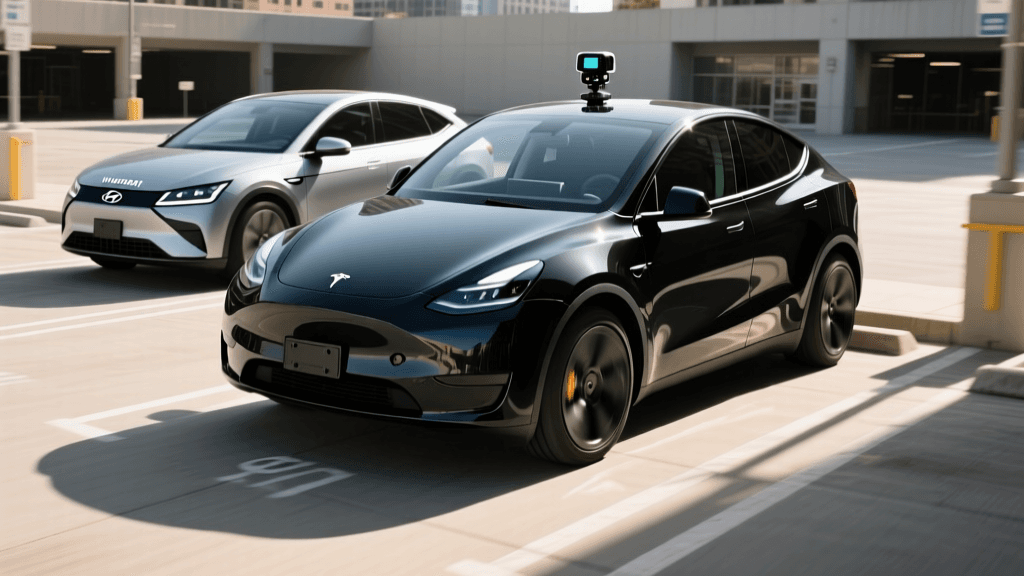
Automated parking has evolved from a luxury novelty into a core expectation for modern electric vehicles and smart cars. Early iterations of parking assist merely provided auditory warnings via basic proximity sensors. Today, Advanced Driver Assistance Systems (ADAS) can execute complex, multi-point turns, navigate tight parking structures, and even drive to the owner from across a lot. However, the underlying architectures achieving these feats vary wildly between automakers. In this technology deep dive, we compare two fundamentally different approaches to automated parking: Tesla's vision-based Smart Summon and the Hyundai Motor Group's Remote Smart Parking Assist (RSPA).
Sensor Modalities: Ultrasonic Time-of-Flight vs. Neural Vision
To understand how automated parking systems navigate tight spaces, we must first examine the sensors they rely upon. The industry has historically favored ultrasonic sensors for low-speed, close-proximity maneuvers. These sensors emit high-frequency sound waves (typically around 40 kHz) and measure the time-of-flight for the echo to return. Ultrasonics are highly effective at detecting solid, flat surfaces and are immune to lighting conditions, making them reliable in pitch-black garages or blinding sunlight.
However, ultrasonics have inherent physical limitations. They struggle with sound-absorbing materials, thin objects like chain-link fences, and angled surfaces that deflect sound waves away from the receiver. To compensate, modern systems fuse ultrasonics with surround-view cameras. Yet, a new paradigm has emerged: vision-only autonomy. By leveraging high-resolution cameras and advanced neural networks, some automakers are attempting to replicate human depth perception, mapping the environment in 3D voxel space without relying on acoustic echoes.
Tesla Smart Summon: The Vision-Only Paradigm
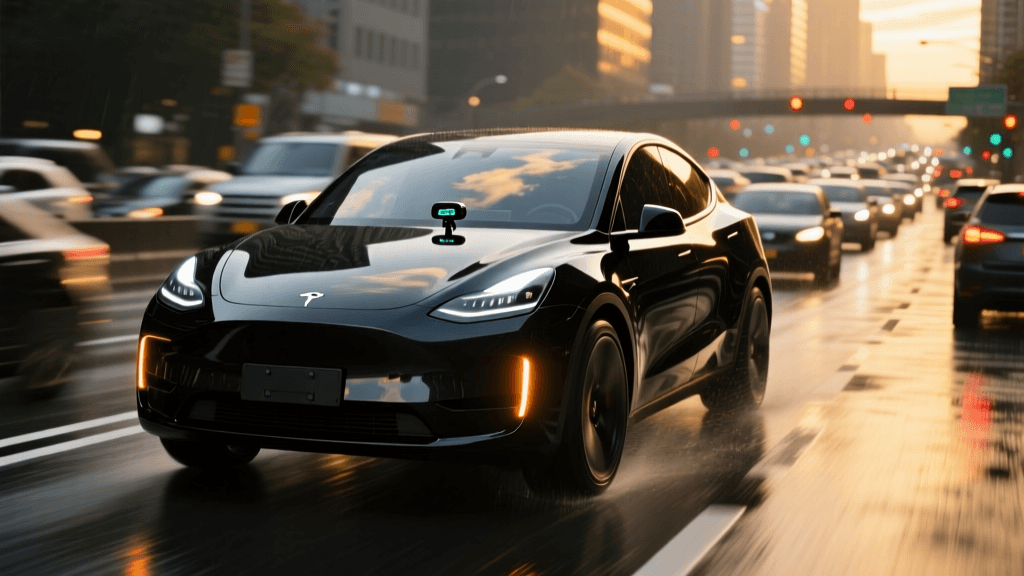
In late 2022, Tesla made the controversial decision to remove ultrasonic Park Assist Sensors (PSS) from its vehicles, transitioning entirely to 'Tesla Vision.' This meant that features like Smart Summon had to be rebuilt from the ground up using only the vehicle's eight-camera array. Initially, this resulted in degraded performance, longer latency, and conservative maneuvering.
However, the introduction of the 2024 'Actually Smart Summon' (ASS) update marked a massive technological leap. Instead of relying on traditional computer vision techniques that draw 2D bounding boxes around identified objects, Tesla now utilizes an end-to-end neural network paired with an occupancy network. The system processes raw video feeds to construct a real-time 3D volumetric map (voxel space) of the environment. It identifies 'drivable space' versus 'obstacles' without needing to explicitly classify every object. When a user initiates Smart Summon via the Tesla app, the vehicle uses GPS and Bluetooth tethering to locate the driver, plotting a path through complex parking lots while continuously updating its voxel map to avoid shopping carts, curbs, and pedestrians.
Hyundai RSPA: Ultrasonic Precision and Deterministic Control
Conversely, the Hyundai Motor Group (encompassing Hyundai, Kia, and Genesis) relies on a highly refined, sensor-fused approach for its Remote Smart Parking Assist (RSPA), prominently featured in EVs like the Ioniq 5 and Genesis GV60. RSPA utilizes a deterministic algorithmic approach rather than an end-to-end neural network.
The system relies on an array of 12 ultrasonic sensors positioned around the bumpers, fused with data from four high-definition surround-view cameras. When the driver steps out of the vehicle, they can hold the smart key fob or use the Bluelink smartphone app to command the car to park or unpark. The vehicle's ADAS computer calculates a geometric path based on the ultrasonic echoes, ensuring the car stays perfectly centered in the space. RSPA is capable of straight-line, perpendicular, and even diagonal parking maneuvers. Because the system relies on deterministic geometry and acoustic proximity, its movements are highly predictable, albeit generally slower and more conservative than a human driver.
Feature Comparison Matrix
| Feature | Tesla Smart Summon (Vision) | Hyundai RSPA (Sensor Fusion) |
|---|---|---|
| Primary Sensors | 8 Cameras (Vision Only) | 12 Ultrasonics + 4 Surround Cameras |
| Processing Architecture | End-to-End Neural Network / Occupancy Net | Deterministic Algorithmic Path Planning |
| Max Remote Distance | Approx. 150 ft (45 meters) | Approx. 13 ft (4 meters) via Fob |
| Obstacle Detection | 3D Voxel Space (Classifies drivable volume) | Time-of-Flight Acoustic Echoes |
| Weather Resilience | Moderate (Cameras affected by heavy fog/glare) | High (Ultrasonics unaffected by lighting/fog) |
| Control Interface | Smartphone App (GPS/BT Tether) | Smart Key Fob or Smartphone App |
Real-World Limitations and Edge Cases
Neither system is infallible, and understanding their edge cases is crucial for ADAS safety. Tesla's vision-based system excels in complex, unstructured environments like a crowded supermarket lot where it must navigate around islands and moving pedestrians. However, vision systems are inherently vulnerable to environmental lighting. Direct sun glare hitting a camera lens, heavy rain obscuring the glass, or pitch-black environments with poor ambient lighting can degrade the neural network's confidence, causing the vehicle to halt abruptly.
Hyundai's RSPA, on the other hand, thrives in structured environments like painted parking garages. The ultrasonic sensors are entirely unaffected by lighting conditions or heavy fog. However, RSPA struggles with unstructured edge cases. A low-hanging wooden beam, a steep concrete curb, or a thin metal pole might not reflect sound waves back to the sensor effectively, creating a blind spot. Furthermore, RSPA's reliance on the smart key fob limits its operational radius to a few meters, meaning the driver must stand dangerously close to the moving vehicle, whereas Tesla allows the user to summon the car from the exit of a store.
Regulatory and Safety Frameworks
When evaluating automated parking, it is vital to understand the regulatory boundaries. According to the SAE International J3016 standard, both Tesla Smart Summon and Hyundai RSPA are classified as Level 2 driving automation. This means the system can control steering, braking, and acceleration simultaneously, but the human driver remains fully responsible for supervising the maneuver and must be prepared to intervene instantly.
The National Highway Traffic Safety Administration (NHTSA) emphasizes that ADAS features are designed to assist, not replace, the driver. Automated parking systems operate in complex environments with unpredictable variables, such as children running between parked cars or shopping carts rolling down inclines. Furthermore, studies highlighted by the Insurance Institute for Highway Safety (IIHS) warn against driver complacency. Users who overly trust remote parking systems may fail to maintain visual line-of-sight, leading to low-speed collisions with property or other vehicles. Ultimately, the liability for any collision during an automated parking maneuver rests entirely on the vehicle owner, not the automaker.
Final Verdict: Which Architecture Wins?
The battle between Tesla's Smart Summon and Hyundai's RSPA represents a microcosm of the broader autonomous driving debate: probabilistic neural networks versus deterministic sensor fusion. Hyundai's RSPA offers a highly reliable, predictable, and safe solution for structured, everyday parking scenarios. Its fusion of ultrasonics and cameras provides a robust safety net that excels in tight garages and poor lighting.
However, Tesla's vision-based Smart Summon represents a more ambitious, scalable technology. By solving the 'summon' problem purely through cameras and AI, Tesla is gathering the exact real-world edge-case data required to train its broader Full Self-Driving (FSD) models. For the consumer, Hyundai RSPA currently offers a more consistent and less stressful experience for simple remote parking. But for technology enthusiasts, Tesla's end-to-end neural approach showcases the staggering potential of vision-based AI, pointing toward a future where vehicles navigate complex spaces with human-like intuition.