The Critical Need for Night Vision and Pedestrian Detection
When the sun goes down, the risk of a fatal traffic incident increases exponentially. According to the Insurance Institute for Highway Safety (IIHS), the vast majority of pedestrian fatalities occur in dark or unlit conditions. While standard Automatic Emergency Braking (AEB) systems have improved drastically over the last decade, traditional optical cameras and radar sensors often struggle with low contrast, deep shadows, and the blinding glare of oncoming headlights. This is where dedicated night vision systems step in, acting as a digital second pair of eyes that can see far beyond the reach of your high beams.
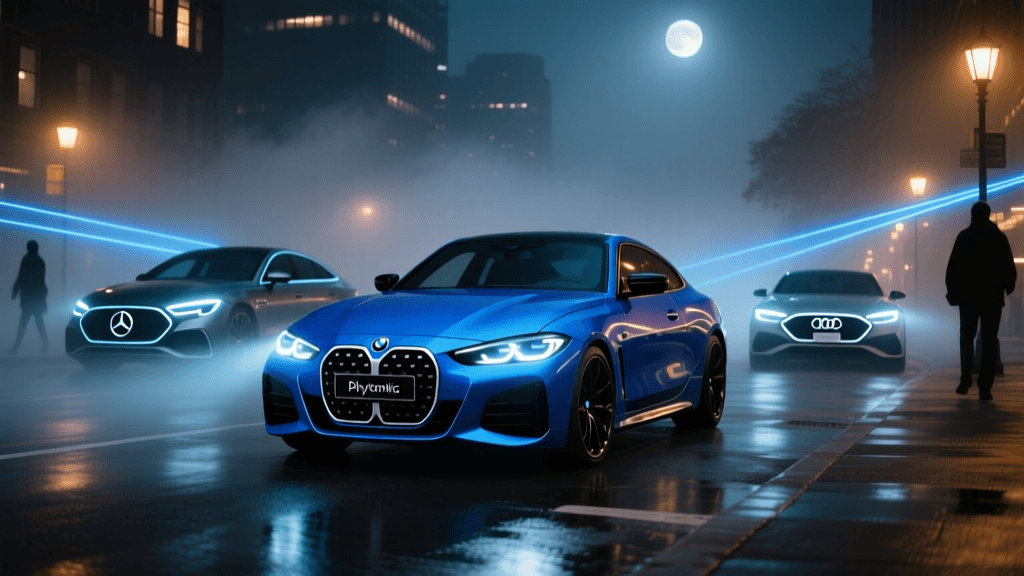
In the luxury automotive segment, three German titans dominate the night vision landscape: BMW, Mercedes-Benz, and Audi. Each brand takes a distinct engineering approach to illuminating the dark and detecting vulnerable road users. In this head-to-head showdown, we break down how each system works, their real-world limitations, and which one offers the best return on investment for your daily commute.
Understanding the Tech: Far Infrared (FIR) vs. Near Infrared (NIR)
Before diving into the brand-specific implementations, it is crucial to understand the two primary types of infrared technology used in automotive ADAS:
- Far Infrared (FIR) / Thermal Imaging: This passive system detects the heat signatures emitted by living beings and objects. It does not require any ambient light and is completely unaffected by the glare of oncoming headlights. It excels at long-range detection but produces a lower-resolution, grayscale image.
- Near Infrared (NIR) / Active Illumination: This active system uses invisible infrared emitters (usually mounted in the grille or headlights) to bathe the road in IR light. An IR-sensitive camera then captures the reflected light, producing a high-resolution, crisp image that looks similar to a black-and-white photograph. However, its range is limited by the power of the emitters.
Contender 1: BMW Night Vision with Dynamic Light Spot
BMW utilizes a Far Infrared (thermal) camera mounted in the lower front grille. The system feeds a thermal image to the central iDrive display, but its true strength lies in its software-driven pedestrian detection. When the system identifies a human or large animal, it draws a yellow bounding box around the heat signature.
If the pedestrian steps toward the roadway, the warning escalates to a flashing red box, accompanied by an audible chime. More importantly, BMW integrates this with its headlights via the Dynamic Light Spot. A targeted, high-intensity beam of light is automatically directed at the pedestrian, illuminating them for the driver without blinding oncoming traffic. The detection range is impressive, spotting heat signatures up to 300 meters ahead—well beyond the reach of standard LED high beams.
Contender 2: Mercedes-Benz Night View Assist Plus
Mercedes-Benz takes a different route, employing a Near Infrared (active) system. Invisible IR emitters project light down the road, and a specialized camera captures the reflection. The result is a remarkably clear, high-contrast grayscale image displayed on the digital instrument cluster directly in the driver's line of sight.
The Night View Assist Plus software highlights detected pedestrians in red. If a collision risk is calculated, the system can use the multi-beam LED headlights to flash the pedestrian with a targeted spotlight, warning them of the approaching vehicle. Because it relies on reflected light rather than heat, the Mercedes system provides superior image clarity and better contextual awareness of the road environment (like reading faded road signs), but its effective range maxes out around 160 meters.
Contender 3: Audi Night Vision Assistant
Audi aligns with BMW by using a Far Infrared (thermal) camera. The thermal feed is seamlessly integrated into the Audi Virtual Cockpit, placing the image directly behind the steering wheel so the driver does not have to look away at a center screen. Pedestrians are highlighted in yellow, shifting to red if they enter the vehicle's projected path.
Audi's standout feature is its deep integration with the Matrix LED headlights. Instead of just flashing a warning light, the Matrix LEDs can precisely dim specific diodes to avoid blinding oncoming drivers while simultaneously keeping the pedestrian fully illuminated. Furthermore, if the system detects a pedestrian in a critical zone, it will emit a short, targeted flash of light directly at the person to grab their attention, a highly effective real-world intervention.
Head-to-Head Comparison Chart
| Feature | BMW Night Vision | Mercedes Night View Assist Plus | Audi Night Vision Assistant |
|---|---|---|---|
| Sensor Type | Far Infrared (Thermal) | Near Infrared (Active) | Far Infrared (Thermal) |
| Max Detection Range | Up to 300 meters | Up to 160 meters | Up to 300 meters |
| Pedestrian Highlighting | Yellow Box / Flashing Red | Red Box / Spotlight Flash | Yellow to Red Box |
| Headlight Integration | Dynamic Light Spot | Multi-Beam LED Flash | Matrix LED Precision Flash |
| Display Location | Center iDrive Screen | Digital Instrument Cluster | Virtual Cockpit (Behind Wheel) |
| Estimated Option Cost | ~$2,500 (Bundled in Executive Pkg) | ~$2,050 (Standalone Option) | ~$2,500 (Bundled in Prestige) |
Real-World Buying Advice: Is It Worth the Premium?
When configuring your luxury vehicle, night vision is rarely a cheap standalone option. It is frequently bundled into $2,500 to $4,000 premium packages. Here is how to decide if it is worth your money based on your driving profile:
- For Rural and Suburban Drivers (Choose BMW or Audi): If you frequently drive on unlit country roads, the Far Infrared systems from BMW and Audi are vastly superior. Thermal cameras do not just detect pedestrians; they easily pick up deer, moose, and stray dogs long before your headlights reach them. The 300-meter range gives you critical extra seconds to brake.
- For Urban and City Drivers (Choose Mercedes): In well-lit city environments, thermal cameras can sometimes be overwhelmed by ambient heat from manhole covers, parked cars, and HVAC units. The Near Infrared system from Mercedes provides a cleaner, more readable image of complex urban landscapes, making it easier to spot pedestrians stepping out from between parked cars.
- The AEB Caveat: Remember that night vision is primarily an information and warning system. While it can trigger the standard AEB to brake, the thermal/NIR cameras themselves are not the primary sensors for emergency stopping. Always ensure your vehicle is equipped with the latest radar and optical camera suites for actual collision mitigation.
System Limitations and Maintenance
Despite their advanced engineering, these systems are not infallible. The National Highway Traffic Safety Administration (NHTSA) consistently reminds drivers that ADAS features are meant to assist, not replace, an attentive driver. You must understand the physical limitations of the hardware:
- Weather Interference: Heavy rain, dense fog, and snow can block infrared radiation. While FIR (thermal) can cut through light fog better than optical cameras, a thick layer of slush or mud on the front grille sensor will completely blind the system. Always keep your front grille and windshield sensor clusters clean.
- Thermal Blinding: FIR cameras can be temporarily blinded by intense heat sources, such as driving directly into the setting sun or following a vehicle with excessively hot exhaust components.
- Speed Dependencies: Many pedestrian spotlighting and flashing features are disabled at low city speeds (typically under 30 mph) to avoid distracting or blinding pedestrians in crowded crosswalks.
The Verdict
For pure, long-range life-saving detection on dark highways, the Far Infrared systems from BMW and Audi take the crown. The ability to see a human's heat signature 300 meters away, combined with targeted Matrix/Dynamic headlight flashing, offers an unparalleled safety net. However, for drivers who prioritize a high-definition, easy-to-read display that integrates seamlessly into the instrument cluster, the Mercedes-Benz Night View Assist Plus remains a brilliantly engineered, albeit shorter-range, alternative.