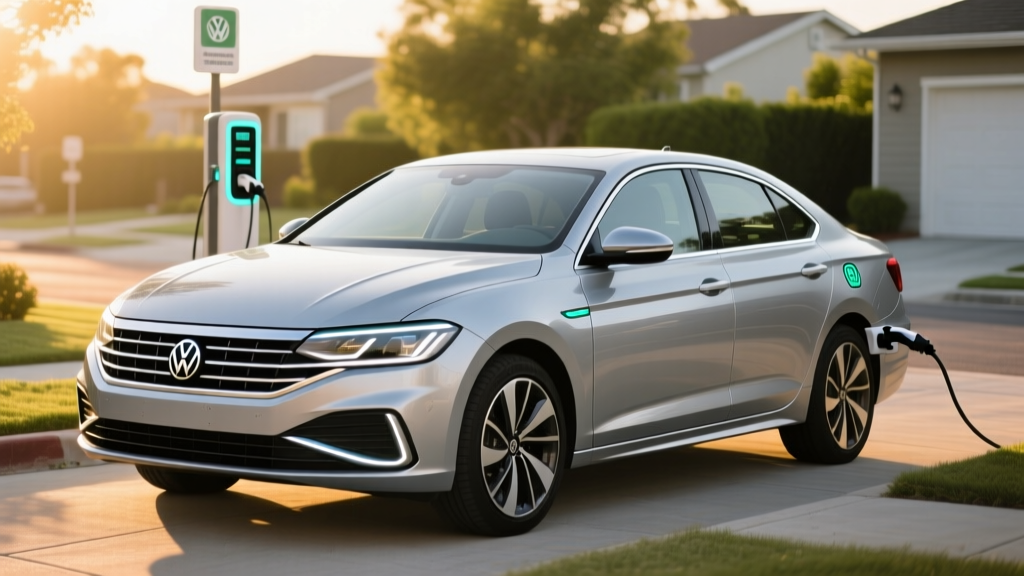
The Volkswagen Jetta Hybrid occupies a narrow but compelling space in the compact sedan segment: it pairs a turbocharged gasoline engine with an electric motor and a small battery pack to deliver hybrid-level fuel economy without requiring a plug. For 2026, the Jetta Hybrid returns as a conventional hybrid (HEV), not a plug-in hybrid (PHEV), meaning it charges its battery entirely through regenerative braking and the engine — no outlet needed.
This guide breaks down the 2026 VW Jetta Hybrid's EPA fuel economy ratings, powertrain specifications, real-world efficiency expectations, battery longevity, pricing, and tax credit eligibility to help you decide whether it fits your driving needs better than a full EV, a PHEV, or a standard gas-only compact sedan.
HEV vs PHEV: Where the Jetta Hybrid Fits
Before examining the specs, it is essential to distinguish what the Jetta Hybrid is — and what it is not. Volkswagen currently sells the Jetta Hybrid as a conventional hybrid electric vehicle (HEV). It has no charging port and no electric-only driving mode of meaningful distance. The battery recharges via regenerative braking and the gasoline engine.
| Feature | HEV (Jetta Hybrid) | PHEV (e.g., Toyota Prius Prime) | BEV (e.g., Tesla Model 3) |
|---|---|---|---|
| Plug-in charging | No | Yes | Yes |
| Electric-only range | ~1 mi (low-speed assist) | 25–44 mi typical | 250–360 mi typical |
| Battery size | ~1.1 kWh | 10–14 kWh | 50–82 kWh |
| Fuel required | Gasoline | Gasoline + electricity | Electricity only |
| Federal tax credit (§30D) | Not eligible | Up to $7,500 (if eligible) | Up to $7,500 (if eligible) |
| Home charging install needed | No | Recommended (Level 2) | Recommended (Level 2) |
The Jetta Hybrid's value proposition is simplicity: you get meaningfully better fuel economy than the gas-only Jetta (which rates around 31 MPG combined) without changing your fueling habits. If you want electric-only commuting, a PHEV like the Toyota Prius Prime or a full BEV is the correct choice.
EPA Fuel Economy and Real-World MPG
The 2026 VW Jetta Hybrid carries an EPA-estimated 45 MPG combined, with a breakdown of approximately 47 MPG city and 43 MPG highway, according to fueleconomy.gov. These figures place it competitively against the Honda Insight (discontinued after 2022 but rated at 52 MPG combined) and the Toyota Prius (up to 57 MPG combined for the LE trim), though the Jetta Hybrid prioritizes driving refinement over maximum efficiency.
| Metric | Rating |
|---|---|
| City MPG | 47 MPG |
| Highway MPG | 43 MPG |
| Combined MPG | 45 MPG |
| Fuel tank capacity | ~13.2 gallons |
| Estimated total range | ~594 miles |
Real-World MPG vs. EPA Estimates
Hybrid vehicles frequently exceed their EPA city ratings in stop-and-go traffic because regenerative braking recovers kinetic energy that a gas-only car wastes as heat. In real-world city driving with frequent stops, expect the Jetta Hybrid to achieve 46–50 MPG. On sustained highway trips at 70–75 mph, efficiency drops as the electric motor contributes less and aerodynamic drag dominates — expect 39–42 MPG on the interstate.
Cold weather reduces hybrid efficiency by roughly 10–15% due to increased engine idling for cabin heat and reduced battery performance at low temperatures. In winter conditions below 30°F, plan for 38–42 MPG combined rather than the 45 MPG sticker figure.
Powertrain: Turbo Engine Meets Electric Motor
The 2026 Jetta Hybrid pairs a 1.5-liter turbocharged inline-four gasoline engine with an integrated electric motor, driving the front wheels through a 6-speed dual-clutch automatic transmission (DSG). Combined system output is approximately 170 horsepower and 184 lb-ft of torque.
| Specification | Value |
|---|---|
| Engine | 1.5L turbocharged I-4 |
| Electric motor | Integrated AC motor (~27 hp / 20 kW) |
| Combined horsepower | ~170 hp |
| Combined torque | ~184 lb-ft |
| Transmission | 6-speed DSG dual-clutch automatic |
| Drivetrain | Front-wheel drive |
| Hybrid battery capacity | ~1.1 kWh (lithium-ion) |
| 0–60 mph (estimated) | ~7.8 seconds |
The electric motor fills in torque at low RPMs before the turbo spools, reducing the lag typical of small-displacement turbocharged engines. The result is responsive acceleration from stops and smooth merging, though the DSG transmission can occasionally hesitate during low-speed maneuvers — a characteristic of dual-clutch designs rather than a hybrid-specific issue.
Battery Warranty, Lifespan, and Replacement Cost
Hybrid Battery Warranty
Volkswagen covers the Jetta Hybrid's battery pack under a 8-year / 100,000-mile warranty (extended to 10 years / 150,000 miles in California Air Resources Board states, including CA, CO, CT, MA, MD, ME, MN, NJ, NY, OR, RI, VT, and WA). This warranty covers defects and capacity loss below a specified threshold, typically 60–70% of original capacity.
How Long Will the Hybrid Battery Last?
Conventional hybrid batteries like the Jetta's ~1.1 kWh pack undergo relatively shallow charge-discharge cycles compared to full EVs. The battery management system (BMS) keeps the state of charge (SoC) within a narrow window — typically 40–80% — which dramatically reduces degradation. Based on industry data from Toyota, Honda, and Hyundai hybrid fleets, lithium-ion HEV batteries routinely last 150,000–200,000+ miles before meaningful capacity loss, often outlasting the vehicle itself.
Battery Replacement Cost
If the hybrid battery does fail outside warranty, replacement costs for compact HEV battery packs currently range from $2,000 to $4,000 including parts and labor. This is significantly less than EV battery replacement ($8,000–$20,000+) because the HEV pack is small. Third-party refurbishers and aftermarket options are increasingly available, potentially reducing cost further.
Pricing, Trims, and Tax Credit Eligibility
The 2026 VW Jetta Hybrid is offered in SE and SEL trims. Pricing starts at approximately $29,995 MSRP for the SE trim (including destination charge), with the SEL trim starting around $33,495 MSRP. These prices reflect the hybrid premium over the gas-only Jetta, which starts around $23,000.
Federal Tax Credit: Not Eligible
Under current IRS §30D rules, the federal clean vehicle credit applies only to plug-in electric vehicles (PHEVs and BEVs) with battery capacities of at least 7 kWh. The Jetta Hybrid's ~1.1 kWh battery and lack of a charging port make it ineligible for the federal EV tax credit. This is a critical distinction: conventional hybrids do not qualify for the up-to-$7,500 credit, regardless of manufacturer or price.
Some states offer separate incentives for hybrid vehicles, though these are less common and typically smaller than EV incentives. Check your state's energy or environmental agency for current programs.
Who Should Choose the Jetta Hybrid?
Pros
- 45 MPG combined without changing fueling habits — no plug, no app, no range planning
- ~594 miles of total range per tank eliminates refueling stops on long trips
- Turbo hybrid powertrain delivers responsive acceleration (170 hp) with efficiency
- Lower purchase price than comparable PHEVs or BEVs
- No home charging installation required — ideal for apartment dwellers and street parkers
- VW's 4-year/50,000-mile basic warranty plus 8-year hybrid battery coverage
Cons
- No electric-only driving mode — not eligible for HOV lane access in most states
- No federal tax credit (saves fuel but no $7,500 purchase incentive)
- Lower combined MPG than Toyota Prius (57 MPG) or Hyundai Ioniq Hybrid (up to 58 MPG)
- DSG transmission can hesitate at very low speeds
- Hybrid premium over gas Jetta adds ~$7,000 to base price (recouped over ~5–7 years of driving)
Decision Framework: Is the Jetta Hybrid Right for You?
Choose the VW Jetta Hybrid if: You want better fuel economy without plugging in, you lack home charging access, you take frequent road trips where EV charging infrastructure is sparse, and you prefer a European driving feel with a turbo engine.
Choose a PHEV (Prius Prime, Hyundai Tucson PHEV) if: You have home charging and want 25–44 miles of electric-only commuting, you qualify for the $7,500 federal credit, and you want HOV lane access.
Choose a full EV (Tesla Model 3, Hyundai Ioniq 6) if: You have reliable home charging, your daily commute is under 250 miles, you want zero tailpipe emissions, and you want to eliminate gasoline entirely.
Stick with the gas Jetta if: You drive fewer than 8,000 miles per year (the hybrid premium won't pay back), or you want the lowest possible purchase price.
Ownership Costs: Fuel Savings vs. Hybrid Premium
At the current national average gasoline price of approximately $3.30 per gallon and 12,000 miles driven annually, the Jetta Hybrid (45 MPG) uses about 267 gallons per year, costing roughly $880 annually. The gas-only Jetta (31 MPG combined) uses about 387 gallons, costing roughly $1,277 annually. The hybrid saves approximately $397 per year in fuel.
Over a 5-year ownership period, that totals about $1,985 in fuel savings. Against the ~$7,000 hybrid purchase premium, the Jetta Hybrid does not break even on fuel savings alone within a typical ownership cycle. The hybrid makes financial sense primarily if you plan to keep the vehicle 8+ years, drive significantly more than 12,000 miles annually, or value the reduced refueling frequency and environmental benefit.
Frequently Asked Questions
How many MPG does the 2026 VW Jetta Hybrid get?
The EPA rates the 2026 Jetta Hybrid at 47 MPG city, 43 MPG highway, and 45 MPG combined. In real-world city driving with frequent stops, expect 46–50 MPG. Highway driving at 70+ mph typically yields 39–42 MPG. Cold weather reduces combined efficiency to roughly 38–42 MPG.
Can the VW Jetta Hybrid drive on electric power only?
Only marginally. As a conventional HEV, the Jetta Hybrid can creep at very low speeds (under 25 mph) on electric power for roughly one mile or less, but it has no meaningful electric-only range. It is designed to assist the gasoline engine, not replace it. For electric-only commuting, you need a PHEV or BEV.
Does the VW Jetta Hybrid qualify for any tax credit?
No. Under IRS §30D rules, the federal clean vehicle credit requires a plug-in vehicle with at least 7 kWh of battery capacity. The Jetta Hybrid is a conventional HEV with a ~1.1 kWh battery and no charging port, making it ineligible. Some states may offer minor hybrid incentives — check your state energy office.
Is the Jetta Hybrid reliable, and what does battery replacement cost?
Volkswagen's hybrid system is less proven at scale than Toyota's (which has decades of Prius data), but the Jetta Hybrid's simple parallel-hybrid architecture and small battery pack carry lower risk than a full EV powertrain. The battery is warrantied for 8 years/100,000 miles (10 years/150,000 in CARB states). Out-of-warranty battery replacement runs $2,000–$4,000. Based on HEV industry data, the battery should last 150,000+ miles under normal use.
Hybrid vs PHEV vs EV — which should I buy?
A conventional hybrid like the Jetta Hybrid suits drivers who want better MPG without changing habits or needing a charger. A PHEV suits drivers with home charging who want electric-only commuting plus gas-engine range for road trips and may qualify for the $7,500 federal credit. A full EV suits drivers with reliable charging who want zero gasoline use, lower per-mile energy costs, and minimal maintenance. Your charging access, daily mileage, and budget determine the right choice.
How does the Jetta Hybrid compare to the Toyota Prius?
The Toyota Prius (up to 57 MPG combined, starting around $28,500) delivers higher fuel economy at a similar price point. The Jetta Hybrid trades roughly 12 MPG of efficiency for a turbocharged powertrain with more passing power, a more premium interior, and VW's driving dynamics. If maximum MPG is your priority, the Prius wins. If you want a hybrid that drives like a conventional European sedan, the Jetta Hybrid fills that niche.