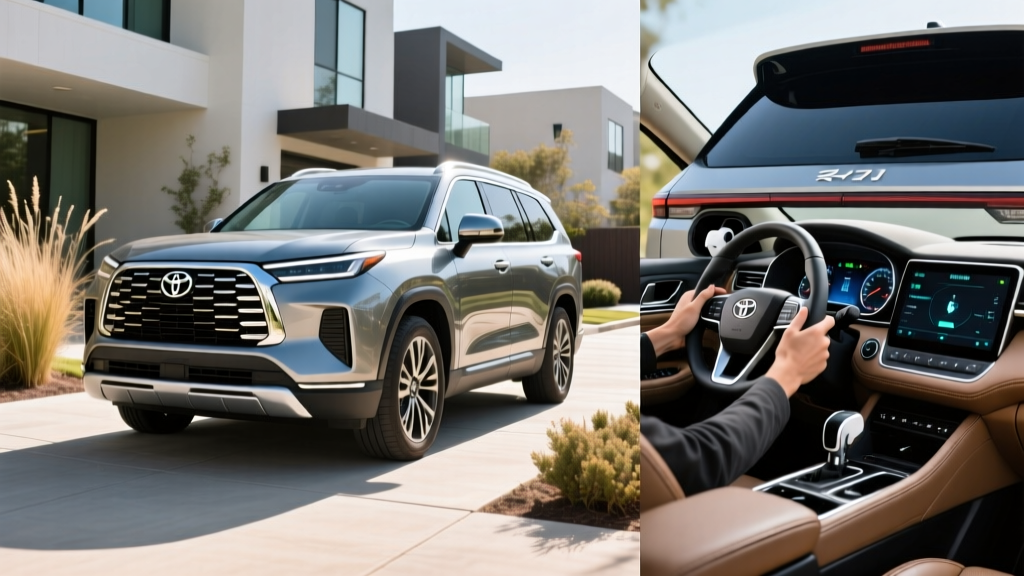
The 2026 Grand Highlander Limited Hybrid occupies a specific niche: a three-row family hauler that sips fuel without requiring a charging cable, a bigger battery, or any change in driving habits. For buyers who want the cargo space and passenger comfort of a large SUV but can't install a Level 2 home charger—or simply don't want to think about plugging in—Toyota's conventional hybrid system in the Grand Highlander remains one of the most practical electrified options on the market.
This review focuses on the Limited trim, the mid-tier luxury option that adds features like SofTex-trimmed seats, a 12.3-inch infotainment display, and Toyota Safety Sense 3.0 over the base XLE. We'll break down the exact EPA figures, real-world fuel economy expectations, powertrain specs, and total ownership costs so you can decide whether this HEV is the right fit—or whether a PHEV or full EV serves your family better.
2026 Grand Highlander Limited Hybrid: Core Specs at a Glance
| Specification | 2026 Grand Highlander Hybrid Limited (AWD) |
|---|---|
| Powertrain Type | Conventional Hybrid (HEV) — no plug-in required |
| Engine | 2.5L 4-cylinder + 3 electric motors (AWD-i) |
| Combined Horsepower | 245 hp (net system) |
| EPA MPG (City / Hwy / Combined) | 36 / 32 / 35 MPG |
| Fuel Tank Capacity | 17.1 gallons |
| Total Driving Range | ~598 miles |
| 0–60 mph | ~7.8 seconds |
| Towing Capacity | 3,500 lbs |
| Seating | 7 or 8 passengers |
| Cargo Volume (behind 3rd / 2nd / 1st row) | 20.6 / 57.9 / 97.5 cu ft |
| Starting MSRP (Limited AWD Hybrid) | ~$51,290 |
| Hybrid Battery Warranty | 10 years / 150,000 miles |
Fuel Economy: EPA Numbers vs. Real-World MPG
The 2026 Grand Highlander Hybrid AWD carries EPA ratings of 36 MPG city, 32 MPG highway, and 35 MPG combined, according to fueleconomy.gov. These are strong numbers for a 4,600-pound, three-row SUV. For comparison, the non-hybrid Grand Highlander turbo 4-cylinder returns roughly 24 MPG combined—a 31% penalty at the pump.
| Driving Scenario | Expected MPG | Notes |
|---|---|---|
| EPA City | 36 MPG | Hybrid system excels in stop-and-go traffic |
| EPA Highway | 32 MPG | Less electric assist at sustained high speeds |
| EPA Combined | 35 MPG | Weighted 55% city / 45% highway |
| Real-World City (owner-reported) | 35–38 MPG | Many owners match or slightly exceed EPA in city driving |
| Real-World Highway (75 mph, flat) | 29–32 MPG | Aerodynamic drag reduces hybrid advantage at speed |
| Cold Weather (below 30°F, mixed) | 30–33 MPG | Engine runs more often for cabin heat; battery less efficient |
| Loaded / Towing (near GVWR) | 25–28 MPG | Heavy loads reduce electric-motor contribution ratio |
Real-world honesty: Toyota's hybrid system is one of the few powertrains where city driving often yields better fuel economy than the EPA sticker suggests. The electric motors handle low-speed acceleration, and regenerative braking recovers energy in traffic. Highway driving is where the Grand Highlander Hybrid gives back some efficiency—pushing a large SUV through air at 75 mph demands sustained engine output that the electric motors can't fully offset. Expect 29–32 MPG on long interstate trips, dropping further in cold weather or when towing near the 3,500-pound limit.
Powertrain Deep Dive: How the Hybrid System Works
The Grand Highlander Hybrid uses Toyota's fourth-generation hybrid system paired with a 2.5-liter inline-4 Atkinson-cycle engine. The front axle is driven by two motor-generators (MG1 for starting and generating electricity, MG2 for propulsion), while a dedicated rear electric motor (MGR) powers the rear wheels for the AWD-i system. There is no mechanical driveshaft connecting the front and rear axles—the rear motor engages electronically as needed for traction.
The combined system output is 245 net horsepower. That's adequate for family duties—merging, passing, and climbing grades are handled without drama—but it's not a performance-oriented powertrain. The 0–60 mph time of roughly 7.8 seconds trails the turbocharged Hybrid MAX variant (362 hp, ~6.0 seconds), but the standard Hybrid delivers far better fuel economy and a lower starting price.
The hybrid battery pack is a compact lithium-ion unit mounted under the rear seats. Unlike a PHEV, it is small (approximately 1.6 kWh usable) and charges exclusively through regenerative braking and the gasoline engine. You never plug it in. The system continuously manages the state of charge, typically keeping the battery between 40% and 80% SoC to maximize longevity. The engine shuts off at stops and during low-load cruising, which is where the city MPG gains come from.
HEV vs. PHEV: What's the Difference Here?
The Grand Highlander is offered as a conventional hybrid (HEV) in its standard and Hybrid MAX forms. Toyota does not currently offer a plug-in hybrid (PHEV) version of the Grand Highlander. This matters because:
- HEV (this vehicle): No plug. No electric-only range to manage. The gas engine and electric motors work together seamlessly. You just drive and refuel normally.
- PHEV (not available for Grand Highlander): Would offer 30–40 miles of electric-only range, a larger battery (15–20 kWh), and require home or public charging to realize full efficiency benefits. Vehicles like the Toyota RAV4 Prime follow this model.
- BEV (full electric): Zero gasoline use, 250–350+ miles of range, requires reliable home or public charging access. Examples include the Kia EV9 or Tesla Model X in this size class.
Pricing, Trims, and Tax Credit Eligibility
The 2026 Grand Highlander Hybrid is available in XLE and Limited trims (the Hybrid MAX powertrain is offered on Limited and Platinum). Here's the pricing landscape:
| Trim | Drivetrain | MSRP (est.) |
|---|---|---|
| XLE Hybrid | AWD | ~$46,890 |
| Limited Hybrid | AWD | ~$51,290 |
| Limited Hybrid MAX | AWD | ~$55,170 |
| Platinum Hybrid MAX | AWD | ~$59,490 |
The Limited Hybrid adds meaningful content over the XLE: a panoramic moonroof, heated and ventilated front seats, heated second-row seats, a 12.3-inch digital gauge cluster, and a hands-free power liftgate. Whether the ~$4,400 premium over the XLE is worth it depends on your comfort priorities and expected ownership duration.
Federal Tax Credit: Does the Grand Highlander Hybrid Qualify?
No. The 2026 Grand Highlander Hybrid does not qualify for the federal §30D clean vehicle tax credit (up to $7,500). Under current IRS rules, the §30D credit applies only to plug-in electric vehicles (BEVs and PHEVs) that meet battery capacity, critical mineral sourcing, and battery component requirements. A conventional hybrid (HEV) like the Grand Highlander Hybrid is classified as a clean-fuel vehicle but does not meet the plug-in threshold.
What about state incentives? Some states offer rebates or HOV lane access for hybrids, but these vary widely and change frequently. Check your state's energy office or AFDC state incentive database for current programs. A few states offer modest hybrid rebates ($500–$1,500), but most incentive funding has shifted toward PHEVs and BEVs.
Battery Warranty, Lifespan, and Replacement Costs
Hybrid battery longevity is one of the most common concerns for HEV buyers—and it's one area where Toyota has built a strong track record over two decades of Prius and Highlander Hybrid production.
Toyota Hybrid Battery Warranty
- Coverage: 10 years or 150,000 miles (whichever comes first)
- What's covered: Hybrid battery pack, hybrid control module, and related components
- Capacity threshold: Toyota warrants the battery against defects and abnormal capacity loss; unlike BEVs, there is no published minimum SoH percentage for HEVs since the battery is small and continuously managed
- Transferability: Warranty transfers to subsequent owners
In practice, Toyota hybrid batteries routinely last well beyond the warranty period. Fleet data and owner reports from the Highlander Hybrid and Prius lines show many original batteries reaching 180,000–250,000 miles before any degradation-related replacement is needed. The Grand Highlander's system keeps the battery in a narrow, healthy state-of-charge window (roughly 40–80%), which minimizes calendar and cycle degradation.
If a replacement is eventually needed out of warranty, a new OEM hybrid battery for the Grand Highlander is expected to cost in the range of $3,000–$4,500 installed. Refurbished or reconditioned units may be available for $1,500–$2,500 through independent hybrid specialists. This is a fraction of what a full BEV battery replacement would cost, largely because the HEV battery is much smaller (~1.6 kWh vs. 75–100 kWh in a BEV).
Reliability and Safety Record
Toyota's hybrid powertrain is among the most proven in the automotive industry. The 2.5L Atkinson-cycle engine and e-CVT transmission have no traditional friction brakes on the transmission (no torque converter, no clutch packs), which reduces mechanical wear points. Regenerative braking also extends the life of the physical brake pads—many hybrid owners report original brake pads lasting 80,000–100,000 miles.
The Grand Highlander earned strong safety marks. Check the latest ratings from the National Highway Traffic Safety Administration (NHTSA) and the Insurance Institute for Highway Safety (IIHS) for the most current crash-test results. Toyota Safety Sense 3.0 comes standard and includes:
- Pre-Collision System with Pedestrian Detection
- Lane Departure Alert with Steering Assist
- Full-Speed Range Dynamic Radar Cruise Control
- Lane Tracing Assist
- Road Sign Assist
- Proactive Driving Assist (gentle braking/steering support)
Important note: These are SAE Level 2 driver-assistance features. The driver must remain fully engaged, hands on the wheel, eyes on the road. This is not autonomous or "self-driving" capability.
Grand Highlander Hybrid vs. PHEV vs. Full EV: Which Is Right for You?
Choose the Grand Highlander Hybrid (HEV) if:
- You don't have access to home or workplace charging (apartment, street parking, no garage outlet)
- You frequently take long road trips (500+ miles) and don't want to plan charging stops
- You want three rows and strong cargo space without the $60,000+ price of a large BEV SUV
- You want lower fuel costs without changing any driving or fueling habits
- You plan to tow occasionally (3,500-lb capacity)
Choose a PHEV (like the Toyota RAV4 Prime or Hyundai Tucson PHEV) if:
- You can install a Level 2 charger at home and have a short commute (under 40 miles round-trip)
- You want some electric-only driving for daily errands but gas flexibility for road trips
- You qualify for the §30D federal tax credit (varies by model and sourcing requirements)
- You're willing to accept smaller cargo space (most PHEVs in this price range are two-row)
Choose a Full EV (like the Kia EV9 or Rivian R1S) if:
- You have reliable home Level 2 charging and your daily driving is under 250 miles
- You want zero tailpipe emissions and the lowest per-mile "fuel" cost
- You're comfortable planning DC fast-charging stops on road trips (20–30 minutes per stop)
- Your budget accommodates $55,000–$75,000+ for a three-row electric SUV
5-Year Ownership Cost Snapshot
| Cost Category | Grand Highlander Hybrid Limited (5 yr / 75,000 mi) | Comparable Gas-Only 3-Row SUV (5 yr / 75,000 mi) |
|---|---|---|
| Purchase Price (MSRP) | ~$51,290 | ~$46,000 |
| Fuel Cost (75,000 mi at $3.40/gal) | ~$7,286 (35 MPG combined) | ~$10,625 (24 MPG combined) |
| Maintenance (est.) | ~$2,800 | ~$3,600 |
| Insurance (est. avg.) | ~$8,500 | ~$7,800 |
| Depreciation (est.) | ~$22,000 | ~$21,000 |
| Estimated 5-Year Total | ~$91,876 | ~$89,025 |
The hybrid's fuel savings (~$3,339 over five years) nearly offset its higher purchase price and slightly elevated insurance premiums. Toyota hybrids also tend to hold strong resale value, which can narrow the depreciation gap further. The net result: total ownership costs are competitive with a gas-only rival, with the added benefit of lower emissions and fewer fuel stops.
Pros and Cons
Pros
- 35 MPG combined in a 4,600-lb three-row SUV is exceptional
- No plug-in required—zero change to fueling habits
- Strong cargo volume (97.5 cu ft max) and 7/8-passenger seating
- 10-year / 150,000-mile hybrid battery warranty
- Proven Toyota hybrid reliability with minimal maintenance needs
- AWD-i standard for all-weather traction without a fuel economy penalty
- Toyota Safety Sense 3.0 standard across all trims
Cons
- No PHEV variant available—can't access electric-only commuting or §30D tax credit
- 245 hp is adequate but not quick for a vehicle this size (7.8s to 60)
- Highway MPG drops to ~29–32 in real-world driving at 75 mph
- 3,500-lb towing limit may not satisfy boat or large trailer owners
- Third-row space accommodates children comfortably but is tight for adults on long trips
Frequently Asked Questions
How many MPG does the 2026 Grand Highlander Hybrid get?
The EPA rates the Grand Highlander Hybrid AWD at 36 MPG city, 32 MPG highway, and 35 MPG combined. Real-world city driving often matches or slightly exceeds the EPA figure thanks to the hybrid system's electric-motor assist at low speeds. Highway driving typically yields 29–32 MPG depending on speed, terrain, and weather conditions.
Does the Grand Highlander Hybrid need to be plugged in?
No. This is a conventional hybrid (HEV), not a plug-in hybrid (PHEV). The small lithium-ion battery charges entirely through regenerative braking and the gasoline engine. You fuel it like any other vehicle—just fill up at a gas station.
How far can the Grand Highlander Hybrid go on electric only?
The standard Grand Highlander Hybrid does not have a meaningful electric-only driving range. The electric motors assist the gasoline engine and can propel the vehicle at very low speeds for brief distances (typically under 1 mile at parking-lot speeds), but it is not designed for electric-only commuting. If you want 30+ miles of electric-only range, you would need a PHEV like the RAV4 Prime.
Is the Grand Highlander Hybrid reliable?
Toyota's hybrid powertrain has one of the strongest long-term reliability records in the industry. The e-CVT transmission has fewer moving parts than a conventional automatic, regenerative braking extends brake pad life, and the hybrid battery is managed conservatively to maximize lifespan. The 10-year / 150,000-mile hybrid battery warranty provides additional peace of mind.
What does a hybrid battery replacement cost?
If the hybrid battery fails outside the 10-year/150,000-mile warranty, expect to pay approximately $3,000–$4,500 for a new OEM replacement installed at a dealership. Refurbished units may be available for $1,500–$2,500. Many Toyota hybrid batteries last 180,000–250,000 miles before replacement is needed.
Does the 2026 Grand Highlander Hybrid qualify for a federal tax credit?
No. The federal §30D clean vehicle credit applies only to plug-in electric vehicles (BEVs and PHEVs) that meet specific battery sourcing and capacity requirements. The Grand Highlander Hybrid is a conventional HEV and does not qualify. Check your state's incentive programs for any hybrid-specific rebates that may apply.
Hybrid vs. PHEV vs. EV—which should I buy?
Choose the hybrid (HEV) if you lack home charging access, take frequent long trips, and want fuel savings with zero behavior change. Choose a PHEV if you can charge at home, have a short commute, and want some electric-only miles plus gas backup. Choose a full EV if you have reliable charging, want the lowest operating costs, and are comfortable with DC fast-charging on road trips. The Grand Highlander Hybrid is one of the strongest HEV options in the three-row SUV segment.