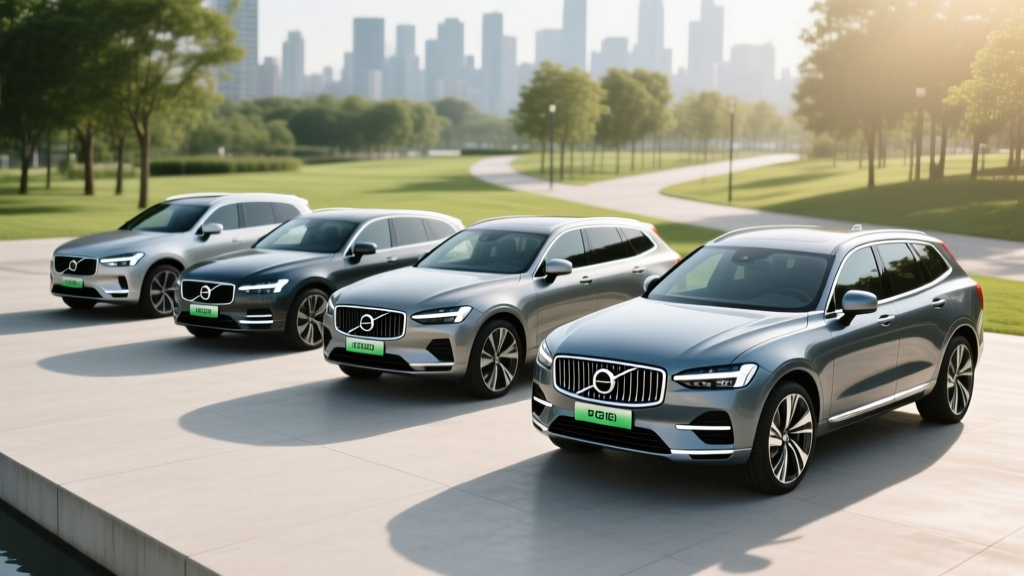
Volvo's Recharge lineup occupies a deliberate middle ground in the electrification spectrum. These aren't full battery-electric vehicles, and they aren't conventional hybrids either. Every current Volvo plug-in hybrid pairs a turbocharged and supercharged (or turbo-only in newer iterations) gasoline engine with a rear-axle electric motor and a battery large enough to deliver meaningful electric-only commuting range. For buyers who want to drive on electricity most weekdays but need gasoline flexibility for road trips, the Recharge PHEVs make a compelling case — provided you understand the math.
This guide breaks down the complete 2026 Volvo plug-in hybrid lineup with exact EPA figures, real-world expectations, pricing, and the ownership details that matter most before you sign.
HEV vs PHEV: Where Volvo Recharge Fits
Volvo no longer sells a conventional hybrid (HEV) in the U.S. market. The entire electrified lineup splits into two camps: Recharge PHEVs (plug-in hybrids) and Recharge BEVs (full battery-electric models like the EX30, EX90, and C40). If you see "Volvo hybrid" at a dealership in 2026, it's a plug-in hybrid that requires a charging cable to unlock its electric range.
| Feature | Conventional Hybrid (HEV) | Volvo Recharge PHEV | Full EV (BEV) |
|---|---|---|---|
| Plugs in? | No — self-charging via regen | Yes — Level 1 or Level 2 | Yes — Level 1, 2, or DC fast |
| Electric-only range | 0–2 miles at low speed | 35–41 miles (EPA) | 250–330+ miles |
| Gasoline engine | Yes (primary) | Yes (backup + combined power) | None |
| Home charging needed | No | Recommended for value | Essential |
| Tailpipe emissions | Reduced vs gas | Zero in EV mode | Zero |
The key takeaway: a Volvo plug-in hybrid only delivers its advertised efficiency if you charge it regularly. Drive one without plugging in and you're hauling a 400-pound battery with a gasoline engine — expect 25–28 MPG combined at best, which is respectable but not class-leading among midsize luxury SUVs running on gas alone.
The 2026 Volvo PHEV Lineup at a Glance
Volvo offers four Recharge PHEV models in the U.S. for the 2026 model year, all sharing the same fundamental powertrain architecture: a 2.0-liter turbocharged four-cylinder engine driving the front wheels, a 143-hp electric motor driving the rear wheels, and an 18.8 kWh (usable) lithium-ion battery pack positioned in the center tunnel.
| Model | Combined HP | 0–60 mph | EPA EV Range | Total Range | Battery (usable) | Base MSRP |
|---|---|---|---|---|---|---|
| XC90 Recharge | 455 hp | 5.0 sec | 35 mi | ~430 mi | 18.8 kWh | $74,900 |
| XC60 Recharge | 455 hp | 4.5 sec | 35 mi | ~440 mi | 18.8 kWh | $59,900 |
| S60 Recharge | 455 hp | 4.1 sec | 41 mi | ~490 mi | 18.8 kWh | $52,950 |
| V60 Recharge | 455 hp | 4.2 sec | 38 mi | ~470 mi | 18.8 kWh | $56,400 |
All four models use the same T8 eAWD powertrain rated at 455 horsepower and 523 lb-ft of combined torque. The differences in electric range come down to vehicle weight and aerodynamics — the lighter, sleeker S60 sedan squeezes six more miles from the same battery than the three-row XC90 SUV.
Fuel Economy: EPA Numbers and Real-World MPG
PHEV fuel economy is measured two ways: MPGe (miles per gallon equivalent, counting electricity as fuel) when operating in electric mode, and conventional MPG when the gasoline engine is running. Here's how the lineup stacks up per fueleconomy.gov:
| Model | Combined MPGe (EV+Gas) | Gas-Only Combined MPG | City MPG (Gas) | Highway MPG (Gas) |
|---|---|---|---|---|
| XC90 Recharge | 55 MPGe | 27 MPG | 26 | 28 |
| XC60 Recharge | 56 MPGe | 28 MPG | 27 | 29 |
| S60 Recharge | 69 MPGe | 31 MPG | 30 | 33 |
| V60 Recharge | 63 MPGe | 30 MPG | 29 | 32 |
Real-world expectations: On gas alone, Volvo PHEVs tend to match or slightly exceed EPA highway estimates in mixed driving because the electric motor assists during acceleration — the most fuel-thirsty phase. City driving on gas alone may return 1–2 MPG above the EPA number thanks to regenerative braking recovering energy at stops. However, sustained highway driving at 75+ mph with a depleted battery will drop the XC90 to roughly 24–25 MPG. Cold weather (below 35°F) reduces electric-only range by 20–30%, meaning your 35-mile EV commute may shrink to 25 miles in January.
Charging: Speeds, Times, and the No-DC-Fast-Charge Limitation
Here's the most important charging detail for prospective buyers: no current Volvo Recharge PHEV supports DC fast charging. The charge port accepts only Level 1 (120V household) and Level 2 (240V) AC power. The onboard charger is rated at 3.7 kW maximum.
| Charging Level | Power (kW) | Time 0–100% | Miles of EV Range per Hour |
|---|---|---|---|
| Level 1 (120V, 12A) | ~1.4 kW | ~13–14 hours | ~3–4 mi/hr |
| Level 2 (240V, 16A) | 3.7 kW | ~5 hours | ~8–9 mi/hr |
For most owners, an overnight Level 2 charge using a 240V outlet (NEMA 14-50 or hardwired wallbox) is the practical standard. You plug in when you get home, and the battery is full by morning — five hours is more than enough for even a late-evening arrival. Level 1 on a standard household outlet works but is slow enough that you'll need to plug in immediately upon returning home to ensure a full charge by morning.
Home Level 2 charger installation typically costs $500–$1,800 depending on panel capacity and wiring distance. Volvo includes a basic Level 1/2 portable charging cable with each Recharge PHEV.
Battery Warranty, Longevity, and Replacement Costs
Volvo PHEV Battery Warranty: 8 years or 100,000 miles (whichever comes first), covering defects and capacity loss below 70% of original capacity. In states that follow California Air Resources Board (CARB) regulations — including CA, NY, WA, MA, and several others — the hybrid battery warranty extends to 10 years or 150,000 miles.
Volvo's 18.8 kWh usable battery pack uses NMC (nickel manganese cobalt) lithium-ion cells. Based on fleet data from earlier-generation Volvo T8 PHEVs (which used smaller 11.6 kWh packs), real-world degradation is modest: expect roughly 8–12% capacity loss over 100,000 miles of daily charge-discharge cycling. Because the battery management system (BMS) maintains a buffer at the top and bottom of the state-of-charge window, catastrophic failure is rare.
Out-of-warranty replacement cost: A full high-voltage battery replacement for a Volvo Recharge PHEV currently runs $8,000–$12,000 including parts and labor at a Volvo dealer. Individual module replacement (if only a subset of cells degrades) can reduce this to $3,000–$5,000. Third-party hybrid battery rebuild services are emerging but remain limited for Volvo's newer 18.8 kWh architecture.
Is it reliable? The T8 powertrain has been in production since 2016 with iterative updates. The most common complaints in earlier model years (2016–2019) involved software glitches in the powertrain control module and occasional electric motor clutch engagement issues. The current-generation hardware (2023+) has addressed most of these. Volvo as a brand scores mid-pack in J.D. Power dependability studies — not Toyota-level, but not worst-in-class either. The gasoline 2.0L engine is well-proven; the electric rear axle is mechanically simple. The main long-term risk is the high-voltage battery, which the warranty largely covers through year eight or ten.
Federal Tax Credit and Incentive Eligibility
Under IRS §30D rules for 2026, new plug-in hybrids with batteries of at least 7 kWh can qualify for up to $7,500 in federal tax credit — but eligibility depends on a matrix of requirements that eliminate many luxury PHEVs. Here's the checklist:
- MSRP cap: SUVs (XC90, XC60) must have an MSRP at or below $80,000; sedans and wagons (S60, V60) must be at or below $55,000. Several XC90 Recharge trims exceed $80,000 and lose eligibility. The S60 Recharge base trims fall under the $55K sedan cap.
- Buyer income cap: Modified adjusted gross income must not exceed $150,000 (single), $225,000 (head of household), or $300,000 (joint filers).
- Battery sourcing: A percentage of critical minerals and battery components must be sourced from the U.S. or free-trade-agreement partners. Volvo's supply chain has been shifting to comply, but eligibility varies by build date and specific battery supplier batch.
- Point-of-sale transfer: As of 2024, eligible buyers can transfer the credit to the dealer at purchase, reducing the purchase price directly rather than waiting for a tax refund.
- Assembly: The vehicle must undergo final assembly in North America. Volvo's Ridgeville, South Carolina plant assembles the XC90 (and the upcoming EX90), but the XC60, S60, and V60 for the U.S. market are assembled in Europe — which disqualifies those models from the §30D new-vehicle credit.
Bottom line on credits: The XC90 Recharge (U.S.-assembled) is the most likely candidate for the federal credit, but only in trims under $80,000 and only if battery-sourcing requirements are met at time of manufacture. Always verify eligibility using the IRS VIN-lookup tool at irs.gov before committing to a purchase. The XC60, S60, and V60 Recharge models, assembled overseas, do not qualify for the new-vehicle §30D credit. State-level incentives may still apply — check your state's energy office for details.
Who Should Buy a Volvo PHEV — and Who Shouldn't
Choose a Volvo Recharge PHEV if:
- Your daily commute is under 35 miles round-trip and you can charge at home every night
- You take 4+ road trips per year where EV charging infrastructure is sparse or unreliable
- You want electric weekday driving but don't want to plan around charging stations on long drives
- You value Scandinavian interior design, standard safety tech (Pilot Assist, run-off-road protection), and all-wheel drive
- You're not ready for a full EV but want to reduce gasoline consumption by 60–80%
Choose a full EV (like the Volvo EX30 or EX90) instead if:
- You have reliable home charging and your longest regular drive is under 250 miles
- You want to eliminate oil changes, spark plugs, and gasoline entirely
- You want access to DC fast charging for road trips (150–250 kW capability)
- You want lower long-term maintenance costs and fewer moving parts
Choose a conventional gas vehicle instead if:
- You cannot install a home charger (apartment, street parking, no garage)
- Your daily driving exceeds 80 miles and you won't charge mid-day
- The PHEV price premium over a comparable gas model exceeds $10,000 and your fuel savings won't close the gap within 6 years
Pros
- 35–41 miles of real electric commuting covers most daily driving
- 455 hp combined — genuinely quick, especially the S60 at 4.1 seconds
- Standard AWD via electric rear axle (no mechanical driveshaft)
- Top-tier safety: IIHS Top Safety Pick+ across the lineup
- Google-based infotainment with built-in navigation and EV route planning
- No range anxiety — gasoline backup for any trip length
Cons
- No DC fast charging — road trips run on gas only once battery depletes
- 3.7 kW onboard charger is slow by 2026 PHEV standards
- XC60/S60/V60 assembled in Europe — no federal §30D credit
- Premium fuel recommended for optimal performance and efficiency
- Cargo space reduced vs gas-only equivalents (battery in center tunnel)
- Insurance premiums run 10–18% higher than comparable gas Volvos
Frequently Asked Questions
How many MPG does a Volvo plug-in hybrid get?
On gasoline alone with a depleted battery, the 2026 Volvo Recharge PHEVs return 27–31 MPG combined depending on the model (EPA-rated). The S60 Recharge sedan leads at 31 MPG combined. When you factor in regular electric-only driving with nightly charging, effective fuel consumption drops dramatically — many owners report using gasoline only 20–30% of the time, equivalent to 60+ MPGe in daily use.
How far can a Volvo PHEV go on electric only?
The EPA-rated electric-only range spans 35 miles (XC90 and XC60 Recharge) to 41 miles (S60 Recharge). In real-world conditions, expect 30–38 miles in mild weather with moderate driving, and 22–28 miles in cold weather (below 35°F) or at sustained highway speeds above 70 mph. The battery preconditioning function helps optimize range when navigation is set to a destination.
Is a Volvo plug-in hybrid reliable?
The current-generation T8 eAWD powertrain (2023+) has proven more reliable than the first-generation T8 (2016–2019), which had software-related drivetrain complaints. The high-voltage battery carries an 8-year/100,000-mile warranty (10 years/150,000 miles in CARB states). Out-of-warranty battery replacement runs $8,000–$12,000. Overall, Volvo PHEVs are a reasonable reliability bet in the luxury segment, though they don't match Toyota/Lexus hybrid longevity data.
Does a Volvo plug-in hybrid qualify for a tax credit?
It depends on the model and trim. The XC90 Recharge, assembled in South Carolina, may qualify for up to $7,500 under IRS §30D — but only in trims with MSRP at or below $80,000, for buyers under the income cap, and subject to battery-sourcing compliance. The XC60, S60, and V60 Recharge are assembled in Europe and do not qualify for the federal new-vehicle credit. Always verify via the IRS qualified vehicles list before purchasing. State incentives may apply separately.
Do I need to charge a Volvo PHEV every night?
You don't need to — the car drives perfectly fine on gasoline alone. But to capture the value proposition, nightly charging is strongly recommended. If you regularly skip charging, you're paying a premium for a battery you're not using, and your effective fuel economy drops to 25–31 MPG. The financial case for a PHEV only works if you charge it.
Hybrid vs PHEV vs EV — which fits my lifestyle?
If you can charge at home and drive under 40 miles daily but take occasional long road trips, the Volvo PHEV is the sweet spot. If you can charge at home and rarely exceed 250 miles between stops, a full EV like the EX90 will cost less to operate long-term. If you cannot charge at home at all, a conventional hybrid from Toyota or Honda will serve you better — Volvo doesn't offer a non-plug-in hybrid in the U.S.