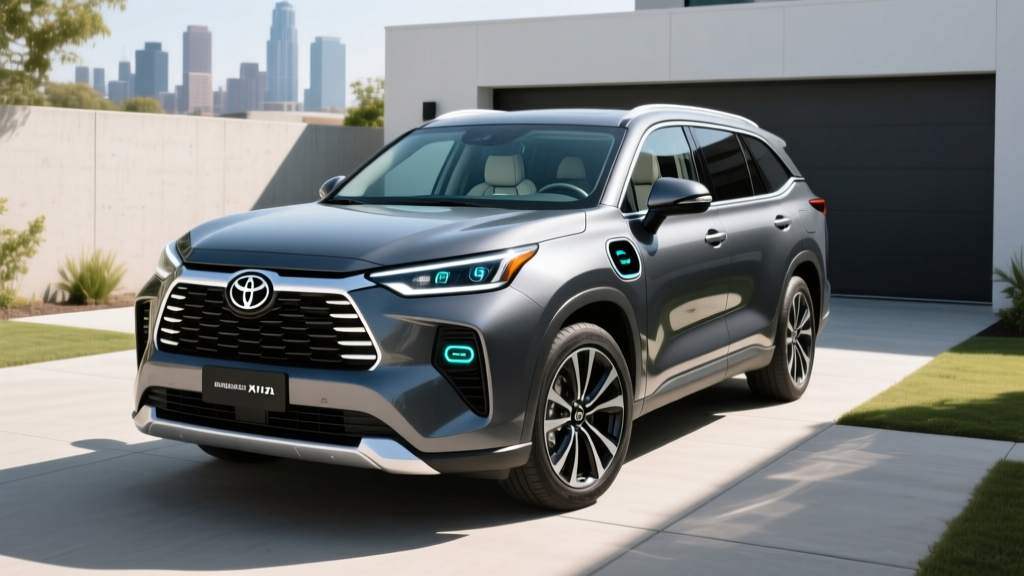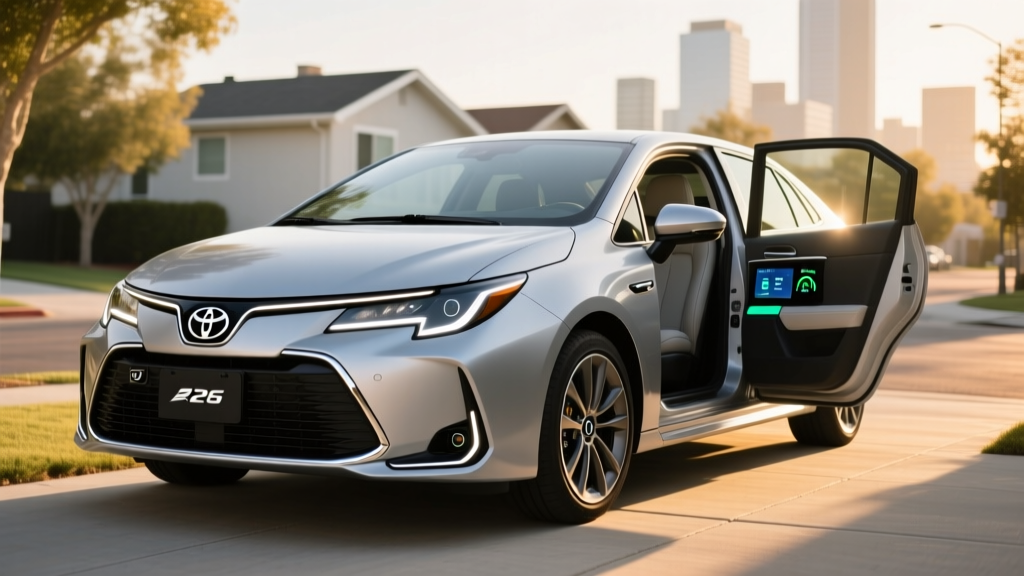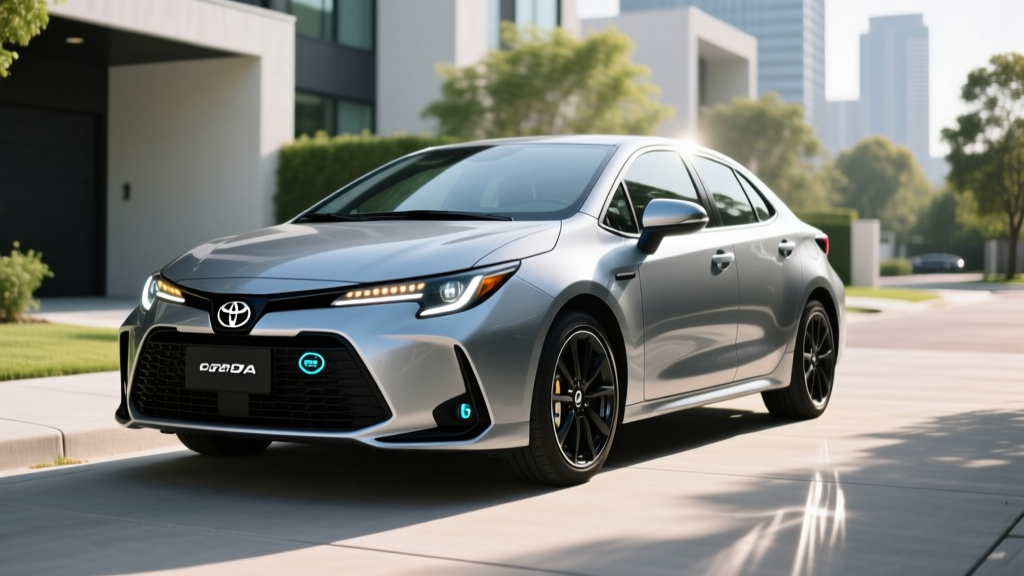
The Toyota Corolla Hybrid occupies a specific niche in the electrified-vehicle market: it's a conventional hybrid (HEV) that requires no plug, no charging infrastructure, and no lifestyle change — just dramatically better fuel economy than a gas-only compact sedan. For 2025, Toyota has streamlined the Corolla Hybrid lineup around the LE trim with an available AWD option, keeping the entry cost low while delivering EPA-estimated fuel economy that routinely exceeds 50 MPG in real-world city driving.
This guide breaks down every trim's MSRP, the real-world MPG you can expect, the hybrid battery's warranty and replacement economics, and how the Corolla Hybrid stacks up against PHEVs and full EVs for different buyer profiles.
2025 Toyota Corolla Hybrid Price by Trim
Toyota keeps the Corolla Hybrid lineup simple for 2025 — one primary trim with an AWD option. Here's the MSRP breakdown before any dealer markups, destination charges, or incentives:
| Trim | Drivetrain | MSRP | Destination | Total Starting |
|---|---|---|---|---|
| LE Hybrid | FWD | $23,725 | $1,095 | $24,820 |
| LE Hybrid | AWD | $25,125 | $1,095 | $26,220 |
The 2025 Toyota Corolla Hybrid price starts at approximately $24,820 out-the-door for the FWD LE before taxes, title, and dealer fees. The AWD variant adds $1,400 and includes a second rear-mounted electric motor that provides torque to the rear wheels during acceleration and low-traction conditions — it's not a full-time AWD system, but rather an on-demand electric rear axle.
Compared to the gas-only Corolla LE (starting around $22,325 with destination), the hybrid carries roughly a $2,495 premium. At current fuel prices and 50 MPG combined, that premium pays for itself in approximately 1.5 to 2 years for a driver covering 12,000 miles annually, depending on local gas costs.
Fuel Economy: EPA Ratings and Real-World MPG
The Corolla Hybrid's 1.8-liter four-cylinder engine paired with Toyota's fourth-generation hybrid synergy drive system delivers class-leading efficiency. Here are the official EPA figures:
| Drivetrain | City MPG | Highway MPG | Combined MPG |
|---|---|---|---|
| FWD | 53 | 46 | 50 |
| AWD | 51 | 44 | 48 |
Source: EPA Fuel Economy
The FWD model achieves an EPA-estimated 50 MPG combined, translating to roughly 545 miles of total range from its 11.4-gallon fuel tank. The AWD variant drops slightly to 48 MPG combined and approximately 523 miles of range.
Powertrain: How the Corolla Hybrid System Works
The 2025 Corolla Hybrid uses Toyota's well-proven hybrid architecture — a series-parallel system that can operate in electric-only mode at low speeds, engine-only mode at steady highway speeds, or a combined mode for maximum acceleration.
| Specification | Detail |
|---|---|
| Engine | 1.8L 4-cylinder Atkinson cycle |
| Engine Power | 96 hp @ 5,200 rpm |
| Electric Motor (Front) | 94 hp / 120 lb-ft torque |
| Combined Net Horsepower | 138 hp |
| AWD Rear Motor | 40 hp (AWD models only) |
| Transmission | Continuously Variable (eCVT) |
| Hybrid Battery | Lithium-ion, ~1.3 kWh (not plug-in) |
| 0-60 MPH | ~9.0 seconds (est.) |
The 138 combined horsepower figure represents the net system output — not a simple addition of engine and motor power, since peak outputs occur at different RPMs. The eCVT isn't a traditional belt-driven CVT; it uses a planetary gearset to blend engine and motor power seamlessly, which contributes to the system's long-term reliability.
HEV vs PHEV vs EV: Which Powertrain Fits You?
The Corolla Hybrid is a conventional hybrid (HEV). It cannot be plugged in. The small lithium-ion battery charges exclusively through regenerative braking and engine-generated electricity. This is fundamentally different from a plug-in hybrid (PHEV) or a battery-electric vehicle (BEV).
- No plug required
- 50 MPG combined
- No electric-only range to speak of
- No range anxiety
- Lowest upfront cost
- Plug in for 39-44 mi electric range
- Gas engine for longer trips
- Needs home charging for full benefit
- May qualify for $3,750-$7,500 credit
- Higher upfront cost
- 250-350+ mi electric range
- No gas engine at all
- Requires reliable charging access
- $7,500 federal credit (if eligible)
- Highest upfront, lowest fuel cost
Choose the Corolla Hybrid (HEV) if: You lack access to home or workplace charging, you want maximum fuel efficiency with zero behavioral change, you drive a mix of city and highway miles, or you want the lowest total cost of entry into an electrified vehicle.
Consider a PHEV instead if: You have a garage or driveway where you can install a Level 2 charger, your daily commute is under 40 miles round-trip (so you can drive mostly on electricity), and you want the option of gas-free daily driving with the security of a gas engine for road trips.
Consider a full EV instead if: You have reliable home charging, your daily driving is predictable, you want to eliminate oil changes and gas-engine maintenance entirely, and you qualify for the full federal EV tax credit.
Tax Credits and Incentives for the Corolla Hybrid
Here's a critical point many buyers miss: the 2025 Toyota Corolla Hybrid does not qualify for the federal §30D clean vehicle tax credit. The §30D credit applies exclusively to plug-in electric vehicles — battery-electric vehicles (BEVs) and plug-in hybrids (PHEVs) with a minimum battery capacity of 7 kWh. Since the Corolla Hybrid is a conventional HEV with a ~1.3 kWh battery that cannot be plugged in, it is ineligible.
- Applies to BEVs and PHEVs only — not conventional hybrids
- Up to $7,500 for new qualifying plug-in vehicles
- Buyer income caps: $150K single / $300K joint
- MSRP caps: $55K sedans / $80K SUVs and trucks
- Battery sourcing and critical mineral requirements apply
- Point-of-sale transfer available at participating dealers
Source: IRS Clean Vehicle Tax Credits
Some states and local utilities offer rebates or incentives for conventional hybrids, though these are becoming less common as incentive programs shift focus toward plug-in vehicles. Check your state energy office and local utility for any current programs. A few states with aggressive emissions targets still offer modest hybrid incentives, but amounts vary widely by jurisdiction.
Battery Warranty, Lifespan, and Replacement Cost
Hybrid battery longevity is consistently the top concern for first-time hybrid buyers. Toyota addresses this with one of the strongest hybrid battery warranties in the industry.
- Hybrid Battery: 10 years / 150,000 miles (whichever comes first)
- Hybrid System Components: 8 years / 100,000 miles
- Capacity Retention: Toyota warrants the battery against defects and abnormal capacity loss
- Transferable: Warranty transfers to subsequent owners at no cost
In practice, Toyota's hybrid batteries have demonstrated exceptional longevity. Data from fleet operators and long-term owners shows that Toyota hybrid batteries routinely last 150,000 to 200,000+ miles before significant degradation. The Corolla Hybrid's relatively small ~1.3 kWh battery undergoes shallow charge-discharge cycles (the system keeps the battery in a narrow state-of-charge window, typically 40-80%), which dramatically extends cell life compared to the deeper cycles in BEVs and PHEVs.
If replacement is eventually needed outside of warranty, a new OEM hybrid battery for the Corolla Hybrid typically costs between $2,000 and $3,500 including installation at a dealership. Third-party refurbished batteries are available for $1,000-$1,800. Given the 10-year/150,000-mile warranty coverage and the battery's demonstrated lifespan, unplanned replacement costs are a low-probability concern for most owners.
Who Should Buy the Corolla Hybrid — and Who Shouldn't
- Apartment dwellers without charging access
- High-mileage commuters (15K+ miles/year)
- Buyers wanting EV-like efficiency without plug-in complexity
- First-time hybrid buyers seeking proven reliability
- Drivers in stop-and-go urban traffic (where hybrids shine)
- Those prioritizing lowest total cost of ownership
- You want any electric-only driving range
- You want to qualify for the federal tax credit
- You need more than 138 hp for highway merging confidence
- You want the latest infotainment or ADAS features (Corolla is basic)
- You prefer a hatchback or SUV body style
- You want to eliminate gasoline entirely
The Corolla Hybrid's strongest value proposition is its total cost of ownership. At 50 MPG combined, a driver covering 12,000 miles annually spends approximately $860 per year on fuel (at $3.60/gallon). A comparable gas-only compact sedan averaging 33 MPG would cost roughly $1,310 annually — a $450/year savings that compounds over ownership. Factor in Toyota's reputation for low maintenance costs and strong resale value, and the Corolla Hybrid is one of the most economical new vehicles available in 2025.
Frequently Asked Questions
How many MPG does the 2025 Toyota Corolla Hybrid get?
The FWD Corolla Hybrid achieves an EPA-estimated 53 city / 46 highway / 50 combined MPG. The AWD variant rates at 51 city / 44 highway / 48 combined. Real-world city driving often exceeds the EPA city estimate, while sustained highway driving above 70 MPH may return 2-4 MPG less than the sticker.
Does the Corolla Hybrid need to be plugged in?
No. The Corolla Hybrid is a conventional hybrid (HEV). Its battery charges through regenerative braking and the gasoline engine. You never plug it in — you simply refuel at any gas station as you would with a conventional car.
Does the 2025 Corolla Hybrid qualify for a tax credit?
It does not qualify for the federal §30D clean vehicle tax credit, which is reserved for plug-in electric vehicles (BEVs and PHEVs). Some state or utility incentives may apply to conventional hybrids, but these vary by location and are increasingly rare.
How long will the Corolla Hybrid battery last?
Toyota warrants the hybrid battery for 10 years or 150,000 miles. Real-world data from Toyota's hybrid fleet (Prius, Camry Hybrid, RAV4 Hybrid) shows batteries routinely lasting 150,000-200,000+ miles. The Corolla Hybrid's battery management system keeps the cells in a narrow charge window, which maximizes longevity.
How much does it cost to replace the hybrid battery?
An OEM replacement hybrid battery costs approximately $2,000-$3,500 installed at a Toyota dealership. Refurbished or aftermarket options range from $1,000-$1,800. Given the 10-year/150,000-mile warranty, most original owners will never face this cost.
Is the Corolla Hybrid AWD system worth the $1,400 premium?
If you regularly drive in snow, rain, or on unpaved roads, the electric AWD system provides meaningful traction benefits during acceleration from a stop and in low-grip conditions. It's an on-demand system that engages the rear motor only when needed, so it doesn't significantly impact fuel economy (only a 2 MPG combined penalty). For dry-climate drivers who rarely encounter adverse conditions, the FWD model is the better value.