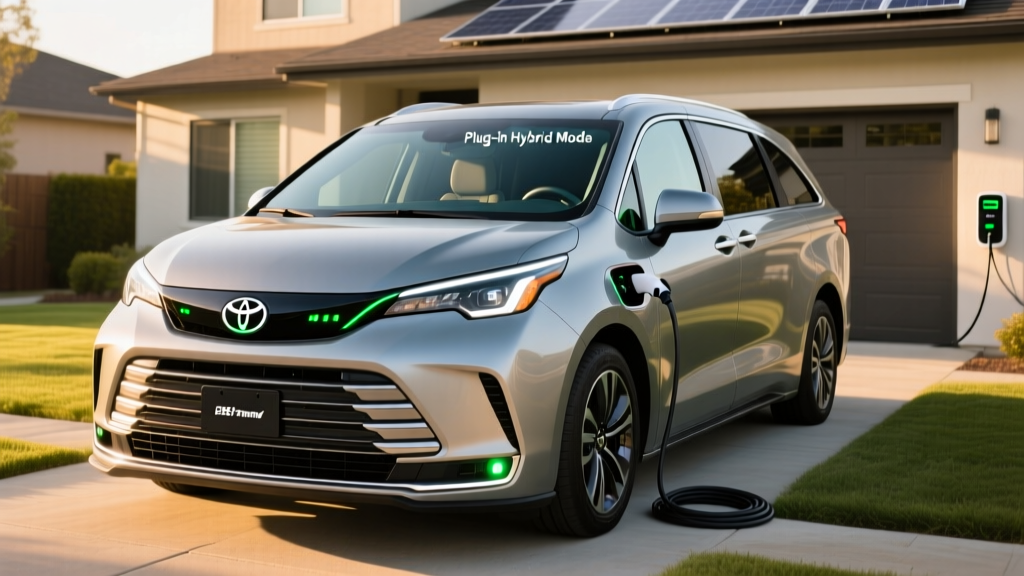
If you've been searching for a Sienna PHEV, you're not alone. Family haulers that blend electric-only commuting with gas-powered road trips are in high demand, and the Toyota Sienna — already a hybrid-only minivan since the 2021 model year — seems like the perfect candidate for plug-in duty. But does Toyota actually offer a Sienna plug-in hybrid in 2026? The short answer is no, at least not yet. Here's everything you need to know about the current Sienna hybrid powertrain, why a PHEV variant remains elusive, and how the existing HEV stacks up against fully electric alternatives for family buyers.
The 2026 Toyota Sienna: Hybrid-Only, Not Plug-In
For the 2026 model year, the Toyota Sienna is sold exclusively as a conventional hybrid electric vehicle (HEV). It pairs a 2.5-liter four-cylinder engine with two electric motors (front-wheel drive) or three electric motors (all-wheel drive) and a small nickel-metal hydride (NiMH) traction battery. Unlike a plug-in hybrid, the Sienna HEV never needs to be plugged in — it recovers energy through regenerative braking and the gasoline engine to keep its battery charged.
Toyota has not announced a Sienna PHEV for the 2026 model year, and as of early 2026, no plug-in variant has appeared on the company's official North American product roadmap. That doesn't mean one will never come — Toyota has been expanding its PHEV lineup globally — but buyers shopping today must work with the HEV as it stands.
HEV vs PHEV: What's the Difference for Minivan Buyers?
| Feature | Toyota Sienna HEV (Current) | Hypothetical Sienna PHEV |
|---|---|---|
| Plug-in charging required? | No — self-charging | Yes — plug in to access EV range |
| Electric-only range | ~1–2 miles at low speed | Est. 30–40 miles (if similar to RAV4 Prime) |
| Battery size | 1.9 kWh (NiMH) | Est. 18–22 kWh (likely NMC lithium-ion) |
| Gas engine | 2.5L 4-cyl + electric motors | Likely similar 2.5L + more powerful motors |
| Federal tax credit (§30D) | Not eligible | Potentially up to $7,500 if battery sourcing qualifies |
| Starting MSRP (2026) | $39,985 | Est. $47,000–$52,000 |
Fuel Economy: Real-World MPG for the 2026 Sienna Hybrid
The Sienna's hybrid powertrain is one of the most efficient minivan setups on the market. According to fueleconomy.gov, the EPA rates the 2026 Sienna as follows:
| Configuration | City MPG | Highway MPG | Combined MPG |
|---|---|---|---|
| FWD (LE, XLE, Limited) | 36 | 36 | 36 |
| AWD (LE, XLE, Limited, Platinum) | 35 | 36 | 35 |
Real-world note: Hybrids like the Sienna tend to meet or even exceed EPA city estimates because regenerative braking captures energy in stop-and-go traffic. On highway-heavy commutes at 70–80 mph, expect fuel economy to dip closer to 30–32 MPG. In cold weather (below 30°F), the engine runs more frequently for cabin heat, which can reduce city MPG by 3–5 MPG. Over a 15-gallon tank, that translates to roughly 450–540 miles of total range depending on driving conditions — far exceeding any current EV minivan on a single charge.
Powertrain Specs: What's Under the Hood
| Specification | 2026 Toyota Sienna HEV |
|---|---|
| Engine | 2.5L DOHC 4-cylinder (189 hp) |
| Electric motors | 2 (FWD) / 3 (AWD) |
| Combined system output | 245 hp (FWD & AWD) |
| Transmission | eCVT (electronically controlled) |
| Traction battery | 1.9 kWh NiMH (sealed) |
| 0–60 mph | ~7.1 seconds (FWD) |
| Towing capacity | 3,500 lbs (all trims) |
| Drivetrain | FWD or electronic AWD |
The 245 combined horsepower is adequate for a loaded family minivan but not thrilling. Where the powertrain shines is smoothness: the electric motors provide instant low-end torque, making around-town acceleration responsive even though peak power is modest. The eCVT eliminates shift shock entirely. At highway speeds, the Sienna cruises quietly, though the 4-cylinder can drone under hard acceleration (merging onto a fast freeway, climbing steep grades).
Why Toyota Hasn't Built a Sienna PHEV (Yet)
Toyota's plug-in hybrid strategy has focused on smaller vehicles where the added battery weight and cost are easier to absorb. The RAV4 Prime (a compact SUV PHEV with 42 miles of electric range) and the Prius Prime (44 miles EV range) have been Toyota's PHEV flagship models. Scaling that architecture to a 4,600-pound minivan presents engineering and pricing challenges:
- Weight penalty: A PHEV battery large enough for 30+ miles of EV range would add 300–400 lbs to an already heavy minivan, reducing cargo capacity and requiring suspension tuning changes.
- Cost increase: A plug-in Sienna would likely start around $47,000–$52,000, pushing it into luxury minivan territory and competing with its own higher trims.
- Charging infrastructure: Toyota has noted that many minivan buyers lack reliable home charging access (garage space, electrical panel capacity), making a PHEV's value proposition weaker for this segment.
- Platform constraints: The Sienna rides on Toyota's GA-K platform, which supports PHEVs in the RAV4 Prime and Highlander Hybrid, but integrating a larger battery pack under the minivan floor without compromising the low step-in height and flat cargo floor is a packaging challenge.
That said, the Chrysler Pacifica PHEV (now in its final model years) proved there is demand for a plug-in minivan. Toyota is watching that market closely, and industry analysts expect a Sienna PHEV could arrive with the next-generation redesign, potentially for the 2028–2029 model year.
Pricing, Trims, and Tax Credit Reality
The 2026 Toyota Sienna starts at $39,985 for the LE FWD trim and tops out around $55,000 for the Platinum AWD. Here's the trim breakdown:
| Trim | MSRP (FWD) | MSRP (AWD) |
|---|---|---|
| LE | $39,985 | $41,985 |
| XLE | $44,485 | $46,485 |
| XSE | $45,485 | $47,485 |
| Limited | $49,485 | $51,485 |
| Platinum | N/A | $55,085 |
Federal tax credit (§30D): Because the Sienna is a conventional HEV — not a plug-in vehicle — it does not qualify for the federal §30D clean vehicle credit. That credit, worth up to $7,500, is reserved for new BEVs and PHEVs that meet battery sourcing, MSRP cap, and buyer income requirements as outlined by the IRS. Some states may offer small hybrid rebates (check your state energy office), but these are typically $500–$1,000, not the substantial credits available to plug-in vehicles.
Battery Warranty, Reliability, and Replacement Cost
Toyota Hybrid Battery Warranty (2026 Models)
- Hybrid battery coverage: 10 years / 150,000 miles (whichever comes first)
- Hybrid system components: 8 years / 100,000 miles
- Capacity retention guarantee: Toyota warrants that the hybrid battery will not fall below a defined performance threshold during the warranty period
Toyota's hybrid reliability track record is among the best in the industry. The Sienna's NiMH battery is a proven, conservative chemistry — the same type used in millions of Prius hybrids since 1997. Unlike lithium-ion batteries, NiMH degrades very slowly and is far less susceptible to thermal runaway. Most Toyota hybrid batteries last 150,000–200,000 miles before requiring replacement.
Replacement cost: If the hybrid battery does fail out of warranty, a new OEM replacement runs approximately $3,000–$4,500 including labor. Third-party refurbished NiMH packs are available for $1,500–$2,500. This is significantly cheaper than BEV battery replacement ($10,000–$20,000+), which is one reason hybrid buyers cite for choosing HEVs over full electrics.
According to IIHS, the 2026 Sienna carries top safety ratings, and Toyota's overall brand reliability consistently ranks in the top five among major automakers in long-term dependability studies.
Sienna Hybrid vs EV Minivan vs Gas Minivan: Which Fits You?
Choose the Toyota Sienna HEV if:
- You want 35–36 MPG combined without changing any habits (no plugging in)
- You take frequent long road trips and don't want to plan charging stops
- You need a proven, reliable minivan with strong resale value
- You don't have reliable home or workplace charging access
- You want 540+ miles of total range between fill-ups
Consider a full EV (BEV) if:
- You have Level 2 home charging and a mostly predictable daily routine
- You want to eliminate gas station visits and reduce maintenance (no oil changes)
- You qualify for the full $7,500 federal tax credit on an eligible EV
- You're comfortable with 250–350 miles of range and occasional DC fast-charging stops on road trips
Wait for a Sienna PHEV if:
- You want 30+ miles of electric-only commuting for school runs and errands
- You have home charging and want to offset gas costs on short trips
- You're willing to wait until the next-generation Sienna (est. 2028–2029)
- You want the tax credit eligibility that only plug-in vehicles offer
For most minivan buyers in 2026, the Sienna HEV occupies a strong middle ground. It delivers hybrid efficiency without the charging logistics of a BEV or the wait for a PHEV that may never arrive. Families who drive 15,000+ miles per year — including road trips, sports tournaments, and vacation hauls — will find the Sienna's 36 MPG combined and 540-mile range hard to beat.
Pros and Cons at a Glance
Pros
- 36 MPG combined — best-in-class minivan efficiency
- No plug-in charging required; works for apartment/renter households
- 10-year / 150,000-mile hybrid battery warranty
- 540+ miles total range per tank
- 3,500-lb towing capacity
- Strong Toyota reliability and resale value
- Standard Toyota Safety Sense 3.0 (Level 2 ADAS)
Cons
- No plug-in variant available — no electric-only commuting
- Not eligible for $7,500 federal EV tax credit
- 245 hp is adequate but not quick for a loaded minivan
- No DC fast charging (not applicable to HEV)
- 4-cylinder engine drones under hard acceleration
- Third-row space is tighter than Chrysler Pacifica
- Higher starting price than some gas-powered rivals
Frequently Asked Questions
How many MPG does the Toyota Sienna hybrid get?
The 2026 Toyota Sienna HEV achieves an EPA-estimated 36 MPG combined (36 city / 36 highway) in FWD configuration and 35 MPG combined (35 city / 36 highway) with AWD. Real-world city driving often meets or slightly exceeds these numbers thanks to regenerative braking, while sustained highway driving above 70 mph may yield 30–32 MPG.
Is there a plug-in hybrid Toyota Sienna PHEV?
No. As of the 2026 model year, Toyota does not offer a Sienna PHEV. The Sienna is available only as a conventional hybrid (HEV) that does not plug in. Toyota has not announced a plug-in variant, though industry speculation points to a possible PHEV with the next-generation Sienna redesign around 2028–2029.
Does the Toyota Sienna qualify for any tax credit?
The Sienna HEV does not qualify for the federal §30D clean vehicle credit, which is reserved for plug-in electric vehicles (BEVs and PHEVs). Some states may offer minor hybrid purchase incentives, but these are typically small ($500–$1,000). Check your state energy office or the IRS clean vehicle credit page for current eligibility details.
How long does the Sienna hybrid battery last and what does replacement cost?
Toyota warranties the Sienna's hybrid battery for 10 years or 150,000 miles. Based on Toyota's long-term hybrid reliability data, most NiMH hybrid batteries last 150,000–200,000 miles. Out-of-warranty replacement costs approximately $3,000–$4,500 for a new OEM battery pack, or $1,500–$2,500 for a refurbished unit.
Should I buy the Sienna hybrid or wait for a PHEV or EV minivan?
If you need a minivan now and don't have reliable home charging, the Sienna HEV is the most efficient option available. If you have home charging and mostly drive under 40 miles daily, a fully electric minivan (such as the Kia EV9 three-row SUV or upcoming electric minivans) might be worth considering. If you specifically want a plug-in Sienna, you'll likely need to wait for the next-generation model, which is not expected before 2028.
Can the Toyota Sienna hybrid drive on electric power alone?
Only for very short distances — roughly 1–2 miles at low speeds (under 25 mph) using its small 1.9 kWh NiMH battery. This is normal for conventional hybrids. A PHEV, by contrast, can typically drive 30–45 miles on electricity alone before the gas engine engages.