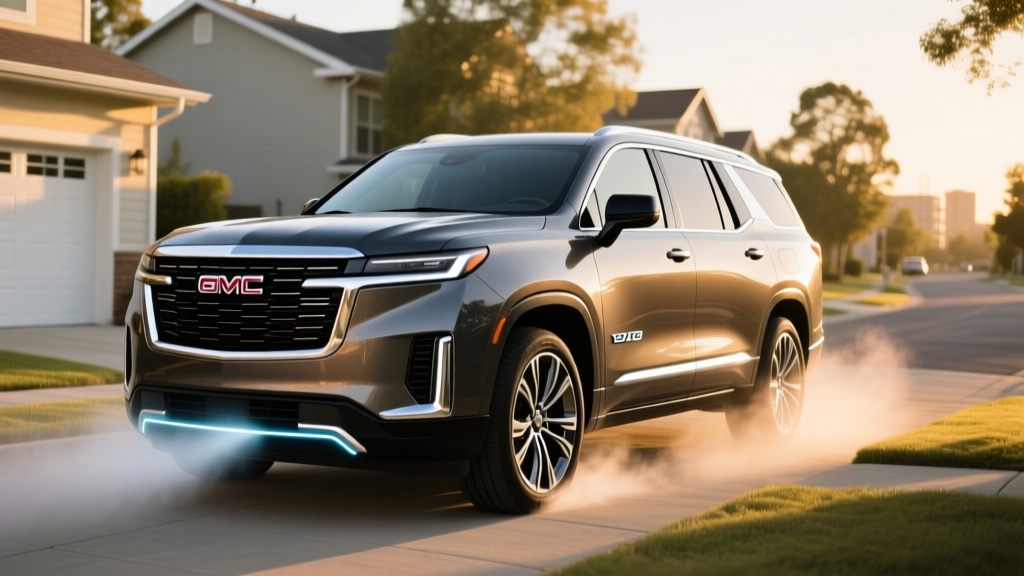
The 2026 GMC Yukon Hybrid: Mild-Hybrid Muscle Meets Full-Size Utility
Full-size SUV buyers have long faced a binary choice: burn fuel or go full electric. The 2026 GMC Yukon Hybrid slots into a narrower lane — a mild-hybrid (MHEV) version of GM's body-on-frame flagship that trims fuel consumption without requiring a plug, a charging routine, or a lifestyle change. For 2026, the Yukon Hybrid pairs GM's turbocharged 3.0L Duramax LZ0 inline-six diesel with a 48-volt mild-hybrid system, delivering meaningful efficiency gains over the gas V8 while preserving the Yukon's 8,000-pound towing rating.
Before we get into the numbers, let's clear up a common search-result confusion: the 2026 Yukon Hybrid is not a plug-in hybrid (PHEV) and it is not a conventional self-charging hybrid (HEV) like a Toyota Highlander Hybrid. It's a mild-hybrid electric vehicle (MHEV) — a 48V system that assists the engine during acceleration, enables smoother stop-start, and powers a brief electric-only coast mode, but cannot propel the vehicle on electric power alone. This distinction matters for your expectations on MPG, tax credits, and daily driving.
HEV vs PHEV vs MHEV — Where the Yukon Hybrid Fits
| Type | Plug-In? | Electric-Only Drive | Typical MPG Gain vs Gas | Federal Tax Credit |
|---|---|---|---|---|
| MHEV (Yukon Hybrid) | No | Coast/assist only | ~10-15% | Not eligible |
| HEV (e.g., Highlander Hybrid) | No | Short low-speed bursts | ~30-50% | Not eligible |
| PHEV (e.g., Chrysler Pacifica Hybrid) | Yes | 20-45 miles | Variable; 80+ MPGe on short trips | Up to $7,500 (§30D, if eligible) |
| BEV (e.g., Rivian R1S) | Yes | Full range | 100% electric | Up to $7,500 (§30D, if eligible) |
Powertrain Specs: Turbo Diesel Meets 48V Assist
The 2026 Yukon Hybrid's powertrain centers on GM's second-generation 3.0L Duramax LZ0 turbo-diesel inline-six, augmented by a belt-integrated 48-volt motor-generator and a small lithium-ion pack (under 1 kWh, used for assist and regen buffering — not for standalone electric driving).
| Spec | Value |
|---|---|
| Engine | 3.0L Duramax LZ0 turbo-diesel I6 |
| Hybrid System | 48V belt-integrated motor-generator (MHEV) |
| Combined Horsepower | 305 hp @ 3,750 rpm |
| Combined Torque | 495 lb-ft @ 1,500 rpm |
| Transmission | 10-speed automatic |
| Drivetrain | RWD standard; 4WD available |
| 0-60 mph (est.) | ~6.8 seconds (4WD) |
| Max Towing | 8,000 lbs (properly equipped) |
| Battery (MHEV) | 48V Li-ion, <1 kWh (assist only) |
The 48V system's primary contributions are threefold: it fills in torque at low RPM before the turbo spools, it enables an extended engine-off coasting mode at highway speeds (saving fuel on gentle grades), and it smooths the stop-start transitions that plague large diesels in city traffic. You won't drive on electric power alone, but you'll feel the assist in everyday driving.
Fuel Economy: EPA MPG and Real-World Expectations
The headline question for any hybrid buyer: how many MPG does the GMC Yukon Hybrid actually get? Per fueleconomy.gov, the 2026 Yukon Hybrid 4WD posts the following EPA estimates:
| Cycle | EPA Estimate |
|---|---|
| City | 24 MPG |
| Highway | 28 MPG |
| Combined | 26 MPG |
For context, the non-hybrid Yukon with the 5.3L V8 gas engine returns 15/20/17 MPG (city/highway/combined), and the 6.2L V8 drops to 14/19/16. The diesel mild-hybrid nearly doubles city efficiency and adds roughly 9 MPG combined over the gas V8 — a substantial gain for a 5,800-pound vehicle.
Pricing, Trims, and Tax Credit Reality
The 2026 Yukon Hybrid is offered across three trims, all built on the standard-length Yukon platform (the extended Yukon XL does not currently offer the hybrid powertrain):
| Trim | Drivetrain | MSRP |
|---|---|---|
| SLE | RWD | $62,100 |
| SLE | 4WD | $65,100 |
| SLT | 4WD | $69,400 |
| AT4 | 4WD | $74,800 |
| Denali (est.) | 4WD | $82,500+ |
Tax credit eligibility: The 2026 Yukon Hybrid does not qualify for the federal §30D clean vehicle credit. Under current IRS rules, the §30D credit applies only to plug-in electric vehicles (PHEVs and BEVs) with a minimum battery capacity of 7 kWh. The Yukon's 48V mild-hybrid system falls well below that threshold. No federal credit applies, and most state incentive programs follow the same plug-in requirement.
This is a critical distinction for buyers cross-shopping against PHEVs like the Jeep Grand Cherokee 4xe or the BMW X5 xDrive50e, which do qualify for up to $7,500 in federal credits (subject to MSRP caps, buyer income limits, and battery-sourcing requirements). The Yukon Hybrid's value proposition rests on fuel savings and diesel torque, not purchase incentives.
Reliability, Battery Warranty, and Long-Term Costs
GM's 3.0L Duramax inline-six has been in production since the 2020 model year, and the second-generation LZ0 variant (introduced for 2023) addressed early reports of oil-pump and rear-main-seal issues. The 48V mild-hybrid system is comparatively simple — a belt-driven motor-generator and a small battery pack — with fewer failure points than a full hybrid transaxle or a PHEV's high-voltage system.
Warranty coverage:
- Powertrain: 5 years / 60,000 miles
- 48V hybrid components: 8 years / 100,000 miles (GM's hybrid/electric component warranty)
- Bumper-to-bumper: 3 years / 36,000 miles
Battery replacement cost: The 48V lithium-ion pack is compact and inexpensive relative to full-hybrid or PHEV batteries. Out-of-warranty replacement is estimated at $800–$1,500 (parts and labor) — a fraction of the $5,000–$15,000 cost for a full-hybrid or PHEV traction battery. The 48V system's low voltage also means no special high-voltage safety certification is required for independent shops to service it.
Diesel maintenance costs run higher than gas: expect DEF fluid top-ups (~$50/year), fuel-filter changes every 20,000 miles, and potentially higher oil-change costs (the 3.0L Duramax takes 8 quarts of 0W-20 diesel-specific oil). These costs partially offset the fuel savings versus the gas V8.
Yukon Hybrid vs. Full EV vs. Gas: Which Fits Your Life?
Choose the GMC Yukon Hybrid if:
- You need 7+ passenger seating and 8,000-lb towing without range anxiety
- You drive 15,000+ miles/year and want diesel efficiency without plugging in
- You tow a boat or trailer regularly and want low-RPM diesel torque
- You lack access to home Level 2 charging (apartment, street parking)
Choose a full EV (e.g., Rivian R1S, Cadillac Escalade IQ) if:
- You have reliable home Level 2 charging
- Your daily driving is under 250 miles and you road-trip infrequently
- You want to minimize maintenance (no oil changes, no DEF, minimal brake wear)
- You qualify for the $7,500 §30D federal credit and state EV incentives
Choose the gas Yukon (5.3L V8) if:
- Your annual mileage is under 10,000 miles (fuel savings won't offset the hybrid premium)
- You want the lowest upfront purchase price
- You prefer the simplicity and widespread serviceability of a naturally aspirated V8
The math on fuel savings: at 15,000 miles/year and $3.80/gallon diesel, the Yukon Hybrid (26 MPG combined) costs roughly $2,192/year in fuel. The gas 5.3L V8 (17 MPG combined) costs $3,353/year — a savings of about $1,160/year with the hybrid. The hybrid trim premium over an equivalent gas V8 SLE is roughly $3,500, meaning you'd recoup the premium in about three years at typical mileage.
Pros and Cons at a Glance
Pros
- 26 MPG combined — nearly double the gas V8
- 495 lb-ft of diesel torque for effortless towing
- No plug-in routine required; fuel and go
- Low 48V battery replacement cost ($800–$1,500)
- 8,000-lb towing capacity maintained
- 8-year / 100,000-mile hybrid component warranty
Cons
- Not a true hybrid — no electric-only driving
- No federal tax credit eligibility
- Diesel fuel not available at all stations
- Higher maintenance costs (DEF, diesel-specific oil)
- Hybrid trim premium (~$3,500 over gas V8)
- Not available on extended Yukon XL platform
Frequently Asked Questions
How many MPG does the GMC Yukon Hybrid get?
The 2026 GMC Yukon Hybrid 4WD is EPA-rated at 24 city / 28 highway / 26 combined MPG. Real-world highway driving on flat terrain often yields 29-31 MPG thanks to the diesel's efficiency and coast-mode assist. City driving in cold weather on short trips may drop to 20-21 MPG.
Is the GMC Yukon Hybrid a plug-in hybrid?
No. The 2026 Yukon Hybrid is a mild-hybrid (MHEV) with a 48-volt system. It does not plug in, has no electric-only driving range, and has a battery smaller than 1 kWh. It assists the diesel engine and enables coasting/stop-start but cannot drive on electric power alone.
Does the GMC Yukon Hybrid qualify for a tax credit?
No. The federal §30D clean vehicle credit requires a minimum 7 kWh battery and plug-in capability. The Yukon Hybrid's 48V mild-hybrid system does not meet these criteria. Most state-level incentives also require plug-in capability.
Is the Yukon Hybrid reliable, and what does battery replacement cost?
GM's 3.0L Duramax I6 has been in production since 2020 with the second-generation LZ0 addressing early issues. The 48V system is simple and low-stress. Hybrid components carry an 8-year / 100,000-mile warranty. Out-of-warranty 48V battery replacement is estimated at $800–$1,500 — far less than a full-hybrid or PHEV battery.
Can the Yukon Hybrid tow as much as the gas version?
Yes. The 2026 Yukon Hybrid maintains an 8,000-pound maximum towing rating (4WD, properly equipped), matching the gas 5.3L V8. The diesel's 495 lb-ft of torque at 1,500 RPM makes it particularly well-suited to heavy loads.
How does the Yukon Hybrid compare to a full EV SUV?
A full-electric SUV like the Rivian R1S offers lower running costs, no tailpipe emissions, and federal tax credit eligibility — but requires home charging access, costs more upfront, and loses range when towing (often 40-50% reduction). The Yukon Hybrid is the pragmatic choice for high-mileage drivers and frequent towers who can't rely on charging infrastructure.