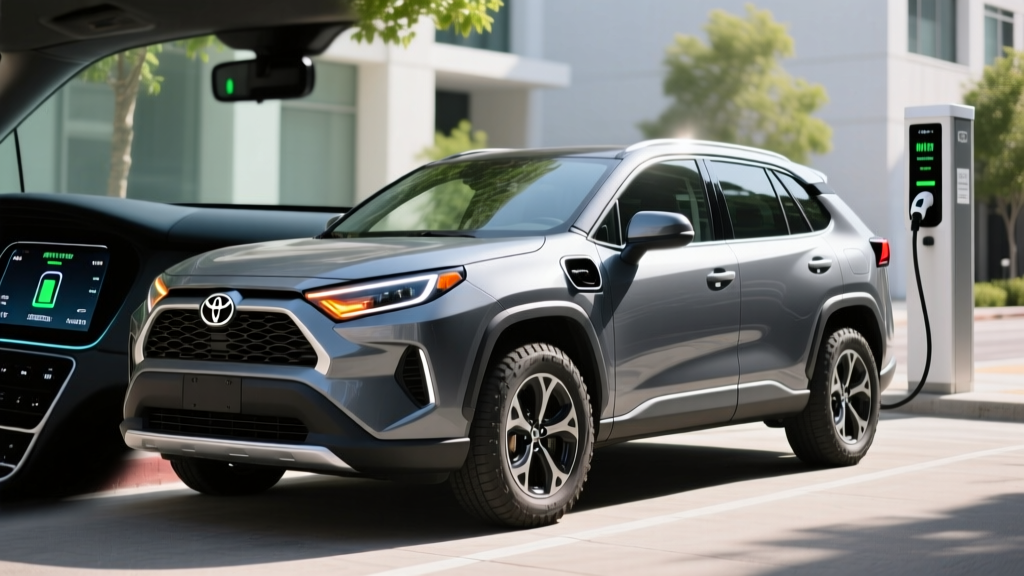
The Toyota RAV4 Prime PHEV occupies a rare sweet spot in the electrified-vehicle market: it delivers genuine electric-only commuting range, all-wheel-drive performance, and the cargo versatility of a compact SUV — without the range anxiety or charging dependency of a full battery-electric vehicle. For 2026, the RAV4 Prime continues to be one of the most sought-after plug-in hybrids on the road, and for good reason. But does it live up to its EPA sticker in the real world, and who should actually buy one over a conventional hybrid or a full EV?
This guide breaks down every critical spec — from electric range and charging times to battery warranty and federal tax credit eligibility — so you can make a data-driven decision.
HEV vs. PHEV: What Makes the RAV4 Prime Different?
Before diving into specs, it's essential to understand what separates the RAV4 Prime (a plug-in hybrid) from the standard RAV4 Hybrid (a conventional hybrid). Both use a gasoline engine paired with electric motors, but the architecture and daily driving experience are fundamentally different.
| Attribute | RAV4 Hybrid (HEV) | RAV4 Prime (PHEV) |
|---|---|---|
| Plug-in charging | No — self-charging via engine & regen | Yes — plug in to access EV mode |
| Battery capacity | 1.6 kWh (NiMH) | 18.1 kWh (Lithium-ion) |
| Electric-only range | <1 mile at low speed | 42 miles (EPA) |
| Combined horsepower | 219 HP | 302 HP |
| 0-60 mph | 7.4 sec | 5.7 sec |
| EPA combined MPG (hybrid mode) | 41 MPG | 38 MPG |
| MPGe (electric + gas combined) | N/A | 94 MPGe |
| Drivetrain | AWD (eAWD) | AWD (eAWD, more powerful rear motor) |
| Starting MSRP (2026) | ~$34,000 | ~$44,500 |
The conventional RAV4 Hybrid never needs to be plugged in. Its small battery recharges through regenerative braking and the gasoline engine. The RAV4 Prime's much larger 18.1 kWh lithium-ion battery can be charged from a wall outlet or Level 2 charger, enabling 42 miles of pure electric driving before the gasoline engine kicks in. Think of the Prime as an EV for your daily commute that carries a gasoline backup for longer trips.
Electric Range, MPGe, and Real-World Efficiency
The EPA rates the 2026 Toyota RAV4 Prime at 42 miles of electric-only range and 94 MPGe (miles per gallon equivalent) when operating in combined EV/hybrid mode. Once the battery is depleted and the vehicle switches to hybrid operation, the EPA rates it at 38 MPG combined.
| Mode | City | Highway | Combined |
|---|---|---|---|
| EV Mode (MPGe) | 105 MPGe | 84 MPGe | 94 MPGe |
| Hybrid Mode (MPG) | 40 MPG | 36 MPG | 38 MPG |
| EV Range | 42 miles (EPA estimate) | ||
| Total Range (EV + Gas) | ~600 miles | ||
Real-world expectations: In mixed suburban and city driving at moderate temperatures (60-80°F), owners consistently report achieving 38-44 miles on electric power — sometimes exceeding the EPA estimate on flat, low-speed routes. However, highway driving at 70+ mph and cold-weather operation (below 32°F) will reduce electric range by 15-25%. In winter testing at 25°F, expect roughly 30-34 miles of EV range. Once the battery is depleted, real-world hybrid-mode MPG tends to land between 35-39 MPG combined, with city driving often yielding higher numbers thanks to Toyota's regenerative braking optimization.
Powertrain and Performance Specs
The RAV4 Prime pairs a 2.5-liter inline-four Atkinson-cycle gasoline engine with two electric motors — one on the front axle and a more powerful motor on the rear axle — for a combined system output of 302 horsepower. This makes it the quickest RAV4 Toyota sells, hitting 0-60 mph in 5.7 seconds.
| Specification | Value |
|---|---|
| Powertrain | 2.5L I4 + 2 electric motors (PHEV) |
| Combined Horsepower | 302 HP |
| 0-60 mph | 5.7 seconds |
| Battery Capacity | 18.1 kWh (Lithium-ion) |
| EV Range (EPA) | 42 miles |
| MPGe (Combined) | 94 MPGe |
| Hybrid MPG (Combined) | 38 MPG |
| Drivetrain | Electronic AWD (eAWD) |
| Level 1 Charging (120V) | ~12 hours (0-100%) |
| Level 2 Charging (240V, 3.3 kW) | ~5.5 hours (0-100%) |
| Level 2 Charging (240V, 6.6 kW optional) | ~2.5 hours (0-100%) |
| DC Fast Charging | Not supported |
| Charger Port | J1772 (Level 2) |
| Cargo Volume (behind rear seats) | 33.5 cu ft |
| Towing Capacity | 1,500 lbs |
| Base MSRP (SE trim) | ~$44,500 |
| XSE Premium MSRP | ~$48,500 |
Unlike a full EV, the RAV4 Prime does not support DC fast charging. This is a deliberate engineering trade-off: adding DC fast-charge hardware would increase weight, cost, and packaging complexity for a battery that's small enough to fill on Level 2 power overnight. For a PHEV with 42 miles of range, Level 2 charging is the practical standard — most owners plug in at home each evening and wake up to a full battery.
Charging the RAV4 Prime: What You Need at Home
The RAV4 Prime charges through a standard J1772 connector. There is no NACS or CCS port because the vehicle does not accept DC fast charging. Here's what charging looks like across different power levels:
| Charging Level | Power (kW) | Time (0-100%) | Miles of EV Range per Hour |
|---|---|---|---|
| Level 1 (120V household outlet) | ~1.0 kW | ~12 hours | ~3.5 miles/hr |
| Level 2 (240V, standard 3.3 kW onboard) | 3.3 kW | ~5.5 hours | ~8 miles/hr |
| Level 2 (240V, optional 6.6 kW onboard) | 6.6 kW | ~2.5 hours | ~17 miles/hr |
Critical note for buyers: The base SE trim comes with a 3.3 kW onboard charger. The available 6.6 kW onboard charger (included on XSE and available as an option on SE) cuts charging time roughly in half. If you plan to charge at a public Level 2 station during the day — say, at work or a shopping center — the 6.6 kW option is highly recommended, as it can replenish the full battery in about 2.5 hours instead of 5.5.
For home charging, a standard 120V outlet technically works but takes about 12 hours for a full charge. Most Prime owners install a 240V Level 2 home charger (typically a 32-amp or 40-amp circuit), which fully replenishes the battery overnight. A Level 2 home charger installation typically costs $500-$1,500 for equipment plus $800-$2,500 for electrician labor and permits, depending on your panel capacity and wiring distance.
According to fueleconomy.gov, the RAV4 Prime's energy consumption in EV mode is rated at 36 kWh/100 miles — meaning a full charge costs roughly $5-$7 depending on your local electricity rate, making the per-mile cost approximately $0.04-$0.06 in electric mode versus $0.12-$0.15 per mile on gasoline at $3.50/gallon.
Pricing, Trims, and Tax Credit Eligibility
The 2026 Toyota RAV4 Prime is offered in two main trims:
- SE: Starting at approximately $44,500 MSRP (destination included). Includes the 3.3 kW onboard charger, 18-inch alloy wheels, heated front seats, Toyota Safety Sense 3.0, and an 8-inch touchscreen.
- XSE: Starting at approximately $48,500 MSRP. Adds the 6.6 kW onboard charger, SofTex-trimmed seats, 19-inch wheels, a 9-inch touchscreen with wireless Apple CarPlay/Android Auto, and a panoramic glass roof (optional package).
Does the RAV4 Prime Qualify for the Federal Tax Credit?
This is where buyers need to pay close attention. Under current IRS §30D Clean Vehicle Credit rules, the RAV4 Prime's eligibility for the full $7,500 federal tax credit depends on several factors that change annually:
- MSRP Cap: The vehicle must have an MSRP below $80,000 for SUVs — the RAV4 Prime qualifies easily.
- Buyer Income Cap: Adjusted gross income must not exceed $150,000 (single), $225,000 (head of household), or $300,000 (joint filing).
- Battery Sourcing: A percentage of critical minerals and battery components must be sourced from the U.S. or free-trade-agreement countries. These thresholds increase annually. Toyota's supply chain has been impacted by these requirements — verify current-year eligibility on the IRS qualified vehicles list before purchasing.
- Point-of-Sale Transfer: If eligible, the credit can be transferred to the dealer at purchase, reducing your out-of-pocket cost immediately rather than waiting for a tax refund.
- Final Assembly: The vehicle must undergo final assembly in North America. The RAV4 Prime is assembled in Japan, which may disqualify it from the §30D credit under current rules.
Bottom line on the tax credit: Because the RAV4 Prime is manufactured in Japan, it may not qualify for the §30D federal tax credit due to the North American final assembly requirement. Always verify on the fueleconomy.gov tax credit lookup and consult a tax professional before counting on the credit in your purchase math. Some state-level incentives (such as those in California, Colorado, and New York) may still apply regardless of assembly location — check your state's energy office for current programs.
Battery Warranty, Reliability, and Replacement Costs
Toyota's hybrid battery warranty is one of the strongest in the industry and a key reason the RAV4 Prime attracts reliability-conscious buyers.
• Duration: 10 years / 150,000 miles (whichever comes first)
• Coverage: Defects and capacity loss below a specified threshold (typically 60-70% of original capacity, as defined by Toyota's diagnostic standards)
• Hybrid System Warranty: 8 years / 100,000 miles covers the inverter, electric motors, and control systems
• Transferability: The hybrid battery warranty transfers to subsequent owners
Toyota's track record with hybrid batteries is exceptional. The company has been producing hybrid vehicles since the 1997 Prius, and real-world data shows that Toyota hybrid batteries routinely last 150,000-200,000+ miles before needing replacement. The RAV4 Prime's lithium-ion pack is more advanced than the older NiMH packs, with active thermal management to mitigate degradation.
Battery replacement cost: If the hybrid battery does need replacement out of warranty, expect to pay between $3,500 and $5,500 for a new OEM battery pack including labor. Refurbished or reconditioned packs are available for $2,000-$3,500. Given Toyota's warranty coverage and historical longevity, battery replacement is a low-probability expense for most owners.
In terms of overall vehicle reliability, Toyota consistently ranks at or near the top in owner satisfaction and reliability surveys. The RAV4 Prime adds complexity over a gas-only RAV4 with its electric motors and larger battery, but Toyota's hybrid powertrain has proven remarkably durable over two decades of production.
RAV4 Prime vs. Full EV vs. Gas RAV4: Which Fits You?
The RAV4 Prime makes sense for a specific buyer profile. Here's a practical decision framework:
Choose the RAV4 Prime PHEV if:
- Your daily commute is under 40 miles round-trip and you can charge at home
- You want EV-like daily driving but need gasoline flexibility for road trips
- You don't have reliable access to public DC fast chargers for longer trips
- You value AWD and want strong acceleration (302 HP, 5.7-sec 0-60)
- You're not ready to commit to a full EV but want to reduce gasoline consumption significantly
Choose a full EV (like the Tesla Model Y or Hyundai Ioniq 5) if:
- You have home Level 2 charging and your daily driving is under 250 miles
- You want zero gasoline expenses and minimal maintenance (no oil changes, no engine)
- You're eligible for the full $7,500 federal tax credit on qualifying EVs
- You want DC fast charging for road trips (200+ kW capability)
Choose the standard RAV4 Hybrid (HEV) if:
- You cannot install a home charger (apartment, street parking, no garage)
- Your budget is closer to $35,000 than $45,000
- You want excellent fuel economy (41 MPG combined) without any plug-in routine
- You drive more than 100 miles daily and rarely take short trips
The RAV4 Prime's $10,000+ premium over the RAV4 Hybrid is justified if you can charge at home and your commute falls within the 42-mile EV window. An owner who drives 30 miles daily and charges at home might use less than 100 gallons of gasoline per year — compared to roughly 375 gallons for a gas-only RAV4 and about 310 gallons for the standard hybrid. Over five years, the fuel savings can offset a meaningful portion of the price premium, especially when electricity rates are low.
Pros and Cons of the Toyota RAV4 Prime
- 42 miles of real-world EV range covers most commutes
- 302 HP / 5.7-sec 0-60 — quickest RAV4 available
- Standard AWD with capable rear electric motor
- Excellent 10yr/150k-mile hybrid battery warranty
- ~600-mile total range eliminates range anxiety
- Strong reliability reputation and resale value
- No dependence on public charging infrastructure
- No DC fast charging capability
- ~$44,500 starting price — $10K+ over standard hybrid
- Likely ineligible for §30D federal tax credit (Japan assembly)
- 3.3 kW base onboard charger is slow; 6.6 kW costs extra
- Cargo space slightly reduced vs. gas RAV4 (battery packaging)
- EV range drops to ~30-34 miles in freezing weather
- Dealer markups remain common due to high demand
Frequently Asked Questions
How many MPG does the Toyota RAV4 Prime get?
The EPA rates the RAV4 Prime at 94 MPGe combined when using both electric and gasoline power, and 38 MPG combined (40 city / 36 highway) in hybrid-only mode after the battery is depleted. In real-world driving, owners report 35-42 MPG in hybrid mode depending on driving conditions, with city driving typically yielding better results due to regenerative braking.
How far can the RAV4 Prime go on electric power alone?
The EPA estimates 42 miles of electric-only range. In real-world conditions, expect 38-44 miles in mild weather at moderate speeds, 36-38 miles on the highway, and 30-34 miles in freezing temperatures. The gasoline engine seamlessly engages once the battery is depleted, so you're never stranded.
Can the RAV4 Prime use DC fast chargers like a Tesla or Ioniq 5?
No. The RAV4 Prime only accepts Level 1 (120V) and Level 2 (240V) AC charging through a J1772 port. It cannot connect to DC fast chargers (CCS, NACS, or CHAdeMO). This is typical for PHEVs — the 18.1 kWh battery is small enough that Level 2 charging fills it overnight without the need for DC fast-charge hardware.
Is the RAV4 Prime reliable, and what does battery replacement cost?
Toyota's hybrid powertrains have an outstanding reliability record spanning over 25 years. The hybrid battery is warrantied for 10 years / 150,000 miles. Out-of-warranty replacement costs $3,500-$5,500 for a new OEM pack. Historical data from Toyota hybrids suggests most batteries last well beyond 150,000 miles.
Does the Toyota RAV4 Prime qualify for the $7,500 federal tax credit?
Most likely not under current rules. The §30D Clean Vehicle Credit requires final assembly in North America, and the RAV4 Prime is assembled in Japan. Always verify current eligibility on the IRS qualified vehicle list and fueleconomy.gov before purchasing. State-level incentives may still apply — check your state's clean vehicle rebate program.
How long does it take to charge the RAV4 Prime at home?
On a standard 120V household outlet (Level 1), a full charge takes about 12 hours. On a 240V Level 2 charger with the standard 3.3 kW onboard charger, expect about 5.5 hours. With the available 6.6 kW onboard charger (standard on XSE), a full charge takes approximately 2.5 hours.
Should I buy the RAV4 Prime or a full EV?
If you can charge at home, your daily driving is under 40 miles, and you occasionally take long road trips where DC fast-charging access is uncertain, the RAV4 Prime is an excellent bridge. If your daily driving is under 250 miles, you have reliable home and public charging access, and you want zero gasoline costs, a full EV like the Tesla Model Y or Hyundai Ioniq 5 may serve you better at a comparable or lower total cost of ownership — especially if you qualify for the federal tax credit on qualifying EVs.