If you have been searching for a breakdown of the Honda Civic Hybrid interior, you are likely weighing one of the most efficient compact sedans on the market against a full battery-electric vehicle. For 2026, Honda continues to refine its two-motor hybrid system in the Civic, delivering exceptional fuel economy without the range anxiety or charging logistics of a BEV. This guide covers everything from cabin materials and tech to the exact MPG figures, powertrain specs, and long-term battery reliability data you need before buying.
HEV vs PHEV: Which Civic Hybrid Are We Talking About?
It is critical to distinguish between a conventional hybrid (HEV) and a plug-in hybrid (PHEV) before evaluating any vehicle. The 2026 Honda Civic Hybrid is a conventional series-parallel HEV. It does not have a plug, does not offer electric-only driving for meaningful distances, and never needs to be connected to a charger. Instead, it uses regenerative braking and its gasoline engine to keep a small lithium-ion battery charged, which then assists the engine and enables brief electric-only operation at low speeds.
Honda does not currently offer a Civic PHEV in the US market. If you need plug-in capability with 30+ miles of electric-only range, you would need to look at competitors like the Toyota Prius Prime or step up to the Honda Clarity PHEV (discontinued after 2021) on the used market. The Civic Hybrid's value proposition is simplicity: no charging routine, no reduced cargo space from a large battery pack, and a lower purchase price than any PHEV.
Fuel Economy: EPA Ratings vs Real-World MPG
The headline number for the 2026 Civic Hybrid is its EPA-estimated combined fuel economy. Honda's two-motor hybrid system excels in city driving where regenerative braking recaptures energy constantly, and the engine can shut off entirely at stops and during low-load cruising.
| Metric | EPA Estimate | Real-World Expectation |
|---|---|---|
| City MPG | 50 MPG | 48–53 MPG (hybrids often beat EPA in city) |
| Highway MPG | 47 MPG | 42–46 MPG (engine runs more at sustained speed) |
| Combined MPG | 49 MPG | 46–50 MPG depending on driving mix |
| Total Range | ~570 miles | ~520–580 miles (12.4-gallon tank) |
Unlike full EVs, which lose significant range in cold weather and at highway speeds, the Civic Hybrid's efficiency remains remarkably stable across conditions. The gasoline engine generates its own heat for cabin warming, so winter MPG drops are modest — typically 2–4 MPG in freezing temperatures, compared to the 20–30% range loss a BEV might experience. According to fueleconomy.gov, the Civic Hybrid's combined rating places it among the most efficient non-plug-in vehicles available in 2026.
Powertrain Specs: Two-Motor Hybrid System
The 2026 Civic Hybrid uses Honda's fourth-generation two-motor hybrid system, pairing a 2.0-liter Atkinson-cycle four-cylinder engine with two electric motors and an electronically controlled continuously variable transmission (eCVT). This is fundamentally different from a traditional belt-driven CVT — there are no belts or pulleys. Instead, the system uses motor-generator units to manage the power split between engine and wheels.
| Specification | 2026 Honda Civic Hybrid |
|---|---|
| Engine | 2.0L DOHC Atkinson-cycle 4-cylinder |
| Engine Power | 146 hp @ 6,000 rpm |
| Electric Motor Power | 184 hp / 232 lb-ft torque |
| Combined System Output | 200 hp / 232 lb-ft torque |
| Transmission | eCVT (two-motor direct-drive) |
| 0–60 mph | ~6.5 seconds |
| Drivetrain | Front-wheel drive |
| Hybrid Battery | ~1.0 kWh lithium-ion (not plug-in) |
| Drive Modes | Normal, ECON, Sport, Individual |
The combined 200 horsepower makes the Civic Hybrid noticeably quicker than most compact hybrid competitors. In Sport mode, the electric motor delivers instant torque from a stop, giving it a responsive feel that masks the Atkinson-cycle engine's inherent low-rpm sluggishness. The engine primarily acts as a generator at lower speeds, only driving the wheels directly at higher cruising speeds where it operates most efficiently.
Inside the Cabin: Interior Quality, Tech, and Space
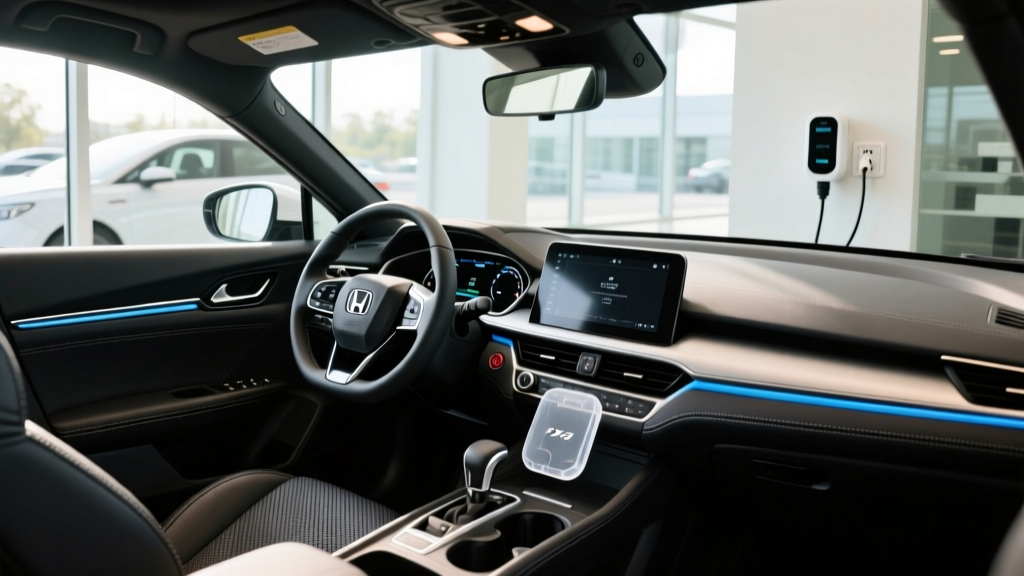
The Honda Civic Hybrid interior shares its architecture with the standard Civic lineup but adds hybrid-specific instrumentation and displays. For 2026, the cabin features Honda's updated 10.2-inch digital instrument cluster with hybrid energy-flow displays, battery state-of-charge monitoring, and real-time MPG readouts. The center stack houses either a 7-inch or available 9-inch touchscreen (depending on trim) running Honda's latest infotainment system with wireless Apple CarPlay and Android Auto on upper trims.
Material quality in the Sport Hybrid and Sport Touring Hybrid trims includes leather-trimmed seats, a leather-wrapped steering wheel, and soft-touch surfaces on the dashboard and door panels. The Touring trim adds heated and ventilated front seats, a heated steering wheel, and a 12-speaker Bose premium audio system.
Critically, the hybrid battery pack is mounted low and does not intrude on passenger or cargo space. The Civic Hybrid sedan offers 14.8 cubic feet of trunk volume — identical to the non-hybrid Civic sedan. The hatchback variant provides 24.4 cubic feet behind the rear seats, making it one of the most practical vehicles in its efficiency class. Rear legroom measures 37.4 inches, comfortably fitting adults on longer trips.
Pricing, Trims, and Tax Credit Eligibility
The 2026 Honda Civic Hybrid is available in Sport Hybrid and Sport Touring Hybrid trims for both sedan and hatchback body styles.
| Trim | Body Style | MSRP |
|---|---|---|
| Sport Hybrid | Sedan | $29,845 |
| Sport Touring Hybrid | Sedan | $32,845 |
| Sport Hybrid | Hatchback | $30,845 |
| Sport Touring Hybrid | Hatchback | $33,845 |
All prices include destination charges. The Civic Hybrid does not qualify for the federal §30D clean vehicle tax credit. Under current IRS rules, only plug-in electric vehicles (BEVs and PHEVs with at least 7 kWh of battery capacity) are eligible for the up-to-$7,500 credit. Conventional hybrids like the Civic Hybrid are excluded regardless of their efficiency. Some states may offer minor incentives for high-efficiency vehicles, but these vary by jurisdiction — check your state's energy office or department of revenue for specifics.
Despite the lack of a federal credit, the Civic Hybrid's lower MSRP compared to most EVs and PHEVs means its effective purchase price is often lower. A comparably equipped EV might cost $38,000–$45,000 before credits, and even after a $7,500 credit, the Civic Hybrid undercuts it while requiring zero charging infrastructure investment.
Battery Longevity, Warranty, and Replacement Costs
Honda Hybrid Battery Warranty: The Civic Hybrid's lithium-ion battery pack is covered by Honda's hybrid system warranty for 10 years or 150,000 miles (whichever comes first) in all 50 states. In states that follow California Air Resources Board (CARB) emissions warranty requirements — including California, New York, Massachusetts, and several others — the hybrid battery is covered for 10 years or 150,000 miles as well, with some components covered up to 15 years/150,000 miles under the PZEV warranty.
Hybrid battery degradation in the Civic is a non-issue for most owners. Unlike a BEV battery that cycles deeply every day, the Civic Hybrid's small battery operates in a narrow state-of-charge window (roughly 40–80% SoC), managed by the powertrain control module. This shallow cycling dramatically extends cell life. Honda's fourth-generation hybrid system has shown excellent durability in long-term fleet data, with most batteries lasting well beyond the warranty period.
If a replacement is needed out of warranty, a new OEM hybrid battery for the Civic Hybrid typically costs between $2,000 and $3,500 including installation at a dealership. Independent hybrid specialists can often perform the replacement for $1,500–$2,500 using refurbished or aftermarket cells. This is a fraction of BEV battery replacement costs, which can exceed $10,000–$20,000.
Civic Hybrid vs Full EV vs Gas Civic: Decision Framework
Choose the Civic Hybrid if:
- You cannot install a Level 2 home charger (apartment, street parking, no garage)
- You regularly drive more than 300 miles in a single day without planned charging stops
- You want maximum fuel efficiency (49 MPG combined) with zero lifestyle changes
- You live in an area with sparse DC fast-charging infrastructure
- Your budget is under $35,000 and you don't qualify for or want to rely on tax credits
Choose a full EV (like the Chevrolet Bolt or Hyundai Kona Electric) if:
- You have reliable home Level 2 charging and a predictable daily commute under 200 miles
- You want the lowest per-mile fuel cost (electricity at $0.13/kWh ≈ $0.04/mile vs gas at $0.08–$0.12/mile for the hybrid)
- You qualify for the full $7,500 federal tax credit and your state offers additional EV incentives
- You prioritize zero tailpipe emissions and reduced maintenance (no oil changes, fewer brake replacements)
Choose the gas-only Civic if:
- Your annual mileage is under 8,000 miles (fuel savings won't offset the hybrid premium)
- You prefer the lowest possible upfront price (gas Civic starts around $24,000)
- You plan to keep the car under 4 years (hybrid fuel savings take time to recoup)
Pros and Cons at a Glance
Pros
- 49 MPG combined EPA — among the best in the compact class
- 200 hp combined output makes it genuinely quick for a hybrid
- No charging required — works with existing gas-station infrastructure
- Identical cargo and passenger space to non-hybrid Civic
- 10-year/150,000-mile hybrid battery warranty
- Stable efficiency in cold weather and at highway speeds
- Well-built interior with modern tech and available premium features
Cons
- No federal tax credit eligibility (HEV, not PHEV/BEV)
- No electric-only driving mode for zero-emission short trips
- Slightly higher MSRP than gas-only Civic (~$4,000–$5,000 premium)
- FWD only — no AWD option for snow-belt buyers
- Regenerative braking feel takes adjustment (can be grabby in Sport mode)
- eCVT drone under hard acceleration (common to all series-parallel hybrids)
Frequently Asked Questions
How many MPG does the 2026 Honda Civic Hybrid get?
The EPA rates the 2026 Civic Hybrid at 50 MPG city, 47 MPG highway, and 49 MPG combined. In real-world driving, many owners report matching or slightly exceeding the city rating thanks to aggressive regenerative braking, while highway MPG tends to run 2–5 MPG below the sticker depending on speed and terrain.
Does the Civic Hybrid need to be plugged in?
No. The Civic Hybrid is a conventional HEV, not a plug-in hybrid. It charges its own battery through regenerative braking and the gasoline engine. You fuel it exclusively at gas stations, exactly like a standard car.
How far can the Civic Hybrid drive on electric power alone?
Less than 1 mile, and only at very low speeds (under 25 mph). The hybrid battery is approximately 1.0 kWh — far too small for meaningful electric-only range. Its purpose is to assist the engine and capture braking energy, not to serve as a primary propulsion source.
Is the Honda Civic Hybrid reliable?
Honda's hybrid systems have demonstrated strong reliability over multiple generations. The two-motor eCVT design eliminates the mechanical complexity of a traditional transmission — there are no gears, belts, or clutch packs to wear out. The hybrid battery is warrantied for 10 years/150,000 miles, and historical data from earlier Honda hybrids (Insight, Accord Hybrid) shows most batteries lasting well beyond 150,000 miles with proper maintenance.
What does a Civic Hybrid battery replacement cost?
An OEM replacement hybrid battery costs approximately $2,000–$3,500 installed at a Honda dealership. Aftermarket or refurbished batteries from independent hybrid specialists can reduce this to $1,500–$2,500. Given the 10-year warranty and the battery's shallow-cycling design, most owners will never face this expense.
Does the Civic Hybrid qualify for any tax credits?
The Civic Hybrid does not qualify for the federal §30D clean vehicle tax credit, which is reserved for plug-in vehicles (BEVs and PHEVs). Check your state's energy office for any local efficiency incentives, but most state programs also require plug-in capability.
How does the Civic Hybrid compare to the Toyota Prius?
The 2026 Prius offers slightly higher EPA ratings (up to 57 MPG combined on the LE trim) and an available AWD option. However, the Civic Hybrid delivers 200 hp compared to the Prius's 196 hp, with a more conventional driving feel and a more premium interior on upper trims. The Prius also offers a PHEV variant (Prius Prime) with 44 miles of electric-only range if you want plug-in capability.
The 2026 Honda Civic Hybrid remains one of the smartest purchases in the compact car segment for drivers who want maximum efficiency without changing their fueling habits. Its interior quality, strong powertrain output, and proven hybrid reliability make it a compelling alternative to both gas-only compacts and full electric vehicles — especially for buyers without home charging access.