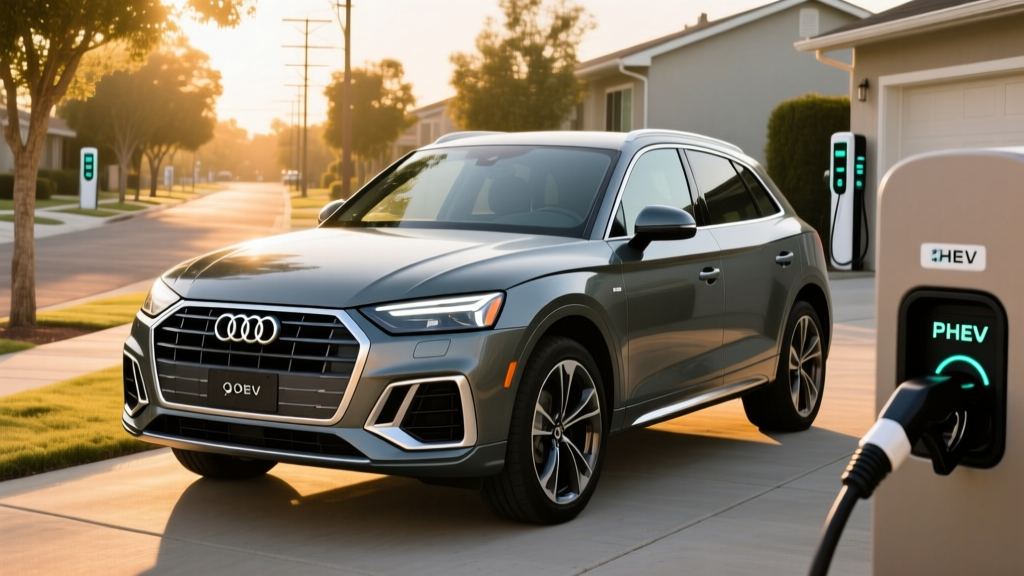
If you're researching the gas mileage of the Audi Q5 hybrid, you're likely weighing whether a luxury plug-in hybrid SUV can meaningfully cut your fuel costs without sacrificing performance or comfort. The 2026 Audi Q5 55 TFSI e — Audi's current plug-in hybrid electric (PHEV) variant of its best-selling compact luxury SUV — offers a compelling middle ground between a conventional gas model and a full battery-electric vehicle. But the real question buyers ask is: how does it actually perform at the pump and on the road?
This guide breaks down the EPA-rated and real-world fuel economy of the Audi Q5 PHEV, its electric-only range, charging logistics, powertrain specs, pricing, and whether it qualifies for federal tax credits in 2026.
Audi Q5 Hybrid MPG: The EPA Numbers
The 2026 Audi Q5 55 TFSI e is a plug-in hybrid, meaning it pairs a turbocharged gasoline engine with an electric motor and a battery you can charge from an external source. When the battery is depleted, it operates like a conventional hybrid, using regenerative braking and engine optimization to maximize efficiency.
| Metric | Value |
|---|---|
| Combined MPG | 25 MPG |
| City MPG | 24 MPG |
| Highway MPG | 27 MPG |
| Combined MPGe (with electric) | 61 MPGe |
| Electric-Only Range | 23 miles (EPA) |
| Total Combined Range | ~420 miles |
| Fuel Tank Capacity | 14.8 gallons |
Source: EPA fueleconomy.gov
Real-World MPG vs. EPA Estimates
EPA stickers are a starting point, not a guarantee. With the Q5 55 TFSI e, real-world results depend heavily on your driving patterns and charging habits.
City driving with regular charging: If you plug in nightly and your daily commute is under 23 miles, you may use almost no gasoline during the week. Owners with short commutes and home Level 2 chargers report effective fuel consumption equivalent to 50+ MPGe over a month of mixed use.
Highway road trips: Once the battery depletes on a long drive, expect the 2.0-liter turbo four to deliver roughly 26–28 MPG at 70 mph cruising speeds — slightly above the EPA highway figure, which is typical for turbocharged hybrids at steady speed. Cold weather (below 35°F) and mountain grades can reduce this to 22–24 MPG.
Charge-sustaining city driving: Without plugging in, the Q5 operates as a conventional hybrid. Expect 22–24 MPG in stop-and-go traffic, slightly below the EPA city rating, because the relatively small 17.9 kWh battery provides limited electric assist between stops compared to a dedicated HEV like the Toyota RAV4 Hybrid.
The key takeaway: the Q5 PHEV rewards owners who charge regularly. If you never plug it in, you're carrying 400+ pounds of battery and motor hardware for minimal efficiency gain over the gas-only Q5 45 TFSI (rated at 25 MPG combined).
Electric-Only Range and Charging Specs
The 2026 Q5 55 TFSI e carries a 17.9 kWh lithium-ion battery pack (NMC chemistry), of which approximately 14.1 kWh is usable — the rest is buffer to protect long-term battery health.
| Specification | Detail |
|---|---|
| Battery Capacity (Total / Usable) | 17.9 kWh / ~14.1 kWh |
| Battery Chemistry | NMC (Nickel Manganese Cobalt) |
| EPA Electric-Only Range | 23 miles |
| Real-World Electric Range (70°F) | 20–23 miles |
| Real-World Electric Range (30°F) | 15–18 miles |
| Onboard Charger (Level 2) | 7.7 kW |
| Level 2 Charge Time (0–100%) | ~2.5 hours |
| Level 1 Charge Time (120V) | ~8 hours |
| DC Fast Charging | Not supported |
| Charging Port | J1772 (Level 2) |
No DC fast charging: This is a significant limitation for apartment dwellers or those without home charging access. The Q5 PHEV can only accept Level 2 AC charging at 7.7 kW. A full charge from a 240V home charger or public Level 2 station takes about 2.5 hours. On a standard 120V household outlet (Level 1), expect roughly 8 hours — feasible for overnight charging but impractical for quick top-ups.
Cold-weather range loss: Like all lithium-ion batteries, the Q5's pack loses efficiency in cold temperatures. Expect electric-only range to drop to 15–18 miles when temperatures fall below freezing, especially if you're using cabin heating. The Q5 PHEV does not include a dedicated heat pump for the cabin — it relies on engine waste heat and resistive heating, which further reduces electric-only range in winter.
Powertrain: Engine, Motor, and Combined Output
The Q5 55 TFSI e pairs Audi's 2.0-liter turbocharged four-cylinder engine with an electric motor integrated into the 7-speed S tronic dual-clutch transmission.
| Component | Specification |
|---|---|
| Gasoline Engine | 2.0L Turbocharged I4 |
| Engine Output | 261 hp / 273 lb-ft torque |
| Electric Motor | Integrated in transmission |
| Motor Output | 141 hp / 258 lb-ft torque |
| Combined System Output | 362 hp / 369 lb-ft torque |
| Transmission | 7-speed S tronic dual-clutch automatic |
| Drivetrain | quattro AWD |
| 0–60 mph | 5.0 seconds |
| Towing Capacity | 4,400 lbs |
The combined 362 horsepower makes the PHEV the most powerful Q5 variant short of the SQ5 performance model. The electric motor fills in torque at low RPMs, eliminating turbo lag and delivering smooth, immediate acceleration from a stop. In EV-only mode, the Q5 can reach speeds up to 84 mph — sufficient for most suburban and city driving.
Three drive modes govern powertrain behavior:
- EV Mode: Pure electric driving until the battery depletes or you demand heavy acceleration.
- Hybrid Mode: The system blends engine and motor for optimal efficiency, using GPS and route data (when navigation is active) to manage battery usage intelligently across your trip.
- Battery Hold/Charge Mode: Preserves or replenishes battery charge using the engine — useful when you want to save electric range for a zero-emission zone or city center later in your drive.
HEV vs. PHEV: What Audi Offers (and Doesn't)
Conventional Hybrid (HEV)
Does Audi sell one? No. Audi does not currently offer a conventional (non-plug-in) hybrid version of the Q5 in the US market. The Q5 mild-hybrid system (MHEV) on the 45 TFSI uses a small 12V belt-driven starter-generator for stop-start smoothing and minor coasting assist, but it cannot drive the vehicle on electric power alone and does not meaningfully improve MPG.
How it works: HEVs recharge their battery entirely through regenerative braking and engine power. No plug required. Examples: Toyota RAV4 Hybrid (39 MPG combined), Honda CR-V Hybrid (40 MPG combined).
Plug-In Hybrid (PHEV)
This is the Q5 55 TFSI e. It offers 23 miles of electric-only driving when charged from an external source, then operates as a hybrid once the battery is depleted.
How it works: Plug in to a Level 2 charger for maximum benefit. The larger battery (17.9 kWh vs. ~1 kWh in an HEV) enables meaningful electric-only commutes. Trade-off: higher purchase price, added weight, and no DC fast charging.
Pricing, Trims, and Tax Credit Eligibility
The 2026 Audi Q5 55 TFSI e is offered in three trims. Pricing reflects MSRP before destination charges and any applicable incentives.
| Trim | MSRP |
|---|---|
| Premium | $58,200 |
| Premium Plus | $62,400 |
| Prestige | $67,100 |
Source: Audi USA
Federal Tax Credit (§30D) — 2026 Rules
The Audi Q5 55 TFSI e does not qualify for the full $7,500 federal EV tax credit under IRS §30D as of 2026. The credit's battery component and critical minerals sourcing requirements have tightened significantly since the Inflation Reduction Act's passage, and the Q5 PHEV's battery supply chain does not currently meet the thresholds.
- MSRP Cap: SUVs must be under $80,000 (Q5 qualifies on price)
- Buyer Income Cap: $150K single / $300K joint AGI
- Battery Capacity: Minimum 7 kWh (Q5's 17.9 kWh qualifies)
- Critical Minerals: Must meet escalating percentage thresholds sourced from US or FTA partners
- Battery Components: Must meet escalating percentage manufactured in North America
- FEOC Restriction: No battery components from Foreign Entities of Concern
Always verify current eligibility at IRS.gov or with a tax professional before purchasing. Rules change frequently.
State incentives: Several states offer their own PHEV rebates or HOV lane access. California's Clean Vehicle Rebate Project (CVRP), Colorado's innovative motor vehicle credit, and New York's Drive Clean Rebate have historically included PHEVs, though amounts and eligibility vary by year and funding availability. Check your state's energy or environmental agency for current programs.
Battery Warranty, Reliability, and Replacement Costs
- High-Voltage Battery: 8 years / 100,000 miles (whichever comes first)
- Capacity Retention Threshold: Warranty covers the battery if it falls below 70% of original capacity within the warranty period
- Powertrain (Engine + Transmission + Motor): 4 years / 50,000 miles
- Bumper-to-Bumper: 4 years / 50,000 miles
Reliability outlook: Audi's PHEV powertrain has been in production since the 2019 model year (as the Q5 55 TFSI e), giving it a multi-year track record. The 2.0L TFSI engine is one of Volkswagen Group's most widely deployed powerplants. Common maintenance items are consistent with other turbocharged Audi models: timing chain tensioner inspections, carbon buildup on intake valves (direct injection), and DSG transmission fluid services at 40,000-mile intervals.
The high-voltage battery uses proven NMC pouch cells manufactured by a Tier 1 supplier. Based on industry data for similar-capacity PHEV packs, expected degradation is 10–15% over 8 years / 100,000 miles — well within the 70% warranty threshold. Because PHEV batteries are smaller and cycled less deeply than full BEV batteries, they tend to experience less calendar and cycle degradation.
Battery replacement cost: Out of warranty, a Q5 PHEV high-voltage battery replacement currently runs $8,000–$12,000 including parts and labor at an Audi dealer. However, out-of-warranty replacements remain rare for vehicles less than 10 years old. Individual module replacement (rather than the full pack) may be possible at lower cost depending on the failure mode.
Source: Audi Warranty Information
Who Should Buy the Q5 PHEV — and Who Shouldn't
✓ Choose the Q5 PHEV If:
- You have home Level 2 charging and a commute under 25 miles round-trip
- You want a luxury compact SUV but aren't ready for a full EV
- You frequently take road trips where charging infrastructure is sparse
- You value the 362 hp combined output and quattro AWD
- You want HOV lane access in states that offer it for PHEVs
✗ Look Elsewhere If:
- You can't charge at home or work (the PHEV premium is wasted without plugging in)
- You want 40+ MPG combined without charging — consider the Lexus NX 350h (39 MPG, conventional hybrid)
- You want 200+ miles of electric range — consider the Tesla Model Y, BMW iX, or Audi Q4 e-tron (full BEVs)
- You want DC fast charging for quick public top-ups
- You're budget-conscious — the gas Q5 45 TFSI starts ~$12,000 less and gets similar MPG when the PHEV isn't charged
Decision Framework: Hybrid vs. PHEV vs. Full EV
| Factor | Conventional Hybrid (HEV) | Plug-In Hybrid (PHEV) | Battery Electric (BEV) |
|---|---|---|---|
| No plug-in needed | ✓ Yes | ✗ Must plug in for benefit | ✗ Must plug in |
| Electric-only driving | ✗ No | ✓ 15–40 miles typical | ✓ 200–350 miles typical |
| Home charging required | No | Strongly recommended | Essential |
| Road trip convenience | Excellent | Excellent | Requires planning |
| Lowest running cost | Moderate | Low (if charging daily) | Lowest |
| Example in this segment | Lexus NX 350h | Audi Q5 55 TFSI e | Audi Q4 e-tron / Tesla Model Y |
Frequently Asked Questions
How many MPG does the Audi Q5 hybrid get?
The 2026 Audi Q5 55 TFSI e (plug-in hybrid) gets 25 MPG combined (24 city / 27 highway) when operating in hybrid mode with a depleted battery. When starting with a full charge, it achieves 61 MPGe combined. Real-world highway driving can yield 26–28 MPG in charge-sustaining mode; cold weather and aggressive driving reduce this to 22–24 MPG.
How far can the Audi Q5 PHEV go on electric only?
The EPA rates the Q5 55 TFSI e at 23 miles of electric-only range. In mild weather (65–75°F), expect 20–23 real-world miles. In freezing temperatures, expect 15–18 miles due to reduced battery efficiency and cabin heating demands. The vehicle can reach up to 84 mph in EV mode.
Does the Audi Q5 hybrid qualify for a federal tax credit?
As of 2026, the Audi Q5 55 TFSI e does not qualify for the $7,500 federal §30D tax credit due to battery sourcing requirements. It meets the MSRP cap ($80K for SUVs) and battery capacity threshold (7 kWh minimum), but its battery components do not satisfy the critical minerals and North American manufacturing percentages required for 2026. Verify at IRS.gov before purchase — rules update periodically.
Is the Audi Q5 PHEV reliable? What about battery replacement cost?
The Q5 PHEV powertrain has been in production since 2019 with no widespread battery failure reports. The high-voltage battery is warranted for 8 years/100,000 miles against capacity loss below 70%. Out-of-warranty battery replacement costs $8,000–$12,000 at a dealer, though full replacements are uncommon within the first decade. Standard maintenance follows typical Audi intervals.
Can the Audi Q5 PHEV DC fast charge?
No. The Q5 55 TFSI e supports only AC charging: Level 2 at 7.7 kW (full charge in ~2.5 hours) and Level 1 at 120V (~8 hours). There is no DC fast charging capability. This is standard for most PHEVs in this class — only a few competitors (like the Mitsubishi Outlander PHEV) offer DC fast charging.
What's the difference between the Q5 mild hybrid and Q5 PHEV?
The standard Q5 45 TFSI has a 12V mild-hybrid system (MHEV) that assists with stop-start and coasting but cannot propel the car on electricity alone. It gets 25 MPG combined. The Q5 55 TFSI e is a full plug-in hybrid with a 17.9 kWh battery, 23 miles of electric-only range, and 362 combined horsepower — a fundamentally different powertrain with a significantly higher price.