The Highlander Goes Plug-In: What Toyota's 3-Row PHEV Actually Delivers
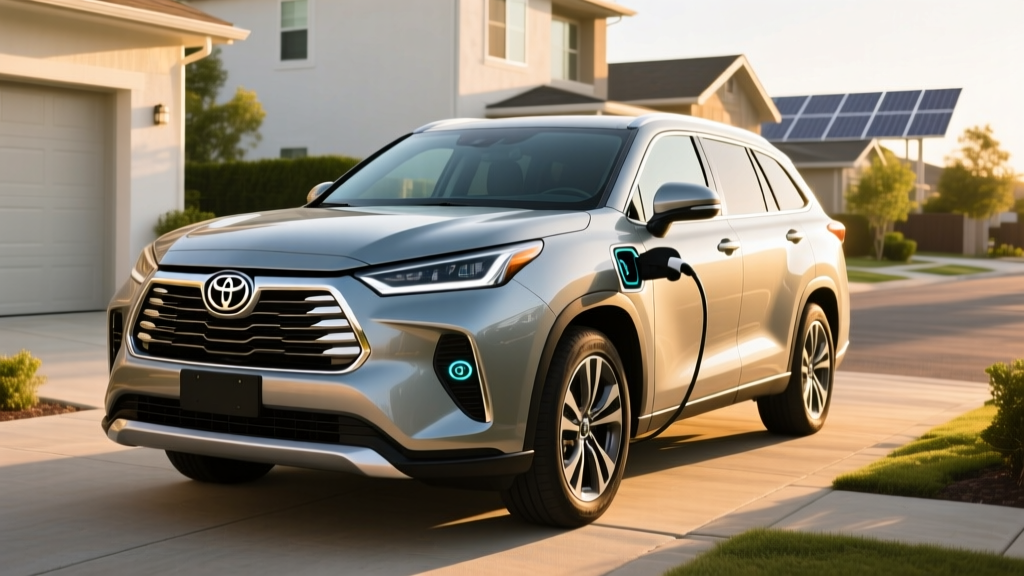
For years, the Toyota Highlander Hybrid has been the default three-row family hauler for buyers who want better fuel economy without plugging in. But with the introduction of the Toyota Highlander Plug-In Hybrid, Toyota is targeting a different buyer: the family that wants short electric-only commutes during the week and gas-engine flexibility for road trips — without committing to a full battery electric vehicle.
This guide breaks down everything you need to know about the 2026 Highlander PHEV — from its EPA-rated electric range and combined MPG, to its battery warranty, tax credit eligibility, and how it stacks up against both the conventional Highlander Hybrid and full-electric three-row competitors like the Kia EV9.
HEV vs PHEV: Understanding the Two Highlander Hybrid Options
Toyota now offers the Highlander with two distinct electrified powertrains. Confusing them is easy — and costly — if you don't know the difference.
| Feature | Highlander Hybrid (HEV) | Highlander Plug-In Hybrid (PHEV) |
|---|---|---|
| Battery Size | ~1.6 kWh (NiMH) | ~18.1 kWh (lithium-ion) |
| Plug-In Required? | No — self-charging via regen & engine | Yes — plug in to access electric-only range |
| Electric-Only Range | None (EV mode limited to ~1 mile at low speed) | EPA est. 32 miles |
| Combined MPG (gas) | 35 MPG combined | 35 MPG combined (after battery depleted) |
| Combined HP | 243 hp | 302 hp |
| DC Fast Charging | N/A | No — Level 2 AC only |
| Federal Tax Credit | Not eligible | Potentially eligible (see §30D rules below) |
The conventional HEV never needs a plug. Its small battery captures energy from regenerative braking and the gas engine, delivering a consistent 35 MPG combined whether you drive 10 miles or 500. The PHEV adds a much larger battery pack and more powerful electric motors, enabling genuine electric-only driving for most daily commutes — but it requires access to a charging outlet to realize those benefits.
Electric-Only Range and Total Driving Range
The Highlander PHEV carries an estimated 18.1 kWh lithium-ion battery pack (approximately 14.5 kWh usable, with the remainder reserved as a buffer to protect long-term battery health). On that usable capacity, the EPA rates the Highlander PHEV at 32 miles of electric-only range.
- EPA sticker: 32 miles electric-only
- Real-world (mild weather, mixed driving): 28–34 miles — PHEVs often match or slightly exceed EPA in city driving thanks to regen braking
- Highway (70+ mph): ~22–26 miles — aerodynamic drag and sustained speed drain the battery faster
- Cold weather (below 32°F): ~20–25 miles — cabin heating and reduced battery efficiency cut range 20–30%
Once the battery is depleted, the Highlander PHEV operates as a conventional hybrid, relying on its 2.5-liter four-cylinder engine paired with the electric motor system. With a full 17.9-gallon fuel tank and 35 MPG combined, total range after battery depletion extends to approximately 625+ miles — eliminating the range anxiety that some pure EV buyers experience on long trips.
Combined electric + gas range from a full battery and full tank: roughly 657 miles.
Fuel Economy and MPGe: The Full Efficiency Picture
PHEV efficiency is measured two ways: MPGe (miles-per-gallon-equivalent) when running on electricity, and standard MPG when running on gas. Both matter depending on your driving pattern.
| Mode | City | Highway | Combined |
|---|---|---|---|
| Electric-only (MPGe) | 94 MPGe | 84 MPGe | 89 MPGe |
| Gas hybrid mode (MPG) | 36 MPG | 34 MPG | 35 MPG |
Real-world MPG reality check: Toyota's hybrid system is one of the most consistent in the industry. In city and suburban driving, owners of the conventional Highlander Hybrid routinely report matching or slightly exceeding the EPA combined figure, thanks to the frequent engine-off coasting and regenerative braking in stop-and-go traffic. Highway driving is where real-world numbers tend to dip — expect 30–32 MPG at sustained 75–80 mph speeds. The PHEV behaves identically once its battery is depleted.
For context, the non-hybrid gas Highlander (if still available in your market) averages around 24 MPG combined. The PHEV's advantage is substantial — especially if most of your weekday driving falls within that 32-mile electric window.
Powertrain, Performance, and Charging Specs
| Engine | 2.5L 4-cylinder Atkinson-cycle |
| Electric Motors | Front + rear (eAWD standard) |
| Combined Horsepower | 302 hp |
| Battery Capacity | 18.1 kWh total / ~14.5 kWh usable |
| Battery Chemistry | Lithium-ion (NMC) |
| Electric-Only Range | EPA est. 32 miles |
| Level 1 Charging (120V) | ~12 hours (full charge) |
| Level 2 Charging (240V, 3.3 kW) | ~4.5 hours (full charge) |
| DC Fast Charging | Not supported |
| 0–60 mph | ~6.8 seconds (est.) |
| Drivetrain | Electronic AWD (eAWD) |
| Towing Capacity | 3,500 lbs |
| Seating | 7 passengers (2nd-row captain's chairs) or 8 (bench) |
Charging: Level 2 Only, and That's Usually Fine
The Highlander PHEV charges via a standard J1772 connector at up to 3.3 kW on Level 2 (240V). It does not support DC fast charging — a limitation shared with most PHEVs, since the battery is small enough that overnight Level 2 charging is sufficient.
On a standard 120V household outlet (Level 1), a full charge takes roughly 12 hours. Most PHEV owners install a Level 2 charger at home (a 240V outlet or hardwired unit), bringing that down to about 4.5 hours. If you plug in when you get home from work, the battery will be fully replenished well before morning. For PHEV use cases, DC fast charging is largely unnecessary — you're charging overnight, not on a road trip.
A typical Level 2 home charger installation costs between $500 and $2,000 depending on whether your electrical panel needs an upgrade. For a detailed breakdown, see our Level 2 home charging cost guide.
Pricing, Trims, and Federal Tax Credit Eligibility
The 2026 Highlander Plug-In Hybrid is expected to start at approximately $48,500 (LE trim, including destination), with higher trims (XLE, Limited, Platinum) pushing the MSRP toward $55,000–$58,000.
Does the Highlander PHEV Qualify for the Federal Tax Credit?
PHEV eligibility for the IRS §30D Clean Vehicle Credit is more complex than a simple yes or no. The credit can reach up to $7,500, but qualification depends on several requirements that change periodically:
- MSRP cap: SUVs/vans/pickups must have an MSRP at or below $80,000 — the Highlander PHEV clears this threshold on all trims.
- Buyer income cap: Modified adjusted gross income (MAGI) must not exceed $150,000 (single), $225,000 (head of household), or $300,000 (joint filers).
- Battery component sourcing: A percentage of battery components must be manufactured or assembled in North America (threshold increases annually under IRA rules).
- Critical minerals: A percentage of critical minerals must be sourced from the U.S. or a free-trade-agreement partner country (threshold also increases annually).
- Point-of-sale transfer: Eligible buyers can now transfer the credit to the dealer at purchase, reducing the vehicle's price at the dealership rather than waiting for a tax refund.
- Battery capacity minimum: The battery must have at least 7 kWh of capacity — the Highlander PHEV's 18.1 kWh pack qualifies.
Important caveat: Toyota's battery sourcing and component manufacturing have historically struggled to meet the increasingly strict North American sourcing requirements under the IRA. As of early 2026, buyers should verify current eligibility on fueleconomy.gov before purchasing, as the qualifying credit amount (partial or full $7,500) can change by model and production batch. Consult a tax professional for your specific situation.
Reliability, Battery Warranty, and Long-Term Ownership Costs
Toyota's hybrid systems carry one of the strongest reliability reputations in the industry. The Highlander PHEV benefits from the same proven e-CVT transaxle and planetary gearset architecture that Toyota has refined across millions of Prius, RAV4 Hybrid, and Highlander Hybrid vehicles over two decades.
- Hybrid battery: 10 years / 150,000 miles (whichever comes first)
- Hybrid system components: 8 years / 100,000 miles
- Basic vehicle warranty: 3 years / 36,000 miles
- Powertrain warranty: 5 years / 60,000 miles
What Does Hybrid Battery Replacement Cost?
If the PHEV's lithium-ion battery pack needs replacement outside of warranty, expect a cost in the range of $6,000 to $9,000 for parts and labor at a Toyota dealership. Independent hybrid specialists may offer refurbished or remanufactured packs for $4,000–$6,000. However, catastrophic hybrid battery failure within the first 150,000 miles is rare — Toyota's hybrid batteries are engineered with significant thermal buffers, and real-world data from Prius and RAV4 Prime owners shows minimal capacity degradation over 100,000+ miles when the battery is not routinely charged to 100% and held there.
For the conventional Highlander Hybrid, replacement costs are significantly lower ($2,000–$4,000) due to its much smaller NiMH battery pack.
Real-World Ownership Economics
The Highlander PHEV's economic advantage depends heavily on your driving pattern. If your daily commute is under 32 miles round-trip and you charge at home every night, you could drive thousands of miles per year on electricity alone. At a national average residential electricity rate of ~$0.16/kWh, a full charge costs roughly $2.32 — equivalent to about $0.07 per mile. Compare that to the gas Highlander Hybrid at 35 MPG and $3.40/gallon gas: roughly $0.10 per mile. The non-hybrid gas Highlander at 24 MPG: roughly $0.14 per mile.
Insurance premiums for PHEVs tend to run 5–15% higher than their gas counterparts due to higher repair costs for battery and power electronics. Get quotes before committing.
Highlander PHEV vs. Full EV vs. Conventional Hybrid: Which Is Right for You?
- Your daily commute is under 35 miles and you can charge at home overnight
- You regularly take road trips exceeding 200 miles and don't want to plan around charging stops
- You need three rows of seating and cargo versatility
- You want to reduce fuel consumption significantly without full EV commitment
- You cannot charge at home (apartment, street parking, no garage outlet)
- Your daily driving exceeds 40+ miles and you don't want to plug in nightly
- You want the lowest purchase price and simplest ownership experience
- You still want strong MPG (35 combined) without any plug-in behavior change
- You have reliable home Level 2 charging and your daily driving is under 250 miles
- You want zero tailpipe emissions and minimal drivetrain maintenance (no oil changes, no transmission fluid)
- You want access to the full $7,500 federal tax credit (more EVs currently qualify than PHEVs due to sourcing rules)
- You're comfortable planning longer road trips around DC fast-charging infrastructure
- 32 miles electric-only covers most commutes
- 302 hp with eAWD — confident acceleration and all-weather traction
- 657+ miles total range eliminates road-trip anxiety
- 35 MPG after battery depletion — no penalty for not charging
- 10-year/150,000-mile hybrid battery warranty
- Proven Toyota hybrid reliability track record
- No DC fast charging — limited to 3.3 kW Level 2
- Higher MSRP than the conventional Highlander Hybrid (~$7,000–$10,000 premium)
- Federal tax credit eligibility uncertain due to battery sourcing rules
- Electric-only range drops significantly in cold weather
- Third row still tight for adults on long trips
- PHEV battery replacement cost ($6K–$9K) if out of warranty
Frequently Asked Questions
How many MPG does the Highlander Plug-In Hybrid get?
The EPA estimates 35 MPG combined (36 city / 34 highway) when operating in hybrid mode after the battery is depleted. In electric-only mode, it achieves 89 MPGe combined. Real-world city driving often matches or slightly exceeds the EPA figure, while sustained highway speeds above 75 mph may yield 30–32 MPG.
How far can the Highlander PHEV go on electric power alone?
The EPA rates it at 32 miles of electric-only range. In real-world conditions, expect 28–34 miles in mild weather with mixed driving, dropping to approximately 20–25 miles in freezing temperatures or 22–26 miles at sustained highway speeds.
Do I have to plug in the Highlander Hybrid (non-PHEV)?
No. The conventional Highlander Hybrid (HEV) is a self-charging system. It uses regenerative braking and the gas engine to maintain its small battery. You simply drive it like a normal vehicle and fill up at the gas station. Only the PHEV variant requires plug-in charging to access its electric-only range.
Is the Highlander PHEV reliable, and what does a battery replacement cost?
Toyota's hybrid powertrains are among the most reliable in the industry, backed by decades of real-world data from Prius and RAV4 Hybrid owners. The hybrid battery carries a 10-year/150,000-mile warranty. Out-of-warranty replacement runs $6,000–$9,000 for the PHEV's larger lithium-ion pack, though failure before 150,000 miles is uncommon.
Does the Highlander PHEV qualify for the $7,500 federal tax credit?
It may qualify for a partial or full credit under IRS §30D, depending on current battery sourcing and critical mineral requirements, your income level, and the vehicle's MSRP. The Highlander PHEV clears the $80,000 SUV MSRP cap and the 7 kWh battery minimum. However, Toyota's compliance with North American battery component sourcing thresholds has varied. Check fueleconomy.gov for the latest eligibility status before purchasing, and consult a tax professional.
How long does it take to charge the Highlander PHEV at home?
On a Level 2 home charger (240V, 3.3 kW), a full charge takes approximately 4.5 hours. On a standard 120V household outlet (Level 1), expect about 12 hours. The vehicle does not support DC fast charging, but for a PHEV with a 32-mile range, overnight Level 2 charging is more than adequate.
Is the Highlander PHEV better than a full electric SUV like the Kia EV9?
It depends on your needs. The EV9 offers 230–300+ miles of electric range, DC fast charging, and zero tailpipe emissions — but requires a higher upfront investment and charging infrastructure planning for road trips. The Highlander PHEV offers flexibility (electric commuting + gas road trips) at a lower price, but with higher per-mile fuel costs on gas and more moving parts to maintain. If you can charge at home and rarely drive more than 250 miles without stopping overnight, the EV9 is the more future-proof choice. If you need maximum flexibility and don't have reliable charging access on your regular routes, the PHEV is the pragmatic option.
Sources: EPA fuel economy data via fueleconomy.gov; IRS Clean Vehicle Credit rules via irs.gov; Toyota specifications via toyota.com. All figures are estimates based on available 2026 model-year data and are subject to change. Verify tax credit eligibility before purchase.