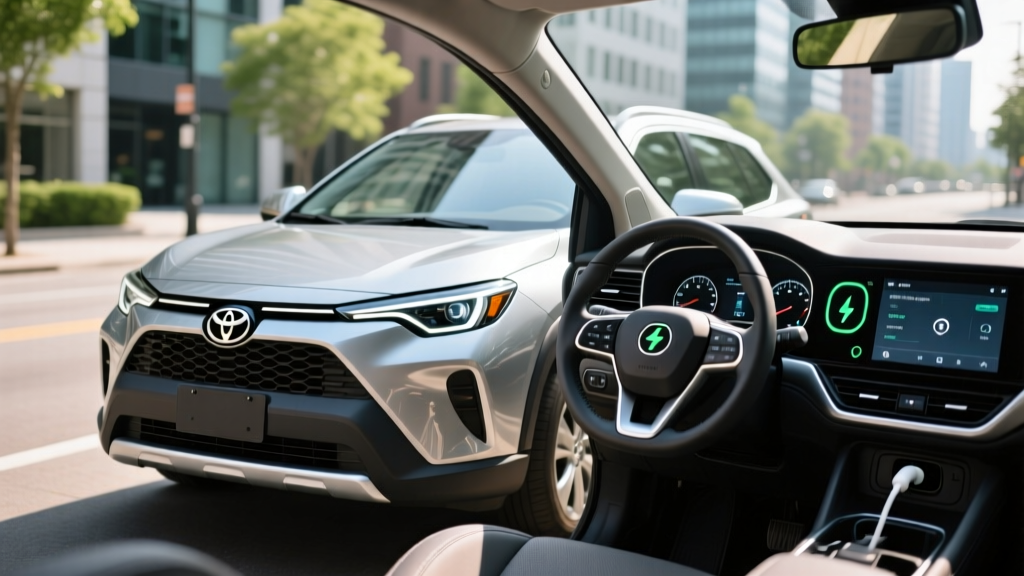
The compact crossover segment is crowded, but the 2026 Toyota Corolla Cross Hybrid occupies a specific niche: standard all-wheel drive, proven hybrid efficiency, and Toyota's long-term reliability reputation — all without requiring a charging cable. For buyers who want electrified efficiency but lack home charging access or don't want to change their fueling habits, this HEV (conventional hybrid) makes a compelling case. Let's break down exactly what you're getting in 2026.
| Specification | Value |
|---|---|
| Powertrain Type | Conventional Hybrid (HEV) — no plug required |
| Combined Horsepower | 196 hp (net) |
| Engine | 2.0L 4-cylinder + 2 electric motor-generators |
| Drivetrain | Electronic AWD (standard on all trims) |
| EPA MPG (City / Hwy / Combined) | 45 / 38 / 42 MPG |
| Hybrid Battery | ~1.3 kWh lithium-ion (sealed, self-charging) |
| 0–60 mph | ~7.5 seconds |
| Cargo Volume | 25.5 cu ft (rear seats up) |
| Base MSRP (S trim) | $31,990 |
| Hybrid Battery Warranty | 10 years / 150,000 miles |
Fuel Economy: EPA Ratings vs. Real-World MPG
The EPA rates the 2026 Corolla Cross Hybrid at 45 MPG city, 38 MPG highway, and 42 MPG combined — figures confirmed by fueleconomy.gov. These numbers are competitive within the hybrid compact crossover class, trailing only the slightly smaller Honda HR-V hybrid in some configurations.
| Driving Condition | EPA Rating | Real-World Expectation |
|---|---|---|
| City | 45 MPG | 43–48 MPG (hybrids often exceed EPA in stop-and-go) |
| Highway (70 mph cruise) | 38 MPG | 35–38 MPG (less electric assist at sustained speed) |
| Combined | 42 MPG | 39–44 MPG (varies with driving mix) |
| Cold Weather (below 32°F) | Not rated | ~35–38 MPG combined (engine runs more for cabin heat) |
Hybrids typically outperform their EPA city ratings in real-world urban driving because regenerative braking recovers energy at every stop. Highway driving is where the Corolla Cross Hybrid loses some ground — the 2.0L engine does more of the work at sustained speeds, and the AWD system's rear electric motor engages less frequently. Expect cold-weather efficiency to drop 10–15% as the engine runs longer to provide cabin heat and maintain battery temperature.
Powertrain and Performance: How the Hybrid System Works
Toyota's fifth-generation hybrid system pairs a 2.0-liter Dynamic Force four-cylinder engine with two motor-generators (MG1 and MG2) through a planetary gearset e-CVT. The combined net output is 196 horsepower — a meaningful step up from the non-hybrid Corolla Cross's 169 hp.
The electronic AWD system uses a separate rear-mounted electric motor (40 hp) that engages automatically during acceleration, low-traction conditions, and cornering. Unlike mechanical AWD systems, there's no driveshaft connecting front and rear axles — the rear motor operates independently and disengages during steady-state cruising to minimize drag.
The result is a 0–60 mph time of approximately 7.5 seconds, which is brisk for this segment. The e-CVT delivers smooth, linear acceleration without the rubber-band effect that older Toyota hybrids exhibited. Passing power at highway speeds is confident, and the transition between electric-only and engine-assisted driving is nearly imperceptible from the driver's seat.
HEV vs. PHEV vs. EV: Which Powertrain Fits Your Life?
The Corolla Cross is available only as a conventional hybrid (HEV) — it cannot be plugged in. This is an important distinction from plug-in hybrids (PHEVs) like the Toyota RAV4 Prime or full battery-electric vehicles (BEVs) like the Toyota bZ4X.
| Factor | HEV (Corolla Cross Hybrid) | PHEV (e.g., RAV4 Prime) | BEV (e.g., bZ4X) |
|---|---|---|---|
| Plug-in charging required? | No — self-charging via regen & engine | Yes — 2.5+ hours on Level 2 | Yes — 8–11 hours on Level 2 |
| Electric-only range | ~1 mile at low speed | 35–42 miles | 220–252 miles (EPA) |
| Home charging needed? | No | Recommended for full benefit | Essential for most owners |
| Combined MPG / MPGe | 42 MPG | 94 MPGe (electric) / 38 MPG (gas) | 114–119 MPGe |
| Federal tax credit (§30D) | Not eligible | Up to $7,500 (if sourcing rules met) | Up to $7,500 (if sourcing rules met) |
| Starting price range | ~$31,990 | ~$44,000+ | ~$38,000+ |
| Best for | No home charging, simple ownership | Short commutes + road trips | Home charging + low running cost |
Choose the Corolla Cross Hybrid (HEV) if: You don't have reliable access to home or workplace charging, you want lower fuel costs without changing your refueling habits, or you want the lowest entry price in an electrified crossover.
Consider a PHEV instead if: You have a garage or driveway where you can install a Level 2 charger, your daily commute is under 40 miles round-trip, and you want the option of electric-only driving for most trips while retaining gas range for road trips.
Consider a full BEV instead if: You have reliable home charging, you want the lowest per-mile fuel cost, you're motivated by eliminating tailpipe emissions, and you're comfortable planning longer road trips around DC fast-charging stops.
Pricing, Trims, and Tax Credit Eligibility
The 2026 Corolla Cross Hybrid is offered in three trims, all with standard AWD:
- S trim: $31,990 MSRP — 8-inch touchscreen, wireless Apple CarPlay/Android Auto, Toyota Safety Sense 3.0, LED headlights
- SE trim: $33,990 MSRP — adds sport-tuned suspension, 18-inch alloy wheels, heated front seats, power moonroof
- XSE trim: $36,490 MSRP — adds SofTex-trimmed seats, JBL 9-speaker audio, 10.5-inch navigation display, panoramic roof
Destination charges add approximately $1,395 to all trims.
Hybrid Battery Longevity, Warranty, and Replacement Costs
Toyota covers the Corolla Cross Hybrid's battery with a 10-year / 150,000-mile warranty (in states following California emissions standards; 10 years / 100,000 miles in some other states — confirm with your dealer). This warranty guarantees the battery will retain sufficient capacity to power the hybrid system; if it degrades below a defined threshold, Toyota replaces it at no cost.
Based on two decades of Toyota hybrid data (the Prius launched in the US in 2000), hybrid battery replacement is uncommon before 150,000 miles. When replacement is needed out of warranty, costs for Toyota's compact hybrid batteries typically range from $2,000 to $4,000 including labor — significantly less than the $10,000–$20,000+ associated with full BEV traction batteries.
The Corolla Cross Hybrid uses a relatively small ~1.3 kWh lithium-ion pack that operates in a narrow state-of-charge window (roughly 40–80%). This shallow cycling strategy is key to longevity — unlike a BEV that charges to 100% and discharges to near zero, the HEV battery experiences far less stress per cycle. Many Toyota hybrid owners report 200,000+ miles on the original battery.
Driving Experience, Interior, and Technology
The 2026 model year brings Toyota's latest infotainment interface with wireless phone mirroring across all trims. The S trim's 8-inch screen is functional but modest; the XSE's 10.5-inch unit with embedded navigation is more satisfying. All trims include a 7-inch digital driver display with a hybrid energy-flow monitor showing real-time power distribution between engine, motors, and battery.
Ride quality is composed but firm — the SE's sport-tuned suspension trades some compliance for reduced body roll. Road noise at highway speeds is noticeable, a common trait in Toyota's TNGA-C platform vehicles. The cabin materials are durable if not luxurious; the XSE's SofTex upholstery is a worthwhile upgrade for families.
Toyota Safety Sense 3.0 is standard across all trims and includes:
- Pre-Collision System with pedestrian detection
- Lane Departure Alert with steering assist
- Full-Speed Range Dynamic Radar Cruise Control
- Lane Tracing Assist
- Automatic High Beams
- Road Sign Assist
This is a SAE Level 1–2 driver-assistance suite. It supports you on the highway but requires continuous driver attention and hands-on-wheel input. It is not autonomous driving.
✓ Pros
- 42 MPG combined with standard AWD — rare in this segment
- No plug-in charging required; refuel at any gas station
- 196 hp provides confident acceleration for the class
- 10-year/150,000-mile hybrid battery warranty
- Competitive pricing starting under $32,000
- Toyota's strong resale value and reliability track record
✗ Cons
- Not eligible for the $7,500 federal §30D tax credit
- Highway MPG drops to 38 — less advantage on long commutes
- Cargo space (25.5 cu ft) trails some non-hybrid rivals
- Road noise is pronounced above 65 mph
- No PHEV variant available if you want electric-only commuting
- Base S trim's 8-inch screen feels dated for 2026
Ownership Costs: 5-Year Fuel Savings vs. Gas-Only Rivals
At 42 MPG combined, the Corolla Cross Hybrid uses approximately 286 gallons of fuel per year (assuming 12,000 miles/year). At $3.40/gallon (2026 national average), that's roughly $972 per year in fuel.
Compare that to a similarly sized gas-only crossover averaging 28 MPG combined: 429 gallons/year at $3.40/gallon equals $1,458 annually. The hybrid saves approximately $486 per year — or $2,430 over five years. That saving nearly covers the price premium over the gas Corolla Cross, which starts around $27,000.
Insurance costs for the hybrid variant tend to run 5–10% higher than the gas model due to the higher MSRP and specialized hybrid components. Maintenance costs are comparable — Toyota's hybrid system eliminates the traditional starter motor and alternator, and regenerative braking extends brake pad life, partially offsetting any hybrid-specific service needs.
Who Should Buy the 2026 Corolla Cross Hybrid?
This vehicle is engineered for a specific buyer profile:
- Apartment dwellers and street parkers who cannot install home charging but want better fuel economy
- High-mileage commuters with mixed city/highway routes where 42 MPG translates to meaningful savings
- First-time hybrid buyers who want electrified efficiency with zero behavioral change
- Cold-climate drivers where BEV range loss in winter is a concern — hybrids are less affected
- Toyota loyalists prioritizing long-term reliability and strong resale value
If you have a garage with a 240V outlet and a short commute, a PHEV like the RAV4 Prime delivers more electric driving and qualifies for federal credits. If you're ready to go fully electric and can charge at home, a BEV offers lower running costs and stronger incentives. But for the buyer who simply wants to fill up less often without any other changes — the Corolla Cross Hybrid delivers exactly that.
Frequently Asked Questions
How many MPG does the 2026 Toyota Corolla Cross Hybrid get?
The EPA rates it at 45 MPG city, 38 MPG highway, and 42 MPG combined. In real-world city driving, many owners report 43–48 MPG thanks to regenerative braking. Highway-heavy commutes will trend closer to 35–38 MPG.
Does the Corolla Cross Hybrid need to be plugged in?
No. This is a conventional hybrid (HEV). The battery charges itself through regenerative braking and the gasoline engine. You refuel it like any other car at a gas station.
Does the 2026 Corolla Cross Hybrid qualify for a federal tax credit?
No. The federal §30D Clean Vehicle Credit (up to $7,500) applies only to plug-in vehicles (PHEVs and BEVs) that meet battery sourcing, MSRP, and buyer income requirements. The Corolla Cross Hybrid is a conventional HEV and is not eligible. Some states may offer separate hybrid incentives — check your state's energy office.
How long will the hybrid battery last, and what does replacement cost?
Toyota warranties the hybrid battery for 10 years / 150,000 miles. Based on historical Toyota hybrid data, most batteries last well beyond 150,000 miles. Out-of-warranty replacement typically costs $2,000–$4,000 including labor — far less than a full BEV battery replacement.
Is the Corolla Cross Hybrid AWD system always on?
The electronic AWD system is automatic and transparent. A rear electric motor engages during acceleration, cornering, and low-traction situations. During steady-state cruising, the rear motor disengages to maximize fuel efficiency. There's no driver control or lock mode — the system manages torque distribution independently.
Hybrid vs. PHEV vs. EV — which should I choose?
Choose a conventional hybrid (HEV) if you lack home charging and want zero lifestyle change. Choose a PHEV if you have home charging, a short commute, and want electric-only daily driving with gas backup. Choose a full BEV if you have reliable home charging, want the lowest per-mile cost, and can plan road trips around DC fast charging. The Corolla Cross Hybrid is strictly an HEV — Toyota does not offer a PHEV version of this model.
What's the difference between the Corolla Cross Hybrid and the RAV4 Hybrid?
The RAV4 Hybrid is larger (more cargo room, more rear legroom), offers 219 hp, and rates at 39 MPG combined. It also has a PHEV variant (RAV4 Prime, 44 miles electric-only). The Corolla Cross Hybrid is smaller, lighter, more affordable ($31,990 vs. ~$38,000), and slightly more efficient (42 MPG combined). Choose based on your space needs and budget.