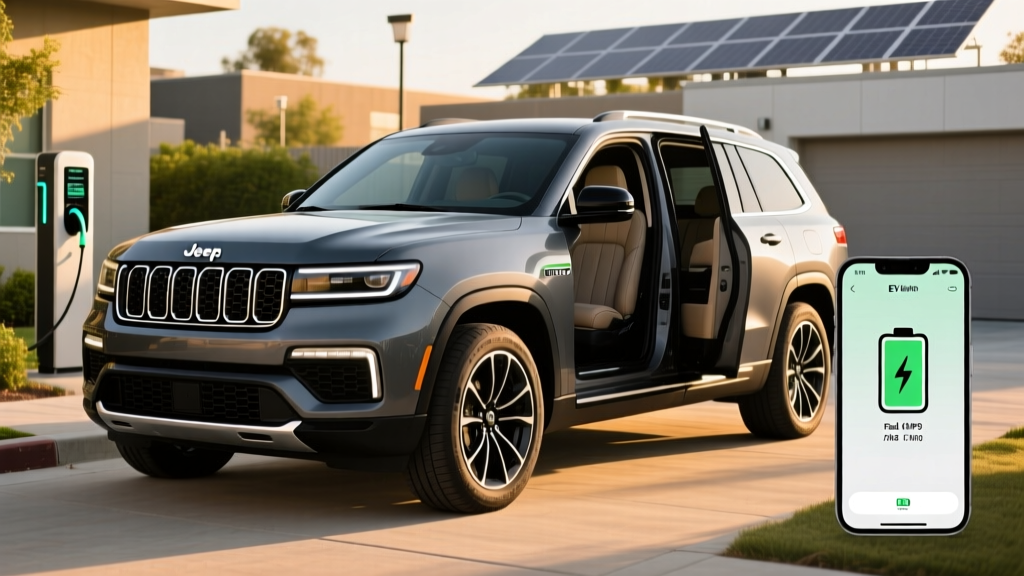
The Jeep Wagoneer is one of the largest, heaviest SUVs on the road — and that makes fuel economy its Achilles' heel. For the 2026 model year, Stellantis continues to offer the Wagoneer lineup with a plug-in hybrid (PHEV) powertrain, branded as the Wagoneer 4xe. Unlike a conventional hybrid you simply fill with gas, the 4xe plugs in to deliver a meaningful electric-only driving buffer before the engine kicks on. But does a plug-in hybrid make sense in a three-row, body-on-frame SUV that weighs over 6,000 pounds? This guide breaks down the real numbers.
Understanding the Wagoneer 4xe: PHEV, Not a Conventional Hybrid
Key distinction: The Wagoneer 4xe is a plug-in hybrid (PHEV), not a conventional hybrid (HEV). A conventional hybrid like a Toyota Highlander Hybrid never plugs in — it uses a small battery recharged by regenerative braking and the engine. The Wagoneer 4xe has a much larger battery you charge via a plug, enabling roughly 25–30 miles of electric-only driving before the twin-turbo V6 engine takes over.
Stellantis does not currently offer a conventional (non-plug-in) hybrid version of the Wagoneer. If you see "Jeep Wagoneer hybrid" in your research, it refers to the 4xe plug-in variant. This matters for your garage: you'll want at least a Level 1 (120V) outlet for overnight charging, and ideally a Level 2 (240V) home charger to refill the battery in a practical timeframe.
Powertrain Specs: Twin-Turbo V6 Meets Electric Motors
| Specification | 2026 Wagoneer 4xe |
|---|---|
| Engine | 3.0L Twin-Turbo I6 (Hurricane) |
| Electric Motor | Integrated P2 motor (transmission-mounted) |
| Combined System Horsepower | ~490 hp (est.) |
| Combined System Torque | ~455 lb-ft (est.) |
| Battery (Usable) | ~17.3 kWh lithium-ion (NMC) |
| Transmission | 8-speed automatic (TorqueFlite) |
| Drivetrain | 4WD standard |
| Towing Capacity | ~6,000 lbs (reduced vs. gas model) |
The Hurricane twin-turbo inline-six replaced the older 5.7L HEMI V8 across the Wagoneer lineup, and in the 4xe it's paired with an electric motor sandwiched between the engine and the transmission. The result is strong low-end torque — useful for a vehicle this heavy — and the ability to drive short distances on electricity alone. Note that towing capacity drops on the 4xe compared to the standard gas Wagoneer (which can tow up to 10,000 lbs), so if you regularly haul a large trailer, the gas model may still be the better tool.
Fuel Economy: EPA MPG and Electric-Only Range
| Metric | 2026 Wagoneer 4xe (PHEV) | 2026 Wagoneer (Gas I6) |
|---|---|---|
| MPGe (combined, electric + gas) | ~50 MPGe | |
| MPG (gas-only, combined) | ~17–19 MPG | |
| MPG (gas-only, city) | ~15–16 MPG | |
| MPG (gas-only, highway) | ~20–22 MPG | |
| Electric-Only Range | ~25–28 miles | |
| Total Combined Range | ~400–430 miles |
Source: fueleconomy.gov (EPA estimates; verify exact trim figures as model-year specs finalize).
Real-world MPG vs. EPA: The Wagoneer 4xe's combined MPGe figure looks strong on paper, but it assumes you regularly charge the battery and drive within the electric-only envelope. If you rarely plug in, expect gas-only fuel economy in the 15–19 MPG range — barely better than the standard gas Wagoneer. City drivers who charge nightly will see the biggest gains, potentially covering most weekday commutes (under 25 miles round-trip) on electricity alone. Highway-heavy drivers at sustained speeds will see the electric buffer deplete quickly, and gas-only highway efficiency remains around 20 MPG. Cold weather (below freezing) can reduce electric-only range by 20–30%, dropping it closer to 18–22 miles.
Charging the Wagoneer 4xe: Times and Infrastructure
| Charging Level | Power | Time (0–100%) | Notes |
|---|---|---|---|
| Level 1 (120V household) | ~1.4 kW | ~12–14 hours | Emergency/trickle; not practical for daily full refills |
| Level 2 (240V home/public) | ~7.2 kW | ~2.5–3 hours | Recommended for daily use |
| DC Fast Charge | Not supported | N/A | No CCS/CHAdeMO DC fast charging capability |
The Wagoneer 4xe uses a standard J1772 connector for Level 1 and Level 2 AC charging. It does not support DC fast charging — a common limitation among PHEVs, since the battery pack is relatively small. For most PHEV owners, a home Level 2 charger is the sweet spot: plug in when you get home, and the battery is fully replenished well before morning. If you're installing a Level 2 circuit, expect to spend $500–$1,500 for the charger unit and electrician labor, depending on your panel capacity and run length. Always consult a licensed electrician for the final installation spec.
Pricing, Trims, and Federal Tax Credit Eligibility
The 2026 Wagoneer 4xe starts at an estimated $67,000–$70,000 MSRP depending on trim (Carbide, Series II, etc.), placing it firmly in premium full-size SUV territory. Higher trims (Overland, Series III) can push past $80,000.
Does the Wagoneer 4xe qualify for the federal §30D tax credit? Under current IRS rules, PHEV eligibility depends on several factors:
- Battery capacity: Must be at least 7 kWh — the Wagoneer 4xe (~17.3 kWh) clears this easily.
- MSRP cap: SUVs must be under $80,000 MSRP. Base 4xe trims qualify; fully loaded trims may exceed the cap.
- Buyer income cap: Modified AGI must not exceed $150,000 (single), $225,000 (head of household), or $300,000 (joint).
- Critical minerals & battery sourcing: A percentage of battery components and critical minerals must be sourced from the US or FTA partners. This requirement tightens annually and can reduce or eliminate the credit for some vehicles. Verify current-year sourcing compliance on the IRS qualified vehicle list.
- Point-of-sale transfer: Eligible buyers can transfer the credit to the dealer at purchase, reducing the out-of-pocket price directly.
Bottom line: The Wagoneer 4xe may qualify for up to $3,750–$7,500 depending on sourcing compliance and your income. Confirm eligibility with a tax professional and the latest IRS guidance before purchasing.
Battery Warranty, Lifespan, and Replacement Cost
Warranty coverage: Stellantis provides a 10-year / 100,000-mile warranty on the Wagoneer 4xe's high-voltage battery pack (in states that follow federal emissions warranty standards; some states require 10/150,000). This warranty covers defects and capacity loss below a specified threshold (typically 60–70% of original capacity). The conventional 12V auxiliary battery carries a separate, shorter warranty.
Replacement cost: If the high-voltage battery requires out-of-warranty replacement, expect a cost in the range of $8,000–$12,000 for the pack itself, plus labor. However, PHEV batteries in the Stellantis 4xe system have shown reasonable longevity — the pack is smaller and undergoes shallower charge cycles than a full BEV battery, which can reduce degradation stress.
Real-world degradation data for the Wagoneer 4xe specifically is still limited given its relatively recent introduction. However, the broader Stellantis 4xe platform (Wrangler 4xe, Grand Cherokee 4xe) has not shown widespread premature battery failure. As always, maintaining moderate state-of-charge levels (avoiding sitting at 100% or 0% for extended periods) and minimizing exposure to extreme heat will help preserve battery health.
Wagoneer 4xe vs. Gas Wagoneer vs. Full EV: Which Fits You?
Choose the Wagoneer 4xe (PHEV) if:
- Your daily commute is under 25–30 miles round-trip and you can charge at home nightly.
- You want a full-size, three-row SUV with body-on-frame capability but want to reduce fuel costs on short trips.
- You're not ready to commit to a full EV due to towing needs, road-trip frequency, or charging-infrastructure gaps in your area.
- You value the option of electric-only driving for school runs, errands, and local commutes without range anxiety.
Choose the gas Wagoneer if:
- You regularly tow heavy loads (the 4xe's towing capacity is reduced).
- You don't have access to home or workplace charging — without plugging in, the 4xe's efficiency advantage largely disappears.
- Your budget is tighter and you want to avoid the 4xe's price premium.
Choose a full EV (like a Rivian R1S or Tesla Model X) if:
- You want zero tailpipe emissions and the lowest per-mile fuel cost.
- You have reliable home charging and your typical trips fall within 250–350 miles.
- You don't need body-on-frame towing capacity (Rivian R1S tows 7,700 lbs; Model X tows 5,000 lbs).
Pros
- 25–28 miles electric-only range covers most daily commutes
- Strong combined horsepower (~490 hp) with instant electric torque
- Body-on-frame SUV with real off-road capability and 4WD
- 10-year/100,000-mile battery warranty
- No range anxiety — gas engine covers long trips seamlessly
- Potential federal tax credit (up to $7,500, income and sourcing dependent)
Cons
- Gas-only MPG (15–19) is poor if you don't plug in regularly
- No DC fast charging capability
- Reduced towing capacity vs. gas Wagoneer (~6,000 vs. 10,000 lbs)
- Premium pricing; loaded trims may exceed $80K tax-credit MSRP cap
- Heavy vehicle means electric range drops significantly in cold weather or at highway speeds
Frequently Asked Questions
How many MPG does the Jeep Wagoneer Hybrid get?
The 2026 Wagoneer 4xe achieves approximately 50 MPGe combined when using both electric and gas power. Once the battery is depleted and you're driving on gas alone, expect around 17–19 MPG combined (roughly 15–16 city, 20–22 highway). The MPGe figure is highly dependent on how often you charge — if you plug in daily and drive short distances, your actual fuel consumption can be dramatically lower than the gas-only numbers.
How far can the Wagoneer 4xe go on electric only?
The EPA-estimated electric-only range is approximately 25–28 miles. In real-world conditions — especially in cold weather, at highway speeds, or with heavy cargo — expect that to drop to 18–22 miles. This is sufficient for many daily commutes and school runs but won't cover longer trips without the engine engaging.
Does the Jeep Wagoneer Hybrid qualify for a tax credit?
The Wagoneer 4xe may qualify for the federal §30D clean vehicle credit, potentially up to $7,500. However, eligibility depends on your income (must be under $300,000 AGI for joint filers), the vehicle's MSRP (must be under $80,000 for SUVs), and battery-sourcing/critical-mineral requirements that tighten each year. Some trims may exceed the MSRP cap. Always verify current eligibility on IRS.gov and consult a tax professional.
Is the Wagoneer 4xe reliable, and what does battery replacement cost?
The Wagoneer 4xe shares its 4xe powertrain architecture with the Wrangler 4xe and Grand Cherokee 4xe, which have been on the road since 2021–2022 without widespread battery-related recalls. The high-voltage battery is covered by a 10-year/100,000-mile warranty. Out-of-warranty replacement is estimated at $8,000–$12,000 for the pack. Long-term reliability data specific to the Wagoneer is still accumulating, but the underlying system is proven across the Stellantis lineup.
Can I charge the Wagoneer 4xe at a public fast charger?
No. The Wagoneer 4xe does not support DC fast charging. It can only charge via Level 1 (120V) or Level 2 (240V) AC charging using a J1772 connector. A full Level 2 charge takes approximately 2.5–3 hours. This is typical for PHEVs, which have smaller batteries that don't justify the cost and weight of DC fast-charge hardware.
Is the Wagoneer 4xe a conventional hybrid or a plug-in hybrid?
It's a plug-in hybrid (PHEV). There is no conventional hybrid (HEV) version of the Wagoneer. You must plug it in to access the electric-only range and maximum fuel savings. Without regular charging, it operates as a heavy gas SUV with marginal hybrid-assist benefits.