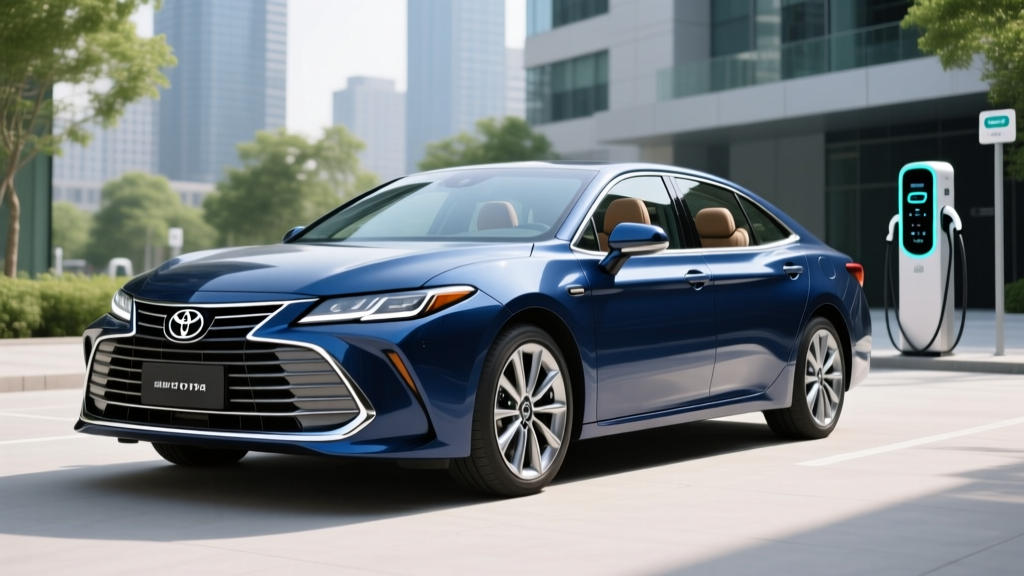
The Toyota Avalon Hybrid Limited represents the premium end of Toyota's full-size sedan lineup — a vehicle that pairs a proven hybrid powertrain with luxury-trim features for buyers who want near-EV efficiency without plugging in. While the Avalon nameplate was discontinued in the U.S. market after the 2022 model year, it remains a strong contender on the used and certified pre-owned market in 2026, particularly for drivers who prioritize highway comfort, proven reliability, and excellent fuel economy without the infrastructure demands of a full EV.
This guide breaks down the Avalon Hybrid Limited's powertrain, real-world MPG, battery longevity, and ownership economics — and explains how it stacks up against PHEV and BEV alternatives for today's buyers.
HEV vs PHEV: What the Avalon Hybrid Actually Is
Before diving into specs, it's essential to understand where the Avalon Hybrid sits in the electrification spectrum. It is a conventional hybrid (HEV), not a plug-in hybrid (PHEV). This distinction matters enormously for how you use and maintain the vehicle.
HEV (Avalon Hybrid) vs PHEV vs BEV at a Glance
| Feature | HEV (Avalon Hybrid) | PHEV (e.g., Prius Prime) | BEV (e.g., Tesla Model 3) |
|---|---|---|---|
| Plug-in charging required? | No | Yes (optional but beneficial) | Yes (mandatory) |
| Electric-only range | ~1 mile (low-speed assist) | 25–44 miles typical | 250–360+ miles |
| Battery size | ~1.6 kWh (NiMH) | 13.6 kWh (Li-ion) | 60–82 kWh (Li-ion) |
| Fuel economy | 44 MPG combined | 94 MPGe / 50 MPG hybrid | 130+ MPGe |
| Home charging install needed? | No | Recommended (Level 2) | Required (Level 2) |
| Federal tax credit (§30D) | Not eligible | Up to $7,500 (if eligible) | Up to $7,500 (if eligible) |
The Avalon Hybrid generates all its electricity internally through regenerative braking and the gasoline engine. You never plug it in. The small nickel-metal hydride (NiMH) battery assists the engine during acceleration, captures energy during braking, and enables brief electric-only movement at very low speeds — but it is not designed for sustained electric-only driving.
Powertrain Specs: 215 HP Hybrid Synergy Drive
The Avalon Hybrid Limited uses Toyota's fourth-generation Hybrid Synergy Drive system, pairing a 2.5-liter inline-4 Atkinson-cycle engine with two electric motor-generators and an electronically controlled continuously variable transmission (eCVT).
Toyota Avalon Hybrid Limited — Key Specifications
| Specification | Value |
|---|---|
| Engine | 2.5L inline-4 Atkinson cycle |
| Engine output | 176 hp / 163 lb-ft torque |
| Electric motor output | 88 kW (118 hp) / 149 lb-ft |
| Combined net horsepower | 215 hp |
| Transmission | eCVT (planetary gearset) |
| Hybrid battery | ~1.6 kWh, NiMH (204 cells) |
| Drivetrain | Front-wheel drive |
| 0–60 mph | ~7.3 seconds |
| Curb weight | ~3,700 lbs |
| EPA fuel economy (city) | 43 MPG |
| EPA fuel economy (highway) | 44 MPG |
| EPA fuel economy (combined) | 44 MPG |
| Fuel tank capacity | 13.2 gallons |
| Total driving range | ~580 miles |
| Base MSRP (final model year) | $43,550 |
Source: EPA Fuel Economy Guide
The 215 combined horsepower is competitive with V6-powered large sedans, and the eCVT delivers seamless power without the shift-shock of a conventional automatic. The Avalon Hybrid Limited's 0–60 time of approximately 7.3 seconds is adequate for highway merging and passing — not sporty, but never strained.
Fuel Economy: EPA Ratings vs Real-World MPG
The EPA rates the Avalon Hybrid Limited at 43 city / 44 highway / 44 combined MPG. Unlike most vehicles, Toyota's hybrid system actually achieves slightly better efficiency in stop-and-go city driving, where regenerative braking and electric-motor assist do the most work.
EPA vs Real-World Fuel Economy
| Driving Scenario | Expected MPG | Notes |
|---|---|---|
| EPA combined (sticker) | 44 MPG | Standardized test cycle |
| City / suburban driving | 42–46 MPG | Regen braking maximizes efficiency |
| Highway cruising (70 mph) | 40–43 MPG | Aerodynamic drag dominates |
| Cold weather (below 30°F) | 36–40 MPG | Engine runs more for cabin heat |
| Aggressive / mountain driving | 34–38 MPG | High load, less regen benefit |
Real-world note: In mixed suburban driving with moderate temperatures, owners consistently report meeting or slightly exceeding the 44 MPG EPA figure. The Avalon Hybrid is one of the rare vehicles where real-world city MPG can match or beat the sticker. However, sustained highway driving at 75+ mph and cold-weather operation will reduce efficiency by 5–15%, consistent with all hybrid and ICE vehicles.
Compared to the non-hybrid Avalon V6 (rated at 22 city / 32 highway / 26 combined), the Hybrid Limited delivers a 69% improvement in combined fuel economy — translating to roughly $600–$800 in annual fuel savings at 15,000 miles/year and $3.50/gallon regular unleaded.
Battery Longevity, Warranty, and Replacement Costs
Hybrid battery longevity is the single most common concern among used-hybrid buyers. Here's what the data shows for the Avalon Hybrid's NiMH pack.
Toyota Hybrid Battery Warranty
| Component | Warranty Coverage |
|---|---|
| Hybrid battery | 10 years / 150,000 miles (2020+ models) |
| Hybrid system components | 8 years / 100,000 miles |
| Powertrain (engine, transaxle) | 5 years / 60,000 miles |
For 2020 and later model years, Toyota extended hybrid battery coverage to 10 years/150,000 miles — up from the prior 8-year/100,000-mile term. This is one of the strongest hybrid battery warranties in the industry. Source: Toyota Warranty Guide
Real-world battery lifespan: Toyota's NiMH hybrid batteries have demonstrated exceptional longevity. Fleet data and owner reports consistently show these packs lasting 150,000–200,000+ miles before significant capacity loss. Unlike the lithium-ion packs in BEVs and PHEVs, NiMH chemistry degrades slowly and predictably. Many Prius taxis have exceeded 300,000 miles on the original hybrid battery.
Replacement cost if needed: A new OEM replacement hybrid battery for the Avalon Hybrid runs approximately $3,000–$4,500 installed at a Toyota dealer. Third-party reconditioned packs are available for $1,500–$2,500 installed. Individual cell replacement (if only a few cells fail) can cost as little as $500–$1,000 at a hybrid specialist shop.
For context, the 1.6 kWh NiMH pack in the Avalon Hybrid is dramatically smaller and less expensive than the 60–80 kWh lithium-ion pack in a BEV, where full replacement can cost $10,000–$20,000+.
Tax Credit Eligibility: What Buyers Need to Know
Because the Avalon Hybrid is a conventional HEV (not a PHEV or BEV), it does not qualify for the federal §30D Clean Vehicle Credit. That credit — up to $7,500 — applies only to plug-in vehicles meeting specific battery-sourcing, critical-mineral, MSRP, and buyer-income requirements outlined by the IRS.
However, there are financial considerations worth noting:
- Used hybrid value: Since the Avalon was discontinued after 2022, all purchases in 2026 are on the used market. The Used Clean Vehicle Credit (§25E) provides up to $4,000 for qualifying used PHEVs and BEVs — but again, conventional hybrids like the Avalon Hybrid are excluded.
- State incentives: A handful of states offer rebates or HOV-lane access for hybrid vehicles, though most have shifted incentives toward PHEVs and BEVs. Check your state's energy office or DMV for current programs.
- Insurance discounts: Some insurers (e.g., Liberty Mutual, Farmers) offer hybrid-vehicle discounts of 5–10%, reflecting the vehicle's lower risk profile and the owner demographics.
- Total savings offset: Even without tax credits, the Avalon Hybrid Limited's fuel savings of $600–$800/year over the non-hybrid V6 model add up to $3,000–$4,000 over five years of ownership.
Avalon Hybrid Limited vs Alternatives: Which Powertrain Fits You?
Pros
- 44 MPG combined — among the best in its class
- No plug-in charging required — zero infrastructure dependency
- 10-year / 150,000-mile hybrid battery warranty (2020+ models)
- Quiet, comfortable highway cruiser with premium Limited trim
- Proven Toyota reliability with low maintenance costs
- ~580-mile total range eliminates range anxiety entirely
Cons
- No electric-only driving range (not a PHEV)
- Discontinued after 2022 — no new models available
- No federal tax credit eligibility
- eCVT can feel unengaging for performance-oriented drivers
- Limited cargo space vs SUV/crossover alternatives
- Infotainment system dated compared to 2026 competitors
Who Should Choose the Avalon Hybrid Limited?
Choose the Avalon Hybrid Limited if:
- You want excellent fuel economy (44 MPG) without installing a home charger or relying on public charging
- You drive 15,000+ miles/year and want to minimize fuel costs
- You prioritize proven reliability and low long-term maintenance costs
- You prefer a large, comfortable sedan over an SUV or crossover
- You're buying used/CPO and want strong value retention
Consider a PHEV (e.g., Toyota Prius Prime) if:
- You can charge at home and want 30–44 miles of electric-only commuting
- Your daily commute is under 40 miles and you want near-zero fuel use on weekdays
- You want eligibility for the federal §30D tax credit (up to $7,500)
Consider a full BEV (e.g., Tesla Model 3, Hyundai Ioniq 6) if:
- You have reliable home Level 2 charging access
- You want zero tailpipe emissions and minimal maintenance (no oil changes, no engine)
- You drive in a region with robust public DC fast-charging infrastructure
- You want the lowest per-mile "fuel" cost (electricity vs gasoline)
5-Year Ownership Cost Estimate
For a 2022 Avalon Hybrid Limited purchased on the used market in 2026 (estimated ~$30,000–$34,000 depending on mileage and condition), here's a projected 5-year ownership cost breakdown assuming 15,000 miles/year:
| Category | 5-Year Cost (Estimated) |
|---|---|
| Purchase price (used/CPO) | $30,000–$34,000 |
| Fuel (44 MPG avg, $3.50/gal) | $5,970 |
| Insurance (avg) | $7,500–$9,000 |
| Maintenance (oil, brakes, tires) | $2,500–$3,500 |
| Depreciation (5 years) | $8,000–$10,000 |
| Total estimated 5-year cost | $54,000–$62,500 |
For comparison, a similarly priced non-hybrid large sedan averaging 26 MPG combined would cost approximately $10,100 in fuel over the same period — $4,130 more than the Avalon Hybrid. That fuel savings significantly offsets the hybrid's modest price premium on the used market.
Frequently Asked Questions
How many MPG does the Toyota Avalon Hybrid Limited get?
The EPA rates the Avalon Hybrid Limited at 43 city / 44 highway / 44 combined MPG. In real-world suburban driving, owners often match or slightly exceed these figures. Highway-only driving at high speeds may reduce efficiency to 40–43 MPG, and cold-weather operation can drop it to 36–40 MPG.
Is the Toyota Avalon Hybrid a plug-in hybrid?
No. The Avalon Hybrid is a conventional hybrid (HEV). It charges its small battery entirely through regenerative braking and the gasoline engine. You never plug it in. If you want plug-in capability with Toyota's hybrid technology, look at the Prius Prime or RAV4 Prime (PHEVs).
Does the Toyota Avalon Hybrid qualify for any tax credit?
No. The federal §30D Clean Vehicle Credit and the §25E Used Clean Vehicle Credit apply only to plug-in electric vehicles (PHEVs and BEVs) with qualifying battery sourcing. Conventional hybrids like the Avalon Hybrid are not eligible. Some states may offer minor hybrid incentives — check your state's energy office.
How long will the Avalon Hybrid battery last, and what does replacement cost?
Toyota's NiMH hybrid batteries routinely last 150,000–200,000+ miles. The warranty covers 10 years/150,000 miles for 2020+ models. If replacement is eventually needed, expect $3,000–$4,500 for a new OEM pack or $1,500–$2,500 for a reconditioned unit from a hybrid specialist.
Is the Avalon Hybrid reliable compared to non-hybrid competitors?
Yes. Toyota's hybrid system has two decades of proven reliability. The eCVT has no traditional clutch packs or bands to wear out — it uses a planetary gearset that is mechanically simpler than a conventional automatic. The hybrid system adds fewer failure points than it eliminates (no alternator, no starter motor, no traditional transmission). Toyota consistently ranks at or near the top of J.D. Power and Consumer Reports reliability surveys, and the Avalon Hybrid benefits from this engineering heritage.
Should I buy the Avalon Hybrid Limited or a full EV?
If you lack reliable home charging access, drive long distances frequently through areas with sparse charging infrastructure, or simply want zero lifestyle adjustment, the Avalon Hybrid delivers excellent efficiency with no behavioral changes. If you can charge at home, want the lowest operating cost, and drive in a region with good public charging, a BEV like the Tesla Model 3 or Hyundai Ioniq 6 may save more over time — but at a higher upfront cost and with some charging-planning requirements on road trips.