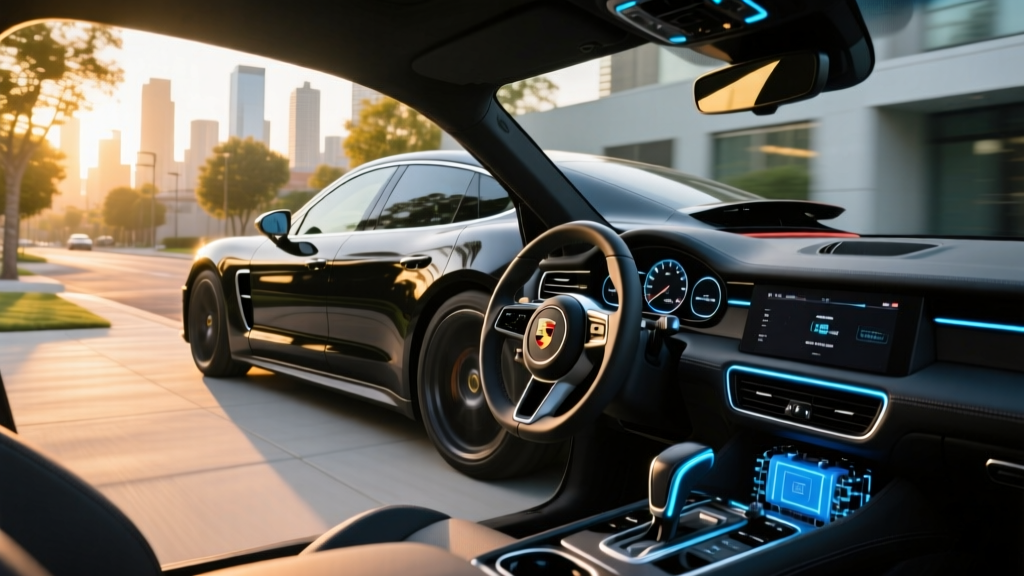
The Porsche Panamera Turbo S E-Hybrid exists in a category of one: a 4,600-pound luxury sedan that sprints like a supercar while offering genuine electric-only commuting capability. For 2025 and carryover into the 2026 model year, Porsche updated the E-Hybrid powertrain with a larger battery and revised electric motor, pushing the Panamera Turbo S E-Hybrid's 0-60 mph time to a claimed 2.8 seconds while extending its all-electric range past 30 miles. But does a plug-in hybrid make sense when battery-electric alternatives like the Porsche Taycan and Tesla Model S Plaid exist? This guide breaks down every spec that matters — from real-world MPG to battery warranty to federal tax credit eligibility — so you can evaluate this PHEV on data, not marketing.
Quick Verdict: Who the Panamera Turbo S E-Hybrid Is For
This PHEV targets a narrow buyer: someone who wants supercar-level acceleration, daily electric-only commuting under 30 miles, and the ability to road-trip 400+ miles without charging stops. If you can charge at home or at the office and your daily drive is short, the Panamera Turbo S E-Hybrid operates as an EV for most weekday miles while retaining a twin-turbo V8 for weekend canyon runs and cross-country trips. If you drive more than 35 miles daily or cannot install a Level 2 charger, a full EV like the Taycan or a conventional hybrid may serve you better.
| Spec | Value |
|---|---|
| Combined Horsepower | 710 hp (V8 + electric motor) |
| Combined Torque | 663 lb-ft |
| Engine | 4.0L twin-turbo V8 (541 hp) + electric motor (187 hp) |
| Transmission | 8-speed PDK dual-clutch |
| 0-60 mph | 2.8 seconds (manufacturer claim, with Sport Chrono) |
| Top Speed | 198 mph |
| Battery (usable) | 25.5 kWh (NMC chemistry) |
| EPA Electric-Only Range | ~30–32 miles (estimated, final EPA TBD for 2026) |
| Drivetrain | All-wheel drive (AWD) |
| Base MSRP | ~$199,000 (before options) |
| Battery Warranty | 8 years / 100,000 miles (hybrid components) |
HEV vs PHEV vs EV: Where the Panamera Turbo S E-Hybrid Fits
Before evaluating specs, it is critical to understand what type of electrified vehicle this is — and what it is not.
| Feature | Conventional Hybrid (HEV) | Plug-In Hybrid (PHEV) | Battery Electric (BEV) |
|---|---|---|---|
| Plug-in charging | No — regenerative braking only | Yes — plug in for electric range | Yes — only electricity |
| Electric-only range | 0–1 mile at low speed | 20–50 miles typical | 200–400+ miles |
| Gas engine | Always available | Always available | None |
| Fuel cost (daily commute) | Reduced | Near-zero if commute < EV range | Zero (electricity cost only) |
| Example | Toyota Prius | Porsche Panamera Turbo S E-Hybrid | Porsche Taycan |
The Panamera Turbo S E-Hybrid is a PHEV. It carries a 25.5 kWh battery pack (up from 17.9 kWh in the prior generation) that enables roughly 30 miles of electric-only driving. Once the battery depletes, the 4.0L twin-turbo V8 takes over, and the car operates as a conventional hybrid — blending engine and motor for efficiency. You can drive it without ever plugging in, but doing so wastes the PHEV's biggest advantage: cheap, silent electric commuting.
Electric-Only Range, Charging Time, and DC Fast Charging
The updated 25.5 kWh battery (approximately 21–22 kWh usable, given Porsche's buffer to protect longevity) delivers an estimated 30–32 miles of EPA electric range in the Turbo S E-Hybrid. Real-world results depend heavily on driving style and conditions:
- EPA estimated: ~30–32 miles
- City/suburban at 35 mph, mild weather: ~33–36 miles (regen braking helps)
- Highway at 70 mph: ~22–25 miles (aerodynamic drag drains battery faster)
- Cold weather (below 32°F): ~20–24 miles (battery chemistry less efficient, cabin heating draws power)
Charging the Panamera Turbo S E-Hybrid:
| Level | Power (kW) | 0–100% Time | Connector |
|---|---|---|---|
| Level 1 (120V household) | ~1.4 kW | ~14–16 hours | J1772 |
| Level 2 (240V home/public) | 7.2 kW (onboard charger max) | ~3.5–4 hours | J1772 / Type 2 |
| DC Fast Charge | Not supported | N/A | N/A |
Critically, the Panamera Turbo S E-Hybrid does not support DC fast charging. This is typical for PHEVs — the battery is small enough that Level 2 charging replenishes it overnight or during a workday. If you install a 240V Level 2 home charger (typically $500–$1,500 for equipment plus $800–$2,500 for electrician labor, depending on panel upgrades), a full charge takes under four hours. A standard 120V outlet works but requires overnight charging to fully replenish.
Fuel Economy: EPA MPG and Real-World Efficiency
Once the battery is depleted, the Panamera Turbo S E-Hybrid operates as a hybrid. EPA ratings for the updated generation are as follows:
| Mode | City | Highway | Combined |
|---|---|---|---|
| Charge-depleting (EV + hybrid blend) | ~46 MPGe (estimated, combined) | ||
| Charge-sustaining (gas-only hybrid) | ~18 mpg | ~24 mpg | ~20 mpg |
Real-world MPG vs EPA: PHEVs are notoriously difficult to rate with a single number because efficiency depends on how often you charge. If you plug in nightly and drive 25 miles round-trip, you may use almost no gasoline during the week — effectively infinite MPG for commuting. On a 400-mile road trip with no charging, expect the charge-sustaining figure of roughly 19–22 mpg combined. That is poor by hybrid standards but respectable for a 710-hp, 4,600-pound V8 sedan. For context, the non-hybrid Panamera Turbo achieves roughly 17 mpg combined — so the E-Hybrid still delivers a 15–20% improvement in gas-only driving.
According to fueleconomy.gov, PHEV efficiency varies dramatically by driving pattern. The EPA's MPGe figure assumes a blend of electric and gas driving over a standardized cycle; your results will differ based on charging frequency.
Performance: The 0-60 Time That Defines This Car
The headline number — and the keyword that brings most shoppers to this page — is the Panamera Turbo S E-Hybrid's 0-60 mph time of 2.8 seconds (with Sport Chrono package, launch control engaged). This makes it one of the fastest four-door sedans ever produced, rivaling the Tesla Model S Plaid (2.3s) and exceeding the BMW M5 CS (2.9s).
How does a luxury sedan achieve this? The electric motor mounted inside the PDK transmission housing delivers instant torque from 0 rpm, filling the gap before the twin-turbo V8's turbos spool. The combined 710 hp and 663 lb-ft of torque hit all four wheels through Porsche's all-wheel-drive system. The result is a launch that feels instantaneous — no turbo lag, no gear-hunting, just relentless acceleration.
Quarter-mile times fall in the 10.8–11.0 second range. More relevant for real driving, the 30–70 mph passing time is under 2.5 seconds, meaning highway overtakes are accomplished with startling urgency. The electric motor also enables "E-Launch" — silent, torque-rich acceleration from stoplights in pure electric mode (though limited to roughly 87 mph in EV-only driving).
Pricing, Trim Levels, and Federal Tax Credit Eligibility
The Panamera Turbo S E-Hybrid starts at approximately $199,000 for the sedan body style, with the Sport Turismo (wagon) variant adding roughly $5,000. Options — carbon ceramic brakes, rear-axle steering, Burmester audio, SportDesign packages — routinely push transaction prices to $215,000–$230,000.
- MSRP cap: Sedans must have an MSRP at or below $55,000 to qualify. The Panamera Turbo S E-Hybrid at ~$199,000 does not qualify for the new-vehicle §30D credit.
- Income cap: Even if the car qualified, buyer AGI must be ≤$150,000 (single) / $300,000 (joint).
- Battery sourcing: Critical mineral and battery component requirements phase in progressively through 2026.
- Bottom line: No federal tax credit applies to this vehicle. Some states may offer separate PHEV incentives — check your state energy office or IRS §30D guidelines for current rules.
Given the $199,000+ price, tax credit ineligibility is expected — buyers in this segment are not purchase-price sensitive. However, it is worth noting that PHEVs in the $40,000–$55,000 range (Toyota RAV4 Prime, Jeep Wrangler 4xe) can still qualify for partial or full credits depending on sourcing compliance.
Battery Longevity, Warranty, and Replacement Cost
Hybrid and PHEV battery anxiety is a top buyer concern, and Porsche addresses it with a comprehensive warranty.
| Component | Warranty Period | Mileage Limit |
|---|---|---|
| High-voltage battery | 8 years | 100,000 miles |
| Hybrid electric motor & power electronics | 8 years | 100,000 miles |
| New vehicle limited | 4 years | 50,000 miles |
| Powertrain (engine, transmission) | 4 years | 50,000 miles |
The 8-year/100,000-mile hybrid battery warranty covers capacity loss below a specified threshold (typically 70% of original capacity, consistent with industry norms). Porsche's 25.5 kWh battery uses NMC (nickel-manganese-cobalt) chemistry, which offers high energy density but is slightly more susceptible to calendar degradation than LFP. Real-world data from earlier Panamera E-Hybrids suggests 8–12% capacity loss over five years of mixed use — well within warranty thresholds.
Out-of-warranty battery replacement cost: If the high-voltage battery requires replacement after the warranty period, expect a parts cost of $15,000–$22,000 plus $2,000–$4,000 in labor. This is a significant expense, though comparable to other luxury PHEVs (BMW XM, Mercedes S 580e). Porsche also offers module-level repair in some cases, replacing individual battery modules rather than the full pack, which can reduce costs to $3,000–$6,000 depending on the failure.
For reliability broadly, Porsche ranks mid-pack among luxury brands in J.D. Power dependability studies. The Panamera's complexity — twin-turbo V8, high-voltage electric motor, PDK transmission, air suspension — means more potential failure points than a simpler vehicle. Budget $1,500–$3,000 annually for maintenance outside the warranty period.
Decision Framework: PHEV, Full EV, or Gas — Which Fits You?
- Your daily commute is under 30 miles and you can charge at home (Level 2).
- You want electric commuting but take road trips exceeding 300 miles regularly.
- You value the V8 sound and character that no EV can replicate.
- You live in an area with limited DC fast-charging infrastructure.
- You can charge at home and have reliable DC fast charging nearby.
- Your longest regular trip is under 280 miles (or you don't mind one charging stop).
- You want lower running costs — electricity is $0.04–$0.06/mile vs $0.18–$0.25/mile for premium gasoline.
- You prefer fewer moving parts and lower long-term maintenance.
- You cannot charge at home or at work.
- You drive 50+ miles daily in mixed highway/city conditions.
- You want to avoid the weight penalty of the PHEV system (~350 lbs heavier than gas-only).
Pros and Cons at a Glance
- 0-60 mph in 2.8 seconds — supercar acceleration in a luxury sedan
- 30+ miles electric-only range covers most commutes
- No range anxiety — V8 takes over seamlessly for long trips
- 8-year/100,000-mile hybrid battery warranty
- Regenerative braking recovers energy in city driving
- Porsche build quality and interior materials
- ~$199,000 base price; $220K+ with typical options
- No DC fast charging — Level 2 only
- Only ~20 mpg combined once battery is depleted
- No federal tax credit eligibility (MSRP far above $55K cap)
- 4,600+ lb curb weight affects braking distances and tire wear
- Complex powertrain = higher out-of-warranty repair risk
- Battery replacement $15K–$22K after warranty
Frequently Asked Questions
How fast is the Panamera Turbo S E-Hybrid from 0 to 60 mph?
The 2025/2026 Porsche Panamera Turbo S E-Hybrid achieves a manufacturer-claimed 0-60 mph time of 2.8 seconds when equipped with the Sport Chrono package and using launch control. Independent testing by automotive publications has verified times in the 2.8–3.0 second range depending on surface conditions and tire temperature.
How many MPG does the Panamera Turbo S E-Hybrid get?
In charge-sustaining mode (battery depleted, operating as a hybrid), the Panamera Turbo S E-Hybrid returns approximately 18 city / 24 highway / 20 combined mpg. When regularly charged and driven within its electric range, effective fuel consumption drops dramatically — many owners report using less than 10 gallons per month on a 25-mile daily commute.
How far can the Panamera Turbo S E-Hybrid go on electric only?
The EPA-estimated electric-only range is approximately 30–32 miles on a full charge. Real-world results vary: expect up to 36 miles in low-speed city driving and as little as 20 miles in cold weather or sustained highway speeds above 65 mph.
Does the Panamera Turbo S E-Hybrid qualify for a federal tax credit?
No. Under current IRS §30D rules, the federal new clean vehicle credit requires a sedan MSRP at or below $55,000. At ~$199,000, the Panamera Turbo S E-Hybrid does not qualify. State-level incentives may exist — check your local energy office. See IRS.gov for current §30D rules.
Is the Panamera Turbo S E-Hybrid reliable? What does battery replacement cost?
Porsche's hybrid components carry an 8-year/100,000-mile warranty. The PHEV system adds complexity over a gas-only Panamera, and out-of-warranty battery replacement costs $15,000–$22,000 for the full pack (or $3,000–$6,000 for module-level repair). Expect annual maintenance of $1,500–$3,000 after the 4-year/50,000-mile new-vehicle warranty expires. Overall reliability is average for the luxury performance segment.
Can the Panamera Turbo S E-Hybrid DC fast charge?
No. The Panamera Turbo S E-Hybrid supports Level 1 (120V, ~1.4 kW) and Level 2 (240V, up to 7.2 kW) charging only. A full Level 2 charge takes approximately 3.5–4 hours. DC fast charging is not available on this model, which is standard for most PHEVs given their smaller battery sizes.
PHEV vs full EV — should I buy this or a Taycan?
If you regularly drive more than 30 miles between charges or take road trips where DC fast-charging infrastructure is sparse, the Panamera Turbo S E-Hybrid PHEV offers the flexibility of a gas engine. If you charge reliably at home and your trips stay within 250–280 miles, the Porsche Taycan delivers lower running costs (~$0.05/mile electricity vs ~$0.22/mile premium gas), fewer moving parts, and comparable performance.
Sources: Porsche AG official specifications, fueleconomy.gov (U.S. EPA), IRS §30D clean vehicle credit guidelines. Specifications reflect the latest available model-year data; confirm final EPA ratings and pricing with your Porsche dealer before purchase.