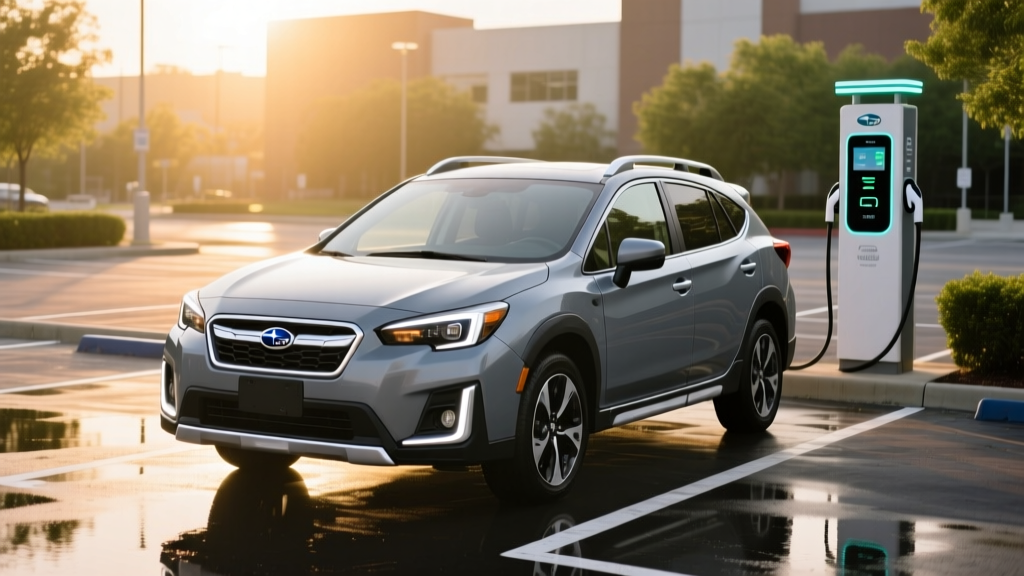
Subaru's Crosstrek has long been the default compact crossover for outdoorsy buyers who need standard all-wheel drive without the fuel thirst of a traditional SUV. But when shoppers search for Crosstrek MPG hybrid figures, they often encounter confusion: Subaru discontinued the plug-in hybrid (PHEV) Crosstrek after the 2023 model year, leaving the 2026 lineup with a conventional mild-hybrid-assisted gasoline powertrain. Understanding what that means for your fuel economy, your wallet, and your daily commute is essential before you sign any paperwork.
This guide breaks down the exact EPA-rated MPG for the current Crosstrek, explains how Subaru's hybrid-assist system works, compares the current model to the discontinued PHEV, and helps you decide whether the Crosstrek's efficiency is enough — or whether you should look at a plug-in hybrid or full EV alternative.
2026 Subaru Crosstrek MPG: EPA Ratings and Real-World Numbers
For the 2026 model year, the Subaru Crosstrek is offered with two engine choices, both paired with Subaru's Lineartronic CVT and standard symmetrical all-wheel drive. The higher-output 2.5-liter flat-four engine (available in Sport and Limited trims) includes Subaru's mild-hybrid system — a small electric motor-generator integrated into the drivetrain that assists during acceleration and enables slightly more aggressive stop-start operation.
| Trim / Engine | City MPG | Highway MPG | Combined MPG | Powertrain Type |
|---|---|---|---|---|
| Base / Premium (2.0L, 152 hp) | 28 | 35 | 30 | Gasoline (no hybrid assist) |
| Sport / Limited (2.5L mild-hybrid, 182 hp) | 27 | 34 | 29 | Mild Hybrid (MHEV) |
| Wilderness (2.5L, 182 hp) | 25 | 29 | 26 | Gasoline (no hybrid assist) |
Source: fueleconomy.gov (EPA estimates). Actual mileage will vary.
How the Crosstrek's Mild-Hybrid System Actually Works
It's critical to understand that the 2026 Crosstrek's "hybrid" designation refers to a mild hybrid electric vehicle (MHEV), not a full hybrid (HEV) like a Toyota RAV4 Hybrid or a plug-in hybrid (PHEV) like the Toyota RAV4 Prime. Here's what that distinction means in practice:
| Feature | MHEV (Crosstrek 2.5L) | Full Hybrid (HEV) | Plug-In Hybrid (PHEV) |
|---|---|---|---|
| Plugs in to charge? | No | No | Yes |
| Electric-only driving? | No | Very short distances at low speed | Yes, 20–45 mi typical |
| Regenerative braking? | Yes (mild) | Yes (strong) | Yes (strong) |
| Typical MPG improvement over gas | 1–3 MPG | 5–15 MPG | N/A when battery depleted; 25–42 MPG gas-only |
| Battery size | ~0.5–1 kWh (48V system) | 1–2 kWh | 13–20 kWh |
| Federal tax credit eligible? | No | No | Potentially up to $7,500 (§30D) |
The Crosstrek's mild-hybrid system uses a small 48-volt battery and motor-generator to smooth out the stop-start system, provide a slight torque fill during initial acceleration, and recover a small amount of energy during deceleration. It cannot propel the vehicle on electric power alone. The fuel-economy benefit is real but modest — roughly 1–2 MPG better than an equivalent non-hybrid 2.5L engine would achieve.
The Discontinued Crosstrek PHEV: What It Offered (and Why It Ended)
From 2019 through 2023, Subaru sold a Crosstrek Plug-In Hybrid based on Toyota's Prius Prime powertrain (Subaru and Toyota share engineering through their corporate partnership). Here's what that model delivered, for buyers considering one on the used market:
| Specification | Value |
|---|---|
| Electric-only range | 17 miles (EPA) |
| Total range (electric + gas) | 480 miles |
| Combined MPG (gas-only after battery depletion) | 35 MPG |
| MPGe (electric + gas combined) | 90 MPGe |
| Battery capacity | 8.8 kWh (lithium-ion) |
| Level 2 charge time (240V) | ~2 hours |
| DC fast charging | Not available |
| Combined horsepower | 148 hp |
| Base MSRP (2023) | $36,845 |
The Crosstrek PHEV's 17-mile electric range was a significant limitation compared to competitors like the Toyota RAV4 Prime (42 miles electric) or the Ford Escape PHEV (37 miles). Subaru discontinued the PHEV variant as it shifted engineering resources toward its dedicated EV platform (the Solterra, co-developed with Toyota). Used 2022–2023 Crosstrek PHEVs remain available and can represent a solid value for short-commute buyers who want AWD and plug-in capability without committing to a full EV.
2026 Crosstrek Pricing and Tax Credit Eligibility
| Trim | Engine | MSRP (incl. destination) |
|---|---|---|
| Base | 2.0L (152 hp) | $26,995 |
| Premium | 2.0L (152 hp) | $28,495 |
| Sport | 2.5L MHEV (182 hp) | $30,995 |
| Limited | 2.5L MHEV (182 hp) | $32,695 |
| Wilderness | 2.5L (182 hp) | $33,495 |
Battery Warranty, Reliability, and Replacement Cost
One of the top concerns for any hybrid buyer — mild, full, or plug-in — is battery longevity. Here's how Subaru covers the Crosstrek's hybrid components:
- Hybrid system warranty: 8 years / 100,000 miles (whichever comes first)
- Covers: 48V battery pack, motor-generator, inverter, and related control electronics on MHEV trims
- Capacity retention guarantee: Subaru does not publish a specific capacity-retention threshold for the mild-hybrid battery (unlike PHEV/BEV manufacturers that warrant 70% SoH). The 48V system is relatively low-stress and rarely requires replacement under normal use.
Subaru's reliability reputation remains strong. The 2.5-liter FB25 engine has been in production since 2019 with few systemic issues, and the mild-hybrid 48V system is a low-complexity add-on — there's no large traction battery, no high-voltage cabling, and no dedicated electric drive motor to fail. If the 48V battery does need replacement out of warranty, expect a cost in the $1,500–$3,000 range at a dealer, though failures before 150,000 miles are uncommon based on industry data from similar 48V systems used by Mercedes-Benz, Volvo, and Stellantis.
For buyers considering a used 2022–2023 Crosstrek PHEV, the high-voltage 8.8 kWh battery is warranted for 8 years/100,000 miles with a capacity-retention threshold of 70%. Full replacement of that battery, if needed out of warranty, would likely cost $5,000–$8,000 based on comparable Toyota Prius Prime battery pricing.
Crosstrek MPG vs. Competitors: Where It Stands
The Crosstrek's mild-hybrid efficiency is competitive within the AWD compact crossover segment, but it doesn't match full-hybrid rivals. Here's how the numbers compare:
| Vehicle | Powertrain | Combined MPG | Electric Range | AWD | Starting MSRP |
|---|---|---|---|---|---|
| Subaru Crosstrek Sport | Mild Hybrid | 29 | — | Standard | $30,995 |
| Toyota RAV4 Hybrid | Full Hybrid (HEV) | 39 | — | Standard | $33,425 |
| Toyota RAV4 Prime | PHEV | 38 (gas) / 94 MPGe | 42 mi | Standard | $44,515 |
| Ford Escape Hybrid | Full Hybrid (HEV) | 39 | — | Available | $34,995 |
| Honda CR-V Hybrid | Full Hybrid (HEV) | 37 | — | Standard (Sport trims) | $36,395 |
The gap is clear: full-hybrid competitors deliver roughly 10 MPG more in combined driving. Over 15,000 miles per year at $3.50/gallon, that's approximately $480 in annual fuel savings with a RAV4 Hybrid versus the Crosstrek Sport. The Crosstrek's advantage lies elsewhere — its 8.7 inches of ground clearance, X-MODE off-road software, and lower starting price make it the efficiency pick for buyers who prioritize trail capability and Subaru's AWD system over maximum MPG.
Who Should Buy the Crosstrek Mild Hybrid — and Who Shouldn't
Choose the Crosstrek If:
- You need genuine off-road capability (8.7" ground clearance, X-MODE) alongside decent fuel economy
- Your commute is short and mixed — the mild-hybrid stop-start system shines in suburban traffic
- You want standard AWD without paying a hybrid premium above $31,000
- You don't have access to home or workplace charging (no plug needed)
- You value Subaru's EyeSight safety suite and strong IIHS ratings
Look Elsewhere If:
- Maximum MPG is your top priority — a RAV4 Hybrid or CR-V Hybrid delivers 10+ more combined MPG
- You want electric-only commuting — consider a PHEV (RAV4 Prime, Tucson PHEV) or a full BEV
- You want federal tax credit eligibility — only PHEVs and BEVs qualify under §30D
- You drive mostly highway miles — the mild-hybrid system provides minimal highway benefit
- You tow frequently — the Crosstrek's 1,500-lb capacity trails the RAV4 Hybrid's 1,750-lb rating
Hybrid vs. PHEV vs. Full EV: Which Powertrain Fits Your Lifestyle?
The Crosstrek's mild-hybrid system occupies the lowest rung of the electrification ladder. Here's a practical decision framework based on your driving pattern and charging access:
Mild Hybrid (Crosstrek Sport/Limited): Best for buyers who want zero behavior change. You fuel up at gas stations exactly as before. The 48V system works invisibly in the background, shaving 1–2 MPG and smoothing the stop-start experience. No charging infrastructure needed, no range planning required. Total annual fuel cost at 15,000 miles/year and $3.50/gallon: approximately $1,810.
Full Hybrid (HEV — RAV4 Hybrid, CR-V Hybrid): Best for high-mileage commuters who want meaningful fuel savings without plugging in. The larger battery and more powerful motor-generator recover significantly more braking energy, especially in stop-and-go traffic. City MPG often exceeds the EPA estimate. Annual fuel cost: approximately $1,346.
Plug-In Hybrid (PHEV — RAV4 Prime, Escape PHEV): Best for buyers with home charging (Level 2) and commutes under 40 miles. You drive on electricity most weekdays and use gas only for longer trips. Federal tax credit of up to $7,500 can offset the higher MSRP. Annual energy cost: approximately $600–$1,100 depending on electric/gas split and local electricity rates.
Battery Electric Vehicle (BEV — Tesla Model Y, Hyundai Ioniq 5): Best for buyers with reliable home charging who want the lowest operating cost and zero tailpipe emissions. Higher upfront cost, but total cost of ownership over 5 years often beats hybrids. Annual energy cost: approximately $450–$700 depending on local electricity rates and charging mix.
Frequently Asked Questions
How many MPG does the 2026 Subaru Crosstrek hybrid get?
The 2026 Crosstrek Sport and Limited trims with the 2.5L mild-hybrid powertrain are EPA-rated at 27 city / 34 highway / 29 combined MPG. The base 2.0L trims without hybrid assist rate slightly higher at 28/35/30 MPG due to lower power output and vehicle weight. Real-world city driving often yields 30–32 MPG combined thanks to the mild-hybrid stop-start system.
Does the 2026 Crosstrek plug in?
No. The current Crosstrek uses a mild-hybrid system that charges its small 48V battery through regenerative braking and the engine — it has no plug and no electric-only driving capability. Subaru discontinued the plug-in hybrid Crosstrek after the 2023 model year.
Is the Crosstrek mild-hybrid battery expensive to replace?
The 48V mild-hybrid battery is covered under Subaru's 8-year/100,000-mile hybrid system warranty. Out-of-warranty replacement is estimated at $1,500–$3,000, but 48V battery failures are uncommon. This is far less expensive than the $5,000–$15,000+ replacement cost for a full-hybrid or PHEV high-voltage traction battery.
Does the 2026 Crosstrek qualify for any federal tax credit?
No. The federal §30D clean vehicle credit applies only to plug-in electric vehicles (PHEVs and BEVs) with sufficient battery capacity. The Crosstrek's mild-hybrid system does not meet the eligibility threshold. Check with your state energy office for any local hybrid incentives, as these vary by jurisdiction.
Should I buy a used Crosstrek PHEV instead?
A used 2022–2023 Crosstrek PHEV can be a smart buy if your commute is under 17 miles (its EPA electric-only range), you have Level 2 home charging, and you want AWD. The 8.8 kWh battery is still covered under the remaining 8-year/100,000-mile warranty. However, the 17-mile electric range is modest compared to newer PHEVs offering 35–45 miles, so weigh the used-market discount against the limited EV capability.
How does Crosstrek MPG compare to a Toyota RAV4 Hybrid?
The RAV4 Hybrid delivers 39 MPG combined — 10 MPG more than the Crosstrek Sport's 29 combined. Over a year of driving (15,000 miles at $3.50/gallon), that translates to roughly $480 in fuel savings with the Toyota. However, the Crosstrek offers 8.7 inches of ground clearance versus the RAV4's 8.1 inches, standard X-MODE off-road programming, and a lower entry price on mild-hybrid trims.