Quick Verdict: The 2006 Civic Hybrid at 20 Years Old
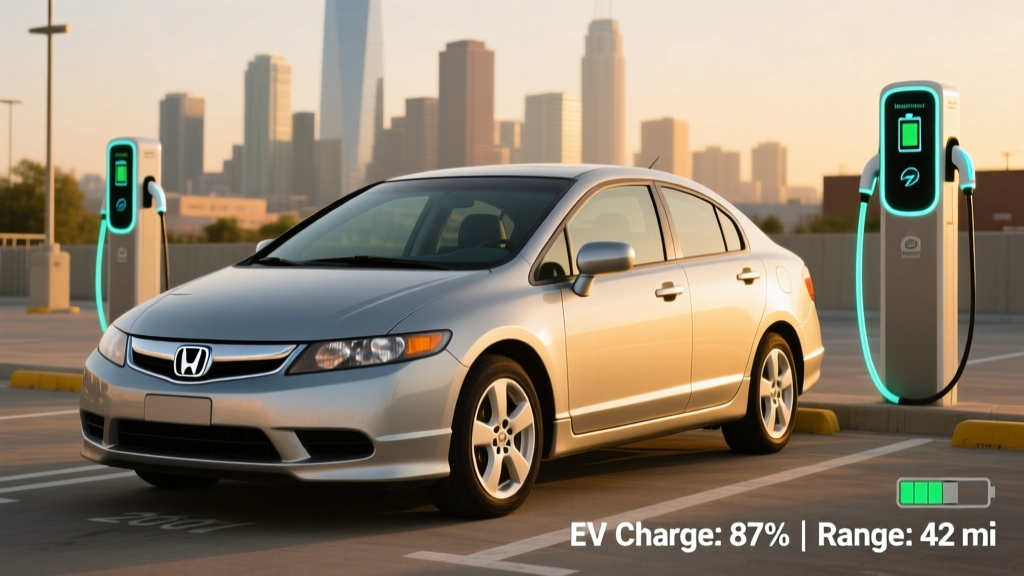
The 2006 Honda Civic Hybrid was one of the first mainstream hybrid sedans sold in the United States, arriving alongside the Toyota Prius as a fuel-sipping alternative during an era of spiking gas prices. Honda's Integrated Motor Assist (IMA) system paired a 1.3-liter four-cylinder engine with a small electric motor to achieve an EPA-estimated 49 MPG combined — a figure that still holds up against many modern non-hybrid compacts.
In 2026, this car exists exclusively on the used market, typically changing hands between $2,500 and $5,500 depending on mileage, condition, and whether the hybrid battery has been replaced. It remains a compelling budget commuter for drivers who want hybrid efficiency without a plug, but buyers must go in with eyes open about the IMA battery's age and Honda's discontinued hybrid-battery support for this generation.
| Spec | Value |
|---|---|
| Powertrain | 1.3L i-DSI 4-cyl + IMA electric motor |
| Combined Horsepower | 110 hp (93 hp engine + 20 hp motor assist) |
| Combined Torque | 123 lb-ft |
| Transmission | CVT (continuously variable) |
| EPA Fuel Economy | 49 city / 51 highway / 49 combined MPG |
| Hybrid Battery | NiMH (nickel-metal hydride), ~0.6 kWh |
| Drivetrain | Front-wheel drive |
| Curb Weight | ~2,806 lbs |
| Fuel Tank | 13.2 gallons |
| Total Range (est.) | ~647 miles |
| Original MSRP (2006) | $22,600 |
| Used Price Range (2026) | $2,500 – $5,500 |
EPA MPG vs. Real-World Fuel Economy
The EPA rated the 2006 Civic Hybrid at 49 MPG city, 51 highway, and 49 combined on the revised testing cycle. However, the 2008 EPA methodology change retroactively adjusted these figures downward for many vehicles of this era. On fueleconomy.gov, the 2006 Civic Hybrid is listed at 49 city / 51 highway / 49 combined under the original cycle, but owner-reported data often clusters between 40 and 48 MPG combined in real-world driving.
| Driving Scenario | MPG |
|---|---|
| EPA City (sticker) | 49 |
| EPA Highway (sticker) | 51 |
| EPA Combined | 49 |
| Real-World City (owner avg.) | 42 – 48 |
| Real-World Highway (70+ mph) | 38 – 44 |
| Cold Weather (below 30°F) | 35 – 42 |
Like all hybrids, the Civic Hybrid benefits most from stop-and-go city driving where regenerative braking recaptures energy and the electric motor handles low-speed propulsion. Highway driving at sustained speeds above 70 mph reduces the hybrid advantage because the gasoline engine does most of the work. Cold weather further diminishes returns — the engine runs longer to reach operating temperature and the NiMH battery becomes less efficient.
How the IMA Hybrid System Works
Honda's Integrated Motor Assist is a mild hybrid architecture, fundamentally different from Toyota's full Hybrid Synergy Drive. The IMA system places a thin electric motor between the engine and transmission. It cannot propel the car on electric power alone (unlike a full hybrid or PHEV). Instead, the motor assists during acceleration, enables regenerative braking, and allows the engine to shut off at stops.
| Feature | Conventional Hybrid (HEV) | Plug-in Hybrid (PHEV) | Battery Electric (BEV) |
|---|---|---|---|
| Example | 2006 Civic Hybrid | 2026 Toyota RAV4 Prime | 2026 Tesla Model 3 |
| Plug-in Charging | No | Yes | Yes |
| Electric-Only Driving | No (motor assist only) | Yes (20–45 mi typical) | Yes (250–350+ mi) |
| Battery Size | ~0.5–1.5 kWh | ~10–20 kWh | ~50–100 kWh |
| Gas Engine | Yes (primary) | Yes (backup + highway) | No |
| Fuel Needed | Yes | Yes | No |
| Federal Tax Credit (2026) | None | Up to $7,500 (§30D) | Up to $7,500 (§30D) |
The IMA system's 144-volt NiMH battery pack stores roughly 0.6 kWh of energy — a fraction of what even a modest PHEV carries today. That small battery is enough to smooth out acceleration, capture braking energy, and enable idle stop-start, but it means the gasoline engine is always running when the car is moving. This is the defining characteristic of Honda's early hybrid approach: the electric motor supplements, never replaces, the internal combustion engine.
IMA Battery Lifespan, Reliability & Replacement Cost
The 2006 Civic Hybrid's NiMH battery pack is now 20 years old, and this is the single most important factor for any prospective buyer. Honda originally warranted the IMA battery for 8 years / 80,000 miles (10 years / 150,000 miles in California-emission states). That factory coverage expired long ago for every 2006 model on the road.
Battery Warranty & Replacement Facts
- Original warranty: 8 yr / 80,000 mi (10 yr / 150,000 mi in CARB states)
- Current factory coverage remaining: None
- Typical IMA battery lifespan: 100,000 – 150,000 miles before degradation triggers warnings
- New OEM battery (Honda): ~$2,000 – $3,000 (limited availability; Honda has reduced production of IMA packs for this generation)
- Refurbished/aftermarket battery: $800 – $1,500 installed
- DIY refurbished pack: $400 – $900 (requires technical skill; several aftermarket suppliers offer reconditioned NiMH packs)
When the IMA battery degrades, the dashboard illuminates the IMA warning light, and the car loses its motor-assist capability. The vehicle remains drivable on the gasoline engine alone, but fuel economy drops noticeably — often into the mid-30s MPG range — and acceleration feels sluggish without the electric torque fill.
The 2006 Civic Hybrid was also the subject of a class-action settlement related to premature IMA battery failures. Honda extended battery coverage on 2006–2008 Civic Hybrids to 10 years with unlimited miles as part of that settlement, but that extended coverage has now expired as well. Buyers should request maintenance records showing whether the IMA battery was replaced under warranty or at owner expense, and whether the replacement was OEM or aftermarket.
Beyond the hybrid battery, the 2006 Civic Hybrid's 1.3L i-DSI engine and CVT transmission are generally durable. The engine is low-stress and timing-chain-driven (no belt to replace). The CVT, however, requires periodic fluid changes — Honda recommends CVT fluid replacement every 30,000 miles, and neglected CVTs are a known failure point. A CVT replacement runs $2,500 – $4,000, which can exceed the car's value.
Does the 2006 Civic Hybrid Qualify for Any Tax Credit?
No. The 2006 Honda Civic Hybrid does not qualify for any current federal tax credit. Here is why:
- §30D New Clean Vehicle Credit: Only applies to new plug-in vehicles (PHEVs and BEVs) with at least 7 kWh of battery capacity. The Civic Hybrid has ~0.6 kWh and cannot be plugged in.
- Used EV Credit (IRC §25E): Applies to used plug-in vehicles (PHEVs and BEVs) priced under $25,000. Conventional hybrids are excluded.
- Original hybrid credit (expired): The Civic Hybrid did qualify for a federal tax credit of up to $2,100 when new, but this credit phased out after Honda reached its 60,000-unit cap in 2007. It has not been available for over 18 years.
- State incentives: A handful of states offer small rebates or HOV-lane access for hybrids, but most have shifted incentive programs exclusively to plug-in vehicles. Check your state's current energy or DMV website for any remaining hybrid-specific benefits.
The bottom line: you are buying this car purely on its fuel-economy merits and low used-car price. There is no government incentive to offset the purchase.
Who Should Buy the 2006 Civic Hybrid — And Who Shouldn't
Pros
- 49 MPG combined EPA — still competitive with modern compacts
- Low purchase price ($2,500–$5,500 used)
- No plug-in required — works for apartment dwellers without charging access
- Simple, proven 1.3L engine with timing chain
- Lightweight (~2,800 lbs) — easy to park, gentle on tires and brakes
- Regenerative braking extends brake-pad life significantly
Cons
- IMA battery likely near end-of-life if not already replaced
- No electric-only driving capability
- Modest power (110 hp combined) — highway merging requires planning
- CVT transmission is a known cost risk if fluid was neglected
- No federal or state tax credit eligibility
- Aging safety tech — no electronic stability control standard, no advanced ADAS
- OEM battery replacement parts are increasingly scarce
Choose the 2006 Civic Hybrid if:
- You need a cheap, ultra-efficient commuter and can't install a home charger
- Your budget is under $5,000 and you want to minimize fuel spend
- You're mechanically inclined and comfortable sourcing aftermarket IMA batteries
- Your commute is city-heavy, where the hybrid system delivers maximum benefit
Look elsewhere if:
- You want plug-in electric-only range — consider a used Chevrolet Volt (~$8,000–$12,000) or a used Toyota Prius Prime
- You need modern safety features (automatic emergency braking, lane-keeping) — look at a 2017+ Prius or a new Corolla Hybrid
- You want a warranty — any 2026 new hybrid (Toyota Corolla Hybrid, Hyundai Elantra Hybrid) comes with an 8–10 year hybrid-battery warranty
- You drive mostly highway miles — the IMA system's advantage shrinks at sustained high speeds, and a modern turbo-diesel or efficient gas car may match its highway MPG
2006 Civic Hybrid vs. Modern Alternatives
| Vehicle | Type | EPA Combined | Used/New Price (2026) | Battery Warranty |
|---|---|---|---|---|
| 2006 Honda Civic Hybrid | HEV | 49 MPG | $2,500–$5,500 (used) | Expired |
| 2016 Toyota Prius | HEV | 52 MPG | $10,000–$14,000 (used) | May have remaining coverage |
| 2026 Toyota Corolla Hybrid | HEV | 50 MPG | $24,000 (new MSRP) | 10 yr / 150,000 mi |
| 2026 Hyundai Elantra Hybrid | HEV | 54 MPG | $26,500 (new MSRP) | 10 yr / 100,000 mi |
| 2017 Chevrolet Volt | PHEV | 42 MPG + 53 mi electric | $10,000–$15,000 (used) | 8 yr / 100,000 mi (may remain) |
The 2006 Civic Hybrid's 49 MPG combined was exceptional for its time, but modern hybrids have caught up and surpassed it while delivering far more power, safety technology, and warranty protection. A new 2026 Toyota Corolla Hybrid achieves 50 MPG combined with 138 hp, Toyota Safety Sense 3.0 (standard AEB, lane-tracing, adaptive cruise), and a 10-year battery warranty — but at five to ten times the purchase price of a used 2006 Civic Hybrid.
The decision comes down to budget and risk tolerance. At $3,000–$5,000, the 2006 Civic Hybrid is a depreciation-proof commuter that sips fuel. But one IMA battery replacement ($1,000–$3,000) or CVT failure ($2,500+) can erase the cost advantage entirely.
Frequently Asked Questions
How many MPG does the 2006 Honda Civic Hybrid get?
The EPA rated it at 49 city / 51 highway / 49 combined MPG. Real-world owners typically report 40–48 MPG combined depending on driving style, climate, and IMA battery health. City driving yields the best results because regenerative braking and motor assist are most active at low speeds.
Can the 2006 Civic Hybrid drive on electric power alone?
No. Honda's IMA system is a mild hybrid that assists the gasoline engine but cannot propel the car independently on electricity. The engine is always running when the vehicle is in motion (except during idle stop-start at red lights). This is fundamentally different from full hybrids like the Toyota Prius or plug-in hybrids that can operate in EV mode for short distances.
Is the 2006 Honda Civic Hybrid reliable?
The underlying 1.3L engine and manual-like CVT are generally reliable with proper maintenance. The main risk is the IMA hybrid battery, which has a typical lifespan of 100,000–150,000 miles. At 20 years old, most original batteries have failed or been replaced. A car with a documented recent battery replacement is a safer buy than one still on the original pack. The CVT is reliable only if fluid was changed every 30,000 miles.
How much does it cost to replace the IMA battery?
A new OEM Honda IMA battery costs approximately $2,000–$3,000, though availability has become limited. Refurbished aftermarket packs run $800–$1,500 installed at a hybrid specialist shop. DIY-sourced reconditioned packs can be found for $400–$900 but require technical knowledge to install safely given the 144-volt system.
Does the 2006 Civic Hybrid qualify for any tax credit?
No federal or state tax credits are available for the 2006 Civic Hybrid in 2026. The original federal hybrid credit (up to $2,100) phased out in 2007 after Honda hit its cap. Current §30D and §25E credits apply only to plug-in vehicles (PHEVs and BEVs), not conventional hybrids.
Is the 2006 Civic Hybrid a good buy in 2026?
It can be — as a budget commuter for drivers who prioritize low purchase price and high MPG over safety tech, warranty coverage, and modern features. Budget $1,000–$2,000 beyond the purchase price for potential IMA battery work and a thorough pre-purchase inspection. If the battery has been recently replaced with documentation to prove it, the car can deliver years of 40+ MPG commuting at minimal cost.