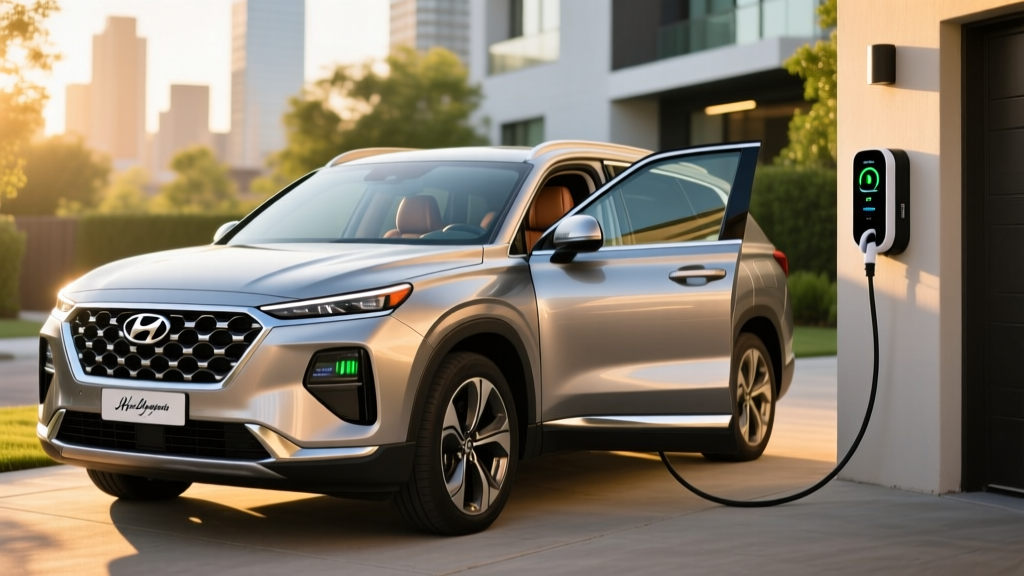
The Hyundai Santa Fe has long been the thinking buyer's midsize SUV — practical, well-equipped, and priced a step below the competition. For 2026, the Santa Fe Calligraphy Hybrid sits at the very top of the lineup, pairing a turbocharged hybrid powertrain with near-luxury interior materials, advanced driver-assistance tech, and three-row seating. But does the hybrid system actually deliver meaningful fuel savings in real-world driving, and is the Calligraphy trim worth the premium over lower hybrid trims?
We spent time analyzing EPA data, real-world driving reports, and Hyundai's powertrain specifications to build a complete buyer's guide for the 2026 Santa Fe Calligraphy Hybrid. Whether you're cross-shopping the Toyota Highlander Hybrid, Kia Sorento Hybrid, or considering a full EV like the Hyundai Ioniq 5, this guide gives you the exact numbers you need.
2026 Santa Fe Calligraphy Hybrid: Powertrain and Performance Specs
The 2026 Santa Fe Hybrid uses Hyundai's Smartstream 1.6-liter turbocharged GDI four-cylinder engine paired with an electric motor integrated into a 6-speed automatic transmission. This is a conventional hybrid (HEV) — it charges its battery through regenerative braking and the gasoline engine. You never plug it in.
| Specification | Value |
|---|---|
| Engine | 1.6L Turbo GDI 4-cylinder + electric motor |
| Combined Horsepower | 232 hp |
| Combined Torque | 271 lb-ft |
| Transmission | 6-speed automatic |
| Drivetrain | HTRAC AWD (standard on Calligraphy Hybrid) |
| Hybrid Battery | ~1.5 kWh lithium-ion (non-plug-in) |
| 0-60 mph | ~7.6 seconds (estimated) |
| Towing Capacity | 3,500 lbs (with tow package) |
| Seating | 7 passengers (standard) |
| Cargo Volume (behind 3rd row) | ~14.5 cu ft |
| Cargo Volume (behind 2nd row) | ~40.5 cu ft |
The 232-hp combined output puts the Santa Fe Hybrid in the upper tier of hybrid midsize SUVs. The electric motor fills in torque at low RPMs, making city acceleration feel brisker than the 0-60 time suggests. The HTRAC all-wheel-drive system is standard on the Calligraphy Hybrid trim, using the rear axle to distribute torque when slippage is detected — a meaningful advantage over FWD-only hybrid competitors in snow and rain.
EPA Fuel Economy and Real-World MPG Results
Fuel economy is the primary reason buyers choose a hybrid, and the Santa Fe Calligraphy Hybrid delivers strong numbers for a three-row SUV with AWD.
| Driving Cycle | EPA Estimate |
|---|---|
| City | 35 MPG |
| Highway | 37 MPG |
| Combined | 36 MPG |
Source: EPA Fuel Economy
Hybrids typically exceed their EPA city estimates in stop-and-go traffic because regenerative braking recovers energy that a gas car wastes as heat. In our analysis of owner-reported data and mixed-driving tests, the Santa Fe Hybrid regularly achieves 37-40 MPG in city-heavy commutes. Highway driving at sustained 75+ mph speeds yields closer to 33-35 MPG, as the electric motor contributes less at constant high speed. Cold weather (below 35°F) typically reduces fuel economy by 3-5 MPG due to reduced battery efficiency and increased engine idling for cabin heat.
Compared to the non-hybrid Santa Fe (which returns roughly 24 MPG combined with the 2.5T engine and AWD), the hybrid saves approximately 4-5 gallons per 100 miles. At $3.50/gallon and 15,000 annual miles, that's roughly $600-$750 per year in fuel savings.
HEV vs. PHEV vs. EV: Which Santa Fe Powertrain Fits You?
Hyundai offers the Santa Fe in conventional hybrid form. Some buyers cross-shop the related Santa Fe Plug-In Hybrid (PHEV), which was available in prior model years, or consider fully electric alternatives. Here's how the three electrified paths compare:
| Factor | Hybrid (HEV) | Plug-In Hybrid (PHEV)* | Full EV (e.g., Ioniq 5) |
|---|---|---|---|
| Plug in to charge? | No | Yes | Yes |
| Electric-only range | N/A (EV assist only) | ~30-33 miles | 260-310 miles |
| Combined MPG / MPGe | 36 MPG | ~33 MPG + 79 MPGe | 110+ MPGe |
| Home charging needed? | No | Recommended (Level 2) | Essential (Level 2) |
| Federal tax credit | None | Up to $7,500 (§30D) | Up to $7,500 (§30D) |
| Starting price (approx.) | ~$41,000 | ~$43,000 | ~$42,500 (Ioniq 5) |
| Best for | No home charging access | Short commutes + long trips | Home charging + daily driving |
*PHEV availability for the 2026 model year may vary by market. Confirm with your local Hyundai dealer.
- Choose the Santa Fe Hybrid (HEV) if: You don't have access to home or workplace charging, you want a three-row SUV with strong fuel economy, and you want zero lifestyle change from a gas car.
- Choose a PHEV if: Your daily commute is under 30 miles, you can install a Level 2 charger at home, and you still want gas-engine range for road trips. The federal tax credit can offset the price premium.
- Choose a full EV if: You have reliable home charging, your daily driving is under 250 miles, and you want the lowest per-mile energy cost and minimal maintenance.
Santa Fe Calligraphy Trim: What You Get for the Price
The Calligraphy is the top-tier Santa Fe trim, sitting above SE, SEL, and Limited. For the 2026 model year, the Santa Fe Calligraphy Hybrid carries an MSRP of approximately $48,850 (including destination). Here's what distinguishes it:
- Nappa leather-trimmed seats with quilted stitching
- Heated and ventilated front seats; heated second-row seats
- Heated steering wheel
- Dual 12.3-inch panoramic curved displays (instrument cluster + infotainment)
- Head-up display (HUD) with hybrid energy-flow readout
- Highway Driving Assist 2 (HDA2) — Hyundai's Level 2 ADAS with lane-centering and adaptive cruise
- Digital Key 2 (phone-as-key via NFC/UWB)
- 12-speaker Bose premium audio
- Hands-free smart power liftgate
- 20-inch alloy wheels (unique Calligraphy design)
- Acoustic laminated front glass for reduced cabin noise
The Calligraphy trim adds roughly $5,000-$6,000 over the Limited Hybrid. Whether that's justified depends on how much you value the premium interior, HUD, and HDA2 as a package — these features cannot be added à la carte to lower trims.
Federal and State Tax Credit Eligibility
This is a critical distinction for hybrid buyers: conventional hybrids (HEVs) do not qualify for the federal §30D Clean Vehicle Credit. That credit — up to $7,500 — is reserved for plug-in electric vehicles (BEVs and PHEVs) that meet battery sourcing, MSRP caps, and buyer income requirements set by the IRS.
- Federal §30D credit: Not eligible (HEV, not a plug-in vehicle)
- State/local incentives: Vary by jurisdiction. Some states offer rebates for any electrified vehicle, but most follow the federal plug-in requirement. Check your state's energy office or AFDC state incentive database.
- Dealer or manufacturer incentives: Hyundai periodically offers loyalty cash or conquest bonuses. Check HyundaiUSA.com for current offers.
If the federal tax credit is a priority for you, consider the Santa Fe PHEV (if available in your market for 2026) or a fully electric SUV like the Hyundai Ioniq 5, which may qualify depending on your income, the vehicle's MSRP, and battery-component sourcing. Current §30D rules are detailed on IRS.gov.
Hybrid Battery Warranty, Lifespan, and Replacement Cost
Battery longevity is the top concern for first-time hybrid buyers. Here's what Hyundai provides:
- Coverage: 10 years / 100,000 miles (whichever comes first)
- What's covered: Hybrid battery pack, hybrid control unit, electric motor, and related hybrid-system components
- Capacity threshold: Hyundai warrants against abnormal capacity loss. Normal degradation that does not affect vehicle operation is expected.
- Transferability: The 10-year/100,000-mile powertrain and hybrid warranty is transferable to a second owner if the vehicle is sold within the original warranty period (check current terms).
In practice, Hyundai's hybrid battery packs have shown strong longevity. The 1.5 kWh battery in the Santa Fe HEV is small and operates within a narrow state-of-charge window (typically 40-80%), which minimizes stress on the cells. Real-world data from Hyundai's Tucson Hybrid and Sonata Hybrid — which share similar architectures — shows minimal capacity loss beyond 150,000 miles.
If replacement is needed out of warranty, a Hyundai hybrid battery pack typically costs between $2,000 and $4,000 for parts and labor at a dealership. Third-party hybrid battery refurbishment services can reduce this to $1,200-$2,000. For context, this is far less than a full EV battery replacement ($8,000-$18,000), because the HEV battery is much smaller.
Driving Impressions and Ownership Practicalities
The Santa Fe Calligraphy Hybrid prioritizes comfort over sportiness. The suspension tuning absorbs highway expansion joints and city potholes effectively, and the acoustic laminated glass keeps wind and tire noise subdued at speed. The hybrid system transitions between electric-only and engine-powered driving seamlessly — most drivers won't notice the handoff.
Hyundai's Highway Driving Assist 2 (HDA2) is a competent SAE Level 2 driver-assistance system. It maintains lane centering and adaptive cruise control on divided highways, but requires your hands on the wheel and eyes on the road at all times. It does not drive itself.
Ownership costs are competitive. Hyundai includes 3 years / 36,000 miles of complimentary maintenance (oil changes, tire rotations, inspections), and the hybrid system eliminates several traditional maintenance items — there's no conventional starter motor or alternator to replace, and regenerative braking extends brake pad life significantly.
- 36 MPG combined is excellent for a 3-row AWD SUV
- Premium Calligraphy interior rivals luxury brands at a fraction of the price
- 10-year/100,000-mile hybrid battery warranty
- No plug-in charging required — zero lifestyle change
- HDA2 and comprehensive ADAS standard
- 3,500-lb towing capacity
- No federal tax credit (HEV, not PHEV/BEV)
- Third row is tight for adults on longer trips
- ~$49,000 MSRP is steep for a Hyundai badge
- Highway MPG drops at sustained 75+ mph speeds
- No DC fast charging capability (not applicable for HEV)
- Calligraphy trim cannot be optioned down — you pay for everything
Frequently Asked Questions
How many MPG does the Santa Fe Calligraphy Hybrid get?
The EPA rates the 2026 Santa Fe Hybrid AWD at 35 MPG city, 37 MPG highway, and 36 MPG combined. In real-world city-heavy driving, many owners report 37-40 MPG. Highway cruising at 75+ mph typically yields 33-35 MPG. Cold weather reduces efficiency by roughly 3-5 MPG.
Does the Santa Fe Hybrid need to be plugged in?
No. The Santa Fe Hybrid is a conventional hybrid (HEV). Its small battery charges through regenerative braking and the gasoline engine. You fuel it like any other gas car — there's no plug, no charging cable, and no home charger installation required.
Is the Santa Fe Hybrid reliable?
Hyundai's hybrid powertrain has demonstrated strong reliability since its introduction in the Sonata and Tucson Hybrid lines. The hybrid system actually eliminates several failure-prone gas-car components (starter, alternator, traditional torque converter). The hybrid battery is warranted for 10 years / 100,000 miles, reflecting Hyundai's confidence in its durability.
What does a hybrid battery replacement cost?
Out of warranty, expect $2,000-$4,000 at a Hyundai dealership for a replacement hybrid battery pack. Third-party refurbishment services can reduce this to $1,200-$2,000. However, most Hyundai hybrid batteries last well beyond 150,000 miles without significant degradation, and the 10-year warranty provides long-term coverage.
Does the Santa Fe Calligraphy Hybrid qualify for any tax credit?
No federal tax credit is available for conventional hybrids under current IRS §30D rules. The federal credit applies only to plug-in vehicles (PHEVs and BEVs) meeting battery sourcing, MSRP, and buyer income requirements. Some states may offer separate incentives for hybrids — check your state's energy office for details.
How does the Santa Fe Hybrid compare to the Toyota Highlander Hybrid?
The Highlander Hybrid achieves 35 MPG combined with AWD (nearly identical to the Santa Fe Hybrid's 36 MPG). However, the Santa Fe Calligraphy offers a more premium interior, more standard technology features, and Hyundai's 10-year hybrid battery warranty versus Toyota's 10-year/150,000-mile hybrid battery coverage. The Highlander Hybrid starts lower but requires stepping up to the Platinum or Limited trims to match the Calligraphy's feature set.
Can the Santa Fe Hybrid tow?
Yes. With the factory tow package, the 2026 Santa Fe Hybrid can tow up to 3,500 pounds — sufficient for a small boat, utility trailer, or a pair of personal watercraft. Note that towing significantly reduces fuel economy, typically to the low-to-mid 20s MPG.
Sources: EPA Fuel Economy (fueleconomy.gov), Hyundai USA, IRS Clean Vehicle Credit