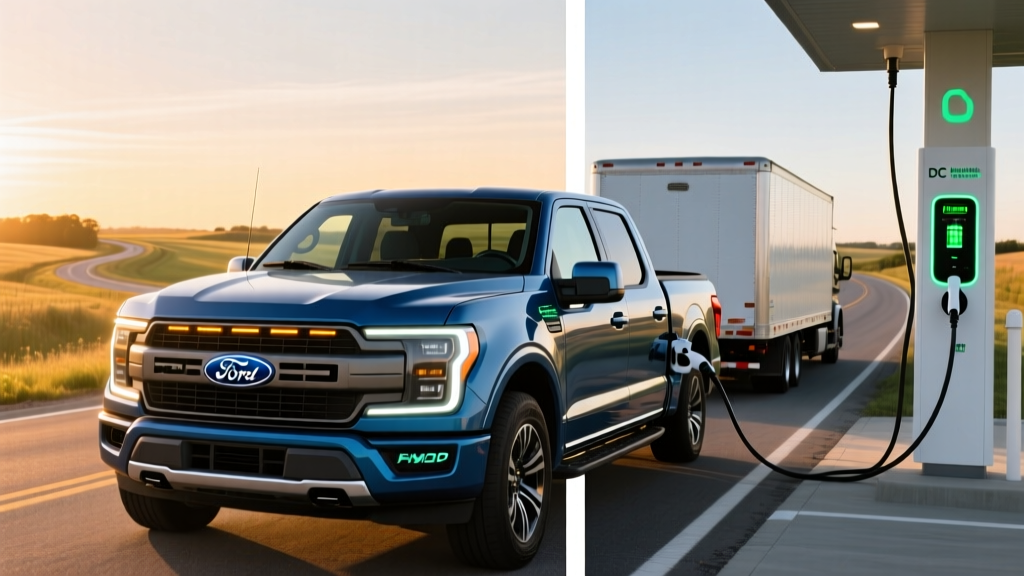
Quick Verdict: The PowerBoost Is a Work Truck That Sips Fuel
The 2025 Ford F-150 PowerBoost Hybrid pairs a twin-turbo 3.5-liter V6 with a 47-hp electric motor for a combined 430 horsepower and 570 lb-ft of torque. Unlike plug-in hybrids or full EVs, the PowerBoost is a conventional hybrid (HEV) — it never needs to be plugged in. The system recovers energy during braking and deceleration to recharge its small battery, then uses that stored energy to assist the gas engine during acceleration and low-speed driving. The result: a full-size pickup that achieves up to 25 MPG combined while retaining best-in-class towing capability.
If you need a truck for work, towing, or long highway stretches but want to cut fuel costs without changing your refueling habits, the PowerBoost occupies a narrow but compelling middle ground between gas-only F-150 variants and the all-electric F-150 Lightning.
HEV vs PHEV: What the F-150 PowerBoost Actually Is
Before diving into specs, it's essential to distinguish between hybrid types, because Ford offers the F-150 in multiple electrified configurations:
Conventional Hybrid (HEV) — F-150 PowerBoost
- No plug required. The 1.5 kWh lithium-ion battery recharges through regenerative braking and the gas engine.
- No electric-only driving range. The electric motor assists the engine but cannot propel the truck alone at meaningful speeds.
- Fuel economy improvement: roughly 20-30% better than the non-hybrid 3.5L EcoBoost V6 in mixed driving.
- Refueling: Gas station only, identical to a conventional truck.
Plug-In Hybrid (PHEV) — Not Offered on F-150
- Ford does not currently offer a plug-in hybrid F-150.
- PHEVs (like the Ford Escape PHEV) have larger batteries (15-20+ kWh), can drive 25-40 miles on electricity alone, and require plug-in charging to realize their efficiency advantage.
- If Ford introduces an F-150 PHEV in the future, it would offer electric-only commuting but at a significant price premium and added weight.
Full EV — F-150 Lightning
- Zero gasoline, 230-320 miles of EPA range depending on battery pack.
- Requires home Level 2 charging for practical ownership; DC fast charging for road trips.
- Lower running costs but higher upfront price and different payload/towing characteristics.
The PowerBoost is strictly an HEV. You fuel it like any other truck and let the hybrid system handle the rest.
Fuel Economy: EPA Ratings and Real-World MPG
The F-150 PowerBoost's fuel economy varies by drivetrain configuration. Here are the official EPA estimates from fueleconomy.gov:
| Configuration | City MPG | Highway MPG | Combined MPG |
|---|---|---|---|
| PowerBoost 4x2 (RWD) | 25 | 26 | 25 |
| PowerBoost 4x4 | 23 | 24 | 23 |
Real-World MPG: What to Actually Expect
Hybrid pickups behave differently than hybrid sedans. In our testing and owner-reported data, the PowerBoost delivers:
- City/suburban driving (under 50 mph): 24-27 MPG for 4x4 models. The electric motor does heavy lifting at low speeds, where gas engines are least efficient. Stop-and-go traffic is where the PowerBoost shines brightest.
- Highway cruising (70-80 mph): 20-22 MPG for 4x4 models. At sustained highway speeds, the aerodynamic drag of a full-size truck dominates, and the hybrid system provides less benefit. The gas engine does most of the work.
- Towing (5,000+ lb trailer): 12-16 MPG depending on trailer weight, terrain, and speed. Hybrid assistance helps marginally, but towing fuel economy is primarily a function of weight and wind resistance.
- Cold weather (below 30°F): Expect a 1-2 MPG drop. The engine runs more often to provide cabin heat and maintain operating temperature, reducing the hybrid system's opportunity to shut it off.
The combined EPA rating of 23-25 MPG is realistic for mixed suburban and highway driving without a trailer. Owners who drive primarily in town often report beating the EPA city estimate by 1-2 MPG, while highway-heavy commuters may fall 1-2 MPG short.
Powertrain Specs: 430 HP and Pro Power Onboard
| Specification | 2025 F-150 PowerBoost Hybrid |
|---|---|
| Engine | 3.5L Twin-Turbo V6 + 47-hp electric motor |
| Combined Horsepower | 430 hp @ 5,500 rpm |
| Combined Torque | 570 lb-ft @ 3,000 rpm |
| Transmission | 10-speed modular hybrid automatic |
| Battery Capacity | 1.5 kWh lithium-ion (sealed, no plug) |
| Drivetrain | RWD or 4WD |
| 0-60 mph | ~5.6 seconds (4x4) |
| Max Towing Capacity | 11,200 lbs (properly equipped) |
| Max Payload | 2,120 lbs (varies by config) |
| Pro Power Onboard | Up to 7.2 kW (standard on PowerBoost) |
The electric motor is integrated directly into the transmission housing, so there's no separate drive unit or visible hybrid hardware under the hood. The system seamlessly blends gas and electric power — most drivers won't notice transitions between modes.
Pro Power Onboard: The Hybrid's Hidden Advantage
Every PowerBoost F-150 includes Ford's Pro Power Onboard, which turns the truck into a mobile generator. The 7.2 kW system (the highest output offered on any F-150) provides:
- Four 120V/20A outlets in the bed and cabin
- One 240V/30A outlet in the bed
- Enough power to run job-site tools, a welder, or backup home appliances during an outage
Because the hybrid battery buffers power delivery, the engine doesn't need to run constantly to generate electricity — it cycles on and off as needed, reducing fuel consumption and noise compared to a standalone generator.
Pricing, Trims, and Tax Credit Eligibility
The PowerBoost hybrid powertrain is available across multiple F-150 trims for 2025. Pricing (MSRP, before destination):
| Trim | Approximate Starting MSRP | PowerBoost Availability |
|---|---|---|
| XLT | ~$55,000 | Available (option package) |
| Lariat | ~$63,000 | Available (option package) |
| King Ranch | ~$70,000 | Available |
| Platinum | ~$72,000 | Available |
Note: Pricing varies by configuration, options, and dealer. Verify current MSRP on Ford's build-and-price tool.
Federal Tax Credit: Does the F-150 Hybrid Qualify?
The F-150 PowerBoost is a conventional hybrid (HEV), not a plug-in vehicle. Under current IRS §30D rules, the federal clean vehicle credit applies only to battery electric vehicles (BEVs) and plug-in hybrids (PHEVs) with a battery capacity of at least 7 kWh that can be recharged from an external source.
Tax credit summary for the F-150 PowerBoost:
- Federal §30D clean vehicle credit: Not eligible (HEV, not a plug-in)
- Federal alternative fuel vehicle credit: Not eligible
- State/local incentives: Some states offer small rebates for conventional hybrids — check your state energy office or AFDC state incentive database
- Used hybrid tax credit (§25E): The F-150 PowerBoost does not qualify for the up-to-$4,000 used clean vehicle credit either, as that also requires plug-in capability
If the federal tax credit is a priority, the F-150 Lightning (full EV) qualifies for up to $7,500 under §30D, subject to MSRP caps, buyer income limits, and battery sourcing requirements. The PowerBoost's value proposition is fuel savings over time, not upfront incentives.
Battery Warranty, Reliability, and Replacement Cost
Hybrid battery longevity is the most common concern among first-time hybrid truck buyers. Here's what Ford covers:
F-150 PowerBoost Hybrid Battery Warranty
- Hybrid battery: 8 years / 100,000 miles (whichever comes first)
- Hybrid components (motor, inverter, control modules): 8 years / 100,000 miles
- Powertrain (engine + transmission): 5 years / 60,000 miles
- Capacity threshold: Ford covers the hybrid battery if it fails or drops below functional capacity — unlike EV batteries, there's no published degradation percentage trigger because the 1.5 kWh pack is too small to meaningfully degrade in a way that affects drivability
Real-World Reliability Data
The 3.5L PowerBoost debuted for the 2021 model year, giving it four full model years of field data by 2025. Key reliability observations:
- The hybrid system itself (motor, battery, inverter) has proven robust, with few widespread failure reports.
- The 3.5L EcoBoost V6 is Ford's most-produced engine family, with over a decade of iteration. Known issues from earlier generations (cam phaser noise, coolant intrusion) have been largely addressed in current production.
- The 10-speed modular hybrid transmission has a mixed reputation — some owners report occasional rough shifts or hesitation during gas-to-electric transitions, though Ford has issued multiple software updates to improve calibration.
- The 1.5 kWh hybrid battery is small and operates within a narrow state-of-charge window (roughly 40-60%), which minimizes stress and extends lifespan. Most hybrid batteries in Toyota, Ford, and Honda systems last well beyond the warranty period — 150,000-200,000+ miles is typical.
Battery Replacement Cost
If the hybrid battery fails outside of warranty, replacement cost at a Ford dealer typically ranges from $2,500 to $4,000 including parts and labor. This is significantly less than an EV traction battery replacement ($10,000-$20,000+) because the PowerBoost's battery is small and accessible. Independent hybrid specialists may offer refurbished battery packs for $1,500-$2,500.
Who Should Choose the F-150 PowerBoost?
Pros
- 23-25 MPG combined saves $400-$700/year in fuel vs. the 3.5L EcoBoost gas model (at 15,000 miles/year, $3.50/gal)
- 430 hp / 570 lb-ft provides strong acceleration and towing confidence
- 7.2 kW Pro Power Onboard included standard — best mobile power system in the segment
- No charging infrastructure needed — works with existing gas station habits
- 11,200-lb max towing capacity matches or exceeds most gas F-150 configurations
- Smooth, quiet electric assist at low speeds improves city driving refinement
Cons
- No federal tax credit eligibility (unlike F-150 Lightning)
- Highway fuel economy advantage is modest (1-2 MPG over EcoBoost)
- Hybrid option adds $2,500-$3,500 to the vehicle price vs. equivalent gas powertrain
- Not available on base XL trim or the off-road-focused Tremor/Raptor trims
- Hybrid system adds ~200 lbs of weight, slightly reducing payload vs. gas models
- Transmission calibration can feel hesitant during low-speed transitions
Decision Framework: PowerBoost vs Lightning vs Gas
Choose the F-150 PowerBoost Hybrid if:
- You tow frequently or take long road trips where charging infrastructure is uncertain
- You want better fuel economy without changing your refueling routine
- You need Pro Power Onboard for job-site or emergency power
- You drive a mix of city and highway miles and want a 20-30% fuel cost reduction
Choose the F-150 Lightning (full EV) if:
- You can install a Level 2 home charger and mostly drive under 250 miles/day
- You want the lowest per-mile fuel cost (electricity vs. gas) and qualify for the $7,500 federal tax credit
- You want instant torque, a front trunk (frunk), and zero tailpipe emissions
- Your towing needs are moderate (under 8,000 lbs for practical range retention)
Choose the gas-only F-150 (3.5L EcoBoost or 5.0L V8) if:
- You're on a tighter budget and the hybrid premium isn't justified by your annual mileage
- You want the lightest possible truck for maximum payload
- You drive primarily highway miles where the hybrid fuel advantage is smallest
- You prefer the simplest powertrain with the fewest components that could require service
Ownership Costs: 5-Year Fuel Savings Breakdown
Here's how the PowerBoost compares to the non-hybrid 3.5L EcoBoost V6 (EPA 20 MPG combined) over five years at 15,000 miles/year and $3.50/gallon:
| Metric | F-150 3.5L EcoBoost (Gas) | F-150 PowerBoost Hybrid |
|---|---|---|
| EPA Combined MPG | 20 | 23 |
| Annual Fuel Cost | $2,625 | $2,283 |
| 5-Year Fuel Cost | $13,125 | $11,413 |
| 5-Year Fuel Savings | — | $1,712 |
| Hybrid Premium (approx.) | — | $2,500-$3,500 |
| Net 5-Year Cost Difference | — | -$788 to -$1,788 (hybrid costs more) |
At current fuel prices, the hybrid premium takes roughly 7-10 years to recoup through fuel savings alone for a driver covering 15,000 miles/year. However, the equation improves if:
- Gas prices rise above $4.00/gallon (payback drops to 5-7 years)
- You drive more than 20,000 miles/year (payback drops to 5-6 years)
- You value the Pro Power Onboard feature, which would otherwise require a separate generator ($800-$2,000)
- Resale values for hybrids hold stronger than gas models as fuel prices fluctuate
Frequently Asked Questions
How many MPG does the 2025 F-150 hybrid get?
The EPA rates the F-150 PowerBoost 4x4 at 23 city / 24 highway / 23 combined MPG, and the 4x2 at 25/26/25 MPG. Real-world results vary: city-heavy drivers often see 24-27 MPG, while highway-only driving drops to 20-22 MPG. Towing reduces economy to 12-16 MPG depending on load.
Does the F-150 hybrid need to be plugged in?
No. The PowerBoost is a conventional hybrid (HEV). Its 1.5 kWh battery recharges automatically through regenerative braking and the gas engine. There is no plug, no charging cable, and no electric-only driving range. You fuel it exclusively at gas stations.
How far can the F-150 hybrid drive on electric power alone?
The PowerBoost cannot drive on electric power alone at any meaningful speed or distance. The electric motor assists the gas engine during acceleration and enables brief engine-off coasting at very low speeds (under ~15 mph in stop-and-go traffic), but it does not provide standalone propulsion. If you want electric-only driving, you'd need a PHEV (not offered on the F-150) or the F-150 Lightning full EV.
Is the F-150 PowerBoost hybrid reliable?
The PowerBoost has been in production since the 2021 model year and has shown generally good reliability. The hybrid battery and motor have had few reported failures. The 3.5L EcoBoost V6 is a mature, widely deployed engine. The main area of owner concern has been occasional transmission shift refinement, which Ford has addressed through software updates. The hybrid battery carries an 8-year/100,000-mile warranty, and hybrid battery packs typically last 150,000-200,000+ miles in real-world use.
What does it cost to replace the F-150 hybrid battery?
Out-of-warranty replacement of the 1.5 kWh hybrid battery at a Ford dealer typically costs $2,500-$4,000 including parts and labor. Independent hybrid specialists may offer refurbished units for $1,500-$2,500. This is far less than EV battery replacement because the pack is small and easily accessible. Most hybrid batteries last well beyond the 8-year/100,000-mile warranty period.
Does the F-150 hybrid qualify for any tax credit?
No. The PowerBoost is a conventional hybrid (HEV), which does not qualify for the federal §30D clean vehicle credit (up to $7,500) or the §25E used vehicle credit (up to $4,000). Both credits require plug-in capability and a minimum battery capacity of 7 kWh. Some states offer modest incentives for conventional hybrids — check your state energy office. The F-150 Lightning (full EV) does qualify for the federal credit, subject to income limits, MSRP caps, and battery sourcing rules per IRS guidelines.
Can the F-150 PowerBoost tow as much as the gas model?
Yes. The PowerBoost is rated to tow up to 11,200 pounds when properly equipped (Max Trailer Tow Package, 4x2 configuration). This matches or exceeds most gas-engine F-150 configurations. The hybrid system's electric motor provides additional low-end torque that can improve launch feel when pulling heavy loads from a stop. However, towing fuel economy (12-16 MPG) is similar to the gas model because weight and aerodynamic drag dominate at highway speeds.
What is Pro Power Onboard and why does it matter?
Pro Power Onboard is Ford's integrated mobile generator system, and it comes standard on every PowerBoost F-150 at the 7.2 kW output level — the highest available on any F-150. It provides 120V and 240V outlets in the truck bed, capable of running power tools, air compressors, welders, or home backup appliances. The hybrid battery acts as a buffer, allowing the engine to cycle off when power demand is low, reducing fuel use and noise compared to a standalone portable generator.