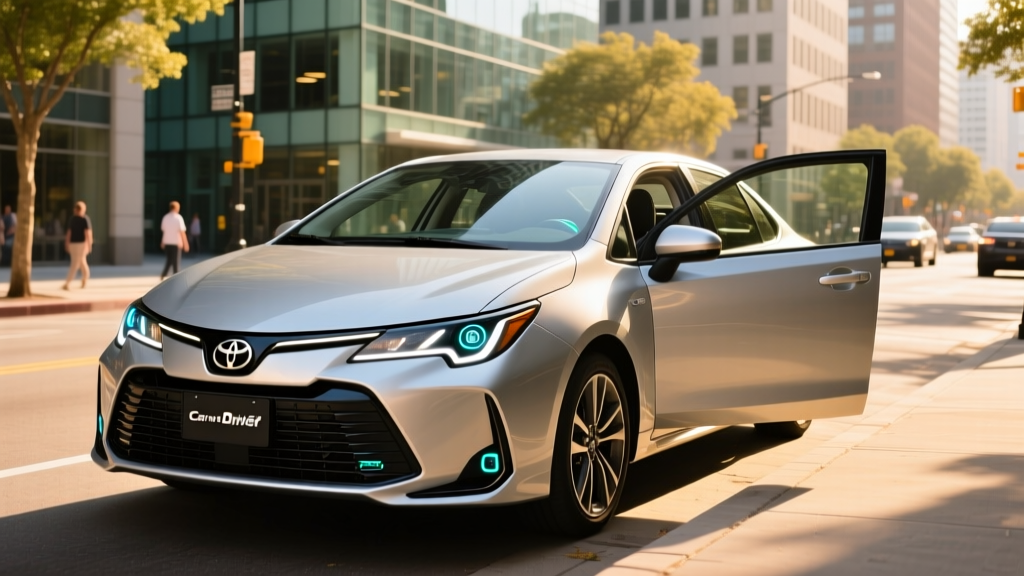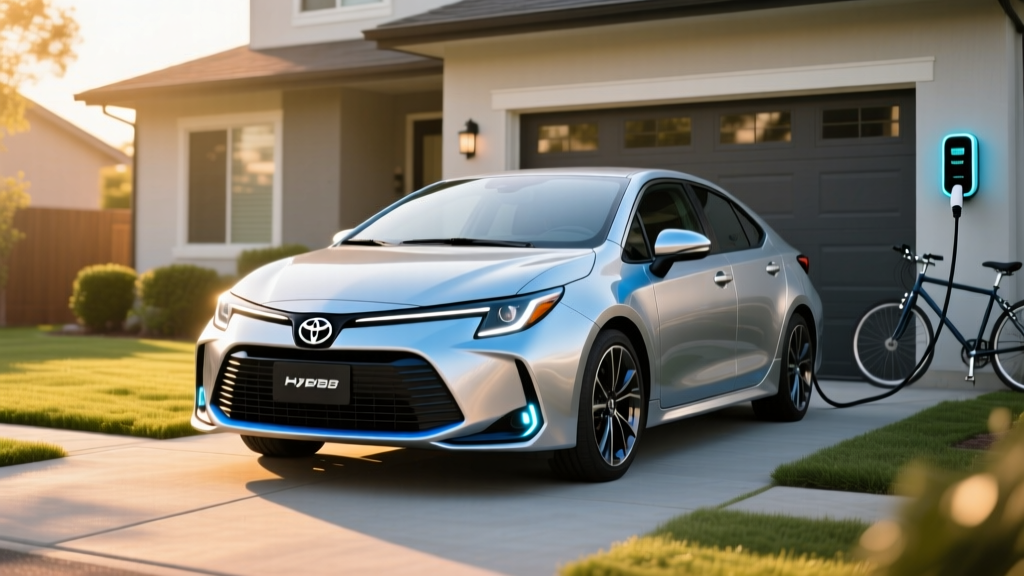
The 2025 Toyota Corolla Hybrid occupies a specific niche: maximum fuel economy with zero plug-in hassle. It's not a plug-in hybrid (PHEV), and it's not a full battery-electric vehicle (BEV). It's a conventional hybrid electric vehicle (HEV) that regenerates its own electricity through braking and engine cycling, requiring nothing more than the gasoline you already pump. For buyers who lack home charging access but want to slash fuel costs below 40 MPG thresholds, the Corolla Hybrid remains one of the most data-backed choices on the market.
HEV vs PHEV vs EV: Where the Corolla Hybrid Fits
Before examining specs, it's critical to distinguish what the Corolla Hybrid is—and isn't. Toyota does not offer a plug-in variant of the Corolla in the US market. The Corolla Hybrid is strictly a conventional HEV, meaning:
| Feature | Corolla Hybrid (HEV) | Plug-in Hybrid (PHEV) | Battery Electric (BEV) |
|---|---|---|---|
| Needs to plug in? | No | Yes (for EV range) | Yes (always) |
| Electric-only range | ~1 mile at low speed | 20–45 miles typical | 200–400+ miles |
| Gasoline engine? | Yes | Yes | No |
| Home charging required? | No | Recommended | Essential |
| Federal tax credit (§30D)? | No | Up to $7,500 (varies) | Up to $7,500 (varies) |
| EPA MPG / MPGe | 50 MPG combined | 40–100+ MPGe + gas MPG | 100–130+ MPGe |
If you have a garage or driveway where you can install a Level 2 charger and want 30+ miles of electric-only commuting, a PHEV like the Toyota Prius Prime or a BEV like the Chevrolet Equinox EV may suit you better. The Corolla Hybrid is purpose-built for drivers who want set-it-and-forget-it efficiency without infrastructure changes.
EPA Fuel Economy: 50 MPG Combined, But What's Real-World?
The 2025 Corolla Hybrid's headline number is its EPA-estimated 50 MPG combined. Here's the official breakdown by drivetrain configuration, sourced from fueleconomy.gov:
| Configuration | City MPG | Highway MPG | Combined MPG |
|---|---|---|---|
| FWD (LE, SE) | 53 | 46 | 50 |
| AWD (LE, SE) | 51 | 44 | 48 |
Like most Toyota hybrids, the Corolla Hybrid tends to exceed its EPA city estimate in stop-and-go traffic, where regenerative braking recaptures the most energy. Real-world city driving of 54–58 MPG is common among owners who drive conservatively in urban environments. Highway efficiency is the trade-off: at sustained 75+ MPH speeds, the gasoline engine carries most of the load, and you can expect 42–46 MPG on the freeway—slightly below the sticker.
Real-World MPG Summary: Expect 48–55 MPG in mixed city driving, 42–46 MPG on the highway, and an honest 46–50 MPG combined depending on climate, terrain, and driving style. Cold weather (below 32°F) can reduce efficiency by 10–15% due to increased engine idling for cabin heat.
Powertrain Specs: 138 HP from a 1.8L Hybrid System
The 2025 Corolla Hybrid uses Toyota's fifth-generation hybrid synergy drive, pairing a 1.8-liter Atkinson-cycle four-cylinder engine with two motor-generators and a lithium-ion hybrid battery pack.
| Specification | 2025 Corolla Hybrid |
|---|---|
| Combined system horsepower | 138 hp |
| Gas engine | 1.8L 4-cyl Atkinson (96 hp) |
| Front electric motor | 94 hp / 139 lb-ft |
| Rear electric motor (AWD only) | 40 hp (on-demand) |
| Hybrid battery | ~0.9 kWh lithium-ion (not plug-in) |
| Transmission | eCVT (planetary gearset) |
| 0–60 mph | ~9.0 seconds (est.) |
| Drivetrain options | FWD or electronic AWD |
The AWD system is not a mechanical driveshaft setup. Instead, a rear-mounted electric motor engages automatically during acceleration from stop, slippery conditions, or when the front wheels lose traction. It operates up to approximately 43 MPH and adds about 2 MPG of consumption versus FWD.
Pricing, Trims, and Tax Credit Eligibility
The 2025 Corolla Hybrid starts at a competitive price point and is available in two trims:
| Trim | Drivetrain | MSRP (incl. destination) |
|---|---|---|
| LE | FWD | $23,600 |
| LE | AWD | $25,000 |
| SE | FWD | $26,050 |
| SE | AWD | $27,450 |
Does the Corolla Hybrid Qualify for a Federal Tax Credit?
No. The federal §30D Clean Vehicle Credit applies only to plug-in electric vehicles (PHEVs and BEVs) with a battery capacity of at least 7 kWh. Because the Corolla Hybrid is a conventional HEV with a sub-1 kWh battery that doesn't accept external charging, it does not qualify for the federal EV tax credit. Some states and municipalities offer rebates for high-efficiency hybrids, but these vary by jurisdiction—check your state energy office or Alternative Fuels Data Center for local incentives.
The trade-off is the lower entry price. A comparably equipped Prius Prime PHEV starts around $33,000 before credits, and a BEV like the Nissan Leaf begins near $29,000. The Corolla Hybrid's $23,600 base price means you're paying less upfront and recouping fuel savings over time rather than chasing tax-credit eligibility.
Hybrid Battery Warranty, Longevity, and Replacement Cost
Hybrid battery anxiety is the top concern for first-time hybrid buyers. Toyota addresses this with one of the strongest hybrid battery warranties in the industry:
Toyota Hybrid Battery Warranty: 10 years or 150,000 miles (whichever comes first), transferrable to subsequent owners. This covers the hybrid traction battery against defects and capacity loss below functional thresholds.
The Corolla Hybrid's lithium-ion hybrid pack is far smaller than a full EV battery (roughly 0.9 kWh vs. 60–100 kWh in a BEV), and it operates within a narrow state-of-charge window—typically 40% to 80%—managed by Toyota's battery control module. This shallow cycling dramatically extends cell life. Real-world data from Toyota's hybrid fleet (Prius, Camry Hybrid, RAV4 Hybrid) shows hybrid batteries routinely lasting 150,000–200,000+ miles before replacement is needed.
If replacement is required out of warranty, a new OEM hybrid battery for the Corolla Hybrid costs approximately $2,000–$3,000 installed at a Toyota dealer. Third-party refurbished or reconditioned packs are available for $1,000–$1,800. This is a fraction of a full EV battery replacement ($8,000–$20,000+), reflecting the smaller pack size.
Who Should Choose the Corolla Hybrid vs. a PHEV or Full EV?
Choose the 2025 Corolla Hybrid if:
- You lack access to home or workplace charging (apartment dwellers, street parkers)
- Your budget is under $28,000 and you don't want to wait for tax-credit paperwork
- You drive 12,000–15,000 miles/year in mixed city/highway conditions
- You want a proven powertrain with a 10-year/150,000-mile battery warranty
- You prefer the lowest possible upfront cost with strong fuel savings
Consider a PHEV (like the Prius Prime) if:
- You can install a Level 2 home charger and want 30–44 miles of electric-only commuting
- Your daily commute is under 40 miles round-trip (you may rarely buy gas)
- You want to qualify for up to $7,500 in federal tax credits (eligibility varies per IRS §30D rules)
Consider a full BEV (like the Chevy Equinox EV or Tesla Model 3) if:
- You have reliable home charging and want zero tailpipe emissions
- You drive 200+ miles regularly and want access to DC fast charging networks
- You want to eliminate gasoline costs entirely and benefit from lower maintenance
Pros and Cons at a Glance
Pros
- 50 MPG combined EPA (53 city) — among the highest for any non-plug-in sedan
- Low $23,600 starting MSRP with strong standard safety tech (TSS 3.0)
- Available electronic AWD for snow-belt buyers
- 10-year / 150,000-mile hybrid battery warranty
- No plug-in infrastructure needed — works with existing gas stations
- Toyota reliability reputation and high resale value
Cons
- 138 hp feels modest — 0–60 in ~9 seconds won't excite enthusiasts
- No PHEV or EV variant available — no electric-only driving range
- No federal tax credit eligibility
- Rear seat and cargo space tighter than Corolla Hatchback or Prius
- Highway MPG drops to 44–46 at sustained 75+ MPH
- Base LE interior materials are functional but plain
Frequently Asked Questions
How many MPG does the 2025 Toyota Corolla Hybrid actually get?
The EPA rates the FWD Corolla Hybrid at 53 city / 46 highway / 50 combined MPG. AWD models drop slightly to 51/44/48. In real-world city driving, many owners report 54–58 MPG thanks to regenerative braking. Highway driving at 75+ MPH typically yields 42–46 MPG.
Does the Corolla Hybrid need to be plugged in?
No. The Corolla Hybrid is a conventional HEV, not a plug-in hybrid. It charges its small hybrid battery through regenerative braking and the gasoline engine. You fuel it exactly like a standard gas car—there is no plug, no charging cable, and no electric-only driving range to manage.
How far can the Corolla Hybrid drive on electric power alone?
Less than 1 mile, and only at very low speeds (under 25 MPH) in ideal conditions. The hybrid battery is roughly 0.9 kWh—far too small for meaningful electric-only driving. If you want 30+ miles of EV range, you need a PHEV like the Prius Prime or a full BEV.
Is the Corolla Hybrid reliable? What about battery replacement?
Toyota's hybrid powertrains have two decades of proven reliability across millions of vehicles. The hybrid battery is warrantied for 10 years or 150,000 miles, and real-world data shows these batteries commonly last 150,000–200,000+ miles. If replacement is needed out of warranty, expect to pay $2,000–$3,000 for an OEM pack installed.
Does the 2025 Corolla Hybrid qualify for any tax credits?
Not the federal §30D Clean Vehicle Credit, which requires a plug-in vehicle with at least 7 kWh of battery capacity. The Corolla Hybrid is a conventional HEV with a sub-1 kWh pack. Some states offer rebates for high-MPG hybrids—check local programs. For federal credit eligibility rules, see the IRS Clean Vehicle Credit page.
How does the Corolla Hybrid compare to the Prius?
The 2025 Prius offers more power (194 hp FWD), a more modern interior, and up to 57 MPG combined on the LE trim. The Corolla Hybrid is about $4,000–$5,000 less expensive at the base level and offers AWD availability. Choose the Corolla Hybrid for budget and simplicity; choose the Prius for efficiency, power, and a more premium cabin.