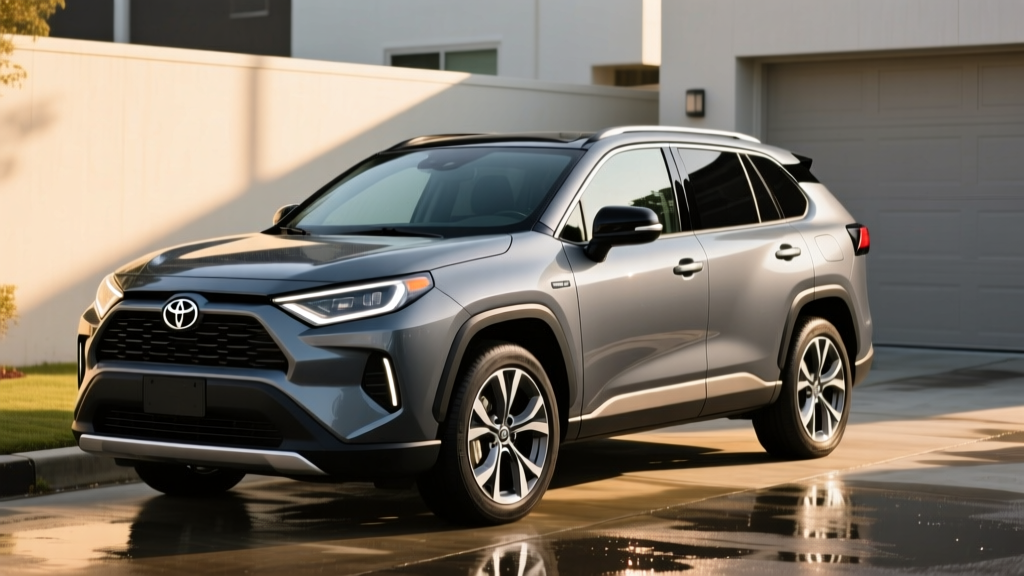
The Toyota RAV4 Hybrid has spent years as America's best-selling hybrid SUV for a reason: it delivers genuine fuel savings without asking you to change a single habit. No plugs, no charging apps, no range calculations — just get in, drive, and watch the fuel gauge barely move in stop-and-go traffic. For 2026, the RAV4 LE Hybrid remains the entry point into Toyota's hybrid compact-SUV lineup, and it continues to set a high bar for efficiency in the segment.
But with plug-in hybrids like the RAV4 Prime offering electric-only commuting and full EVs like the Hyundai Ioniq 5 pushing lower running costs, where does the conventional RAV4 LE Hybrid fit in 2026? This guide covers everything a buyer needs: exact EPA MPG figures, real-world fuel economy, the 219-hp hybrid powertrain, battery warranty details, tax-credit eligibility, and who should choose this HEV over a PHEV or BEV.
2026 RAV4 LE Hybrid Powertrain and Key Specifications
The RAV4 LE Hybrid pairs Toyota's proven 2.5-liter four-cylinder Dynamic Force engine with front and rear electric motors, delivering all-wheel drive as standard on every trim. There is no front-wheel-drive option — Toyota made AWD standard across the RAV4 Hybrid lineup starting with the current generation. Here are the core numbers:
| Specification | Value |
|---|---|
| Powertrain type | Conventional hybrid (HEV) — no plug |
| Engine | 2.5L inline-4 Atkinson cycle |
| Combined system horsepower | 219 hp |
| Electric motors | Front motor + rear motor (e-AWD) |
| Hybrid battery (traction) | ~1.6 kWh (sealed NiMH) |
| Transmission | eCVT (planetary gearset, no belts) |
| Drivetrain | Electronic on-demand AWD (standard) |
| EPA city / highway / combined MPG | 41 / 38 / 40 MPG |
| Fuel tank capacity | 14.5 gallons |
| EPA-estimated total range | ~580 miles |
| 0–60 mph | ~7.4 seconds |
| Cargo volume (rear seats up / folded) | 37.5 / 69.8 cu ft |
| Starting MSRP (LE Hybrid) | ~$34,000 |
A few things jump out. First, 219 hp is genuinely adequate for merging, passing, and highway driving — this is not a slow, efficiency-compromised vehicle. Second, the e-AWD system uses a dedicated rear electric motor rather than a mechanical driveshaft, which means rear wheels engage instantly when slip is detected, with no driveline loss during normal cruising.
Fuel Economy: EPA Ratings vs. Real-World MPG
The EPA rates the 2026 RAV4 LE Hybrid at 41 city / 38 highway / 40 combined MPG, according to fueleconomy.gov. That city-dominant split is typical of Toyota's hybrid system: the electric motor handles low-speed acceleration where gasoline engines are least efficient, while the engine takes over on sustained highway cruising.
- City / suburban driving: 40–44 MPG. Hybrids thrive here. Expect to beat the EPA city number in warm weather with moderate traffic — the engine shuts off frequently and the motor recovers braking energy.
- Highway (70–80 mph): 34–38 MPG. Aerodynamic drag dominates at speed, and the hybrid system has less opportunity to recapture energy. Expect the EPA highway number on flat terrain, less in hilly routes or with roof cargo.
- Cold weather (below 32°F): 33–37 MPG combined. The engine runs longer to heat the cabin and keep the catalytic converter warm, reducing electric-only operation. Short trips in winter hit hardest.
- Overall mixed driving: Most owners report 38–42 MPG combined across seasons, closely tracking the EPA figure.
At 40 MPG combined and a national average of roughly $3.30/gallon for regular unleaded, the RAV4 LE Hybrid costs approximately $0.083 per mile in fuel. Compare that to a gas-only compact SUV at 28 MPG combined (~$0.118/mi), and you save roughly $525 per year driving 15,000 miles annually.
HEV vs. PHEV vs. Full EV: Which RAV4 Fits You?
Toyota offers the RAV4 in three powertrain flavors, and buyers frequently confuse them. Here is the critical distinction:
| Feature | RAV4 LE Hybrid (HEV) | RAV4 Prime (PHEV) | RAV4 Gas (LE AWD) |
|---|---|---|---|
| Plug-in charging required? | No — self-charging via engine + regen | Yes — plug in for EV range | No |
| Electric-only range | None (EV assists at low speed only) | ~42 miles | None |
| Combined MPG / MPGe | 40 MPG | 94 MPGe (EV mode) / 38 MPG (hybrid) | ~30 MPG |
| Combined horsepower | 219 hp | 302 hp | 203 hp |
| Starting MSRP | ~$34,000 | ~$45,000 | ~$31,000 |
| Federal tax credit (§30D) | Not eligible | Up to $7,500 (eligibility varies) | Not eligible |
| Best for | No home charging, simple ownership | Home charging + short commute | Lowest upfront cost |
Who Should Choose the RAV4 LE Hybrid (HEV)?
- You lack access to home or workplace Level 2 charging and don't want to rely on public infrastructure
- Your daily driving mix includes substantial city and stop-and-go traffic where hybrid efficiency shines
- You want lower fuel costs without behavioral changes — no plugging in, no pre-conditioning, no route planning around chargers
- You value long total range (~580 miles per tank) for road trips without charging stops
- You want Toyota's proven hybrid reliability track record at a moderate price premium over the gas model
Who Should Look at the RAV4 Prime (PHEV) Instead?
- You have a Level 2 charger at home and a commute under 40 miles round-trip — you could drive months without using gas
- You want the 302-hp performance advantage and don't mind the ~$11,000 price premium (partially offset by potential tax credits)
- You want to reduce tailpipe emissions on daily driving while keeping gas-engine flexibility for road trips
Who Should Consider a Full EV Instead?
- You have reliable home charging and want the lowest per-mile energy cost (~$0.04–0.06/mi on home electricity)
- You want zero tailpipe emissions and minimal drivetrain maintenance (no oil changes, no spark plugs)
- Your road trips are infrequent or within DC fast-charging corridors
Pricing, Trims, and Tax Credit Eligibility
The 2026 RAV4 LE Hybrid starts at approximately $34,000 MSRP, including destination. That positions it roughly $3,000 above the gas-only RAV4 LE AWD. Higher hybrid trims (XLE, XSE, Limited) push pricing into the $37,000–$43,000 range with added features like a larger touchscreen, SofTex seats, and a power liftgate.
Federal Tax Credit: Not Eligible
Under current IRS §30D Clean Vehicle Credit rules, conventional hybrids (HEVs) do not qualify for the federal $7,500 tax credit. The credit is reserved for plug-in electric vehicles (BEVs and PHEVs) meeting battery-sourcing, critical-mineral, MSRP, and buyer-income requirements. The RAV4 LE Hybrid has no plug, no qualifying battery capacity, and therefore no federal credit.
Some states may offer small incentives for hybrid purchases — check your state energy office or department of environmental quality for current programs. However, these are typically modest ($250–$500 rebates) compared to the federal PHEV/EV credit.
Break-Even vs. Gas Model
At $3,000 more than the gas RAV4 LE AWD and a fuel savings of ~$525/year (at 15,000 miles/year), the hybrid premium pays for itself in roughly 5.7 years of ownership. If you drive more than 15,000 miles annually or if gas prices rise, that timeline shortens. The hybrid also typically commands a higher resale value, further narrowing the gap.
Hybrid Battery Warranty, Lifespan, and Replacement Cost
Toyota covers the RAV4 Hybrid's traction battery with one of the strongest warranties in the industry:
- Coverage: 10 years / 150,000 miles (whichever comes first) for hybrid battery components
- Hybrid system warranty: 8 years / 100,000 miles for related components (inverter, motor, control modules)
- Capacity threshold: Toyota warrants the battery against defects and abnormal loss of capacity — if the battery cannot hold sufficient charge to operate the hybrid system, it is covered
Real-World Battery Longevity
Toyota's hybrid batteries have an exceptional track record. The Prius — which uses a similar NiMH chemistry in earlier generations and lithium-ion in newer ones — routinely sees original batteries lasting 200,000+ miles. The RAV4 Hybrid's relatively small ~1.6 kWh battery operates in a narrow state-of-charge window (roughly 40%–80%), which dramatically reduces stress and degradation compared to a full EV battery cycling from 10% to 90%.
According to Toyota's official warranty guide, the hybrid battery is designed to last the life of the vehicle under normal use. Out-of-warranty replacement, should it ever be necessary, typically costs between $3,000 and $5,000 including labor at a Toyota dealer. Independent hybrid specialists often offer refurbished units for $1,500–$2,500.
In practice, hybrid battery failure before 150,000 miles is rare. The far more common maintenance items are the same as any vehicle: tires, brakes (which last longer thanks to regenerative braking), cabin filters, and fluid changes.
Driving Experience: Performance, Comfort, and Cargo
The 219-hp combined output gives the RAV4 LE Hybrid confident acceleration. The 0–60 mph time of roughly 7.4 seconds is quicker than most turbocharged gas competitors in this class and substantially quicker than the gas-only RAV4 AWD (~8.1 seconds). The eCVT operates without the rubber-band feel of belt-driven CVTs — Toyota's planetary gearset provides seamless power delivery without simulated "shifts."
Ride quality is firm but compliant, tuned for American road surfaces rather than sporty handling. Road noise is the RAV4's most common complaint — it is noticeable at highway speeds compared to competitors like the Hyundai Tucson Hybrid. The LE trim rides on 18-inch wheels, which helps absorb bumps better than the larger wheels on higher trims.
Cargo space is identical to the gas RAV4: 37.5 cu ft behind the rear seats and 69.8 cu ft with them folded. The hybrid battery is packaged under the rear seats, so there is zero cargo compromise compared to the non-hybrid model. Toyota Safety Sense 3.0 (TSS 3.0) is standard on every trim, including adaptive cruise control, lane-keeping assist, automatic emergency braking, and blind-spot monitoring.
Pros
- 40 MPG combined with zero lifestyle changes — no plug needed
- Standard AWD on every trim, no FWD compromise
- 580-mile total range eliminates road-trip fuel stops
- 219 hp is quicker than most gas compact SUVs
- 10-year / 150,000-mile hybrid battery warranty
- Strong resale value and proven reliability
- TSS 3.0 safety suite standard on base LE
Cons
- No federal tax credit (HEV, not PHEV/BEV)
- Highway MPG drops to mid-30s at 75+ mph
- Noticeable road noise at highway speeds
- LE trim interior is basic — cloth seats, smaller screen
- No DC fast charging capability (not applicable — no plug)
- ~$3,000 premium over gas model requires years to recoup
- Infotainment system lags behind competitors in responsiveness
Reliability Ratings and Safety Scores
Toyota's hybrid system is among the most proven in the automotive industry, with over 25 years of continuous refinement since the original Prius. The RAV4 Hybrid benefits from this maturity — there are no first-generation risks here.
For safety, the RAV4 has consistently earned top marks. Check the latest results at IIHS and NHTSA for the current model year's crash-test ratings. The standard TSS 3.0 suite provides SAE Level 2 driver assistance — meaning adaptive cruise and lane-centering can reduce fatigue, but the driver must remain fully engaged at all times.
Frequently Asked Questions
How many MPG does the RAV4 LE Hybrid get?
The EPA rates it at 41 city / 38 highway / 40 combined MPG. In real-world driving, most owners see 38–44 MPG depending on conditions. City driving often exceeds the EPA estimate thanks to frequent regenerative braking and engine shutoff at stops.
Does the RAV4 LE Hybrid need to be plugged in?
No. The RAV4 LE Hybrid is a conventional hybrid (HEV). The battery charges through regenerative braking and the gasoline engine. There is no charging port, no plug, and no electric-only driving range. You fuel it like any other car at a gas station.
How far can the RAV4 Hybrid go on a full tank?
With a 14.5-gallon tank and 40 MPG combined, EPA-estimated range is approximately 580 miles. In real-world highway driving at higher speeds, expect closer to 490–530 miles before the low-fuel warning.
Is the hybrid battery reliable and what does replacement cost?
Toyota's hybrid batteries are among the most reliable in the industry, routinely lasting 200,000+ miles. The warranty covers 10 years / 150,000 miles. Out-of-warranty replacement costs $3,000–$5,000 at a dealer, or $1,500–$2,500 from independent specialists using refurbished units.
Does the RAV4 LE Hybrid qualify for a tax credit?
No. Federal §30D tax credits apply only to plug-in vehicles (PHEVs and BEVs). The RAV4 LE Hybrid is a conventional HEV with no plug and does not qualify. Some states may offer small hybrid rebates — check your state energy office.
Is the RAV4 Hybrid better than the gas RAV4?
For most buyers, yes. The hybrid costs ~$3,000 more but delivers 40 MPG vs. ~30 MPG, standard AWD, more horsepower (219 vs. 203), and better acceleration. The premium pays for itself in about 5–6 years of typical driving, and the hybrid holds higher resale value.
Should I get the RAV4 Hybrid or the RAV4 Prime?
If you have home charging and a short commute, the Prime's 42-mile EV range and $7,500 potential tax credit (subject to eligibility) make it compelling despite the ~$11,000 higher price. If you lack charging access or want simplicity, the LE Hybrid at $34,000 is the more practical choice with no compromise on cargo space or road-trip flexibility.