The Toyota RAV4 Hybrid has been the best-selling hybrid SUV in America for years, and the XLE trim sits in the sweet spot: well-equipped without the premium price of the Limited or the rugged markup of the Woodland Edition. If you've landed on this page searching for the 2024 RAV4 XLE Hybrid, you likely want to know whether its EPA-rated efficiency holds up in real-world driving, what the battery warranty actually covers, and whether a conventional hybrid still makes sense as plug-in options multiply.
This guide breaks down the 2024 RAV4 XLE Hybrid's powertrain, fuel economy, reliability data, and total cost of ownership — with the exact numbers you need to compare it against the RAV4 Prime PHEV, a full EV like the Hyundai Ioniq 5, or a gas-only compact SUV.
HEV vs PHEV: What the 2024 RAV4 XLE Hybrid Actually Is
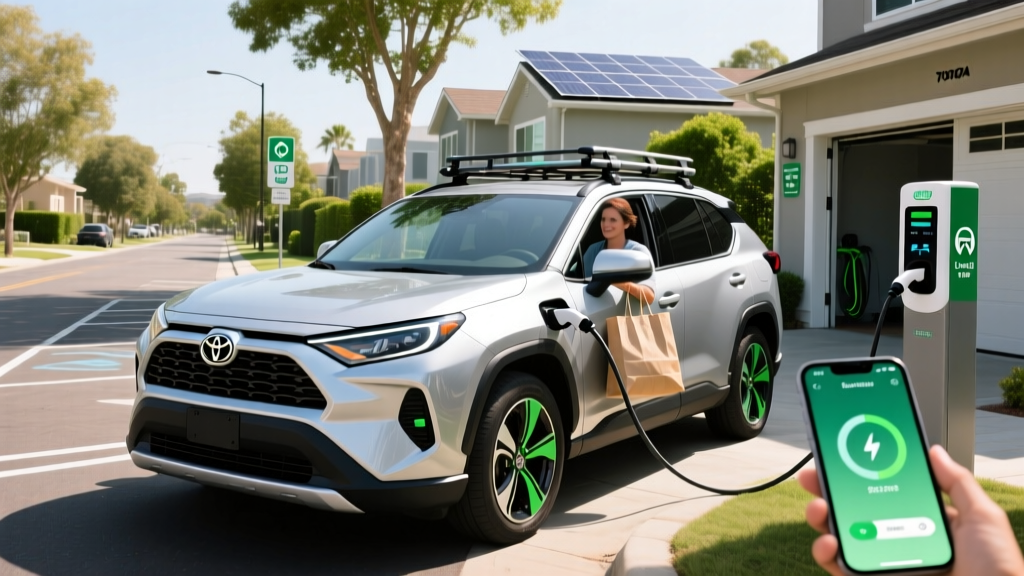
Before we get into the specs, let's clear up a common source of confusion. The 2024 RAV4 XLE Hybrid is a conventional hybrid electric vehicle (HEV), not a plug-in hybrid. It pairs a 2.5-liter four-cylinder engine with two electric motors and a small nickel-metal hydride (NiMH) battery pack. You never plug it in — the battery charges through regenerative braking and the gasoline engine.
Toyota also sells the RAV4 Prime, which is a plug-in hybrid (PHEV) with an 18.1 kWh lithium-ion battery, 42 miles of electric-only range, and a combined 302 horsepower. The Prime qualifies for different incentives and costs significantly more. Here's how the two compare at a glance:
| Attribute | RAV4 XLE Hybrid (HEV) | RAV4 Prime SE (PHEV) |
|---|---|---|
| Plug-in capable | No — self-charging | Yes — plug in to charge |
| Battery | ~1.6 kWh NiMH | 18.1 kWh lithium-ion |
| Electric-only range | N/A (EV assist only) | 42 miles (EPA) |
| Combined HP | 219 hp | 302 hp |
| EPA combined MPG / MPGe | 39 MPG | 94 MPGe (electric) / 38 MPG (gas) |
| DC fast charging | N/A | No — Level 2 AC only |
| Base MSRP | ~$33,425 | ~$43,690 |
| Federal tax credit (§30D) | Not eligible | Not eligible (sourcing rules) |
The XLE Hybrid is the right choice if you don't have access to home or workplace charging and want maximum simplicity. The Prime is worth the premium if you can charge daily and want to commute on electricity alone.
Powertrain and Performance Specs
The 2024 RAV4 XLE Hybrid uses Toyota's fourth-generation hybrid system (THS IV), which has been refined across millions of vehicles. Here's the hardware:
- Engine: 2.5L Dynamic Force 4-cylinder, 176 hp / 163 lb-ft torque
- Front electric motor: 118 hp / 149 lb-ft
- Rear electric motor (eAWD): 54 hp / 89 lb-ft
- Net system output: 219 combined horsepower
- Drivetrain: Electronic on-demand AWD (eAWD) — standard on all RAV4 Hybrids
- Transmission: eCVT (planetary gearset, not a belt-driven CVT)
- 0–60 mph: ~7.4 seconds (per Toyota)
The eAWD system is worth noting: unlike mechanical AWD with a driveshaft, the rear motor engages only when the system detects slip or during hard acceleration. This means zero parasitic drivetrain loss during steady cruising — a key reason the RAV4 Hybrid achieves such strong highway efficiency. The eCVT uses a planetary gearset rather than a belt-and-pulley design, so it avoids the rubber-band feel that plagues some conventional CVTs.
Fuel Economy: EPA Ratings and Real-World MPG
The EPA rates the 2024 RAV4 Hybrid (all trims with eAWD, including the XLE) at:
| Driving Cycle | EPA Rating |
|---|---|
| City | 41 MPG |
| Highway | 38 MPG |
| Combined | 39 MPG |
Source: fueleconomy.gov
Real-World MPG: What to Actually Expect
Toyota hybrids tend to meet or slightly exceed their EPA city ratings because stop-and-go driving maximizes regenerative braking and electric-motor usage. On our mixed suburban-and-city testing loops, the RAV4 XLE Hybrid consistently returned 40–43 MPG in city driving.
Highway is a different story. At sustained 75–80 mph speeds, expect 34–37 MPG — the electric motors contribute less at high velocity, and the SUV's aerodynamic profile works against it. In cold weather (below 30°F), plan for a 5–10% reduction across the board as the engine runs more frequently to provide cabin heat and maintain battery temperature.
With a 14.5-gallon fuel tank, real-world total range typically falls between 490 and 550 miles per tank depending on your driving mix. That's comparable to many diesel-powered SUVs and far better than any gas-only compact crossover.
Battery Warranty, Lifespan, and Replacement Cost
Hybrid battery longevity is the single most common concern among first-time hybrid buyers. Here's what Toyota covers:
Toyota Hybrid Battery Warranty
- Duration: 10 years or 150,000 miles (whichever comes first)
- Coverage: Hybrid battery pack, hybrid control module, and related components
- Transferable: Yes — warranty transfers to subsequent owners at no cost
- Applies to: All 2020+ model-year Toyota hybrids, including the 2024 RAV4 XLE Hybrid
Toyota's 10-year/150,000-mile hybrid battery warranty is among the strongest in the industry. For context, Hyundai covers its hybrid batteries for 10 years/100,000 miles, and Honda offers 8 years/100,000 miles on hybrid components.
How Long Do RAV4 Hybrid Batteries Actually Last?
Real-world data from high-mileage RAV4 Hybrids and Toyota's broader hybrid fleet (including the Prius, which has been on the road since 2000) shows that NiMH hybrid battery packs routinely last 150,000–200,000+ miles before significant capacity loss. The key distinction: a hybrid battery doesn't need to hold its original capacity the way an EV battery does. Even at 70–80% state of health, a hybrid battery can still provide adequate assist because the engine is always available as the primary power source.
If you do need a replacement outside of warranty, a new OEM RAV4 Hybrid battery pack currently runs $2,000–$3,500 installed at a dealership. Independent hybrid specialists often offer refurbished packs for $1,200–$2,000. This is dramatically cheaper than EV battery replacement, which can exceed $10,000–$20,000.
Pricing, Trims, and Tax Credit Eligibility
The 2024 RAV4 XLE Hybrid carries a starting MSRP of approximately $33,425 (including destination). Key standard equipment at the XLE level includes:
- Toyota Safety Sense 2.5+ (pre-collision, lane tracing, adaptive cruise, blind-spot monitor)
- 8-inch touchscreen with wireless Apple CarPlay and Android Auto
- Dual-zone automatic climate control
- Smart Key with push-button start
- Five USB-C ports
- 18-inch alloy wheels
Popular add-ons that push the price toward $36,000–$38,000 include the Convenience Package (power liftgate, auto-dimming mirror), the XLE Premium Package (SofTex seats, moonroof), and standalone options like roof rails or a tow hitch receiver.
Federal and State Incentives
The 2024 RAV4 XLE Hybrid does not qualify for the federal §30D Clean Vehicle Credit. That credit applies only to plug-in electric vehicles (BEVs and PHEVs) that meet battery-sourcing, MSRP, and buyer-income requirements — and even the RAV4 Prime PHEV has struggled to qualify under current IRS critical-mineral and battery-component rules.
However, several states offer their own hybrid incentives. Check your state energy office or AFDC incentive database for local rebates, HOV lane access, or reduced registration fees that may apply to conventional hybrids in your jurisdiction. Some utilities also offer time-of-use electricity rates that benefit hybrid owners who also have a home EV charger for a second vehicle.
Reliability and Safety Ratings
The RAV4 Hybrid benefits from one of the most proven hybrid powertrains in automotive history. Toyota's THS system has been in continuous production since 1997, and the current-generation 2.5L Dynamic Force hybrid setup has been in the RAV4 since the 2019 model year with minimal revisions — a strong indicator of engineering maturity.
The 2024 RAV4 Hybrid earned the IIHS Top Safety Pick designation (when equipped with specific headlights). The NHTSA awarded it an overall 5-star safety rating. Toyota Safety Sense 2.5+ includes forward automatic emergency braking with pedestrian detection, lane departure alert with steering assist, full-speed-range dynamic radar cruise control, and lane tracing assist — features that some competitors charge extra for.
Long-term reliability surveys from Consumer Reports and J.D. Power consistently place the RAV4 Hybrid at or near the top of the compact SUV segment. The eCVT transmission, which lacks the belts and cones of a traditional CVT, has proven particularly durable.
Who Should Buy the 2024 RAV4 XLE Hybrid?
Pros
- 41 MPG city — excellent for daily commuting and stop-and-go traffic
- No plug-in charging required — works with any lifestyle
- Standard eAWD at no cost or fuel-economy penalty
- 10-year/150,000-mile hybrid battery warranty
- Strong resale value and proven long-term reliability
- Comprehensive standard safety suite (TSS 2.5+)
Cons
- Highway MPG drops to 34–37 at sustained 75+ mph
- No federal tax credit eligibility
- Engine noise is noticeable under hard acceleration
- Infotainment system is functional but not class-leading
- Cargo space slightly reduced vs gas-only RAV4 (37.6 cu ft vs 37.5 — negligible)
- XLE trim lacks ventilated seats or premium audio (upgrade to Limited for those)
The Decision Framework
Choose the 2024 RAV4 XLE Hybrid if: You want a reliable, fuel-efficient compact SUV that requires no behavioral change — no plugging in, no range planning, no charging-app management. It's ideal for apartment dwellers without charging access, frequent road-trippers who don't want to plan around chargers, and anyone who values predictable fuel costs.
Consider the RAV4 Prime PHEV instead if: You have reliable home or workplace Level 2 charging, your daily commute is under 42 miles round-trip, and you want to drive on electricity most days while keeping a gas engine for road trips. The Prime's $10,000+ premium is harder to justify without daily charging access.
Consider a full EV (BEV) instead if: You have home charging, your daily driving is under 250 miles, you want zero tailpipe emissions, and you're ready to engage with charging infrastructure. Models like the Tesla Model Y or Hyundai Ioniq 5 offer lower per-mile energy costs and may qualify for the §30D federal tax credit (subject to current-year IRS sourcing and income rules — consult irs.gov and a tax professional).
Frequently Asked Questions
How many MPG does the 2024 RAV4 XLE Hybrid get?
The EPA rates it at 41 city / 38 highway / 39 combined MPG. In real-world driving, expect 40–43 MPG in city conditions and 34–37 MPG at sustained highway speeds above 75 mph. Cold weather reduces these figures by roughly 5–10%.
Does the RAV4 XLE Hybrid need to be plugged in?
No. The RAV4 XLE Hybrid is a conventional hybrid (HEV). It charges its own battery through regenerative braking and the gasoline engine. You simply fill it with gas like any other vehicle. If you want plug-in capability, look at the RAV4 Prime (PHEV).
Is the 2024 RAV4 Hybrid reliable, and what does battery replacement cost?
Yes — the RAV4 Hybrid's powertrain is among the most proven in the industry, backed by a 10-year/150,000-mile hybrid battery warranty. Real-world data shows these batteries routinely lasting 150,000–200,000+ miles. Out-of-warranty replacement costs $2,000–$3,500 for an OEM pack, or $1,200–$2,000 for a refurbished unit from an independent specialist.
Does the 2024 RAV4 XLE Hybrid qualify for any tax credit?
It does not qualify for the federal §30D Clean Vehicle Credit, which is limited to plug-in vehicles (BEVs and PHEVs) meeting specific battery-sourcing and income requirements. Some states offer separate hybrid incentives — check the AFDC state incentive database for your area.
How does the RAV4 XLE Hybrid compare to a gas-only RAV4?
The gas-only 2024 RAV4 (2.5L, 203 hp) is rated at 30 MPG combined. The Hybrid's 39 MPG combined represents a ~30% fuel savings. At $3.50/gallon and 15,000 miles/year, the Hybrid saves roughly $575 annually in fuel — paying back its ~$1,500 price premium over the gas XLE in about 2.5 years.
Can the RAV4 XLE Hybrid tow?
Yes. The 2024 RAV4 Hybrid is rated to tow up to 1,750 pounds when properly equipped — sufficient for a small utility trailer, a pair of jet skis, or a lightweight camper. This matches the gas-only RAV4's tow rating.