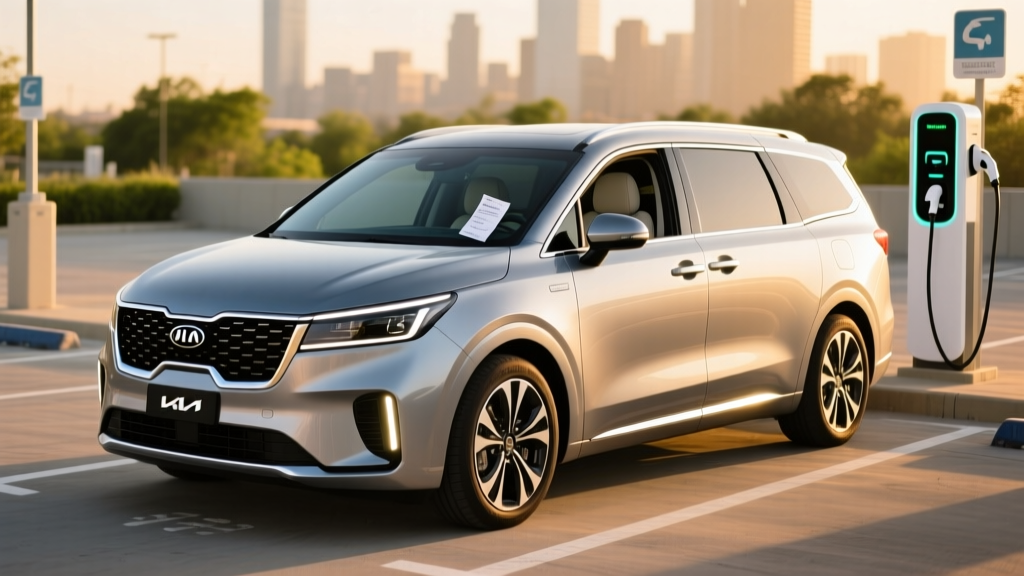
The 2025 Kia Carnival Hybrid arrived as a replacement for the V6-only minivan formula, swapping the naturally aspirated 3.5-liter for a 1.6-liter turbocharged four-cylinder paired with an electric motor. The result: a minivan that posts 34 MPG combined while still hauling seven or eight passengers and their cargo. For families who want electrified efficiency without plugging in, the Carnival HEV occupies a specific niche — and it's worth understanding exactly what you're getting before signing the paperwork.
This guide covers the 2025 Kia Carnival Hybrid's real-world fuel economy, powertrain specs, pricing across trims, battery warranty, and how it stacks up against plug-in hybrid and full-electric alternatives. We'll also address the tax-credit question that trips up many hybrid shoppers.
HEV vs PHEV: What the 2025 Kia Carnival Hybrid Actually Is
Let's clear up a common point of confusion before we get into the numbers. The 2025 Kia Carnival Hybrid is a conventional hybrid electric vehicle (HEV). It is not a plug-in hybrid (PHEV), and it does not have a charging port. You fuel it with gasoline like any other car, and the hybrid system recovers energy through regenerative braking and engine optimization to boost efficiency.
| Feature | HEV (Carnival Hybrid) | PHEV (e.g., Chrysler Pacifica Hybrid) |
|---|---|---|
| Plugs in to charge? | No — gas only | Yes — has a charge port |
| Electric-only range | None (motor assists engine) | ~32 miles (Pacifica Hybrid) |
| Battery size | ~1.5 kWh (small buffer) | ~16 kWh usable |
| EPA combined MPG / MPGe | 34 MPG combined | 30 MPG + 82 MPGe (electric) |
| Federal tax credit | Not eligible | Up to $7,500 (§30D, if eligible) |
| Home charger needed? | No | Yes, for electric range benefit |
Why does this matter? Because many buyers search for "Carnival Hybrid" expecting plug-in capability. As of the 2025 model year, Kia does not offer a Carnival PHEV in the US market. If you want electric-only driving in a minivan, the Chrysler Pacifica Hybrid is currently the only PHEV option. The Carnival Hybrid instead focuses on delivering strong MPG without any change to your fueling routine.
Fuel Economy: EPA Ratings and Real-World MPG
The EPA rates the 2025 Kia Carnival Hybrid at 34 MPG city / 31 MPG highway / 34 MPG combined, according to fueleconomy.gov. That combined figure represents a significant jump over the non-hybrid Carnival's 22 MPG combined — a 55% improvement in fuel efficiency.
| Model | City MPG | Highway MPG | Combined MPG |
|---|---|---|---|
| 2025 Carnival Hybrid (HEV) | 34 | 31 | 34 |
| 2025 Carnival (3.5L V6) | 19 | 26 | 22 |
| Toyota Sienna Hybrid (FWD) | 36 | 36 | 36 |
| Honda Odyssey (3.5L V6) | 19 | 28 | 22 |
Real-world expectations: Hybrids typically exceed their EPA city ratings in stop-and-go driving because regenerative braking recovers more energy at lower speeds. On the highway, the Carnival Hybrid's boxy aerodynamics and 4,600-pound curb weight work against it — expect closer to 28-30 MPG on sustained 75+ mph interstate runs. In mixed suburban driving with school runs, grocery trips, and moderate traffic, owners commonly report 32-35 MPG, which aligns well with the EPA combined estimate.
Cold weather will knock 10-15% off these numbers in winter months, primarily because the engine runs more frequently to provide cabin heat. This is true of all hybrids, not just the Carnival.
Powertrain Specs: 1.6L Turbo Hybrid Under the Hood
The 2025 Carnival Hybrid pairs a 1.6-liter turbocharged GDI four-cylinder engine with a 54 kW (72 hp) electric motor mounted between the engine and a 6-speed automatic transmission. Here's the full breakdown:
| Specification | Detail |
|---|---|
| Engine | 1.6L turbocharged GDI 4-cylinder |
| Engine output | 180 hp / 195 lb-ft torque |
| Electric motor | 54 kW (72 hp) / 195 lb-ft |
| Combined system output | 245 hp / 271 lb-ft torque |
| Transmission | 6-speed automatic |
| Drivetrain | FWD (AWD not available on hybrid) |
| Battery | ~1.5 kWh lithium-ion (HEV buffer) |
| Towing capacity | 3,500 lbs |
| 0-60 mph | ~7.5 seconds (est.) |
The combined 245 horsepower is a modest bump over the V6's 290 hp, but the hybrid's electric motor delivers instant torque from a stop, which makes the Carnival Hybrid feel responsive in city driving despite the smaller displacement engine. The trade-off is highway passing power — the V6 still has an edge in high-speed merge situations when fully loaded.
One important note: the hybrid powertrain is only available with front-wheel drive. If you need AWD, Kia offers it on the non-hybrid Carnival (starting with the 2025 refresh), but the hybrid remains FWD-only.
Pricing by Trim and Tax Credit Eligibility
The 2025 Kia Carnival Hybrid is available across four trims, with pricing that starts in the low $40,000s. Here's the MSRP breakdown (destination included):
| Trim | MSRP (approx.) | Key Features |
|---|---|---|
| LXS | $40,500 | 7-passenger, power sliding doors, 12.3" display |
| EX | $43,500 | 8-passenger, heated front seats, smart power liftgate |
| SX | $47,000 | Leather, dual sunroof, highway driving assist |
| SX Prestige | $52,500 | Nappa leather, VIP rear lounge seats, 360° camera |
Does the 2025 Carnival Hybrid Qualify for a Federal Tax Credit?
No. The 2025 Kia Carnival Hybrid does not qualify for the federal §30D clean vehicle tax credit. That credit — up to $7,500 — is reserved for plug-in electric vehicles (BEVs and PHEVs) that meet battery sourcing, critical minerals, MSRP cap, and buyer income requirements as outlined by the IRS. Conventional hybrids like the Carnival HEV have not qualified for a federal purchase credit since the original Hybrid Tax Credit expired years ago.
Some states offer their own incentives for hybrid vehicles, though these are less common than EV incentives. Check your state's energy office or department of revenue for current programs. A few states offer reduced registration fees or HOV lane access for hybrids, but direct purchase rebates are rare for HEVs in 2025-2026.
Battery Warranty, Reliability, and Replacement Cost
2025 Kia Carnival Hybrid Battery Warranty:
- Hybrid battery: 10 years / 100,000 miles (whichever comes first)
- Hybrid system components (motor, inverter, controller): 10 years / 100,000 miles
- Basic vehicle warranty: 5 years / 60,000 miles
- Powertrain warranty: 10 years / 100,000 miles
Kia's hybrid battery warranty is one of the strongest in the segment, matching Hyundai's coverage and exceeding Toyota's 10-year/150,000-mile hybrid battery warranty only on the mileage side (Toyota offers 150K miles vs Kia's 100K). For context, the hybrid battery in the Carnival is a relatively small ~1.5 kWh unit — it's not the massive 70-100 kWh pack you'd find in a full EV. This means two things:
- Replacement cost is manageable. If the hybrid battery fails outside warranty, expect a replacement cost in the range of $2,000-$3,500 including labor. This is significantly less than a full EV battery replacement, which can run $10,000-$20,000+.
- Failure is rare. Modern lithium-ion hybrid batteries from Kia/Hyundai have demonstrated strong longevity. The hybrid battery undergoes far fewer deep discharge cycles than an EV battery — it operates in a narrow state-of-charge window (roughly 40-60% SoC), which dramatically extends cycle life. Most hybrid batteries outlast the vehicle itself.
As for overall reliability, Kia's hybrid powertrain has been in use across the Sorento Hybrid and Sportage Hybrid since 2022-2023, and early data shows no systemic failure patterns. The 1.6L turbo engine is a proven design shared across the Hyundai-Kia lineup. The main reliability consideration is the turbocharger long-term — keeping up with oil change intervals (every 5,000-7,500 miles with synthetic) is essential for turbo longevity.
Who Should Buy the Carnival Hybrid vs an EV or Gas Minivan?
Choose the 2025 Kia Carnival Hybrid if:
- You drive 12,000-20,000 miles/year and want lower fuel costs without changing your fueling habits
- You don't have access to home charging (apartment, street parking, no garage outlet)
- You regularly take long road trips and don't want to plan around charging stops
- You want a minivan with strong MPG but can't justify the $50K+ price of a Pacifica Hybrid
- You need a proven 7-8 seat people hauler with 3,500-lb towing
Consider a full EV (e.g., Kia EV9) instead if:
- You have Level 2 home charging and mostly drive under 250 miles/day
- You want zero tailpipe emissions and the lowest per-mile fuel cost (~$0.04-$0.06/mi on home electricity)
- You qualify for the $7,500 federal tax credit, which significantly narrows the price gap
- You're willing to plan DC fast-charging stops on road trips (300+ mi range)
Stick with the gas V6 Carnival if:
- You need AWD for snow/ice belt driving
- You tow frequently near the 3,500-lb limit (the V6 handles heavy loads with less strain)
- You drive very low annual miles (<8,000) where the hybrid fuel savings won't offset the higher MSRP within your ownership period
Annual Fuel Cost Comparison
At 15,000 miles/year and $3.40/gallon regular unleaded, the math looks like this:
| Vehicle | Combined MPG | Annual Fuel Cost | 5-Year Fuel Cost |
|---|---|---|---|
| Carnival Hybrid | 34 | $1,500 | $7,500 |
| Carnival V6 | 22 | $2,318 | $11,591 |
| Toyota Sienna Hybrid | 36 | $1,417 | $7,083 |
The Carnival Hybrid saves approximately $818 per year vs the V6 model, or about $4,091 over five years. That's meaningful, though the hybrid carries roughly a $1,500-$2,500 price premium over an equivalently trimmed V6 model, so the payback period is approximately 2-3 years for most drivers.
How It Compares: Carnival Hybrid vs Sienna Hybrid vs Pacifica Hybrid
| Spec | 2025 Kia Carnival Hybrid | 2025 Toyota Sienna Hybrid | 2025 Chrysler Pacifica Hybrid (PHEV) |
|---|---|---|---|
| Type | HEV | HEV | PHEV |
| Combined MPG | 34 | 36 | 30 (gas) / 82 MPGe |
| Electric-only range | N/A | N/A | 32 miles |
| Combined HP | 245 | 245 | 260 |
| AWD available? | No | Yes | No |
| Starting MSRP | ~$40,500 | ~$39,500 | ~$51,000 |
| Federal tax credit | None | None | Up to $7,500* |
| Seating | 7 or 8 | 7 or 8 | 7 |
| Max cargo (cu ft) | 145.1 | 101.0 | 140.5 |
*Pacifica Hybrid §30D eligibility depends on MSRP cap, buyer income, battery sourcing, and point-of-sale transfer rules. Verify current eligibility at fueleconomy.gov.
The Sienna Hybrid edges out the Carnival on MPG (36 vs 34) and offers AWD, but the Carnival Hybrid wins decisively on cargo volume — 145.1 cu ft with seats folded vs the Sienna's 101.0 cu ft. If maximum interior space is your priority, the Carnival's SUV-inspired design delivers minivan passenger comfort with crossover-class cargo capability.
Pros
- 34 MPG combined — massive improvement over V6
- Best-in-class cargo volume (145.1 cu ft)
- No charging infrastructure needed
- 10-year/100,000-mile hybrid battery warranty
- Strong tech: dual 12.3" displays, available Highway Driving Assist
- Competitive starting price vs Pacifica Hybrid
Cons
- FWD only — no AWD option on hybrid
- No federal tax credit (HEV ineligible for §30D)
- Highway MPG drops under heavy load at 75+ mph
- 245 hp is adequate, not thrilling, for a 4,600-lb vehicle
- Sienna Hybrid offers slightly better MPG and AWD availability
Frequently Asked Questions
How many MPG does the 2025 Kia Carnival Hybrid get?
The EPA rates it at 34 MPG city / 31 MPG highway / 34 MPG combined. In real-world suburban driving, expect 32-35 MPG. Highway-only trips at 75+ mph will yield closer to 28-30 MPG, especially when loaded with passengers and cargo.
Does the Carnival Hybrid need to be plugged in?
No. The 2025 Carnival Hybrid is a conventional HEV, not a plug-in hybrid. You fuel it exclusively with gasoline. The hybrid battery charges itself through regenerative braking and engine power. There is no charging port on the vehicle.
How far can the Carnival Hybrid go on electric only?
It cannot drive on electric power alone for any meaningful distance. The electric motor assists the gasoline engine during acceleration and low-speed maneuvers, but it does not provide standalone electric-only driving like a PHEV would. If electric-only range is a priority, look at the Chrysler Pacifica Hybrid (32 miles electric-only).
Is the 2025 Carnival Hybrid reliable?
Kia's 1.6L turbo hybrid powertrain has been deployed in the Sorento and Sportage hybrids since 2022-2023 with no widespread failure reports. The hybrid battery operates in a narrow charge window that maximizes longevity, and Kia backs it with a 10-year/100,000-mile warranty. Long-term turbo reliability depends on consistent oil change intervals.
What does a Carnival Hybrid battery replacement cost?
If the hybrid battery fails outside the 10-year/100,000-mile warranty window, expect a replacement cost of approximately $2,000-$3,500 including parts and labor. This is far less than an EV traction battery replacement because the HEV battery is much smaller (~1.5 kWh vs 70-100+ kWh in a BEV).
Does the Carnival Hybrid qualify for any tax credit?
The 2025 Carnival Hybrid does not qualify for the federal §30D clean vehicle credit, which is limited to plug-in EVs and PHEVs that meet battery sourcing and income requirements. Some states may offer minor hybrid incentives — check your state's energy office. The IRS clean vehicle credit page has full details on which vehicles qualify.
Should I get the Carnival Hybrid or a full EV like the Kia EV9?
It depends on your driving pattern and charging access. The EV9 offers ~270-300 miles of EPA range, qualifies for the $7,500 federal credit (subject to eligibility), and costs roughly $0.05/mile to fuel at home. But it starts above $56,000, requires home Level 2 charging for convenience, and seats a maximum of 7 with less cargo flexibility. If you drive under 250 miles/day, have home charging, and want the lowest operating cost, the EV9 is compelling. If you road-trip frequently, lack charging access, or need maximum cargo space, the Carnival Hybrid is the more practical choice.