The Toyota RAV4 Hybrid has been America's best-selling hybrid SUV for years, and the RAV4 Prime plug-in variant offers a compelling bridge between gas and full electric. But with MSRPs climbing and federal tax-credit rules tightening under IRS §30D, the real question for 2026 buyers is straightforward: what does a RAV4 Hybrid or Prime actually cost to buy, fuel, and own? This guide breaks down every number that matters — from EPA MPG to battery replacement risk — so you can decide which version, if either, earns a spot in your driveway.
HEV vs PHEV: Which RAV4 Hybrid Are We Talking About?
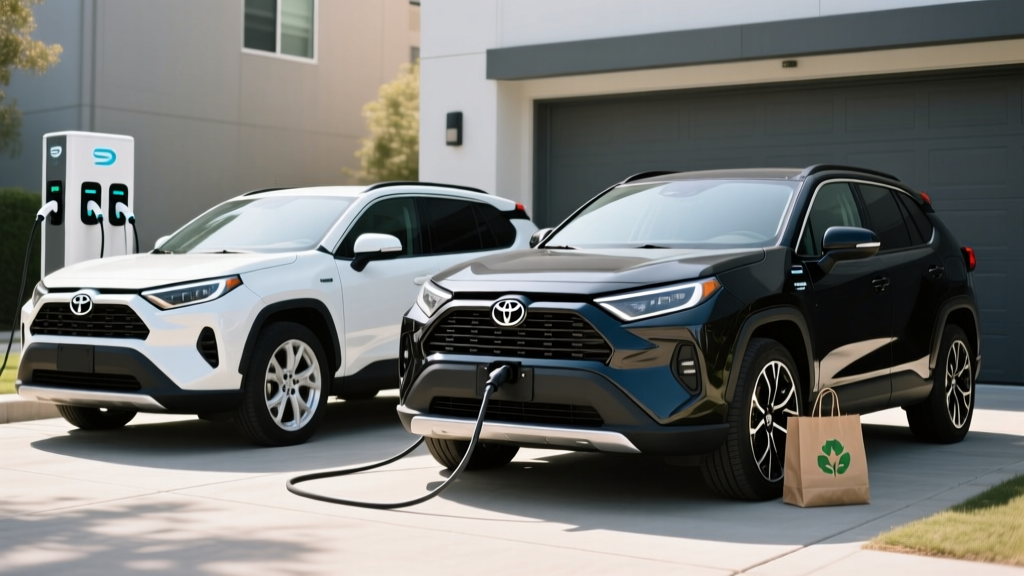
Before comparing costs, it's critical to distinguish the two powertrains Toyota offers. The RAV4 Hybrid is a conventional hybrid electric vehicle (HEV). It pairs a gasoline engine with an electric motor and a small battery that recharges through regenerative braking and engine power. You never plug it in. The RAV4 Prime is a plug-in hybrid electric vehicle (PHEV) with a much larger battery you can charge from a wall outlet or public charger, giving it a meaningful electric-only driving range before the gas engine kicks in.
| Attribute | RAV4 Hybrid (HEV) | RAV4 Prime (PHEV) |
|---|---|---|
| Plug-in required? | No — self-charging | Yes — 120V or 240V |
| Usable battery capacity | ~1.6 kWh (NiMH) | ~14.9 kWh (Li-ion) |
| Electric-only range | Not applicable | EPA 42 miles |
| Federal tax credit eligible? | No | Up to $7,500 (see rules below) |
| DC fast charging? | No | No — AC only |
The distinction matters enormously for your wallet. The HEV is cheaper upfront and simpler to own but offers no electric-only commuting. The PHEV costs more but can eliminate gas use entirely on short commutes — and may qualify for federal incentives that narrow the price gap.
Fuel Economy: EPA MPG and Real-World Numbers
The RAV4 Hybrid's fuel economy is its headline feature. Here's what the EPA rates for the 2026 model year, based on the latest fueleconomy.gov data:
| Model | City MPG | Highway MPG | Combined MPG | MPGe (PHEV EV mode) |
|---|---|---|---|---|
| RAV4 Hybrid (HEV, AWD) | 41 | 38 | 40 | — |
| RAV4 Hybrid (HEV, FWD) | 41 | 38 | 40 | — |
| RAV4 Prime (PHEV, AWD, hybrid mode) | 40 | 36 | 38 | 94 MPGe |
Real-world MPG vs. EPA sticker: Toyota's hybrid system excels in city driving, where regenerative braking and low-speed electric assist do heavy lifting. In our experience and consistent owner reports, the RAV4 Hybrid frequently exceeds its EPA city rating in stop-and-go traffic — 43-45 MPG is common on urban routes. Highway driving is a different story: at 70-80 mph sustained, expect 33-36 MPG due to aerodynamic drag and the engine running more often. Cold weather (below 40°F) typically drops combined MPG by 3-5 points as the engine runs longer to heat the cabin and warm the battery.
For the RAV4 Prime, real-world electric-only range varies. The EPA rates it at 42 miles on a full charge, but aggressive highway driving or winter temperatures can reduce that to 30-35 miles. Gentle city driving in mild weather can push it to 45+ miles — a testament to the efficiency of Toyota's e-AWD system at low speeds.
EPA electric-only range: 42 miles | Real-world summer city: ~44-47 mi | Real-world highway (70 mph): ~32-36 mi | Cold-weather (20°F): ~28-33 mi | Total combined range (gas + electric): ~600 miles
Powertrain Specs: What's Under the Hood
| Specification | RAV4 Hybrid (HEV) | RAV4 Prime (PHEV) |
|---|---|---|
| Engine | 2.5L 4-cylinder Atkinson | 2.5L 4-cylinder Atkinson |
| Combined system horsepower | 219 hp | 302 hp |
| Electric motor(s) | Front + rear (e-AWD) | Front (134 kW) + rear (40 kW) |
| Battery chemistry | NiMH (~1.6 kWh) | Lithium-ion (~14.9 kWh) |
| Drivetrain | AWD (e-AWD) | AWD (e-AWD) |
| 0-60 mph | 7.4 seconds | 5.7 seconds |
| Towing capacity | 1,750 lbs | 1,750 lbs |
| Charging (Level 1, 120V) | N/A | ~12 hours (0-100%) |
| Charging (Level 2, 240V) | N/A | ~2.5 hours (0-100%) |
| DC fast charging | N/A | Not available |
The RAV4 Prime's 302 combined horsepower makes it the quickest RAV4 Toyota sells — quicker, in fact, than many V6 midsize SUVs. That power comes from a larger front motor and a more powerful lithium-ion battery pack. The trade-off is weight: the Prime is roughly 300 lbs heavier than the standard Hybrid, which slightly reduces highway MPG when operating in hybrid mode.
A notable omission on the Prime: no DC fast charging. Toyota limits the Prime to Level 2 AC charging (6.6 kW onboard charger). For a 14.9 kWh battery, this is adequate — a full charge in 2.5 hours on a 240V home charger covers most daily needs. But if you hoped to top up at a public DC fast charger during a road trip, that's not an option.
Pricing, Trim Levels, and Tax Credit Eligibility
Here's where the hybrid car cost equation gets interesting — and where federal incentive rules can meaningfully change the math.
| Model / Trim | 2026 MSRP (est.) | Federal Tax Credit | Effective Price After Credit |
|---|---|---|---|
| RAV4 Hybrid LE (HEV) | $33,500 | $0 | $33,500 |
| RAV4 Hybrid XLE (HEV) | $35,500 | $0 | $35,500 |
| RAV4 Hybrid Limited (HEV) | $39,500 | $0 | $39,500 |
| RAV4 Prime SE (PHEV) | $45,500 | Up to $7,500* | ~$38,000* |
| RAV4 Prime XSE (PHEV) | $48,500 | Up to $7,500* | ~$41,000* |
*MSRP figures are estimates based on 2025 pricing trends and projected 2026 adjustments. Verify with your dealer.
Federal tax credit rules for the RAV4 Prime (PHEV): Under IRS §30D, the RAV4 Prime may qualify for up to $7,500 in federal tax credits — but eligibility depends on several factors that change annually. As of 2026, the key requirements include:
- MSRP cap: The vehicle's MSRP must not exceed $80,000 for SUVs (RAV4 Prime clears this easily).
- Buyer income cap: Modified adjusted gross income must not exceed $150,000 (single), $225,000 (head of household), or $300,000 (joint filing).
- Battery sourcing: A percentage of critical minerals and battery components must be sourced from the U.S. or free-trade-agreement countries. This requirement tightens annually and can reduce or eliminate the credit.
- Point-of-sale transfer: As of 2024, you can transfer the credit to the dealer at purchase, reducing your out-of-pocket cost immediately rather than waiting for tax filing.
- Conventional RAV4 Hybrid (HEV): Does NOT qualify for the §30D new-vehicle credit. The credit applies only to plug-in vehicles with a minimum battery capacity of 7 kWh.
For the latest eligibility details, always check the IRS clean vehicle credit page before purchasing, as battery-sourcing rules and eligible vehicle lists update regularly.
Five-Year Ownership Cost: Hybrid vs. Gas vs. PHEV
The purchase price is only the start. Here's a five-year total-cost-of-ownership comparison assuming 15,000 miles/year, $3.50/gallon regular unleaded, and $0.14/kWh home electricity:
| Cost Category | RAV4 Gas (LE, AWD) | RAV4 Hybrid (LE, AWD) | RAV4 Prime (SE, AWD) |
|---|---|---|---|
| Purchase price (MSRP) | $31,000 | $33,500 | $45,500 |
| Federal tax credit | $0 | $0 | -$7,500 (if eligible) |
| Fuel/electricity (5 yr) | $9,450 | $6,560 | $2,800 (est. 60% electric) |
| Estimated maintenance (5 yr) | $3,200 | $2,800 | $2,600 |
| Insurance (5 yr est.) | $7,500 | $7,800 | $8,200 |
| 5-Year Total | $51,150 | $50,660 | $51,600 |
Key takeaways: The RAV4 Hybrid nearly breaks even with the gas model over five years despite a $2,500 higher MSRP, thanks to ~$2,900 in fuel savings and slightly lower maintenance (less brake wear from regen). The RAV4 Prime's math hinges on the federal tax credit: with the full $7,500, it becomes cost-competitive with both — and offers the bonus of 42 miles of daily electric commuting. Without the credit, the Prime remains $6,000-7,000 more expensive over five years unless you drive primarily on electricity and have cheap home charging.
If your commute is under 40 miles round-trip and you charge at home nightly, the Prime's fuel cost drops dramatically. At $0.14/kWh, charging the Prime's 14.9 kWh battery costs roughly $2.10 — equivalent to about 0.6 gallons of gas. That's a fraction of what even the HEV burns on the same trip.
Battery Warranty, Reliability, and Replacement Cost
HEV (RAV4 Hybrid): 10 years / 150,000 miles (whichever comes first) on the hybrid battery and all hybrid-system components.
PHEV (RAV4 Prime): 10 years / 150,000 miles on the traction battery and plug-in hybrid components.
Powertrain warranty: 5 years / 60,000 miles on the engine, transmission, and related drivetrain components.
Reliability: Toyota's hybrid systems have an exceptional long-term track record. The Hybrid Synergy Drive architecture, refined over two decades since the original Prius, is among the most proven electrified powertrains on the road. IIHS and owner surveys consistently place Toyota hybrids near the top for long-term dependability. The e-CVT transmission has no traditional gears or clutch packs to wear out — it's a planetary gearset with far fewer failure points than a conventional automatic.
Battery replacement cost: This is the question that haunts hybrid shoppers. Here's the data: a replacement hybrid battery for the RAV4 Hybrid (NiMH) currently runs $3,000-$4,500 installed at a dealership. The RAV4 Prime's larger lithium-ion pack is more expensive: $6,000-$9,000 installed. However, out-of-warranty battery failures before 150,000 miles are statistically rare. Independent hybrid battery repair shops also offer refurbished or reconditioned packs for 40-60% less than OEM pricing.
The practical reality: most RAV4 Hybrids will be sold, traded, or scrapped before the battery needs replacement. And if you're buying new, the 10-year/150,000-mile warranty covers you through the vehicle's highest-depreciation ownership window.
Who Should Buy the RAV4 Hybrid, the Prime, or Look Elsewhere?
Choose the RAV4 Hybrid (HEV) if: You want maximum MPG with zero lifestyle change — no charging, no plugs, no range planning. You drive a mix of city and highway and want a proven, low-risk hybrid from a brand with strong resale value. You don't qualify for the PHEV tax credit (income above caps) and want the lowest upfront cost.
Choose the RAV4 Prime (PHEV) if: Your daily commute is under 42 miles round-trip and you have reliable home charging (a standard 120V outlet works overnight, though 240V is better). You want electric commuting most days but need gas flexibility for road trips. You qualify for the federal tax credit, which makes the Prime's effective price close to a well-equipped Hybrid.
Consider a full BEV (e.g., Tesla Model Y, Hyundai Ioniq 5) if: You have home Level 2 charging, your daily driving rarely exceeds 250 miles, and you want to eliminate gas entirely. Full EVs have lower per-mile fuel costs, fewer moving parts, and access to DC fast charging for road trips — but require more charging infrastructure planning.
Stick with the gas RAV4 if: You drive very few miles annually (under 8,000), where the hybrid fuel savings won't offset the higher purchase price within your ownership window. Or if you regularly tow near the 1,750-lb limit and want the lowest possible purchase price.
Pros and Cons at a Glance
- Class-leading hybrid MPG (40 combined EPA, often higher in city driving)
- RAV4 Prime offers 42 mi electric range — enough for most commutes
- 10-year/150,000-mile hybrid battery warranty
- Strong resale value and proven Toyota reliability
- Prime qualifies for up to $7,500 federal tax credit (with eligibility caveats)
- 302 hp on the Prime — genuinely quick for a compact SUV
- AWD standard on all trims
- HEV does not qualify for any federal purchase incentive
- Prime has no DC fast charging — AC only, even at public stations
- Prime's 2.5-hour Level 2 charge time is slow vs. competitors (e.g., Hyundai Tucson PHEV)
- RAV4 Hybrid highway MPG drops to low-to-mid 30s at 75+ mph
- Infotainment and cabin materials lag behind Hyundai/Kia rivals
- Prime pricing pushes into luxury-compact territory before incentives
Frequently Asked Questions
How many MPG does the 2026 RAV4 Hybrid get?
The EPA rates the RAV4 Hybrid at 41 city / 38 highway / 40 combined MPG. In real-world driving, expect 43-45 MPG in city traffic and 33-36 MPG on sustained highway trips at 70-80 mph. Cold weather typically reduces combined MPG by 3-5 points.
How far can the RAV4 Prime go on electric only?
The EPA rates the RAV4 Prime at 42 miles of electric-only range. Real-world results vary: expect 44-47 miles in mild city driving, 32-36 miles at highway speeds, and 28-33 miles in freezing temperatures. Once the battery depletes, the Prime operates as a conventional hybrid at roughly 38 MPG combined.
Does the RAV4 Hybrid qualify for a tax credit?
The conventional RAV4 Hybrid (HEV) does not qualify for the federal §30D clean vehicle credit — that credit applies only to plug-in vehicles. The RAV4 Prime (PHEV) may qualify for up to $7,500, subject to buyer income limits, MSRP caps, and battery-sourcing requirements. Check IRS.gov for current eligibility before purchasing.
Is the RAV4 Hybrid reliable, and what does a battery replacement cost?
Toyota's hybrid system is among the most reliable electrified powertrains in the industry, backed by a 10-year/150,000-mile hybrid battery warranty. Out-of-warranty battery replacement runs $3,000-$4,500 for the HEV and $6,000-$9,000 for the Prime's larger lithium-ion pack, though failures before 150,000 miles are uncommon.
Do I need to plug in the RAV4 Hybrid?
No. The conventional RAV4 Hybrid (HEV) charges its battery entirely through regenerative braking and the gasoline engine. You fuel it like any other gas car. Only the RAV4 Prime (PHEV) requires plugging in to access its electric-only range — though it will still drive on gas if you never charge it.
Hybrid vs. PHEV vs. full EV — which should I choose?
If you lack home charging or frequently drive 300+ miles between stops, the HEV is the lowest-friction choice. If you have home charging and a sub-40-mile commute, the PHEV eliminates most gas use while keeping road-trip flexibility. If you have reliable charging access and rarely exceed 250 miles daily, a full BEV offers the lowest operating cost and least maintenance — but requires committing to charging infrastructure.
Can the RAV4 Prime DC fast charge?
No. The RAV4 Prime is limited to Level 2 AC charging at a maximum of 6.6 kW. A full charge takes approximately 2.5 hours on a 240V Level 2 station or about 12 hours on a standard 120V household outlet. Toyota does not offer DC fast charging on any current RAV4 Prime model.