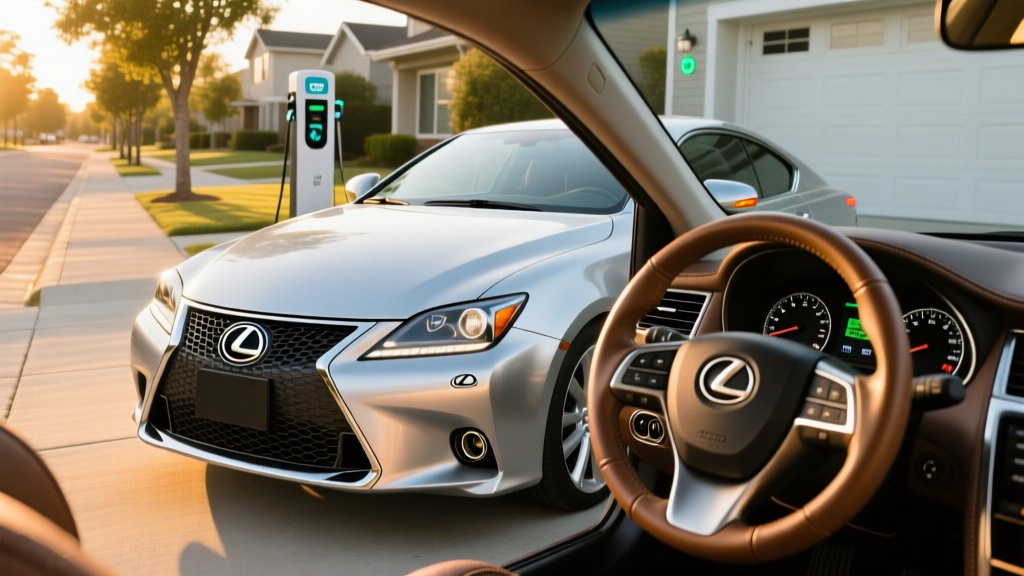
The 2010 Lexus HS 250h occupies a curious space in the used-hybrid market. Built on the Toyota MC platform and sold only for the 2010–2012 model years in the United States, this compact luxury sedan paired a 2.4-liter four-cylinder engine with Toyota's Hybrid Synergy Drive system. It was Lexus's first dedicated hybrid-only nameplate, and while it never achieved the sales volume of the RX or CT lines, it remains a data-rich case study in early luxury hybrid ownership.
If you're researching a used 2010 Lexus HS 250h today, you likely want hard numbers: real-world fuel economy, battery longevity, replacement cost, and how it stacks up against modern hybrids, PHEVs, and full EVs. This guide breaks down every metric that matters.
HEV vs. PHEV: What the 2010 Lexus HS 250h Actually Is
The HS 250h is a conventional hybrid electric vehicle (HEV), not a plug-in hybrid (PHEV). That distinction is critical for buyers coming from today's electrified-vehicle landscape:
| Feature | 2010 Lexus HS 250h (HEV) | Typical PHEV (e.g., Toyota Prius Prime) | Full EV (BEV) |
|---|---|---|---|
| Plug-in charging required? | No — regenerative braking + engine charges battery | Yes — plug in for electric-only miles | Yes — plug in for all energy |
| Electric-only range | ~1 mile at very low speed | 25–44 miles (2025 models) | 200–400+ miles |
| Battery size | 1.9 kWh (NiMH) | 13.6 kWh (Li-ion) | 60–100+ kWh (Li-ion/LFP) |
| Fuel source | Gasoline only | Gasoline + grid electricity | Grid electricity only |
| Tax credit (new) | None | Up to $7,500 (§30D) | Up to $7,500 (§30D) |
The HS 250h's 1.9 kWh nickel-metal hydride (NiMH) battery is far too small to provide meaningful electric-only driving. It functions as a buffer: capturing energy from regenerative braking and the gasoline engine, then deploying it to assist acceleration and enable brief low-speed electric motoring. You never plug it in. You simply fuel it with gasoline.
Fuel Economy: EPA Ratings vs. Real-World MPG
The EPA rated the 2010 Lexus HS 250h at 35 MPG city / 34 MPG highway / 35 MPG combined. Those figures were competitive for a luxury compact in 2010, though the HS 250h trails modern hybrids like the Toyota Prius (57 MPG combined) and even the current Lexus ES 300h (44 MPG combined).
| Driving Scenario | EPA Rating | Real-World Expectation |
|---|---|---|
| City | 35 MPG | 33–37 MPG (hybrids often exceed EPA in stop-and-go) |
| Highway (70 mph) | 34 MPG | 29–33 MPG (aerodynamic drag + no regen benefit) |
| Combined | 35 MPG | 31–35 MPG |
| Cold weather (below 30°F) | — | 27–31 MPG (engine runs more for cabin heat) |
Source: fueleconomy.gov — 2010 Lexus HS 250h
The HS 250h behaves like most Toyota hybrids of its era: city mileage meets or slightly exceeds the EPA sticker thanks to frequent regenerative braking opportunities, while highway mileage falls short because the 2.4-liter Atkinson-cycle engine must work continuously at sustained speeds with minimal electric assist. Cold weather hits hybrids harder than many buyers expect — the engine runs more often to generate cabin heat, reducing efficiency by 10–20%.
Powertrain Specs and Performance
| Specification | 2010 Lexus HS 250h |
|---|---|
| Engine | 2.4L 4-cylinder Atkinson-cycle |
| Engine output | 147 hp / 138 lb-ft torque |
| Electric motor output | 103 kW (138 hp) |
| Combined system horsepower | 187 hp (net) |
| Transmission | eCVT (planetary gearset, no traditional gears) |
| 0–60 mph | 8.4 seconds (Car and Driver tested) |
| Drivetrain | Front-wheel drive |
| Curb weight | ~3,680 lbs |
| Battery chemistry | NiMH (nickel-metal hydride) |
| Battery capacity | 1.9 kWh (gross) |
| Fuel tank | 13.2 gallons |
| Total range (est.) | ~462 miles at combined EPA |
The 187 net horsepower figure is lower than the simple sum of engine + motor outputs because peak engine and peak motor power occur at different RPMs. The eCVT is Toyota's proven planetary-gearset design — there are no belts, cones, or traditional gear ratios to wear. It's one of the most durable transmission designs in production.
Hybrid Battery Longevity and Replacement Cost
This is the top concern for any used-hybrid buyer, and the data here is encouraging.
Original Battery Warranty
When new, the 2010 HS 250h's hybrid battery was covered under Lexus's Hybrid System Warranty: 8 years / 100,000 miles (10 years / 150,000 miles in California and states adopting CARB emissions standards). That factory warranty has expired for all 2010 examples as of 2020.
Real-World Battery Lifespan
The NiMH battery in the HS 250h shares its fundamental architecture with the Toyota Camry Hybrid and Prius of the same era — powertrains that have demonstrated 150,000–250,000+ mile lifespans in fleet and taxi service. NiMH chemistry degrades more gracefully than early lithium-ion: rather than sudden capacity cliff failure, you'll notice gradually declining fuel economy and more frequent engine engagement.
Based on owner reports and hybrid repair-shop data:
- Expected lifespan: 150,000–200,000 miles before significant degradation
- Failure mode: Individual cell imbalance, not total pack death
- Warning signs: Check hybrid system light, reduced MPG, battery fan running constantly, state-of-charge gauge fluctuating rapidly
Battery Replacement Costs
| Option | Cost Range (2026) | Notes |
|---|---|---|
| New OEM Lexus battery | $3,500–$4,800 (parts + labor) | Dealer-installed; full new pack |
| Remanufactured battery | $1,800–$2,800 | Reconditioned cells; 1–3 year warranty typical |
| Used/salvage battery | $800–$1,500 | From wrecked HS 250h or compatible Camry Hybrid; unknown remaining life |
| Individual cell reconditioning | $500–$1,200 | Specialist hybrid shops replace bad cells only; most cost-effective if only 1–3 cells are weak |
Because the HS 250h shares its hybrid architecture with the Toyota Camry Hybrid (2007–2011 era), aftermarket and remanufactured battery availability is solid. Independent hybrid specialists in most metro areas can perform the replacement in 2–3 hours.
Used Pricing and Tax Credit Reality
As of early 2026, a 2010 Lexus HS 250h with 100,000–150,000 miles typically sells for $5,500–$9,000 depending on condition, mileage, and battery health. Examples with a recently replaced hybrid battery command a $1,500–$2,500 premium.
Tax Credit Eligibility
The 2010 HS 250h does not qualify for any federal tax credit under current IRS §30D rules. The federal new-vehicle clean vehicle credit applies only to new qualifying plug-in vehicles (BEVs and PHEVs meeting battery-sourcing and critical-mineral requirements). Conventional hybrids like the HS 250h have never been eligible for §30D.
The federal used clean vehicle credit (up to $4,000 or 30% of sale price, whichever is lower) also requires the vehicle to be a qualifying plug-in EV or fuel-cell vehicle — conventional HEVs are excluded. Some states offered hybrid rebates when the HS 250h was new, but those programs have long since closed. Check your state's current incentive database for any local programs, but do not expect credits for a 2010 HEV purchase.
Reliability, Safety, and Known Issues
The HS 250h benefits from Toyota's hybrid-system reliability track record. The 2AR-FXE 2.4-liter engine is well-proven, and the eCVT has no friction bands or clutch packs to fail. However, a few model-specific issues deserve attention:
- Brake actuator recall: The HS 250h was included in Toyota's 2010 brake-feel recall (related to the ABS accumulator). Verify this recall was performed — check NHTSA VIN lookup at nhtsa.gov/recalls.
- 12V auxiliary battery: Like all hybrids, the HS 250h has a standard 12V battery that can fail independently of the hybrid pack. A dead 12V battery will prevent the car from starting even if the hybrid battery is fully charged.
- Water pump (electric): The electric coolant pump can fail around 120,000–150,000 miles. Replacement runs $400–$700.
- Interior materials: Dashboard cracking was a known issue on 2010–2012 Lexus models; check for warranty-extension coverage.
The IIHS rated the HS 250h as a Top Safety Pick for its model year, with Good ratings in frontal offset, side impact, and roof strength tests.
Who Should Buy the 2010 Lexus HS 250h — and Who Shouldn't
Pros
- Low used entry price ($5,500–$9,000)
- Proven Toyota hybrid reliability
- No plug-in infrastructure needed — works for apartment dwellers
- Quiet, comfortable ride quality for the price
- Solid safety ratings for its era
- NiMH battery is rebuildable at the cell level
Cons
- MPG trails modern hybrids by 10–20 MPG combined
- Discontinued after 2012 — limited parts for body/interior trim
- No EV tax credits available
- Dated infotainment (no Apple CarPlay/Android Auto natively)
- Modest 187 hp — feels sluggish merging onto fast highways
- High-mileage examples may need hybrid battery replacement soon
Choose the 2010 Lexus HS 250h If:
- You need a budget-friendly commuter with no plug-in requirement
- You drive 10,000–15,000 miles/year and want lower fuel costs without a big upfront investment
- You can verify hybrid battery health before purchase (pre-purchase inspection at a hybrid specialist)
Look at a Modern PHEV or EV Instead If:
- You have home charging access and want 25–40 miles of electric-only commuting
- You want to qualify for the federal used-EV tax credit (up to $4,000 on qualifying plug-in models under $25,000)
- You drive more than 15,000 miles/year — the MPG gap vs. a modern Prius (57 MPG) or PHEV (100+ MPGe on electric) adds up fast
Frequently Asked Questions
How many MPG does the 2010 Lexus HS 250h get?
The EPA rates it at 35 MPG city / 34 MPG highway / 35 MPG combined. In real-world driving, expect 31–35 MPG combined, with city driving slightly exceeding the EPA figure and highway driving falling to 29–33 MPG at 70 mph. Cold weather can reduce efficiency to 27–31 MPG.
Does the 2010 Lexus HS 250h need to be plugged in?
No. The HS 250h is a conventional hybrid (HEV), not a plug-in hybrid (PHEV). Its 1.9 kWh NiMH battery charges exclusively through regenerative braking and the gasoline engine. There is no charge port.
How far can it drive on electric power alone?
Effectively zero miles at normal driving speeds. The HS 250h can creep at very low speeds (under 10 mph) for roughly one mile on battery alone in ideal conditions, but the electric motor primarily assists the gasoline engine rather than replacing it. This is fundamentally different from a PHEV, which offers 25–44 miles of genuine electric-only driving.
Is the 2010 HS 250h reliable, and what does battery replacement cost?
Yes — the Toyota hybrid powertrain is among the most reliable in the industry. The NiMH hybrid battery typically lasts 150,000–200,000 miles. If replacement is needed, expect $1,800–$4,800 depending on whether you choose a remanufactured or new OEM pack. Cell-level reconditioning by a hybrid specialist can cost as little as $500–$1,200.
Does the 2010 Lexus HS 250h qualify for any tax credit?
No. Federal tax credits under IRS §30D (new clean vehicle) and §25E (used clean vehicle) apply only to plug-in electric vehicles (BEVs and PHEVs) and fuel-cell vehicles. Conventional hybrids like the HS 250h are not eligible for any federal purchase credit. Some states may offer separate incentives, but hybrid-specific programs are rare in 2026.
Hybrid vs. PHEV vs. EV — which should I buy?
A conventional hybrid (HEV) like the HS 250h is best if you lack home charging access and want lower fuel costs with zero behavioral change. A PHEV (like a used Toyota Prius Prime or Chrysler Pacifica Hybrid) is ideal if you can charge at home and want 25–40 miles of electric commuting with a gas engine for longer trips. A full EV (BEV) makes sense if you have reliable home or workplace charging, want the lowest per-mile fuel cost, and your daily driving is under 200 miles. For a detailed breakdown, see our fueleconomy.gov hybrid comparison tool.
What's the difference between kW and kWh on this car?
The HS 250h's electric motor produces 103 kW (kilowatts) of power — that's the rate at which it can deliver energy, like the flow rate of a hose. The battery stores 1.9 kWh (kilowatt-hours) of energy — that's the total volume in the tank. A 103 kW motor draining a 1.9 kWh battery would theoretically empty it in about 67 seconds at full output, which is why the hybrid system constantly balances engine and motor contributions.