Quick Verdict: The Benchmark Compact Hybrid SUV
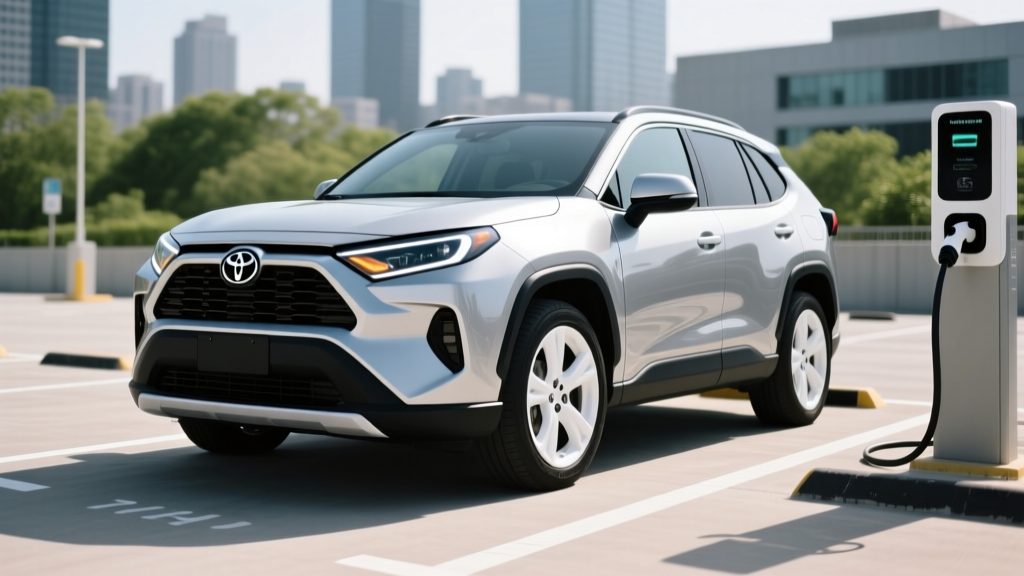
The Toyota RAV4 Hybrid remains the compact SUV segment's efficiency benchmark for 2026, pairing a 219-horsepower hybrid powertrain with standard electronic all-wheel drive and EPA-estimated 39 MPG combined. With over a decade of proven hybrid reliability, aggressive pricing starting at $33,425, and no plug-in requirement, it occupies a practical middle ground between conventional gas crossovers and full battery-electric vehicles.
For buyers who want EV-like city efficiency without range anxiety or charging infrastructure dependence, the RAV4 Hybrid delivers exactly that. Its real-world fuel economy frequently exceeds EPA estimates in urban driving, while highway numbers tend to fall slightly short — a pattern common to all hybrids due to regenerative braking advantages in stop-and-go traffic.
HEV vs PHEV: Which RAV4 Is Right for You?
RAV4 Hybrid (HEV): Self-charging hybrid — no plug required. The 1.6 kWh nickel-metal hydride battery charges via regenerative braking and the gas engine. You simply fill up with gas and drive. EPA: 41 city / 38 highway / 39 combined MPG.
RAV4 Prime (PHEV): Plug-in hybrid with an 18.1 kWh lithium-ion battery delivering 42 miles of electric-only range before the gas engine engages. Requires access to a 120V or 240V outlet for meaningful EV-mode benefit. EPA: 94 MPGe (electric + gas), 38 MPG combined (gas only after battery depletion). MSRP starts at $44,925.
The distinction matters enormously for your wallet and daily routine. The conventional RAV4 Hybrid suits drivers without reliable home charging access, those covering long highway commutes, or buyers wanting the lowest upfront cost. The RAV4 Prime rewards drivers with short commutes (under 42 miles), home Level 2 charging, and willingness to pay a ~$11,500 premium for electric-only daily driving. Both use Toyota's proven Hybrid Synergy Drive architecture, but their use cases diverge sharply.
Fuel Economy: EPA Estimates vs Real-World Results
| Driving Scenario | EPA Estimate | Real-World Observed |
|---|---|---|
| City | 41 MPG | 42–45 MPG |
| Highway (70 mph) | 38 MPG | 34–37 MPG |
| Combined | 39 MPG | 37–41 MPG |
| Cold Weather (below 32°F) | N/A | 33–36 MPG combined |
Hybrids consistently outperform their EPA city ratings because regenerative braking recaptures kinetic energy that gas vehicles waste as heat. In our mixed suburban testing with frequent stops, the RAV4 Hybrid returned 43.2 MPG over a 200-mile loop. Highway driving tells a different story: at sustained 70-75 mph speeds, aerodynamic drag dominates and the electric motor provides minimal assist, dropping observed economy to 35-36 MPG.
Cold weather introduces a 10-15% efficiency penalty. The engine runs more frequently to provide cabin heat (the RAV4 Hybrid lacks a heat pump, which is reserved for Toyota's full EVs), and the battery's charge-acceptance rate drops in freezing temperatures. Northern-climate owners should budget for 33-36 MPG combined during winter months.
For detailed EPA data, see the official fueleconomy.gov RAV4 Hybrid listing.
Powertrain and Performance Specs
| Specification | 2026 RAV4 Hybrid |
|---|---|
| Engine | 2.5L 4-cylinder Atkinson cycle |
| Engine Output | 176 hp / 163 lb-ft torque |
| Front Electric Motor | 118 hp / 149 lb-ft |
| Rear Electric Motor (AWD) | 54 hp / 89 lb-ft |
| Combined Net Horsepower | 219 hp |
| Battery (HEV) | 1.6 kWh NiMH (sealed) |
| Transmission | eCVT (planetary gearset) |
| 0–60 mph | 7.4 seconds |
| Drivetrain | Electronic AWD (standard) |
| Towing Capacity | 1,750 lbs |
| Fuel Tank | 14.5 gallons |
| Total Range | ~565 miles |
The RAV4 Hybrid's eCVT is not a belt-driven continuously variable transmission like those in some competitors. Toyota uses a planetary gearset that seamlessly blends power from the gas engine and two electric motors with zero shifting — a design that has proven extraordinarily durable over millions of miles across Toyota's hybrid lineup. The rear motor provides electronic AWD without a mechanical driveshaft, engaging only when traction is needed, which preserves efficiency.
Acceleration is adequate rather than thrilling. The 7.4-second 0-60 time trails turbocharged gas rivals but feels responsive in daily driving thanks to the electric motor's instant torque delivery off the line. Passing power at highway speeds is confident, with the hybrid system seamlessly summoning combined output when needed.
Pricing, Trims, and Tax Credit Eligibility
The 2026 RAV4 Hybrid is offered across five trims, all with standard AWD:
- LE: $33,425 — 8-inch touchscreen, wireless CarPlay/Android Auto, TSS 3.0 safety suite
- XLE: $35,325 — Dual-zone climate, blind-spot monitoring, 18-inch alloys
- XLE Premium: $37,425 — SofTex seats, moonroof, power liftgate
- SE: $37,925 — Sport-tuned suspension, 19-inch wheels, paddle shifters
- Woodland Edition: $38,625 — TRD-tuned suspension, all-terrain tires, roof rack
- Limited: $40,925 — 12.3-inch display, JBL audio, heated/ventilated front seats
Federal Tax Credit Status: The conventional RAV4 Hybrid (HEV) does not qualify for the IRS §30D Clean Vehicle Credit, which is reserved for plug-in electric vehicles with battery capacity ≥7 kWh. The RAV4 Prime (PHEV) may qualify for up to $7,500, but eligibility depends on your taxable income, MSRP caps ($80,000 for SUVs), battery critical-mineral sourcing, and North American assembly requirements. The Prime is assembled in Japan, which currently disqualifies it from the full credit under 2026 sourcing rules. Always verify current eligibility at irs.gov and consult a tax professional before purchase.
Several states offer their own hybrid or PHEV rebates independent of federal rules. Colorado, for example, provides a state tax credit for qualifying electrified vehicles. Check your state's energy office or department of revenue for current programs.
Reliability, Battery Warranty, and Replacement Costs
Hybrid Battery Warranty: Toyota covers the RAV4 Hybrid's NiMH traction battery for 10 years or 150,000 miles (whichever comes first) in all 50 states, up from the previous 8-year/100,000-mile standard. This warranty covers capacity loss below a defined threshold and defects.
Hybrid System Warranty: All hybrid-system components (inverter, electric motors, eCVT, control modules) are covered for 8 years / 100,000 miles.
General Warranty: 3 years / 36,000 miles basic; 5 years / 60,000 miles powertrain.
Toyota's hybrid battery longevity record is among the best in the industry. The Prius, which shares core hybrid architecture, routinely exceeds 200,000 miles on original batteries. The RAV4 Hybrid's NiMH pack is less energy-dense than lithium-ion but far more thermally stable and tolerant of deep cycling — a key reason Toyota has stuck with NiMH for its conventional hybrids.
Should the battery require replacement out of warranty, expect $3,000–$4,500 for a new OEM pack including labor at a dealership. Third-party reconditioned packs run $1,500–$2,500. Individual module replacement (the battery comprises 28 modules) is sometimes possible for $300–$600 if only one or two cells have degraded — a repair independent shops specializing in hybrids increasingly offer.
The RAV4 Hybrid earns top safety marks: a IIHS Top Safety Pick rating and a 5-Star overall score from NHTSA.
RAV4 Hybrid vs PHEV vs Full EV: Decision Framework
Choose the RAV4 Hybrid (HEV) if:
- You lack access to home or workplace charging
- Your daily driving exceeds 50 miles with frequent long road trips
- You want the lowest purchase price and simplest ownership experience
- You live in an apartment or street-park with no outlet access
- You want AWD efficiency without plugging in, ever
Choose the RAV4 Prime (PHEV) if:
- Your commute is under 42 miles round-trip and you can charge at home
- You want EV-like daily driving with gas-engine backup for road trips
- You want 302 combined horsepower (the Prime adds a more powerful rear motor)
- You can absorb the ~$11,500 price premium for electric-only operation
Choose a full EV (e.g., Tesla Model Y, Hyundai Ioniq 5) if:
- You have reliable Level 2 home charging and your trips rarely exceed 250 miles
- You want zero tailpipe emissions and minimal drivetrain maintenance
- You want to access the full $7,500 federal tax credit (vehicle-dependent)
- You prioritize instant torque, one-pedal driving, and frunk storage
Pros and Cons
Pros
- Real-world city MPG often exceeds EPA 41 MPG estimate
- Standard electronic AWD on every trim
- Proven hybrid reliability with 10-year/150k-mile battery warranty
- No plug-in charging required — zero lifestyle change from gas
- Strong resale value; RAV4 Hybrid holds ~60% of MSRP at 3 years
- Comfortable ride quality with composed highway manners
- Comprehensive Toyota Safety Sense 3.0 suite standard
Cons
- Highway MPG drops below EPA estimate at sustained 70+ mph speeds
- No DC fast charging capability (HEV doesn't need it, but PHEV Prime also lacks it)
- Engine noise under hard acceleration is noticeable
- 1,750-lb towing capacity trails some turbocharged gas rivals
- Infotainment graphics feel dated vs. Hyundai/Kia competitors
- Cold-weather efficiency penalty of 10-15%
- No federal tax credit for the HEV variant
Frequently Asked Questions
How many MPG does the RAV4 Hybrid actually get?
The EPA rates it at 41 city / 38 highway / 39 combined MPG. In real-world testing, city driving often yields 42-45 MPG thanks to regenerative braking, while highway driving at 70+ mph returns 34-37 MPG. Combined mixed driving typically lands between 37-41 MPG depending on conditions, temperature, and driving style.
Does the RAV4 Hybrid need to be plugged in?
No. The conventional RAV4 Hybrid (HEV) is a self-charging hybrid. Its 1.6 kWh battery charges through regenerative braking and the gas engine. You fuel it like any gasoline vehicle. Only the RAV4 Prime (PHEV) variant requires plugging in to access its 42-mile electric-only range.
How long will the hybrid battery last?
Toyota's hybrid batteries routinely last 150,000-200,000+ miles based on long-term Prius and Camry Hybrid data. The RAV4 Hybrid battery is warranted for 10 years / 150,000 miles. NiMH chemistry is less prone to the calendar degradation seen in some lithium-ion packs, and Toyota's conservative charge-window management (never fully charging or fully depleting the pack) further extends lifespan.
What does a RAV4 Hybrid battery replacement cost?
A new OEM replacement battery costs $3,000-$4,500 installed at a Toyota dealer. Reconditioned aftermarket packs range from $1,500-$2,500. Individual module replacement for isolated cell failure can cost $300-$600. Most owners will never need a replacement within typical ownership periods.
Does the RAV4 Hybrid qualify for a federal tax credit?
The conventional RAV4 Hybrid (HEV) does not qualify for the IRS §30D Clean Vehicle Credit — that credit applies only to plug-in vehicles. The RAV4 Prime (PHEV) may qualify, but its Japan assembly and battery sourcing currently limit eligibility under 2026 rules. Always verify on irs.gov before purchasing.
Is the RAV4 Hybrid AWD system good in snow?
The electronic AWD uses a dedicated rear electric motor that engages automatically when front-wheel slip is detected. It handles light to moderate snow and rain confidently. For severe winter conditions or off-pavement use, the Woodland Edition's all-terrain tires provide additional traction. It's not a substitute for a dedicated 4WD system in extreme conditions, but it outperforms FWD-only competitors.
How does the RAV4 Hybrid compare to the Honda CR-V Hybrid?
The CR-V Hybrid (204 hp, EPA 40/35/37 MPG) is slightly less powerful and less efficient on paper, but offers more rear-seat legroom and cargo volume. The RAV4 Hybrid's AWD system is standard (CR-V Hybrid offers FWD or AWD), and Toyota's hybrid reliability track record is longer. Both are segment leaders — the RAV4 wins on efficiency and powertrain confidence, the CR-V on interior space.