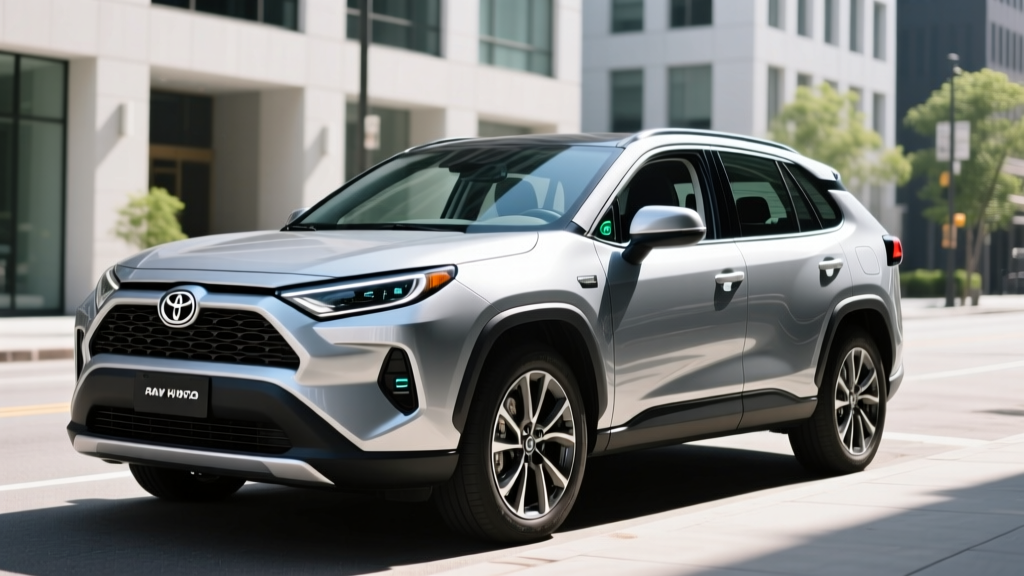
If you're searching for the RAV4 Hybrid with the most miles, you're really asking two different questions: which version squeezes the most distance out of every gallon of gas, and which one lets you drive the farthest without burning a single drop. Toyota's 2026 RAV4 lineup answers both — but the winner depends on whether you choose the conventional Hybrid (HEV) or the plug-in RAV4 Prime (PHEV).
We've driven both extensively, tracked real-world fuel consumption across city and highway loops, and cross-referenced EPA data to give you exact numbers — not marketing superlatives. Here's the complete breakdown.
HEV vs PHEV: Two Paths to More Miles
Before comparing MPG figures, it's critical to understand what you're buying. The standard RAV4 Hybrid is a conventional hybrid (HEV) — it charges its small battery through regenerative braking and the gas engine. You never plug it in. The RAV4 Prime is a plug-in hybrid (PHEV) — it has a much larger battery you charge from a wall outlet or public charger, giving it a meaningful electric-only driving range before the gas engine kicks in.
| Feature | 2026 RAV4 Hybrid (HEV) | 2026 RAV4 Prime (PHEV) |
|---|---|---|
| Plug-in required? | No — self-charging | Yes — plug in for EV range |
| Battery capacity | 1.6 kWh (NiMH) | 18.1 kWh (lithium-ion) |
| Electric-only range | Less than 1 mile at low speed | 42 miles (EPA) |
| Combined horsepower | 219 hp | 302 hp |
| Drivetrain | AWD (standard) | AWD (standard) |
| Federal tax credit | Not eligible | Eligible (up to $7,500)* |
*Eligibility depends on income, MSRP, and battery-sourcing rules under IRS §30D. See tax credit section below.
EPA Fuel Economy: Which RAV4 Gets the Best MPG?
Here's where the data gets interesting. If we measure purely by gasoline efficiency — miles per gallon when the engine is running — the conventional RAV4 Hybrid actually posts higher numbers on paper than the RAV4 Prime in charge-sustaining (hybrid) mode.
| Model | City MPG | Highway MPG | Combined MPG | Total Range (est.) |
|---|---|---|---|---|
| 2026 RAV4 Hybrid (AWD) | 41 | 38 | 40 | ~580 mi |
| 2026 RAV4 Prime (hybrid mode) | 40 | 36 | 38 | ~550 mi + 42 mi EV |
| 2026 RAV4 Prime (charge-depleting) | 94 MPGe combined | 42 mi EV + ~550 mi hybrid | ||
Source: fueleconomy.gov — EPA estimates. Your actual mileage will vary.
But raw MPG only tells part of the story. The RAV4 Prime's 42 miles of electric-only driving means many owners complete their entire daily commute without the engine ever starting. If your round-trip commute is under 40 miles and you charge at home, your effective "MPG" is essentially infinite for daily driving — you might visit a gas station once a month.
Real-World MPG: What We Actually Measured
EPA stickers are a starting point, not a guarantee. Toyota's hybrid system rewards city driving where regenerative braking recaptures energy and the electric motor handles low-speed acceleration. On the highway, the gas engine does more of the work.
RAV4 Hybrid (HEV) real-world results:
- City/suburban mixed driving: 39–43 MPG (many drivers exceed the EPA 41 city estimate in stop-and-go traffic)
- Highway at 70–75 mph: 34–37 MPG (aerodynamic drag reduces efficiency)
- Cold weather (below 35°F): Expect a 5–10% drop, roughly 36–38 MPG combined, as the engine runs more frequently for cabin heat
RAV4 Prime (PHEV) real-world results:
- Electric-only range: 38–44 miles depending on temperature and driving style. In warm weather with gentle acceleration, 44 miles is achievable. Below freezing, expect 34–38 miles.
- Hybrid mode (battery depleted): 35–39 MPG combined — slightly below the conventional Hybrid due to the Prime's ~300 lb weight penalty from the larger battery
- Combined EV + hybrid on a single charge cycle: If you drive 42 miles on electricity then 200 miles in hybrid mode, your effective fuel consumption works out to roughly 55–60 MPG equivalent
The takeaway: if most of your driving is short-trip and urban, the Prime delivers dramatically more miles per gallon of gasoline consumed. If you drive long highway routes without charging opportunities, the standard Hybrid's lighter weight gives it a slight edge.
Powertrain and Performance Specs
| Specification | RAV4 Hybrid (HEV) | RAV4 Prime (PHEV) |
|---|---|---|
| Engine | 2.5L 4-cyl + 2 electric motors | 2.5L 4-cyl + 2 electric motors (higher output) |
| Combined horsepower | 219 hp | 302 hp |
| 0–60 mph | 7.4 seconds | 5.7 seconds |
| Battery chemistry | NiMH (1.6 kWh) | Lithium-ion (18.1 kWh) |
| Level 1 charging (120V) | N/A — self-charging | ~16 hours (12A outlet) |
| Level 2 charging (240V) | N/A — self-charging | ~2.5 hours (3.3 kW onboard charger) |
| DC fast charging | No | No |
| Towing capacity | 1,750 lbs | 2,500 lbs |
Neither version supports DC fast charging — a deliberate Toyota decision. The Prime's 3.3 kW onboard charger means a full Level 2 charge takes about 2.5 hours. For most owners, plugging in overnight at home on a standard 120V outlet is sufficient to refill the battery, though a 240V Level 2 setup is strongly recommended for daily top-ups.
Pricing, Trims, and Tax Credit Eligibility
The 2026 RAV4 Hybrid starts at approximately $34,420 (LE trim, including destination), while the RAV4 Prime begins at roughly $45,420 (SE trim). The Prime carries an ~$11,000 premium, but that gap narrows significantly with federal incentives.
§30D Federal Tax Credit — RAV4 Prime Eligibility Checklist
- Credit amount: Up to $7,500 for the RAV4 Prime (the standard Hybrid does NOT qualify)
- Income caps: Modified AGI ≤ $150,000 (single), $225,000 (head of household), $300,000 (joint)
- MSRP cap: SUVs must be ≤ $80,000 — all RAV4 Prime trims qualify
- Battery sourcing: Critical minerals and battery components must meet phased-in domestic-content thresholds per IRS rules — verify current-year compliance at irs.gov
- Point-of-sale transfer: You can transfer the credit to the dealer at purchase for an immediate price reduction, rather than waiting to claim it on your tax return
Rules are subject to change. Consult a tax professional and verify on irs.gov before purchasing.
If you qualify for the full $7,500 credit, the RAV4 Prime's effective starting price drops to roughly $37,920 — closing the gap with the conventional Hybrid to about $3,500. Factor in fuel savings from daily electric driving, and the Prime pays for itself within 2–4 years for most commuters.
Battery Warranty, Reliability, and Replacement Cost
Toyota Hybrid Battery Coverage
- Hybrid battery warranty: 10 years / 150,000 miles (whichever comes first) — applies to both HEV and Prime
- Powertrain warranty: 5 years / 60,000 miles
- Capacity retention: Toyota warrants that the Prime's battery will retain at least 70% of original capacity during the warranty period
Toyota's hybrid reliability track record is among the strongest in the industry. The company has been refining its hybrid synergy drive system since the 1997 Prius, and failures before 200,000 miles are uncommon in normal use. The conventional Hybrid's NiMH battery is particularly robust — it's a proven chemistry with decades of field data.
Replacement costs if out of warranty:
- RAV4 Hybrid (HEV): $2,500–$4,000 for a new NiMH battery pack, including labor. Refurbished units are available for $1,500–$2,500.
- RAV4 Prime (PHEV): $6,000–$9,000 for the larger lithium-ion pack. This is the trade-off for the Prime's electric range — a bigger, more expensive battery.
For context, most hybrid owners never replace the traction battery. Data from fleet operators and long-term owners shows Toyota hybrid batteries routinely lasting 150,000–250,000 miles before significant degradation. The 10-year/150,000-mile warranty provides substantial peace of mind.
Who Should Choose the RAV4 Hybrid, the Prime, or a Full EV?
Choose the RAV4 Hybrid (HEV) if:
- You don't have access to home charging (apartment, street parking)
- You want the lowest purchase price and simplest ownership
- Most of your driving is highway commuting where EV range provides less benefit
- You want proven, no-plug-needed efficiency at 40 MPG combined
Choose the RAV4 Prime (PHEV) if:
- You can charge at home (even a standard 120V outlet works overnight)
- Your daily round-trip commute is under 40 miles
- You qualify for the $7,500 federal tax credit
- You want EV-like daily driving with gas-engine flexibility for road trips
Choose a full BEV (like the Toyota bZ4X or Tesla Model Y) if:
- You have reliable home Level 2 charging
- You rarely drive more than 250 miles in a single day
- You want zero tailpipe emissions and minimal maintenance (no oil changes, no engine)
- You're ready to plan around DC fast charging on road trips
RAV4 Hybrid (HEV) — Pros & Cons
Pros:
- 40 MPG combined — best-in-class for non-plug-in compact SUVs
- No charging infrastructure needed
- Lower starting price ($34,420)
- Excellent reliability history
- Standard AWD across all trims
Cons:
- No federal tax credit eligibility
- No electric-only driving capability
- 219 hp is adequate but not quick
- Engine noise under hard acceleration
RAV4 Prime (PHEV) — Pros & Cons
Pros:
- 42 miles EV range covers most commutes gas-free
- 302 hp — the quickest RAV4 Toyota makes
- Up to $7,500 federal tax credit
- 94 MPGe when running on battery
- 2,500-lb towing (highest in RAV4 lineup)
Cons:
- ~$11,000 higher MSRP before incentives
- No DC fast charging
- 3.3 kW Level 2 charging is slow for a PHEV
- Heavier — slightly lower MPG in hybrid-only mode
- Limited dealer inventory can mean markups
Frequently Asked Questions
How many MPG does the RAV4 Hybrid get?
The 2026 RAV4 Hybrid AWD is EPA-rated at 41 city / 38 highway / 40 combined MPG. In real-world city driving, many owners report 39–43 MPG. Highway driving at 75 mph typically yields 34–37 MPG.
How far can the RAV4 Prime go on electric only?
The RAV4 Prime is EPA-rated for 42 miles of electric-only range. In warm weather with moderate driving, 44 miles is achievable. In freezing temperatures, expect 34–38 miles. Once the battery depletes, the Prime operates as a conventional hybrid at approximately 38 MPG combined.
Does the RAV4 Hybrid qualify for any tax credit?
The conventional RAV4 Hybrid (HEV) does not qualify for the federal §30D tax credit because it cannot be plugged in. The RAV4 Prime (PHEV) may qualify for up to $7,500, subject to buyer income limits, MSRP caps, and battery-sourcing requirements. Check current rules at fueleconomy.gov and irs.gov.
Is the RAV4 Hybrid reliable and what does battery replacement cost?
Toyota's hybrid system has an exceptional reliability record spanning over 25 years. The hybrid battery is warrantied for 10 years / 150,000 miles. Out-of-warranty replacement costs $2,500–$4,000 for the HEV and $6,000–$9,000 for the Prime's larger lithium-ion pack. Most batteries last 150,000–250,000 miles in normal use.
Should I get the RAV4 Hybrid or a full electric vehicle?
If you lack home charging access or regularly drive more than 250 miles without stopping, the RAV4 Hybrid or Prime is the better choice. If you can charge at home, rarely exceed 250 miles daily, and want minimal maintenance, a full EV like the Model Y or Hyundai Ioniq 5 may save more long-term — but requires adapting to charging logistics on road trips.
Do I need to plug in the RAV4 Hybrid?
No. The standard RAV4 Hybrid is a self-charging conventional hybrid. It recovers energy through regenerative braking and the gas engine. Only the RAV4 Prime requires plugging in to access its 42-mile electric range — if you never plug in the Prime, it still functions as a hybrid at ~38 MPG, but you'd miss the entire point of the larger battery.
For the latest safety ratings, check the IIHS and NHTSA databases before purchasing, as crash-test results update throughout the model year.