Quick Verdict: The Efficiency Sedan That Doesn't Ask You to Plug In
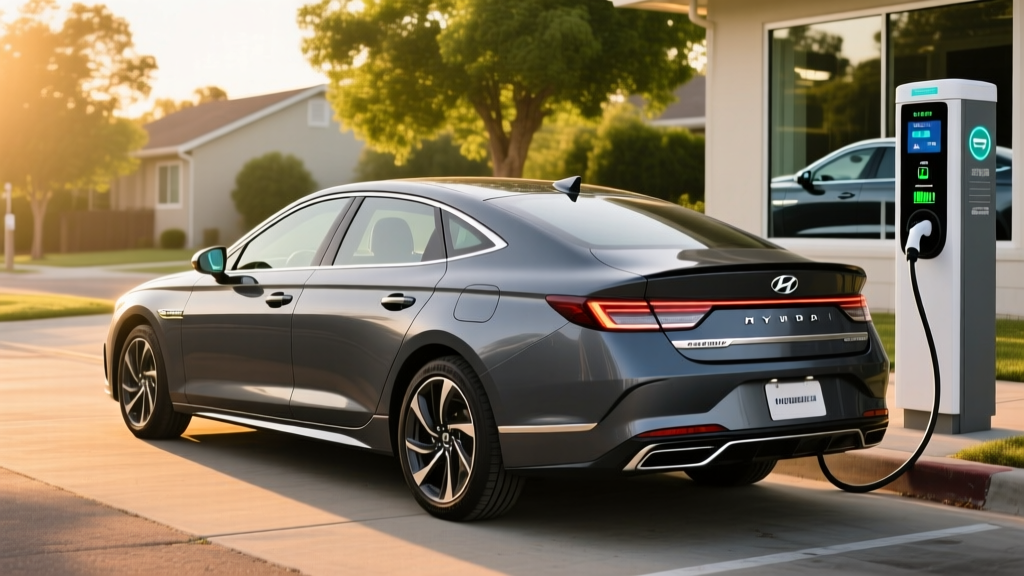
The 2023 Hyundai Sonata Hybrid occupies a precise niche: a midsize sedan that squeezes every mile from a gallon of gas without requiring a single change to your driving routine. There's no plug, no range anxiety, no charging-curve math — just a 2.0-liter four-cylinder paired with an electric motor and a lithium-ion battery that recovers energy every time you lift off the throttle or tap the brakes.
For 2026 buyers browsing the used market, the 2023 Sonata Hybrid remains compelling. With an EPA-rated 52 MPG combined, it undercuts the Toyota Camry Hybrid on price while delivering comparable efficiency. But before you pull the trigger on a pre-owned model, you need the exact numbers — real-world MPG, battery longevity data, and how this conventional hybrid (HEV) stacks up against the plug-in and full-EV alternatives.
| Spec | 2023 Hyundai Sonata Hybrid |
|---|---|
| Powertrain | 2.0L I4 + 39 kW electric motor (HEV) |
| Combined Horsepower | 192 hp |
| Transmission | 6-speed automatic (no CVT) |
| EPA MPG (City / Hwy / Combined) | 50 / 54 / 52 |
| Fuel Tank | 13.2 gallons |
| Total Range | ~686 miles |
| 0–60 mph | ~7.9 seconds |
| Hybrid Battery | 1.6 kWh lithium-ion (nominal) |
| Battery/Powertrain Warranty | 10 years / 100,000 miles (original owner) |
| Original MSRP (Blue trim) | $29,490 |
Understanding the Powertrain: HEV, Not PHEV
A critical distinction before going further: the 2023 Hyundai Sonata Hybrid is a conventional hybrid electric vehicle (HEV). It is not a plug-in hybrid (PHEV). You do not plug it in. There is no electric-only driving range to quote, no charging port, and no kWh battery large enough to meaningfully drive on electricity alone.
Here's how the two hybrid architectures differ and why it matters for your purchase decision:
| Feature | HEV (Sonata Hybrid) | PHEV (e.g., Tucson PHEV) |
|---|---|---|
| Plug-in Required? | No — self-charging via regen & engine | Yes — Level 1 or Level 2 |
| Electric-Only Range | Less than 1 mile at low speed | 20–40 miles typical |
| Battery Size | ~1.6 kWh | 13–18 kWh typical |
| DC Fast Charge | N/A | Rarely available |
| Federal Tax Credit (§30D) | Not eligible | Up to $7,500 if criteria met |
| Best For | No home charging, long commutes, simplicity | Home charging access, short daily commutes |
The Sonata Hybrid's 1.6 kWh lithium-ion pack serves as an energy buffer. The 39 kW (approximately 52 hp) electric motor assists the 150-hp gasoline engine during acceleration, fills torque gaps during gear shifts, and enables brief engine-off coasting at low speeds. Energy is recovered through regenerative braking — the system converts kinetic energy back into stored electrical energy whenever you decelerate.
Hyundai pairs this system with a conventional 6-speed automatic transmission rather than the continuously variable transmission (CVT) found in the Toyota Camry Hybrid. The result is more natural-feeling acceleration with distinct gear shifts, though the Camry Hybrid's CVT contributes to its slightly higher combined EPA rating.
Fuel Economy: EPA Ratings vs. Real-World MPG
The EPA rates the 2023 Sonata Hybrid at 50 MPG city, 54 MPG highway, and 52 MPG combined. These figures apply to the Blue trim, which is the efficiency-optimized variant with 16-inch wheels and lighter equipment. The SEL and Limited trims, equipped with 17- or 18-inch wheels and additional features, drop slightly to 44/51/47 MPG combined.
| Trim | City | Highway | Combined | Est. Annual Fuel Cost* |
|---|---|---|---|---|
| Blue | 50 | 54 | 52 | ~$850 |
| SEL | 44 | 51 | 47 | ~$950 |
| Limited | 44 | 51 | 47 | ~$950 |
*Based on 15,000 miles/year, 55% city driving, $3.20/gallon regular unleaded. Your costs will vary with local fuel prices and driving patterns.
Real-World MPG: What Owners Actually See
Hybrids routinely outperform their EPA city estimates in stop-and-go traffic because regenerative braking recovers energy that a gas car wastes as heat. Highway driving tells a different story — sustained high speeds reduce the hybrid system's advantage because the electric motor contributes less at constant velocity.
Based on owner-reported data and independent testing, expect the Blue trim to deliver:
- City / suburban driving: 50–56 MPG (regen-heavy routes can push above the EPA sticker)
- Highway (70–80 mph sustained): 44–49 MPG
- Mixed real-world combined: 47–52 MPG
- Cold weather penalty: Expect 5–10% reduction (roughly 45–48 MPG combined) due to engine running longer for cabin heat and reduced battery efficiency at low temperatures
The Sonata Hybrid's highway MPG advantage over city is unusual for a hybrid and partly attributable to its 6-speed automatic, which locks the torque converter at highway speeds for efficient direct-drive operation. If your commute is 80% highway, the efficiency gap between the Sonata Hybrid and a conventional gas sedan narrows — though it still meaningfully outperforms the non-hybrid Sonata's 28/38/32 MPG EPA rating.
Pricing, Trims, and Tax Credit Reality
When new, the 2023 Sonata Hybrid started at $29,490 for the Blue trim, rising to approximately $34,750 for the Limited. As a 2026 used-market purchase, expect pricing in the $21,000–$29,000 range depending on mileage, condition, and trim level.
Tax Credit Eligibility
The 2023 Sonata Hybrid does not qualify for the federal §30D clean vehicle tax credit. That credit applies only to plug-in electric vehicles (BEVs and PHEVs) meeting specific battery sourcing, critical mineral, MSRP cap, and buyer income requirements under current IRS rules. Conventional hybrids like the Sonata Hybrid are excluded entirely.
Some states offer their own incentives for hybrid purchases, though these are increasingly rare as state programs shift toward plug-in vehicles. Check your state's energy office or department of environmental quality for current programs. A tax professional can confirm any applicable state-level credits or deductions.
Battery Longevity, Warranty, and Replacement Cost
Hyundai Hybrid Battery Warranty: 10 years / 100,000 miles for the original owner. For subsequent owners (relevant on the used market), the warranty transfers but drops to 5 years / 60,000 miles from the original in-service date.
The Sonata Hybrid's 1.6 kWh lithium-ion battery pack is far smaller and less stressed than the traction batteries in full EVs. It operates within a narrow state-of-charge window — the hybrid control system never fully charges or fully depletes it, which significantly extends cycle life. Hyundai has been building hybrid systems since the 2011 Sonata Hybrid, and real-world failure data on their lithium-ion hybrid packs is encouraging: most units retain functional capacity well past 150,000 miles.
If replacement becomes necessary outside warranty, expect a hybrid battery pack cost in the $2,000–$3,500 range (parts and labor) from a Hyundai dealer. Independent hybrid specialists may offer refurbished packs for $1,200–$2,000. This is a fraction of full EV battery replacement costs and a manageable expense spread over a decade of 50-MPG driving.
The broader hybrid powertrain — including the electric motor, inverter, and transmission — is covered under Hyundai's 10-year/100,000-mile powertrain warranty (original owner). On the used market, verify the remaining warranty by providing the VIN to a Hyundai dealer before purchase.
Driving Impressions and Practicality
The Sonata Hybrid prioritizes comfort and composure over sportiness. The 192 combined horsepower is adequate for merging and passing, with the electric motor providing instant low-rpm torque that masks the 2.0L engine's modest output off the line. The 0–60 mph time of approximately 7.9 seconds places it in the middle of the midsize hybrid sedan segment.
Ride quality is compliant, road noise is well-managed, and the cabin materials on the Limited trim approach entry-luxury territory. Cargo space stands at 15.1 cubic feet — competitive with the Camry Hybrid (15.1 cu ft) and Honda Accord Hybrid (16.7 cu ft).
Hyundai's SmartSense suite is standard across all trims: forward collision-avoidance assist with pedestrian detection, blind-spot monitoring, rear cross-traffic collision-avoidance, lane-keeping assist, and adaptive cruise control with stop-and-go. The IIHS rated the 2023 Sonata Hybrid as a Top Safety Pick when equipped with specific headlights, a meaningful consideration for family sedan buyers.
Who Should Buy the 2023 Sonata Hybrid?
Choose the 2023 Sonata Hybrid if:
- You want 50+ MPG without installing a home charger or changing your fueling routine
- Your commute involves a mix of city and highway driving
- You're buying on the used market and want strong remaining hybrid warranty coverage
- You prefer a conventional automatic transmission feel over CVT drone
- You need a spacious midsize sedan with a large trunk (no battery intrusion into cargo space)
Consider a PHEV instead if:
- You have home charging access and a commute under 30 miles — a PHEV lets you drive most days on electricity alone
- You want federal tax credit eligibility (up to $7,500 on qualifying new PHEVs)
Consider a full BEV instead if:
- You have reliable home Level 2 charging and want to eliminate gasoline costs entirely
- You drive under 250 miles daily and want lower long-term maintenance (no oil changes, fewer moving parts)
- You want the full $7,500 federal credit on a qualifying new EV
Stick with a gas-only sedan if:
- You drive under 8,000 miles per year — the hybrid premium may not pay back in fuel savings
- Upfront budget is the primary constraint and the $3,000–$5,000 hybrid price delta matters
Pros
- 52 MPG combined (Blue trim) — among the most efficient non-plug-in sedans available
- No plug-in required; zero change to fueling habits
- 6-speed automatic avoids CVT drone
- Generous 10-year/100,000-mile hybrid warranty for original owner
- Comprehensive SmartSense safety suite standard
- Spacious 15.1 cu ft trunk with no hybrid battery compromise
Cons
- No federal tax credit eligibility
- Higher trims (SEL/Limited) drop to 47 MPG combined
- Acceleration is adequate, not quick (7.9 sec 0–60)
- No all-wheel-drive option (available on Camry Hybrid)
- Infotainment learning curve for some users
- Used-market warranty reduces to 5yr/60k for second owner
Frequently Asked Questions
How many MPG does the 2023 Hyundai Sonata Hybrid get?
The Blue trim achieves 50 city / 54 highway / 52 combined MPG per the EPA. The SEL and Limited trims are rated at 44/51/47 MPG. Real-world city driving often exceeds the EPA sticker thanks to regenerative braking, while sustained highway driving at 75+ mph typically yields 44–49 MPG.
Does the 2023 Sonata Hybrid need to be plugged in?
No. The Sonata Hybrid is a conventional HEV, not a PHEV. It charges its small 1.6 kWh battery entirely through regenerative braking and the gasoline engine. There is no charging port and no electric-only driving range of practical significance.
Is the Sonata Hybrid reliable, and what does a battery replacement cost?
Hyundai's hybrid system has proven durable over multiple generations. The lithium-ion hybrid battery is covered by a 10-year/100,000-mile warranty (original owner) and typically lasts well beyond that. Out-of-warranty replacement costs approximately $2,000–$3,500 at a dealer, or $1,200–$2,000 through an independent hybrid specialist.
Does the 2023 Sonata Hybrid qualify for any tax credit?
It does not qualify for the federal §30D clean vehicle tax credit, which is limited to plug-in vehicles (BEVs and PHEVs). Some states may offer hybrid-specific incentives, though these are uncommon. Consult your state's energy office and a tax professional for details.
How does the Sonata Hybrid compare to the Toyota Camry Hybrid?
The Camry Hybrid LE achieves a slightly higher 52/53/52 EPA rating and offers available all-wheel drive, which the Sonata Hybrid lacks. The Sonata Hybrid counters with a more traditional 6-speed automatic (vs. CVT), a longer hybrid battery warranty for original owners, and a slightly lower entry price on the used market. Both are strong choices — your preference may come down to transmission feel, AWD needs, and brand loyalty.
How far can the 2023 Sonata Hybrid go on a full tank?
With a 13.2-gallon fuel tank and a 52 MPG combined rating, the Blue trim delivers approximately 686 miles of total range. Real-world range depends on driving conditions but commonly falls between 600 and 700 miles per tank.