The Prius Prime in 2026: Still the Benchmark Plug-In Hybrid
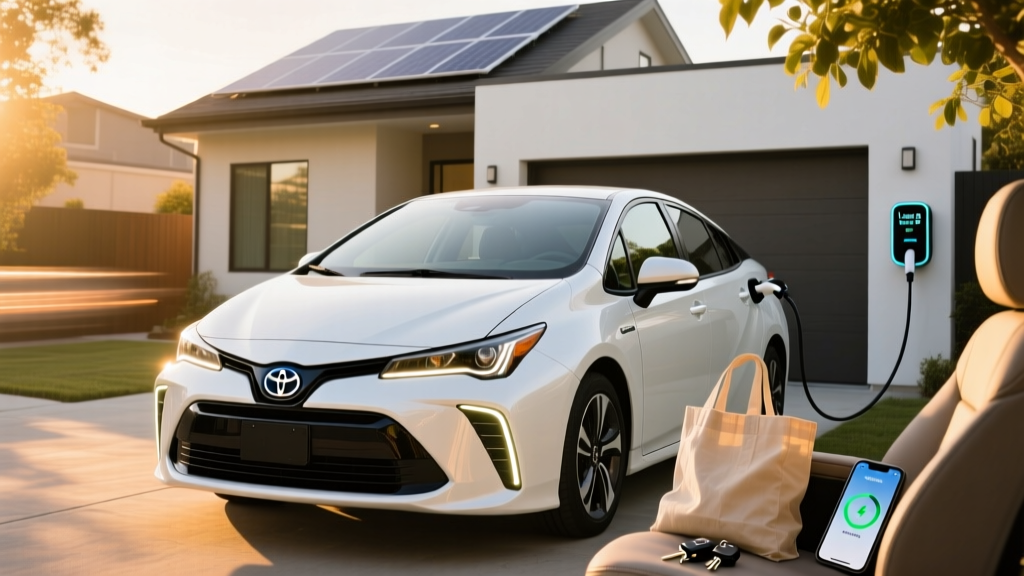
When buyers search for a "prius hybrid plug in," they are almost always looking for the Toyota Prius Prime — Toyota's plug-in hybrid (PHEV) variant of the iconic Prius. The 2026 Prius Prime continues the formula that made its predecessor a best-seller: a usable electric-only range for daily commuting, excellent hybrid fuel economy when the battery depletes, and Toyota's reputation for long-term reliability. But with the EV market maturing and competitors like the Hyundai Tucson PHEV and Ford Escape PHEV pushing larger batteries, the Prius Prime must earn its spot on spec sheets, not nostalgia alone.
This guide breaks down exactly what the 2026 Prius Prime offers — EPA range, real-world MPG, charging speeds, battery chemistry, warranty coverage, and federal tax credit eligibility — so you can decide whether this PHEV fits your garage or whether a conventional hybrid (HEV) or full battery-electric vehicle (BEV) makes more sense.
HEV vs. PHEV: Which Prius Is Right for You?
Toyota sells two distinct Prius models, and confusing them is the most common buyer mistake:
| Feature | Prius (HEV) | Prius Prime (PHEV) |
|---|---|---|
| Plug-in charging? | No — self-charging via regenerative braking and engine | Yes — plug in to charge the larger battery |
| Electric-only range | ~0.5 mi at low speed | 44 mi (EPA, SE trim) |
| Battery size | ~1.0 kWh (small buffer) | 13.6 kWh usable (lithium-ion) |
| EPA combined MPG (hybrid mode) | 57 MPG | 50 MPG (after battery depletes) |
| Starting MSRP (2026) | ~$29,445 | ~$34,070 |
| Federal tax credit (§30D) | Not eligible | Up to $3,750 (see eligibility below) |
The conventional Prius HEV never needs to be plugged in. Its small battery charges through regenerative braking and the gasoline engine. The Prius Prime PHEV has a substantially larger 13.6 kWh battery that you charge via a standard outlet or Level 2 charger, giving you a genuine all-electric commute before the hybrid system takes over. If you have home charging access and a commute under 40 miles, the Prime effectively operates as an EV on most days, with the gas engine as a seamless backup for road trips.
Range, MPG, and Efficiency: The Numbers That Matter
Electric-Only Range (PHEV Mode)
The EPA rates the 2026 Prius Prime SE at 44 miles of electric-only range, while the heavier XSE and XSE Premium trims are rated at 40 miles. These figures assume moderate temperatures and mixed driving. In real-world conditions:
- City driving (under 45 mph): Expect 42–48 miles on the SE — the Prius Prime's electric motor is most efficient at low speeds, and regen braking recaptures energy in stop-and-go traffic.
- Highway driving (70+ mph): Expect 32–38 miles. Aerodynamic drag and higher motor load reduce electric range significantly at freeway speeds.
- Cold weather (below 32°F): Expect 28–35 miles. The battery's usable capacity shrinks in cold temperatures, and cabin heating draws additional power. The Prius Prime uses a heat pump on higher trims, which helps, but cold-weather range loss of 20–30% is typical for PHEVs.
Hybrid-Mode Fuel Economy
Once the battery depletes, the Prius Prime operates as a conventional hybrid. According to fueleconomy.gov, the 2026 Prius Prime achieves:
| Trim | City MPG | Highway MPG | Combined MPG | Combined MPGe (electric mode) |
|---|---|---|---|---|
| SE | 50 | 50 | 50 | 127 MPGe |
| XSE | 48 | 48 | 48 | 121 MPGe |
| XSE Premium | 48 | 47 | 48 | 121 MPGe |
Real-world MPG note: Hybrid fuel economy often exceeds EPA city estimates in practice because regenerative braking is most effective in urban stop-and-go driving. Many Prius Prime owners report 52–58 MPG in city hybrid mode during warm months. Highway hybrid-mode economy tends to align closely with or slightly fall below the EPA estimate, typically 46–50 MPG at 70–75 mph.
Powertrain and Performance Specs
| Specification | 2026 Toyota Prius Prime |
|---|---|
| Powertrain | 2.0L 4-cylinder + 2 electric motors (series-parallel hybrid) |
| Combined horsepower | 220 hp net |
| Engine output | 150 hp @ 6,000 rpm / 139 lb-ft torque |
| Electric motor output | 161 hp / 153 lb-ft (front-mounted) |
| 0–60 mph | 6.6 seconds |
| Battery (usable) | 13.6 kWh, lithium-ion (NMC chemistry) |
| Transmission | Electronic continuously variable (eCVT) |
| Drivetrain | Front-wheel drive |
| Cargo volume | 20.3 cu ft (rear seats up) |
The 220 hp combined output is a dramatic improvement over the pre-2023 Prius generation (121 hp). The Prius Prime now merges onto highways and passes with genuine confidence. The 6.6-second 0–60 time places it in the same performance bracket as many turbocharged compact sedans — a remarkable transformation for a nameplate once synonymous with slow, hypermiling commutes.
Charging the Prius Prime: Speeds, Connectors, and Costs
Understanding PHEV charging is essential before you buy. The Prius Prime uses a J1772 connector for Level 1 and Level 2 AC charging. It does not support DC fast charging — a limitation shared with most PHEVs, given their smaller batteries.
| Charging Level | Power | Time (0–100%) | Setup |
|---|---|---|---|
| Level 1 (120V household outlet) | ~1.4 kW | ~11 hours | Standard 15A outlet; included mobile cord |
| Level 2 (240V home/public charger) | ~3.3 kW (onboard charger limit) | ~4 hours | Requires 240V outlet or hardwired Level 2 station |
Key detail: The Prius Prime's onboard charger is limited to 3.3 kW. Even if you plug into a 7.2 kW or 11.5 kW Level 2 station, the car will only accept 3.3 kW. This means a full charge takes approximately 4 hours regardless of Level 2 station capacity. For most owners, plugging in overnight at home on Level 1 (120V) is sufficient — 11 hours of charging easily replenishes the 13.6 kWh battery while you sleep.
Cost to charge: At the US average residential electricity rate of ~$0.17/kWh (per EIA data), a full 13.6 kWh charge costs approximately $2.31. That powers roughly 40 miles of electric driving — equivalent to about $0.06 per mile, compared to ~$0.14 per mile for a 30 MPG gas car at $3.50/gallon.
Pricing, Trims, and Federal Tax Credit Eligibility
The 2026 Toyota Prius Prime is offered in three trims:
- SE: ~$34,070 MSRP — 44 mi electric range, 17" alloy wheels, 8" touchscreen
- XSE: ~$37,370 MSRP — 40 mi range, 19" wheels, SofTex seats, 12.3" display, heat pump
- XSE Premium: ~$40,670 MSRP — 40 mi range, panoramic roof, premium audio, heated/ventilated front seats
Does the Prius Prime Qualify for a Federal Tax Credit?
Under the current IRS §30D rules, the 2026 Prius Prime qualifies for up to $3,750 in federal tax credits — not the full $7,500. The reduced amount reflects the vehicle's battery sourcing and critical-mineral supply chain compliance. Specifically:
- ✓ Vehicle MSRP under $55,000 (sedan cap) — all trims qualify
- ✓ Buyer adjusted gross income under $150,000 (single) / $300,000 (joint) — verify your AGI
- ✓ Battery capacity ≥ 7 kWh — Prius Prime has 13.6 kWh usable
- ⚠ Critical minerals & battery component sourcing — currently meets partial requirements, yielding $3,750 (not the full $7,500)
- ✓ Point-of-sale transfer available — you can apply the credit at purchase rather than waiting for tax filing
Source: IRS §30D guidance. Rules are subject to change. Consult a tax professional to confirm your personal eligibility.
After the $3,750 credit, the effective starting price of the Prius Prime SE drops to approximately $30,320 — narrowing the gap with the conventional Prius HEV and making the PHEV a compelling value for buyers with home charging.
Battery Warranty, Reliability, and Replacement Costs
Reliability track record: Toyota's hybrid system is among the most proven in the industry, with over 25 years of continuous refinement since the original 1997 Prius. The current-generation PHEV powertrain uses a planetary gearset eCVT with no traditional transmission clutches or bands to wear out. Independent reliability data from sources like Consumer Reports consistently rates the Prius line as "Above Average" for predicted reliability.
Battery replacement cost: If the high-voltage battery fails outside of warranty coverage, replacement currently costs approximately $3,000–$5,000 (parts and labor at a Toyota dealer). However, real-world data from the Prius community shows that Toyota hybrid batteries frequently last 150,000–200,000+ miles with minimal degradation. The PHEV battery sees deeper cycling than a conventional HEV battery, but Toyota's thermal management system and conservative state-of-charge buffer (the car never uses the full 13.6 kWh — it reserves top and bottom buffers) protect long-term health.
Degradation expectations: Plan for approximately 1–2% capacity loss per year under normal use. After 5 years, expect roughly 38–40 miles of electric range on the SE trim versus the original 44. This is gradual and rarely impacts daily usability within the warranty period.
Pros, Cons, and the Competition
- 44-mile EV range covers most daily commutes
- 50 MPG hybrid mode eliminates range anxiety on road trips
- 220 hp — genuinely quick for an efficiency-focused car
- 510+ mile total range (electric + gas)
- Level 1 overnight charging is sufficient for most owners
- 10-year / 150,000-mile hybrid battery warranty
- Eligible for $3,750 federal tax credit
- Strong resale value and Toyota reliability reputation
- No DC fast charging — irrelevant for most PHEV buyers, but limits public charging utility
- 3.3 kW onboard charger is slow for public Level 2 stations
- Rear seat headroom is tight for taller passengers (sloping roofline)
- Cargo space (20.3 cu ft) is modest for a hatchback
- XSE Premium trim pushes past $40K — encroaching on BEV territory
- All-wheel drive not available on Prius Prime
Who Should Buy the Prius Prime — and Who Shouldn't?
Choose the Prius Prime (PHEV) if:
- You have home or workplace Level 1/Level 2 charging access
- Your daily round-trip commute is under 40 miles
- You take regular road trips where EV charging infrastructure is sparse
- You want EV-like daily driving without range anxiety
- You live in an apartment or area where DC fast charging is unreliable
Choose the standard Prius (HEV) if:
- You cannot charge at home or work (street parking, no outlet access)
- Your budget is tighter and the $4,600 price premium over the HEV isn't justified
- Your commute is mostly highway, where electric-only range depletes quickly
Choose a full EV (BEV) if:
- You have reliable home Level 2 charging and access to DC fast chargers for road trips
- You want zero tailpipe emissions and minimal maintenance (no oil changes, no gas engine)
- Your daily driving is under 250 miles and you rarely take long road trips
- You want the full $7,500 federal tax credit available on qualifying BEVs
Frequently Asked Questions
How many MPG does the 2026 Prius Prime get?
In hybrid mode (after the battery is depleted), the Prius Prime SE achieves an EPA-rated 50 MPG combined (50 city / 50 highway). The XSE and XSE Premium trims are rated at 48 MPG combined. In real-world city driving, many owners report exceeding the EPA estimate, reaching 52–58 MPG thanks to aggressive regenerative braking in stop-and-go traffic.
How far can the Prius Prime go on electric only?
The EPA rates the SE trim at 44 miles of electric-only range, and the XSE/XSE Premium at 40 miles. Real-world range varies: expect 35–42 miles in typical mixed driving, up to 48 miles in gentle city driving, and 28–35 miles in cold weather or sustained highway driving. Once the battery depletes, the gas engine seamlessly engages and the car operates as a conventional hybrid with 510+ miles of total range.
Does the Prius Prime need to be plugged in?
To get the benefit of its 40–44 mile electric range, yes — you should plug it in regularly. However, if you never plug it in, the Prius Prime still functions perfectly as a conventional hybrid, achieving 48–50 MPG. The gas engine and regenerative braking will maintain the battery at a minimum charge level. You will simply miss out on the electric-only driving that makes the PHEV premium worthwhile.
Is the Prius Prime reliable, and what does battery replacement cost?
Toyota's hybrid powertrain has an exceptional reliability record spanning 25+ years. The hybrid battery is warranted for 10 years / 150,000 miles in all states. Out-of-warranty battery replacement costs approximately $3,000–$5,000, but real-world data shows these batteries commonly last 150,000–200,000+ miles. The eCVT transmission has no wear-prone clutches or bands, further reducing long-term maintenance risk.
Does the 2026 Prius Prime qualify for a federal tax credit?
Yes, the 2026 Prius Prime qualifies for up to $3,750 under IRS §30D, subject to buyer income limits ($150K single / $300K joint AGI) and the vehicle's MSRP falling below the $55,000 sedan cap. The credit can be transferred to the dealer at the point of sale, reducing your purchase price directly. It does not currently qualify for the full $7,500 due to partial battery-sourcing compliance. Always verify current eligibility at irs.gov or with a tax professional before purchasing.
Can the Prius Prime DC fast charge?
No. The Prius Prime only accepts AC charging via a J1772 connector — Level 1 (120V, ~1.4 kW) or Level 2 (240V, up to 3.3 kW). This is typical for PHEVs, whose smaller batteries make DC fast charging less practical and less necessary. A full Level 2 charge takes about 4 hours; overnight Level 1 charging is sufficient for most owners.
How does the Prius Prime compare to a full EV like the Tesla Model 3 or Chevy Equinox EV?
The Prius Prime costs less upfront, never requires public charging infrastructure, and eliminates range anxiety on long trips. A full EV like the Model 3 (341 mi EPA range) or Equinox EV (319 mi) offers zero tailpipe emissions, lower per-mile "fuel" costs, less maintenance, and often a larger federal tax credit ($7,500). If you have reliable home charging and rarely exceed 250 miles in a day, a BEV may save more long-term. If road trips, charging deserts, or apartment living are factors, the Prius Prime's dual-powertrain flexibility is a genuine advantage.