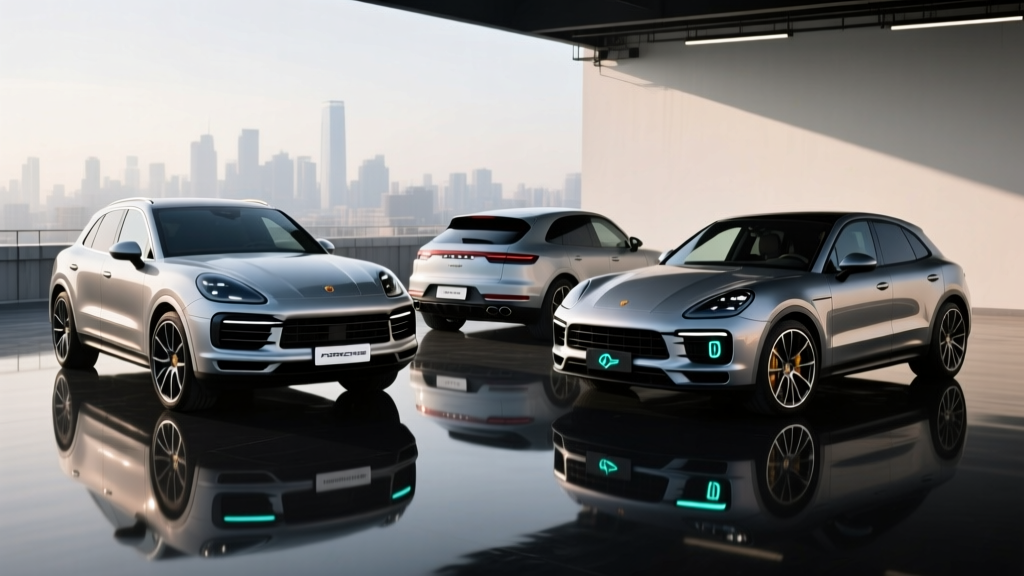
Porsche's electrification strategy has always been pragmatic rather than purist. Instead of leaping straight to full battery-electric vehicles across the board, the automaker has invested heavily in plug-in hybrid (PHEV) powertrains that pair turbocharged engines with increasingly powerful electric motors and larger batteries. For 2026, three core models carry the Porsche hybrid torch: the Cayenne E-Hybrid SUV, the Panamera E-Hybrid sedan, and the all-new Macan PHEV. Each targets a different buyer, but all share a philosophy — deliver genuine electric-only commuting range without sacrificing the performance DNA that defines the brand.
This guide breaks down every current Porsche hybrid by the numbers: EPA-rated MPG, electric-only range, battery capacity, charging times, powertrain output, pricing, and federal tax-credit eligibility. If you're cross-shopping a Porsche hybrid against a full EV or a conventional luxury gas car, the data below should make the decision clearer.
HEV vs PHEV: What Porsche Actually Offers in 2026
Before diving into individual models, a critical distinction. A conventional hybrid (HEV) — like a Toyota Prius — uses a small battery that recharges solely through regenerative braking and the engine. You never plug it in. A plug-in hybrid (PHEV) carries a much larger battery that you charge from a wall outlet or public charger, giving it a meaningful electric-only driving range before the gas engine kicks in.
Every current Porsche hybrid is a PHEV. Porsche does not sell a conventional HEV in the U.S. market. This means every hybrid Porsche requires plug-in charging to realize its electric-only range and efficiency benefits. If you cannot charge at home or at work, a Porsche PHEV will function as a heavy, less-efficient gas car — negating the entire purpose of the powertrain.
The upside: Porsche's PHEV systems are among the most powerful in the luxury segment, with electric motors contributing substantial torque and enabling combined outputs that rival or exceed their pure-gas siblings.
2026 Porsche Cayenne E-Hybrid: The Family SUV PHEV
The Cayenne E-Hybrid is Porsche's volume PHEV and one of the best-selling luxury plug-in hybrids in the U.S. The current generation received a significant battery upgrade, pushing usable capacity to approximately 25.9 kWh — enough for a meaningful daily commute on electrons alone.
| Specification | Cayenne E-Hybrid | Cayenne S E-Hybrid |
|---|---|---|
| Combined HP | 463 hp | 512 hp |
| Engine | 3.0L turbo V6 + e-motor | 3.0L turbo V6 + e-motor |
| Battery (usable) | 25.9 kWh | 25.9 kWh |
| EPA Electric Range | ~32 mi | ~30 mi |
| EPA Combined MPG (hybrid mode) | ~21 MPG | ~20 MPG |
| 0-60 mph | 4.7 sec | 4.5 sec |
| Max DC Fast Charge | No DC fast charging | No DC fast charging |
| Level 2 Charge Time (0-100%) | ~2.5 hrs @ 11 kW | ~2.5 hrs @ 11 kW |
| Base MSRP | $97,900 | $109,900 |
Real-world range note: The EPA-estimated ~32 miles of electric range assumes moderate temperatures and mixed driving. Expect 24–28 miles in cold weather (below 40°F) due to cabin heating demands and reduced battery efficiency. Highway-speed electric-only driving at 70+ mph will also reduce range to roughly 22–25 miles. For most commutes under 25 miles round-trip, the Cayenne E-Hybrid can operate as a pure EV on most days.
How Many MPG Does the Cayenne E-Hybrid Get?
Once the battery is depleted, the Cayenne E-Hybrid operates as a conventional hybrid, returning approximately 21 MPG combined (roughly 20 city / 22 highway) according to EPA estimates at fueleconomy.gov. That figure is unremarkable for a 5,000+ lb luxury SUV, but it's critical context: the efficiency story here is about the electric-only miles, not the gas-only MPG. If you charge nightly and commute within the electric range, you may use very little gasoline for weeks at a time.
2026 Porsche Panamera E-Hybrid: The Executive Sedan PHEV
The Panamera E-Hybrid targets buyers who want a luxury sport sedan with daily electric commuting capability. The latest generation pairs a 2.9L twin-turbo V6 with a more powerful electric motor integrated into the 8-speed PDK transmission, yielding a combined 463 hp in the base E-Hybrid and a thunderous 670 hp in the Turbo E-Hybrid variant.
| Specification | Panamera E-Hybrid | Panamera Turbo E-Hybrid |
|---|---|---|
| Combined HP | 463 hp | 670 hp |
| Engine | 2.9L twin-turbo V6 + e-motor | 4.0L twin-turbo V8 + e-motor |
| Battery (usable) | 25.9 kWh | 25.9 kWh |
| EPA Electric Range | ~34 mi | ~29 mi |
| EPA Combined MPG (hybrid mode) | ~22 MPG | ~19 MPG |
| 0-60 mph | 4.5 sec | 3.0 sec |
| Max DC Fast Charge | No DC fast charging | No DC fast charging |
| Level 2 Charge Time (0-100%) | ~2.5 hrs @ 11 kW | ~2.5 hrs @ 11 kW |
| Base MSRP | $107,900 | $195,900 |
The Panamera's lower, lighter chassis gives it a slight electric-range edge over the Cayenne in the base E-Hybrid configuration. The Turbo E-Hybrid sacrifices range for brute force — 670 hp makes it one of the quickest four-door sedans on the planet, electric or otherwise.
2026 Porsche Macan PHEV: The New Entry-Level Hybrid
The redesigned Macan generation introduces a PHEV variant for the first time, slotting below the Cayenne in both size and price. This is Porsche's bid to capture luxury compact SUV buyers who want plug-in capability without stepping up to Cayenne pricing. The Macan PHEV uses a 2.0L turbocharged four-cylinder paired with an electric motor, producing a combined output of approximately 389 hp.
| Specification | Macan PHEV |
|---|---|
| Combined HP | 389 hp |
| Engine | 2.0L turbo I4 + e-motor |
| Battery (usable) | ~22 kWh (estimated) |
| EPA Electric Range | ~28 mi (preliminary) |
| EPA Combined MPG (hybrid mode) | ~24 MPG (preliminary) |
| 0-60 mph | 5.0 sec (estimated) |
| Base MSRP | ~$72,000 (estimated) |
Note: The Macan PHEV is announced for the 2026 model year. Final EPA figures and pricing are preliminary and subject to change before deliveries begin.
Charging the Porsche PHEV Fleet: What You Need at Home
A consistent thread across all Porsche PHEVs: none support DC fast charging. This is typical for plug-in hybrids — the battery is small enough that Level 2 AC charging is sufficient. Porsche equips its PHEVs with an onboard charger rated at up to 11 kW (AC), which is notably faster than many competitors limited to 3.6 kW or 7.2 kW.
| Charging Level | Power | 0-100% Time (25.9 kWh) | Where |
|---|---|---|---|
| Level 1 (120V) | ~1.4 kW | ~18 hours | Standard outlet |
| Level 2 (240V) | Up to 11 kW | ~2.5 hours | Home wallbox / public AC |
| DC Fast Charge | N/A | Not supported | — |
Home charging setup: A 240V Level 2 wallbox (such as a ChargePoint Home Flex or Porsche's own Mobile Charger Connect) on a 50-amp circuit will fully replenish any Porsche PHEV overnight. Installation costs typically range from $500 to $2,000 depending on panel proximity and local permitting, based on national electrician averages. For a PHEV with a ~26 kWh battery, a full Level 2 charge costs roughly $3–$5 at the U.S. average electricity rate of $0.16/kWh — dramatically less than the gasoline equivalent.
Federal Tax Credit: Do Porsche Hybrids Qualify?
Under the current IRS §30D clean vehicle credit rules, PHEVs can qualify for up to $7,500 in federal tax credits — but the barriers are significant for Porsche models:
- MSRP cap: SUVs must be priced at or below $80,000; sedans at or below $55,000. This immediately disqualifies the Cayenne E-Hybrid ($97,900+), Panamera E-Hybrid ($107,900+), and likely the Macan PHEV depending on final pricing and classification.
- Income cap: Modified adjusted gross income must not exceed $150,000 (single), $225,000 (head of household), or $300,000 (joint).
- Battery sourcing: The battery's critical minerals and components must meet phased-in sourcing requirements that tighten annually through 2026.
- Point-of-sale transfer: Eligible buyers can now transfer the credit to the dealer at purchase, reducing the sale price directly rather than waiting for a tax refund.
Bottom line on tax credits: Most Porsche PHEVs exceed the MSRP cap and will not qualify for the federal §30D credit. The Macan PHEV is the only model that might fall under the $80,000 SUV threshold at base pricing, but options and destination charges could push it over. Always verify eligibility with a tax professional and consult the latest IRS guidance before assuming credit availability.
Reliability, Battery Warranty, and Replacement Costs
Porsche's hybrid battery warranty covers 8 years or 100,000 miles (whichever comes first) against defects and excessive capacity loss — typically defined as dropping below 70% of original capacity. This aligns with industry norms and meets the federal minimum for hybrid battery coverage.
Porsche PHEV Battery Warranty: 8 years / 100,000 miles. Capacity retention threshold: ~70%. Out-of-warranty replacement cost: estimated $8,000–$14,000 depending on model, based on industry PHEV battery replacement data. In practice, modern lithium-ion PHEV batteries rarely require full replacement within the first 10–12 years under normal use.
Porsche's overall vehicle reliability has improved in recent years, though it remains below Japanese luxury brands in J.D. Power and Consumer Reports rankings. The PHEV powertrain adds complexity (two power sources, high-voltage electronics, additional cooling circuits), but Porsche's hybrid systems have been in production since the 2014 Panamera S E-Hybrid and are now in their third generation. Major failures within the warranty period are uncommon based on owner forums and industry data.
Pros and Cons: Porsche PHEVs at a Glance
Pros
- 28–34 miles of electric-only range covers most daily commutes
- Combined HP figures rival or exceed pure-gas variants
- 11 kW AC onboard charger is faster than most PHEV competitors
- No range anxiety — gas engine covers long trips seamlessly
- Porsche build quality, driving dynamics, and resale value
Cons
- No DC fast charging on any model
- Gas-only MPG is unremarkable (19–24 combined) once battery depletes
- MSRP exceeds federal tax credit caps on most trims
- Premium fuel required for optimal performance
- Added weight from battery/motor reduces agility vs gas-only counterparts
Porsche Hybrid vs Full EV vs Gas: Which Fits You?
Choose a Porsche PHEV if: You have home charging, a commute under 30 miles, and regularly take road trips where EV charging infrastructure is sparse or unreliable. You want electric daily driving without sacrificing the ability to drive 500+ miles in a day without planning charging stops.
Choose a full EV (like the Porsche Taycan or Macan Electric) if: You have reliable home and workplace charging, rarely drive more than 250 miles in a single day, and want to eliminate gasoline entirely. Full EVs offer lower running costs, instant torque, and less mechanical complexity.
Choose a gas-only Porsche if: You cannot charge at home or work, live in an apartment without charging access, or drive patterns that make the PHEV premium hard to recoup. The gas-only Cayenne and Macan remain excellent vehicles, and you'll save on the purchase price.
Frequently Asked Questions
How far can a Porsche hybrid go on electric only?
The 2026 Cayenne E-Hybrid achieves approximately 32 miles of EPA-rated electric-only range, while the Panamera E-Hybrid reaches about 34 miles. The upcoming Macan PHEV is estimated at roughly 28 miles. Real-world range will be 20–25% lower in cold weather or at sustained highway speeds.
Do Porsche hybrids charge themselves while driving?
Partially. Porsche PHEVs use regenerative braking and the gas engine to maintain or slightly recharge the battery during driving. However, you cannot fully recharge the battery this way — you must plug in to a Level 1 or Level 2 charger to restore the full electric-only range. This is different from a conventional hybrid (HEV), which relies entirely on self-charging.
What is the total combined range of a Porsche PHEV?
With a full battery and a full tank of gas, the Cayenne E-Hybrid can travel approximately 430–460 total miles, and the Panamera E-Hybrid roughly 440–470 miles. The electric portion covers the first ~30 miles, after which the vehicle operates as a hybrid on gasoline alone.
Is the Porsche PHEV battery expensive to replace?
Out-of-warranty replacement is estimated at $8,000–$14,000 depending on the model. However, the battery is covered under Porsche's 8-year/100,000-mile hybrid warranty, and modern PHEV batteries are designed to last 10–15 years before significant degradation. Actual full replacements within the vehicle's lifespan are rare.
Does the Porsche Cayenne E-Hybrid qualify for a tax credit?
As of 2026, the Cayenne E-Hybrid's MSRP of $97,900+ exceeds the federal §30D SUV cap of $80,000, making it ineligible for the federal clean vehicle credit. State-level incentives vary — check your local energy office or IRS §30D guidance for current eligibility. Some states offer separate rebates for PHEVs regardless of MSRP.
How long does it take to charge a Porsche hybrid at home?
On a 240V Level 2 charger rated at 11 kW, a full charge takes approximately 2.5 hours. On a standard 120V household outlet (Level 1), a full charge takes roughly 18 hours — making Level 1 impractical for daily use but viable as a backup or for occasional top-ups.