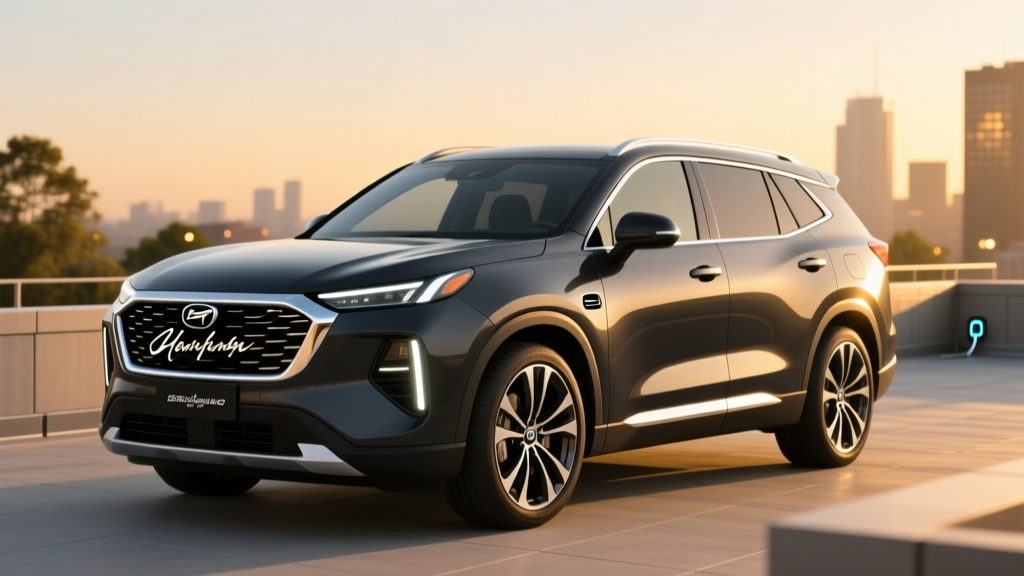
The 2026 Hyundai Santa Fe Calligraphy Hybrid occupies a narrow but appealing lane: a three-row midsize SUV with genuine luxury touches, all-wheel drive as standard, and a conventional hybrid powertrain that returns up to 34 MPG combined without ever needing a plug. It is not a plug-in hybrid, and it is not a full EV. It is a self-charging hybrid — and for buyers who want electrified efficiency without altering their fueling habits, that distinction matters enormously.
This review breaks down every number that matters for the top-trim Calligraphy Hybrid: EPA fuel economy across city, highway, and combined driving; the 1.6-liter turbo hybrid powertrain's real output; pricing against the non-hybrid and PHEV Santa Fe variants; battery warranty and replacement-cost expectations; and whether this SUV fits your driveway better than a full EV or a gas-only competitor.
2026 Santa Fe Calligraphy Hybrid: Key Specs at a Glance
| Spec | Value |
|---|---|
| Powertrain | 1.6L turbocharged 4-cyl + electric motor (HEV) |
| Combined Output | 232 hp / 271 lb-ft torque |
| Transmission | 6-speed automatic |
| Drivetrain | HTRAC AWD (standard on Calligraphy) |
| EPA MPG (City / Hwy / Combined) | 35 / 32 / 34 |
| Fuel Tank | 17.7 gallons |
| Total Driving Range | ~602 miles (EPA est.) |
| Seating | 6 passengers (2nd-row captain's chairs) or 7 (bench) |
| Cargo (behind 3rd row / 2nd row / max) | 14.0 / 40.5 / 79.6 cu ft |
| Towing Capacity | 2,000 lbs (est.) |
| 0–60 mph | ~7.8 seconds (est.) |
| Hybrid Battery Warranty | 10 years / 100,000 miles |
| MSRP (Calligraphy Hybrid AWD) | $46,850 (incl. destination) |
| Federal Tax Credit | Not eligible (conventional HEV) |
Sources: fueleconomy.gov, Hyundai Motor America press materials. Specs reflect 2025–2026 model year data; confirm with your dealer for final 2026 MSRP and EPA certification.
HEV vs. PHEV vs. EV: What the Santa Fe Calligraphy Hybrid Actually Is
Hyundai sells the Santa Fe in three powertrain flavors for 2026, and confusing them is the single most common mistake shoppers make:
Conventional Hybrid (HEV) — This Review
The Santa Fe Hybrid pairs a 1.6L turbo engine with a small electric motor and a ~1.5 kWh lithium-ion battery. It never plugs in. The battery charges through regenerative braking and engine power. You fuel it at a gas station like any other car. EPA-rated at 34 MPG combined.
Plug-In Hybrid (PHEV) — Santa Fe PHEV
The Santa Fe Plug-in Hybrid uses a larger ~13.8 kWh battery and a more powerful electric motor. It plugs into a Level 2 home charger or public station and delivers roughly 30–33 miles of electric-only driving before the gas engine kicks in. Total range exceeds 430 miles. MSRP starts around $4,000–$5,000 above the HEV.
Battery Electric (BEV) — Ioniq 5 or Competitors
No gas engine at all. Full EVs like the Hyundai Ioniq 5 offer 300+ miles of range, DC fast charging, and eligibility for the §30D federal tax credit (up to $7,500, subject to income, MSRP, and battery-sourcing rules). Require home charging infrastructure.
The Calligraphy Hybrid is an HEV. It does not plug in, has no electric-only range, and does not qualify for the federal EV tax credit. If you want plug-in capability, you need the Santa Fe PHEV — but note that the PHEV is not currently offered in the Calligraphy trim in all markets. Check with your dealer.
How Many MPG Does the 2026 Santa Fe Calligraphy Hybrid Get?
| Driving Cycle | EPA MPG | Real-World Expectation |
|---|---|---|
| City | 35 MPG | 34–37 MPG (hybrids often beat EPA in stop-and-go) |
| Highway | 32 MPG | 29–31 MPG (aerodynamic drag, sustained 70+ mph) |
| Combined | 34 MPG | 32–35 MPG (mixed driving) |
The Santa Fe Hybrid's city MPG exceeds its highway number — a hallmark of conventional hybrids. The electric motor handles low-speed acceleration where gas engines are least efficient, and regenerative braking recaptures energy in stop-and-go traffic. On the highway, the turbocharged 1.6L does the work alone at higher RPMs, and the boxy, three-row SUV shape creates aerodynamic drag that no amount of hybrid assist can fully offset.
Real-world note: In mixed suburban-and-highway driving, expect 32–35 MPG. In heavy city traffic with frequent stops, some owners report briefly touching 37–38 MPG on short trips where the electric motor dominates. Cold weather (below 32°F) typically drops hybrid efficiency by 8–12% due to engine warm-up cycles and cabin heating demand. A 30 MPG combined average in January in Chicago is realistic.
Powertrain Deep Dive: 232 HP From a 1.6L Turbo Hybrid
The Santa Fe Hybrid's powertrain combines a 1.6-liter turbocharged four-cylinder engine (178 hp on its own) with a 47.7 kW (64 hp) electric motor integrated into the transmission housing. Combined system output is 232 horsepower and 271 lb-ft of torque, routed through a conventional 6-speed automatic — not a CVT, which is notable. Hyundai's HTRAC all-wheel drive is standard on the Calligraphy trim.
The 0–60 mph time lands around 7.8 seconds. That is not quick in an era of 3-second EVs, but it is adequate for a 4,500-pound family SUV. The electric motor fills in the low-end torque gap that small turbo engines typically exhibit, so around-town acceleration feels brisker than the number suggests. Merging onto highways at speed requires planning — the 6-speed downshifts and the turbo spools, but there is a perceptible 1–2 second lag before full power arrives.
Compared to the non-hybrid Santa Fe's 2.5L turbo (277 hp), the hybrid gives up 45 horsepower but gains roughly 8–10 MPG in combined driving. For most families, that trade is worth it.
Hybrid Battery Warranty, Lifespan, and Replacement Cost
Battery Warranty
Hyundai covers the Santa Fe Hybrid's lithium-ion battery pack for 10 years or 100,000 miles, whichever comes first. This is one of the strongest hybrid battery warranties in the segment and has been a Hyundai/Kia hallmark since the early Ioniq days.
Expected Lifespan
Conventional hybrid batteries (typically 1.0–2.0 kWh in HEVs) experience far fewer deep charge/discharge cycles than EV batteries. The Santa Fe Hybrid's battery operates in a narrow state-of-charge window (roughly 40–80%) managed by the vehicle's battery management system. Real-world data from Hyundai/Kia hybrids suggests these packs routinely last 150,000–200,000+ miles before significant degradation. Many first-generation Hyundai hybrid owners report no battery replacement over the vehicle's full life.
Replacement Cost
If the hybrid battery does fail outside warranty, replacement costs for Hyundai/Kia HEV packs currently range from $2,500 to $4,500 (parts and labor), depending on whether you go OEM through a dealer or use a refurbished unit from a hybrid specialist. This is dramatically less than EV battery replacement ($8,000–$20,000+), because the HEV pack is small.
The hybrid system also includes an electric motor, inverter, and control electronics. Hyundai's general powertrain warranty covers 10 years/100,000 miles as well, so hybrid-specific components beyond the battery are protected under the same term. Per IIHS and long-term owner surveys, the Santa Fe Hybrid's powertrain has shown strong reliability in the model years since the current generation launched.
Pricing, Trims, and Tax Credit Reality for the Calligraphy Hybrid
The 2026 Santa Fe Calligraphy Hybrid AWD carries an MSRP of approximately $46,850 including destination charges. This positions it as the most expensive Santa Fe Hybrid trim, but it is loaded:
- Nappa leather seating surfaces with quilted stitching
- Heated and ventilated front seats, heated second-row seats
- Head-up display (HUD)
- Dual 12.3-inch displays (instrument cluster + infotainment)
- Bose premium audio
- Digital Key 2 (phone-as-key via NFC/UWB)
- Highway Driving Assist 2 (Level 2 ADAS with lane-centering and adaptive cruise)
- Surround-view monitor, blind-spot view monitor
- Power-folding third row, hands-free liftgate
- 20-inch alloy wheels
Tax Credit Eligibility
The conventional Santa Fe Hybrid (HEV) does not qualify for the §30D federal Clean Vehicle Credit. That credit — up to $7,500 — applies only to plug-in electric vehicles (BEVs and PHEVs) that meet battery-sourcing, critical-mineral, MSRP, and buyer-income requirements as defined by the IRS. Since the HEV has no plug and a battery far below the 7 kWh PHEV threshold, it is ineligible.
If the federal tax credit is a decisive factor in your purchase, you would need to look at the Santa Fe PHEV (if available in your desired trim) or a full EV like the Hyundai Ioniq 5. The PHEV version of the Santa Fe may qualify for a partial or full §30D credit depending on its battery sourcing compliance for the 2026 tax year — verify current eligibility on the IRS Clean Vehicle list before purchasing.
Some states and utilities offer separate rebates for conventional hybrids, though these are increasingly rare as incentive programs shift toward plug-in vehicles. Check your state energy office or utility provider for local programs.
Who Should Buy the Santa Fe Calligraphy Hybrid — And Who Shouldn't
Pros
- 34 MPG combined in a three-row AWD SUV — no plug required
- 600+ mile total range; no range anxiety or charging logistics
- 10-year/100,000-mile hybrid battery and powertrain warranty
- Calligraphy trim delivers genuine luxury at $47K (vs. $60K+ European rivals)
- Conventional 6-speed auto avoids CVT drone under acceleration
- Strong city MPG where families do most driving
Cons
- No federal tax credit eligibility (HEV)
- Highway MPG drops to ~30 in real-world 75+ mph driving
- 2,000-lb towing capacity trails body-on-frame competitors
- Boxy styling creates wind noise above 70 mph
- No electric-only driving mode — always burns some fuel
- Third row is best suited for children; adults will find it tight on long trips
Decision Framework
Choose the Santa Fe Calligraphy Hybrid if: You want a premium three-row family SUV with excellent fuel economy, you cannot install a home charger (apartment, street parking, HOA restrictions), and you drive 12,000–18,000 miles per year in mixed city/highway conditions.
Choose the Santa Fe PHEV instead if: You have access to Level 2 home charging, your daily commute is under 30 miles round-trip (so you can drive mostly on electricity), and you want partial §30D tax credit eligibility.
Choose a full EV (Ioniq 5, EV6, etc.) if: You have reliable home charging, your daily driving is under 250 miles, you want the lowest per-mile fuel cost (~$0.04/mile vs. ~$0.11/mile for this hybrid at $3.50/gal), and you want the full $7,500 federal credit.
Stick with a gas-only SUV if: You tow more than 3,500 lbs regularly, you drive predominantly long highway miles where hybrid advantages shrink, or your budget is below $35,000.
Real-World Ownership: What 34 MPG Actually Saves You
At 15,000 miles per year and $3.50 per gallon of regular unleaded:
- Santa Fe Hybrid (34 MPG): ~441 gallons/year → ~$1,544/year in fuel
- Gas-only midsize AWD SUV (24 MPG avg): ~625 gallons/year → ~$2,188/year in fuel
- Annual savings: ~$644/year → ~$3,220 over 5 years
That fuel savings partially offsets the Calligraphy Hybrid's premium over a base gas-only Santa Fe SEL (~$37,000). Over a typical 7-year ownership period, the hybrid saves roughly $4,500 in fuel — enough to justify the hybrid powertrain upgrade cost, though not the full Calligraphy trim premium, which is largely about luxury features rather than the powertrain alone.
Insurance for the Santa Fe Calligraphy Hybrid runs comparable to other premium midsize SUVs. Expect annual premiums in the $1,600–$2,200 range depending on your state, driving record, and coverage level. Hybrid-specific insurance discounts are uncommon; most insurers price based on vehicle value and repair cost, and the Calligraphy's loaded MSRP puts it in a higher premium bracket than base trims.
Frequently Asked Questions
Does the 2026 Santa Fe Calligraphy Hybrid need to be plugged in?
No. It is a conventional hybrid (HEV), not a plug-in hybrid. The battery charges automatically through regenerative braking and the gas engine. You fuel it at a gas station like any other vehicle.
How far can the Santa Fe Hybrid drive on electricity alone?
It cannot drive on electricity alone for any meaningful distance. The hybrid system uses the electric motor to assist the gas engine during acceleration and low-speed maneuvering, but the gas engine is always running or ready to engage. If you want 30+ miles of electric-only driving, you need the Santa Fe PHEV.
Is the Santa Fe Hybrid reliable?
Hyundai's hybrid powertrains have demonstrated strong reliability since the current generation launched. The 10-year/100,000-mile hybrid battery warranty is among the best in the industry. Long-term data from related Hyundai/Kia hybrid platforms (Tucson Hybrid, Sportage Hybrid) shows low failure rates for the battery and electric motor. The NHTSA and IIHS safety ratings for the Santa Fe platform are strong; check both for the latest crash-test results.
What does the hybrid battery replacement cost?
Outside warranty, expect $2,500–$4,500 for a replacement HEV battery pack (parts and labor). However, Hyundai/Kia hybrid batteries routinely last 150,000–200,000+ miles, and the 10-year/100,000-mile warranty covers most owners through the vehicle's prime life.
Does the 2026 Santa Fe Calligraphy Hybrid qualify for any tax credit?
No federal tax credit applies. The §30D Clean Vehicle Credit requires a plug-in vehicle with at least 7 kWh of battery capacity. The Santa Fe HEV's battery is approximately 1.5 kWh and has no plug. Some states may offer minor hybrid incentives — check your state energy office. The Santa Fe PHEV (if available) may qualify for partial or full §30D credit.
How does the Calligraphy Hybrid compare to the Tucson Hybrid?
The Tucson Hybrid is smaller (compact SUV, 2 rows), lighter, and returns slightly better MPG (~38 combined). The Santa Fe Hybrid gives you a third row, more cargo space, a more refined ride, and the Calligraphy's luxury features — at the cost of about 4 MPG and roughly $8,000–$10,000 in price.
Can the Santa Fe Hybrid tow?
Yes, but modestly. The hybrid is rated for approximately 2,000 lbs — enough for a small utility trailer, a pair of dirt bikes, or a light pop-up camper. It is not suitable for boats or travel trailers. If towing is a priority, a body-on-frame SUV with a turbo V6 is a better choice.
Specifications and pricing in this review are based on the most current Hyundai Motor America data and EPA fueleconomy.gov listings available at time of publication. Model-year details, trim availability, and federal/state incentive rules are subject to change. Verify final pricing, EPA certification, and tax-credit eligibility with your dealer and a qualified tax professional before purchase.