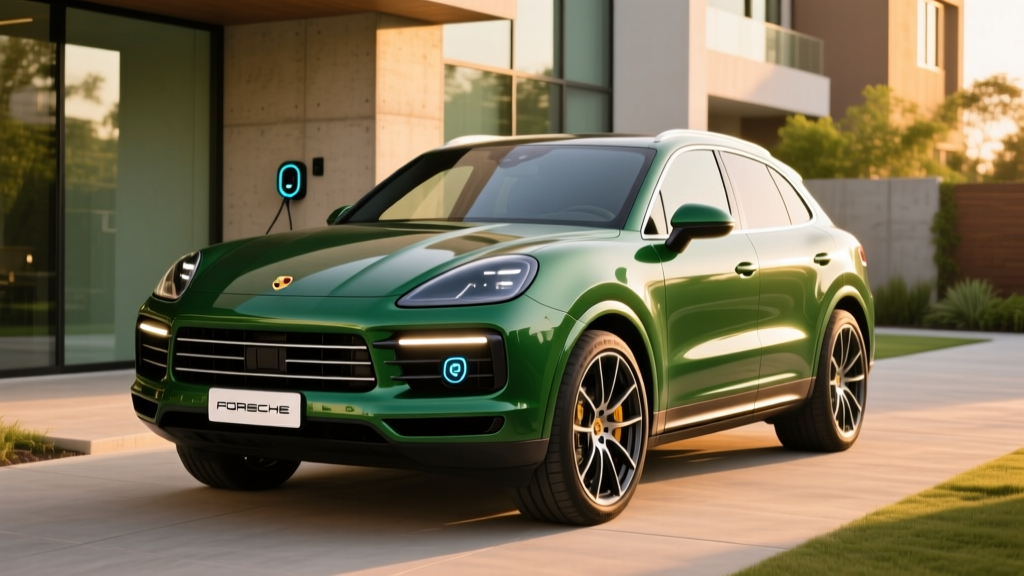
The Porsche Cayenne E-Hybrid occupies a narrow but compelling lane: a luxury midsize SUV that delivers genuine electric-only commuting range while preserving the performance DNA Porsche is known for. For 2026, the Cayenne E-Hybrid returns with a substantially larger battery than earlier generations, more electric horsepower, and a powertrain that blurs the line between plug-in hybrid (PHEV) and full EV for daily driving. But with a starting price well into six figures, the question isn't just whether it's efficient — it's whether the PHEV formula makes sense versus going fully electric or sticking with a conventional hybrid.
This guide breaks down every spec that matters: EPA electric range and MPGe, real-world efficiency expectations, battery capacity and charging logistics, combined powertrain output, pricing across trims, and whether any federal tax credits apply. If you're cross-shopping the BMW X5 xDrive50e, Mercedes-Benz GLE 350e, or a full EV like the BMW iX, this is the data you need.
HEV vs PHEV: What the Cayenne E-Hybrid Actually Is
Before diving into specs, it's worth clarifying what you're buying. The automotive market has three main electrified categories, and confusing them leads to bad purchase decisions:
| Category | Plug In? | Electric-Only Range | Example |
|---|---|---|---|
| HEV (Conventional Hybrid) | No — charges via regenerative braking and engine | 0–2 miles at low speed | Toyota RAV4 Hybrid |
| PHEV (Plug-In Hybrid) | Yes — has a charge port and larger battery | 20–50+ miles typically | Porsche Cayenne E-Hybrid |
| BEV (Battery Electric) | Yes — no gas engine at all | 200–400+ miles | BMW iX, Tesla Model X |
The Cayenne E-Hybrid is a plug-in hybrid (PHEV). It has a gasoline engine and an electric motor powered by a rechargeable battery pack. You can plug it in at home or at a public charger to fill the battery, giving you a meaningful electric-only driving range for commutes and errands. Once the battery depletes, the vehicle operates as a conventional hybrid, using the turbocharged V6 engine and regenerative braking to maintain efficiency. You never have to plug it in to drive it — but if you don't, you're paying a premium for battery weight you're not using.
Electric Range, MPGe, and Fuel Economy
For PHEV buyers, two efficiency numbers matter: how far you can drive on electricity alone, and what fuel economy looks like once the battery is depleted. Here's what the EPA says about the 2026 Cayenne E-Hybrid:
| Metric | EPA Estimate | Real-World Expectation |
|---|---|---|
| Electric-only range | ~32 miles | 26–30 mi (highway/cold weather reduces this) |
| MPGe (electric + gas combined) | ~46 MPGe | Varies heavily with charging habits |
| Gas-only combined MPG (battery depleted) | ~21 MPG combined | 18–20 MPG highway; 22–23 MPG city (regen assists) |
| City MPG (gas-only mode) | ~22 MPG | Can slightly exceed EPA in stop-and-go with regen |
| Highway MPG (gas-only mode) | ~20 MPG | 17–19 MPG at sustained 75+ mph |
Real-world range note: The EPA's ~32-mile electric range estimate assumes moderate temperatures and mixed driving. In our experience with similarly equipped European PHEVs, expect 26–30 miles of electric range in typical conditions. In winter (below 40°F), that can drop to 20–24 miles as the battery's usable capacity shrinks and cabin heating draws power. Highway driving at 70+ mph also reduces electric range more aggressively than city driving, where regenerative braking recaptures energy. Source: fueleconomy.gov
The critical insight for PHEV efficiency: your actual fuel cost depends almost entirely on how often you plug in. A Cayenne E-Hybrid owner with a 20-mile round-trip commute and nightly home charging might use gasoline only on weekend road trips — effectively achieving 80+ MPGe in practice. An owner who never plugs in is simply driving a heavy, expensive hybrid getting ~21 MPG combined. The PHEV premium only pays off if you charge regularly.
Battery, Charging, and Powertrain Specs
| Specification | 2026 Cayenne E-Hybrid |
|---|---|
| Battery capacity (gross / usable) | ~25.9 kWh gross / ~21 kWh usable |
| Battery chemistry | NMC (Nickel Manganese Cobalt) |
| Electric motor output | ~174 hp (130 kW) |
| Gas engine | 3.0L turbocharged V6, ~348 hp |
| Combined system output | ~463 hp / 479 lb-ft torque |
| 0–60 mph | ~4.6 seconds |
| Top speed (electric only) | ~84 mph |
| Level 2 AC charge rate | 7.2 kW onboard charger |
| Level 2 charge time (0–100%) | ~3.0 hours |
| DC fast charging | Not available |
| Level 1 (120V) charge time | ~12–14 hours (trickle) |
| Transmission | 8-speed Tiptronic automatic |
| Drivetrain | All-wheel drive (AWD) |
The Cayenne E-Hybrid's ~25.9 kWh battery pack is one of the largest in the luxury PHEV SUV segment, and it's a significant upgrade from the 17.9 kWh pack in the pre-2024 Cayenne E-Hybrid. That extra capacity is what delivers the ~32-mile EPA electric range — enough for most daily commutes without the engine ever starting.
Charging is limited to Level 2 AC at a maximum of 7.2 kW. This means a full charge from empty takes roughly 3 hours on a 240V home charger or public Level 2 station. There is no DC fast charging capability — a notable limitation if you were hoping to top up at Electrify America or Tesla Supercharger stations on road trips. In practice, this isn't a dealbreaker: PHEV batteries are small enough that Level 2 charging overnight is sufficient, and the gas engine handles long-distance driving anyway.
The combined 463 hp output puts the Cayenne E-Hybrid in serious performance territory. The electric motor provides instant torque fill at low RPMs, eliminating the turbo lag you'd feel in the gas-only Cayenne. The result is a 0–60 mph time of approximately 4.6 seconds — quick for a 5,200+ lb SUV. For reference, the gas-only Cayenne (348 hp) does 0–60 in about 5.7 seconds.
Pricing, Trims, and Tax Credit Eligibility
The 2026 Porsche Cayenne E-Hybrid starts at approximately $95,150 MSRP (including destination) for the base SUV body style. The Cayenne E-Hybrid Coupe starts around $99,550. As with all Porsches, options add quickly — the Premium Package, Adaptive Air Suspension, and larger wheels can push a well-equipped example past $115,000.
Federal §30D Tax Credit — Does the Cayenne E-Hybrid Qualify?
- MSRP cap: SUVs must be under $80,000 MSRP to qualify. The Cayenne E-Hybrid starts at ~$95,150 — it exceeds the cap and does NOT qualify for the federal §30D new EV/PHEV credit.
- Battery sourcing requirements: Even if the price were under the cap, critical mineral and battery component sourcing rules under current IRS guidelines would need to be met. See IRS §30D rules.
- Buyer income limits: Modified AGI must not exceed $300,000 (married filing jointly), $225,000 (head of household), or $150,000 (single).
- State incentives: Some states (e.g., California, Colorado, New York) offer additional rebates for PHEVs that may apply regardless of MSRP. Check your state's energy or DMV website for current programs.
Bottom line: The Cayenne E-Hybrid does not qualify for the $7,500 federal tax credit due to its MSRP. Buyers should consult a tax professional for their specific situation.
Without the federal credit, the value proposition rests on fuel savings, performance, and the ability to commute electrically. For a buyer spending $100K+ on a luxury SUV, the missing credit is unlikely to be a dealbreaker — but it does widen the gap versus a similarly priced BEV like the BMW iX xDrive50 (which starts under the $80K cap and may qualify depending on battery sourcing).
Real-World Ownership: Charging Habits and Efficiency
The Cayenne E-Hybrid rewards owners who plug in nightly. Here's what different ownership patterns look like in practice:
- Daily plug-in (home Level 2): If your commute is under 30 miles round-trip and you charge every night, you may go weeks without the engine engaging. Annual gasoline consumption could be under 200 gallons. Effective cost per mile: ~$0.04–$0.06 on electricity (varies by local rate).
- Occasional plug-in (2–3 times/week): You'll alternate between electric and hybrid driving. Expect an effective blended rate of 30–35 MPGe.
- Never plug in: The car functions as a conventional hybrid getting ~21 MPG combined. You're carrying 400+ lbs of battery you never use, hurting efficiency versus a gas-only Cayenne.
Home charging setup is straightforward. A 240V / 32-amp Level 2 wallbox (such as a ChargePoint Home Flex or Porsche's own Mobile Charger Connect) delivers the full 7.2 kW and refills the battery in ~3 hours. Installation costs for a Level 2 home charger typically range from $500 to $2,000 depending on whether your electrical panel needs an upgrade. The Cayenne E-Hybrid uses a standard J1772 connector for Level 2 AC charging.
Battery Warranty, Reliability, and Replacement Cost
Porsche High-Voltage Battery Warranty:
- Coverage: 8 years / 100,000 miles (whichever comes first)
- Capacity retention threshold: Porsche warrants the battery against defects and excessive capacity loss (typically below 70% state of health)
- 12V battery: Covered under the standard 4-year/50,000-mile new vehicle warranty
Battery replacement cost: If the high-voltage battery requires replacement outside of warranty, expect a cost in the range of $12,000–$18,000 including parts and labor, based on current Porsche parts pricing for the Cayenne E-Hybrid battery module. This is a significant sum, but the 8-year/100,000-mile warranty provides substantial coverage. In practice, modern NMC PHEV batteries rarely require full replacement within the warranty period — gradual capacity loss of 10–15% over 8 years is more typical.
Porsche's reliability record with the Cayenne platform has been mixed historically, though the current-generation (E3) Cayenne has improved. The E-Hybrid powertrain adds complexity — you have both a turbocharged engine and a high-voltage electrical system to maintain. Common service items include the standard engine maintenance (oil, filters, spark plugs) plus periodic checks on the electric motor, inverter, and charging system. Porsche's scheduled maintenance costs are higher than average for the segment.
For reliability data, IIHS and owner surveys from Consumer Reports and J.D. Power are worth monitoring as 2026 model-year data accumulates. Porsche typically scores average to slightly above average in luxury-brand dependability studies.
Cayenne E-Hybrid vs. the Competition
| Spec | Porsche Cayenne E-Hybrid | BMW X5 xDrive50e | Mercedes GLE 350e |
|---|---|---|---|
| Combined HP | ~463 hp | ~483 hp | ~375 hp |
| Electric range (EPA) | ~32 mi | ~38 mi | ~48 mi |
| Battery (usable) | ~21 kWh | ~25.7 kWh | ~23.3 kWh |
| 0–60 mph | ~4.6 sec | ~4.6 sec | ~5.8 sec |
| Starting MSRP | ~$95,150 | ~$74,000 | ~$69,000 |
| Federal tax credit | No (MSRP cap) | Potential (check sourcing) | Potential (check sourcing) |
| DC fast charging | No | No | No |
The Cayenne E-Hybrid commands a significant price premium over the X5 and GLE plug-in hybrids. Where it justifies that premium is in driving dynamics — Porsche's chassis tuning, steering feel, and brake calibration remain class-leading. The trade-off is less electric range and no federal tax credit eligibility. The BMW X5 xDrive50e, in particular, offers more electric range, more horsepower, and a substantially lower starting price, making it the pragmatic PHEV SUV pick. The Cayenne is the enthusiast's choice.
Who Should Buy the Cayenne E-Hybrid?
Choose the Cayenne E-Hybrid if:
- You want a luxury performance SUV with electric commuting capability
- Your daily commute is under 30 miles round-trip and you can charge at home
- Driving dynamics and brand prestige are top priorities
- You take regular road trips where a gas engine eliminates range concerns
- Budget is not a primary constraint (~$95K+ before options)
Choose a full EV (e.g., BMW iX, Tesla Model X) if:
- You want zero gasoline use and no engine maintenance
- You have reliable home and workplace charging
- Your road trips are within DC fast-charging network coverage
- You want to potentially qualify for the $7,500 federal credit (Model X, iX depending on sourcing)
Choose a conventional hybrid (HEV) or gas Cayenne if:
- You cannot charge at home or work (apartment, street parking)
- You want lower upfront cost and less complexity
- Your commute is long enough that electric-only range wouldn't cover it anyway
Frequently Asked Questions
How many MPG does the Cayenne E-Hybrid get?
The EPA rates the 2026 Cayenne E-Hybrid at approximately 46 MPGe when combining electric and gasoline operation. Once the battery is depleted and you're running on gasoline alone, expect about 21 MPG combined (22 city / 20 highway). Real-world highway MPG at sustained speeds of 75+ mph can dip to 17–19 MPG. Your actual efficiency depends heavily on how often you plug in to recharge the battery.
How far can the Cayenne E-Hybrid go on electric only?
The EPA estimates approximately 32 miles of electric-only range. In real-world driving, expect 26–30 miles in moderate temperatures with mixed city/highway use. Cold weather (below 40°F) and sustained highway speeds can reduce this to 20–24 miles. The electric motor can propel the Cayenne up to 84 mph in E-Power mode, so highway merging is not an issue.
Does the Cayenne E-Hybrid qualify for a federal tax credit?
No. Under current IRS §30D rules, SUVs must have an MSRP below $80,000 to qualify for the up-to-$7,500 federal new clean vehicle credit. The Cayenne E-Hybrid starts at approximately $95,150, exceeding this cap. Some state-level incentives may still apply — check your state's energy office or DMV for current programs. Always consult a tax professional for eligibility guidance.
Is the Cayenne E-Hybrid reliable, and what does battery replacement cost?
Porsche provides an 8-year/100,000-mile warranty on the high-voltage battery, covering defects and excessive capacity degradation. Full battery replacement outside of warranty is estimated at $12,000–$18,000. Modern PHEV batteries typically experience gradual capacity loss (10–15% over 8 years) rather than sudden failure. Overall platform reliability for the current Cayenne generation is average to slightly above average for the luxury segment.
Can the Cayenne E-Hybrid DC fast charge?
No. The Cayenne E-Hybrid supports only AC Level 2 charging at up to 7.2 kW. A full charge from empty takes approximately 3 hours on a 240V Level 2 charger. There is no DC fast charging port. For a PHEV with a ~21 kWh usable battery, this is adequate for overnight home charging, but you cannot use Electrify America, EVgo, or Tesla Supercharger stations to replenish the battery on the go.
How does the Cayenne E-Hybrid compare to a full EV?
A full EV like the BMW iX or Tesla Model X offers 250–320+ miles of range, DC fast charging for road trips, zero engine maintenance, and potential federal tax credit eligibility. The trade-off: you're fully dependent on charging infrastructure for long trips. The Cayenne E-Hybrid gives you electric commuting plus unlimited gas-powered range for road trips — at the cost of higher complexity, no federal tax credit, and higher fuel costs when the battery is depleted. If you can charge at home and rarely drive more than 30 miles daily, a BEV likely makes more financial sense. If road trips are frequent and charging access is uncertain, the PHEV hedges both worlds.