Quick Verdict: A Three-Row Hybrid That Actually Delivers
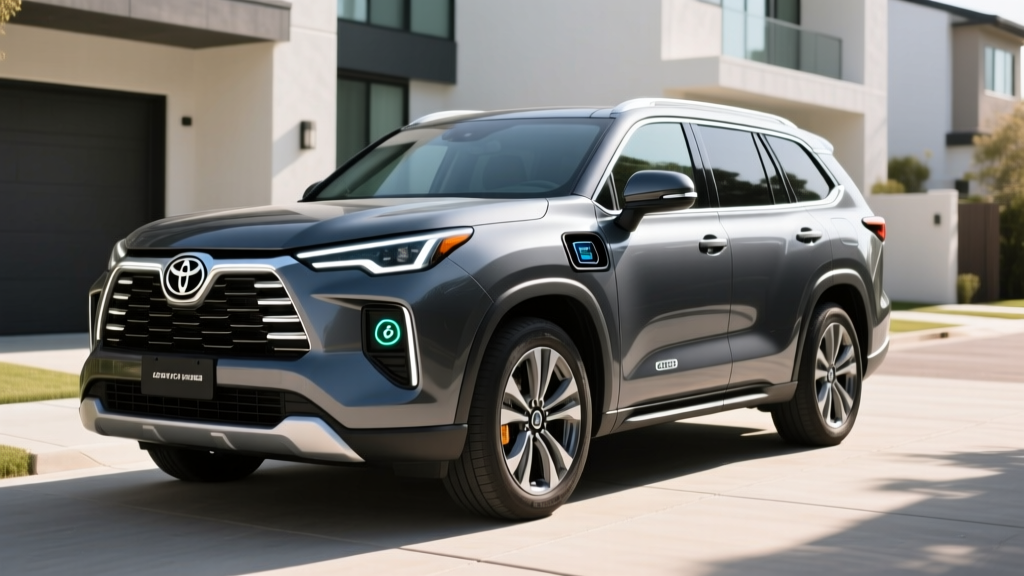
The 2025 Toyota Grand Highlander Hybrid fills a narrow but important gap: a three-row family hauler that sips fuel without requiring a plug, a charging routine, or any change in driving habits. With EPA ratings up to 36 MPG combined and seating for up to eight, it competes directly with the Kia Sorento Hybrid and its own non-hybrid sibling while offering substantially better fuel economy than any gas-only midsize SUV in its class.
Toyota offers two distinct hybrid powertrains here — a standard hybrid and the performance-oriented Hybrid MAX — and the differences in specs, MPG, and pricing are significant enough to warrant a careful look before choosing a trim.
2025 Toyota Grand Highlander Hybrid Specs at a Glance
| Specification | Standard Hybrid (LE/XLE/Limited) | Hybrid MAX (Limited/Platinum) |
|---|---|---|
| Powertrain | 2.5L 4-cyl + 3 electric motors (AWD-i) | 2.4L turbo 4-cyl + electric motor (6-spd auto) |
| Combined Horsepower | 245 hp | 362 hp |
| Combined Torque | 173 lb-ft (engine) + motor torque | 400 lb-ft |
| Drivetrain | AWD (electronic rear motor) | AWD (mechanical) |
| EPA City MPG | 36 | 26 |
| EPA Highway MPG | 32 | 27 |
| EPA Combined MPG | 35 | 27 |
| 0–60 mph (est.) | ~7.8 sec | ~6.3 sec |
| Towing Capacity | 3,500 lbs | 5,000 lbs |
| Battery Type | Nickel-metal hydride (NiMH), ~1.6 kWh | NiMH, ~1.6 kWh |
| Starting MSRP | $45,390 (LE) | $54,490 (Limited) |
Source: fueleconomy.gov and Toyota Motor Corporation specifications.
Fuel Economy: EPA Ratings vs. Real-World MPG
The standard Grand Highlander Hybrid's 35 MPG combined EPA rating puts it at the top of the three-row SUV class for fuel efficiency. But as with all hybrids, the EPA sticker only tells part of the story.
| Driving Scenario | Standard Hybrid (EPA) | Real-World Expectation |
|---|---|---|
| City driving | 36 MPG | 35–40 MPG (regenerative braking shines in stop-and-go) |
| Highway (70 mph) | 32 MPG | 29–32 MPG (less electric assist at sustained speed) |
| Cold weather (below 32°F) | — | 28–33 MPG combined (engine runs more for cabin heat) |
| Loaded (7 passengers + cargo) | — | 27–31 MPG combined |
The Hybrid MAX trades fuel economy for performance. Its 27 MPG combined is respectable for a 362-hp turbocharged SUV, but it's a meaningful step down from the standard hybrid — roughly 8 fewer miles per gallon in mixed driving, which translates to about $250–$350 more in annual fuel cost at 15,000 miles per year and $3.50/gallon.
Hybrid vs. PHEV vs. EV: Which Powertrain Fits Your Family?
The Grand Highlander is available only as a conventional hybrid (HEV) — there is no plug-in hybrid (PHEV) version and no full-electric (BEV) variant. Understanding the distinction matters for your purchase decision.
Conventional Hybrid (HEV) — What the Grand Highlander Is
- No plug required. The battery recharges through regenerative braking and the gasoline engine.
- Small battery (~1.6 kWh). Provides electric assist during acceleration and low-speed driving but cannot propel the vehicle on electricity alone for meaningful distances.
- No electric-only range. The gasoline engine is always available and does most of the work.
- No federal tax credit. HEVs do not qualify for the IRS §30D Clean Vehicle Credit.
Plug-In Hybrid (PHEV) — What the Grand Highlander Is NOT
- Requires plugging in to realize electric-only range (typically 25–40 miles on models like the Toyota RAV4 Prime).
- Larger battery (18–22 kWh) enabling short commutes on electricity alone.
- May qualify for the §30D federal tax credit (up to $7,500) depending on battery sourcing, MSRP caps, and buyer income limits.
- Not available in the Grand Highlander lineup.
Full Electric (BEV) — The Alternative
- Zero gasoline, 250–350+ miles of EPA range, but requires home or public charging infrastructure.
- Three-row BEV options remain limited and generally more expensive (Kia EV9 starts ~$55K).
- May qualify for the §30D credit if MSRP, income, and battery-sourcing requirements are met.
Who Should Choose the Grand Highlander Hybrid?
Choose this HEV if: You need three rows, want 35 MPG combined without changing your fueling routine, don't have reliable access to home or workplace charging, or frequently drive in areas with sparse DC fast-charging infrastructure.
Look elsewhere if: You have a short commute and home charging access (a PHEV like the RAV4 Prime or a BEV could eliminate most gasoline use), you want federal tax-credit eligibility, or you need more than 5,000 lbs of towing capacity.
Powertrain Deep Dive: Two Very Different Hybrids
Standard Hybrid (245 hp)
The standard powertrain pairs a 2.5-liter naturally aspirated four-cylinder engine with three electric motors — two on the front axle and one on the rear — for electronic on-demand AWD. The system prioritizes efficiency, using the electric motors to fill torque gaps during acceleration and to recapture energy during braking. The continuously variable transmission (eCVT) keeps the engine in its most efficient RPM range. This is Toyota's fourth-generation hybrid system, proven across the Camry, RAV4, and Highlander lineups.
The result is smooth, adequate acceleration and exceptional fuel economy. The 0–60 mph time of roughly 7.8 seconds is sufficient for highway merging and daily driving, though it won't feel quick with a full load of passengers and cargo.
Hybrid MAX (362 hp)
The Hybrid MAX is a fundamentally different animal. It uses a 2.4-liter turbocharged four-cylinder paired with a single electric motor and a traditional six-speed automatic transmission — no eCVT. This powertrain sends power through a mechanical AWD system with a torque-sensing limited-slip center differential, giving it a more traditional and engaging driving character.
The 362 hp and 400 lb-ft of combined torque deliver a 6.3-second 0–60 mph time and a 5,000-lb towing capacity — 1,500 lbs more than the standard hybrid. The trade-off is fuel economy: 27 MPG combined versus 35. If you tow a boat or trailer regularly, the MAX is the clear choice. If you don't, the standard hybrid's 8-MPG advantage compounds into significant annual savings.
Pricing, Trims, and Tax Credit Eligibility
| Trim | Powertrain | MSRP (2025) |
|---|---|---|
| LE | Standard Hybrid | $45,390 |
| XLE | Standard Hybrid | $47,890 |
| Limited | Standard Hybrid | $50,990 |
| Limited | Hybrid MAX | $54,490 |
| Platinum | Hybrid MAX | $58,790 |
Prices include destination charge. Source: Toyota Motor Corporation.
Federal Tax Credit: What You Need to Know
The Grand Highlander Hybrid is a conventional HEV and does not qualify for the IRS §30D New Clean Vehicle Credit. That credit applies only to plug-in electric vehicles (BEVs and PHEVs) meeting specific battery-sourcing, critical-mineral, MSRP, and buyer-income requirements. See the IRS §30D page for current rules.
Some states offer their own incentives for hybrids, though these are increasingly rare and typically modest ($250–$1,000). Check your state's energy or environmental agency website for current programs.
Battery Warranty, Reliability, and Replacement Cost
Toyota Hybrid Battery Warranty
Coverage: 10 years / 150,000 miles (whichever comes first) for the hybrid battery and all hybrid-system components, including the inverter and electric motors.
Capacity retention threshold: Toyota warrants the hybrid battery against defects and abnormal capacity loss. Unlike BEV warranties, there is no published minimum State of Health percentage — Toyota evaluates on a case-by-case basis under warranty.
Transferability: The hybrid battery warranty is fully transferable to subsequent owners, which supports strong resale value.
Long-Term Reliability Outlook
Toyota's hybrid system is among the most proven in the industry. The Prius has accumulated billions of real-world miles since 2000, and the eCVT design — which has no traditional gears, belts, or clutches to wear — is mechanically simpler than a conventional automatic transmission. The 2.5L four-cylinder in the standard hybrid runs an Atkinson cycle, which reduces thermal stress and contributes to longevity.
Based on data from earlier Toyota hybrid SUVs (Highlander Hybrid, RAV4 Hybrid), the hybrid battery in the Grand Highlander should comfortably exceed 150,000 miles before any capacity concerns arise. Many Toyota hybrid batteries last the lifetime of the vehicle.
Battery Replacement Cost
If the hybrid battery does require replacement outside of warranty, expect to pay between $3,000 and $5,000 for a new OEM battery pack, including labor. Refurbished or reconditioned packs are available for $1,500–$2,500. This is dramatically less than a BEV traction battery replacement ($10,000–$20,000+) because the Grand Highlander's hybrid battery is small (~1.6 kWh) and uses mature NiMH chemistry.
Pros and Cons
Pros
- 35 MPG combined in a true three-row SUV — class-leading efficiency
- No plug, no charging infrastructure required — works like a gas car
- Hybrid MAX offers 362 hp and 5,000-lb towing for active families
- 10-year/150,000-mile hybrid battery warranty
- Strong Toyota reliability record and resale value
- Standard Toyota Safety Sense 3.0 (adaptive cruise, lane-keep, auto emergency braking)
Cons
- No PHEV option — no electric-only commuting capability
- No federal tax credit eligibility for the HEV
- Standard hybrid acceleration is adequate but not quick (7.8s 0–60)
- Hybrid MAX fuel economy drops to 27 MPG combined
- Third row is usable for adults on short trips but tight for long hauls
- Starting price ~$45K is steep before options
Frequently Asked Questions
How many MPG does the 2025 Grand Highlander Hybrid get?
The standard hybrid achieves 36 city / 32 highway / 35 combined MPG per the EPA. The Hybrid MAX gets 26 city / 27 highway / 27 combined. In real-world city driving, the standard hybrid often exceeds its EPA rating, sometimes reaching 38–40 MPG in stop-and-go traffic where regenerative braking is most effective. Highway driving at 75+ mph and cold-weather operation will reduce these numbers by 3–7 MPG.
Does the Grand Highlander Hybrid need to be plugged in?
No. The Grand Highlander Hybrid is a conventional hybrid (HEV), not a plug-in hybrid. Its small battery recharges automatically through regenerative braking and the gasoline engine. You fuel it exactly like any other gas vehicle — at a gas station.
Is there a plug-in hybrid (PHEV) Grand Highlander?
Not for 2025. Toyota has not announced a Grand Highlander PHEV. If you want a Toyota plug-in hybrid SUV, the RAV4 Prime (42 miles electric-only range, 94 MPGe) is the closest option, though it only seats five. The Prius Prime is a five-seat sedan alternative with 44 miles of electric range.
Does the Grand Highlander Hybrid qualify for any tax credit?
No federal tax credit. The IRS §30D Clean Vehicle Credit applies only to plug-in vehicles (BEVs and PHEVs) that meet battery-sourcing, MSRP, and buyer-income requirements. Conventional hybrids like the Grand Highlander Hybrid are not eligible. Some states may offer small hybrid incentives — check your local regulations.
How reliable is the Grand Highlander Hybrid?
Toyota's hybrid powertrain is one of the most reliable in the industry, with decades of real-world data from the Prius, Camry Hybrid, and Highlander Hybrid. The eCVT has no wearable friction components like clutch packs or torque converters. The hybrid battery carries a 10-year/150,000-mile warranty, and historical data suggests most Toyota hybrid batteries last well beyond 150,000 miles without replacement.
What does a hybrid battery replacement cost?
Out of warranty, a new OEM hybrid battery for the Grand Highlander would cost approximately $3,000–$5,000 installed. Refurbished packs run $1,500–$2,500. This is far less expensive than a BEV battery replacement because the hybrid battery is only ~1.6 kWh versus 60–100+ kWh in a full electric vehicle.
Hybrid vs. PHEV vs. EV — which should I buy for a three-row family SUV?
Choose the Grand Highlander Hybrid (HEV) if you lack home charging access, take frequent long road trips, or want maximum simplicity. Choose a three-row PHEV (like the Mazda CX-90 PHEV, ~26 miles electric range) if you have home charging and a short commute. Choose a three-row BEV (like the Kia EV9, 279–304 miles EPA range) if you have reliable home charging, want zero gasoline use, and can absorb the higher purchase price. Each powertrain has a clear ideal use case — there is no single best answer.
Can the Grand Highlander Hybrid tow?
Yes. The standard hybrid is rated for 3,500 lbs of towing. The Hybrid MAX increases that to 5,000 lbs, making it suitable for small boats, utility trailers, and light campers. Note that towing will significantly reduce fuel economy — expect 18–22 MPG combined when pulling a loaded trailer with the standard hybrid.
Specifications and pricing reflect 2025 model year data from Toyota Motor Corporation and fueleconomy.gov. Tax credit rules are subject to change; consult a tax professional and the IRS §30D guidance before making a purchase decision.