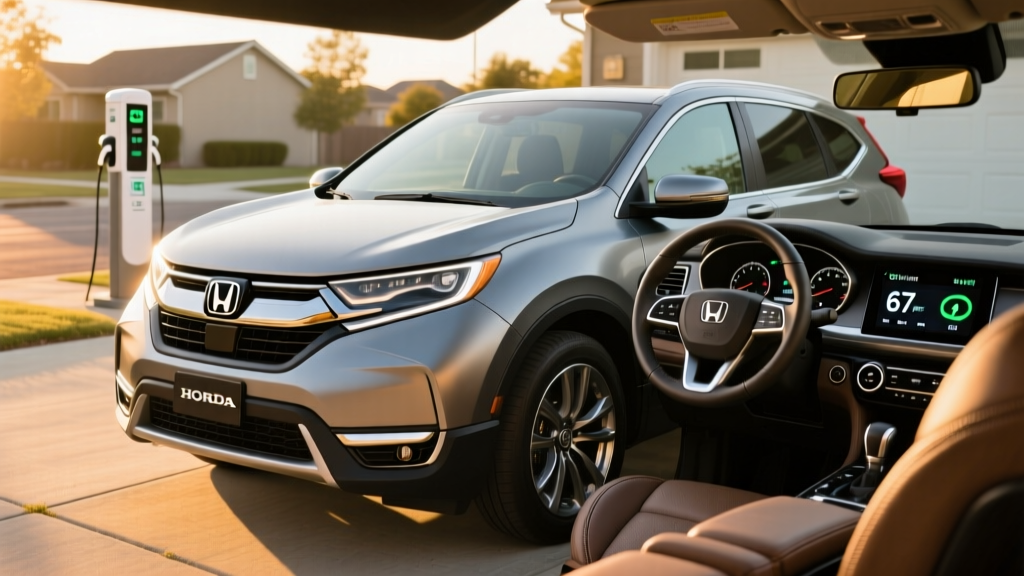
The compact hybrid SUV market has exploded since 2021, but the 2021 Honda CR-V Hybrid remains a benchmark in the used-vehicle market for buyers who want proven efficiency without plugging in. With its 212-horsepower two-motor powertrain, standard all-wheel drive, and EPA-rated 33 MPG combined, it holds its own against newer rivals — and in 2026, it's available at a fraction of its original MSRP.
This guide covers everything a used-car buyer needs to know: real-world fuel economy, the hybrid battery's long-term reliability, ownership costs, and how the CR-V Hybrid stacks up against plug-in hybrids and full battery-electric vehicles.
HEV vs PHEV vs EV: Where the CR-V Hybrid Fits
Before diving into specs, it's critical to understand what the 2021 CR-V Hybrid is — and what it isn't. Honda built this as a conventional hybrid electric vehicle (HEV), not a plug-in hybrid (PHEV) or a battery-electric vehicle (BEV). That distinction shapes everything from how you fuel it to whether it qualifies for federal tax credits.
| Feature | 2021 CR-V Hybrid (HEV) | Typical PHEV (e.g., Toyota RAV4 Prime) | Typical BEV (e.g., Tesla Model Y) |
|---|---|---|---|
| Plug-in required? | No — self-charging via regen + engine | Yes — plug in for electric range | Yes — plug in for all driving |
| Electric-only range | ~1–2 miles at low speed | 25–42 miles | 260–330 miles |
| Fuel source | Gasoline only | Gasoline + grid electricity | Grid electricity only |
| Federal tax credit (new) | $0 — not eligible under §30D | Up to $7,500 (if eligible) | Up to $7,500 (if eligible) |
| Home charging needed? | No | Recommended for EV range | Required |
The CR-V Hybrid captures energy through regenerative braking and its gasoline engine to recharge its small 1.3 kWh lithium-ion battery. You never plug it in. If you want electric-only commuting with a gas backup, you'd look at a PHEV like the RAV4 Prime. If you're ready to go fully electric, the Model Y or Hyundai Ioniq 5 are strong alternatives — but they demand reliable home or workplace charging access.
Fuel Economy: EPA Ratings and Real-World MPG
The 2021 Honda CR-V Hybrid carries EPA ratings of 40 MPG city / 35 MPG highway / 38 MPG combined across all trims (LX, EX, EX-L, Touring), all equipped with standard Real Time AWD. These figures come from fueleconomy.gov.
| Driving Condition | EPA Estimate | Real-World Expectation |
|---|---|---|
| City | 40 MPG | 38–43 MPG (hybrids often exceed EPA in stop-and-go) |
| Highway (70 mph cruise) | 35 MPG | 31–34 MPG (aero drag reduces hybrid advantage) |
| Combined | 38 MPG | 34–39 MPG |
| Cold weather (below 30°F) | — | 29–34 MPG (engine runs more for cabin heat) |
The two-motor hybrid system shines in city driving, where regenerative braking recovers energy at every stop and the electric motor handles low-speed propulsion. On sustained highway runs above 70 mph, the 2.0-liter Atkinson-cycle engine does most of the work directly, and efficiency drops closer to a conventional gas CR-V's highway number.
In cold weather, expect a 10–15% fuel-economy penalty. The engine must run more frequently to provide cabin heat (the CR-V Hybrid lacks a heat pump, which is more common in BEVs), and battery efficiency decreases at low temperatures. Owners in northern climates typically report 30–34 MPG combined during winter months.
Powertrain and Performance Specifications
| Specification | 2021 Honda CR-V Hybrid |
|---|---|
| Engine | 2.0L Atkinson-cycle 4-cylinder |
| Engine output | 145 hp / 129 lb-ft torque |
| Electric motors | Two-motor system (drive + generator) |
| Electric motor output | 181 hp / 232 lb-ft torque |
| Combined system output | 212 hp |
| Transmission | Electronic CVT (e-CVT, no belt) |
| Drivetrain | Real Time AWD (standard, all trims) |
| Hybrid battery | 1.3 kWh lithium-ion |
| 0–60 mph | ~7.5 seconds |
| Towing capacity | 1,500 lbs |
| Cargo volume (behind rear seats) | 33.2 cu ft |
| Cargo volume (seats folded) | 68.7 cu ft |
Honda's two-motor hybrid system operates differently from Toyota's planetary-gear setup. At low speeds, the CR-V Hybrid runs primarily on its electric drive motor, with the gasoline engine spinning a generator motor to produce electricity. At highway speeds, a lockup clutch connects the engine directly to the front wheels for better efficiency. The rear axle receives torque via a mechanical driveshaft when the AWD system detects front-wheel slip — it is not a separate rear electric motor.
The 212 combined horsepower gives the CR-V Hybrid a meaningful advantage over the gas-only CR-V's 190 hp, and the electric motor's instant 232 lb-ft of torque makes it feel responsive in daily driving. The e-CVT is smooth and avoids the rubber-band effect of traditional belt-driven CVTs because it uses motor-generator speed control rather than variable pulleys.
Battery Longevity, Warranty, and Replacement Cost
Hybrid battery reliability is the top concern for used-hybrid buyers, and the 2021 CR-V Hybrid's track record is strong. Honda's hybrid system uses a relatively small 1.3 kWh battery that operates in a narrow state-of-charge window (roughly 40–60%), which significantly reduces stress on the cells compared to a BEV that cycles through 0–100%.
Honda Hybrid Battery Warranty (Original):
- 8 years / 80,000 miles in most states
- 10 years / 150,000 miles in CARB states (CA, CT, ME, MD, MA, NJ, NY, OR, RI, VT, WA, and others adopting California emissions standards)
- Covers battery capacity below approximately 70% of original and any manufacturing defects
For a 2021 model purchased used in 2026, the original federal warranty provides coverage through 2029 or 80,000 miles — whichever comes first. If the vehicle was originally sold and registered in a CARB state, the extended 10-year/150,000-mile coverage applies regardless of subsequent ownership transfers.
Real-world data from Honda hybrid owners (including the Insight and Accord Hybrid, which share similar battery architecture) shows minimal degradation in the first 100,000 miles. The small battery's shallow cycling and Honda's conservative thermal management mean most units outlast the warranty period without issue.
If a replacement is needed out of warranty, expect to pay $2,000–$4,000 for a new OEM hybrid battery pack plus labor at a Honda dealer. Third-party refurbishers offer reconditioned packs for $1,000–$2,500. This is far less than a BEV traction battery replacement, which can exceed $10,000–$20,000.
Pricing in the 2026 Used Market and Tax Credit Eligibility
When new, the 2021 CR-V Hybrid carried MSRPs ranging from $30,560 (LX) to $36,350 (Touring), including destination charges. In the 2026 used market, examples with 40,000–70,000 miles typically sell for $21,000–$28,000 depending on trim, condition, and mileage.
| Trim | Original 2021 MSRP | 2026 Used Price (est. 50k mi) |
|---|---|---|
| LX | $30,560 | $21,000–$23,500 |
| EX | $33,150 | $23,500–$25,500 |
| EX-L | $35,550 | $25,000–$27,000 |
| Touring | $36,350 | $26,000–$28,000 |
Federal tax credit: The 2021 CR-V Hybrid did not qualify for the federal §30D clean vehicle credit when new, because conventional hybrids (HEVs) are not eligible — only plug-in hybrids and battery-electric vehicles with sufficient battery capacity qualify under IRS rules. This remains true on the used market: the used clean vehicle credit (up to $4,000 or 30% of sale price, whichever is less) applies only to qualified plug-in electric or fuel-cell vehicles, not conventional hybrids.
Some states offer their own incentives for efficient vehicles, but these vary widely and change frequently. Check your state's energy or environmental agency for current programs.
Who Should Buy the 2021 CR-V Hybrid — And Who Shouldn't
Pros
- 38 MPG combined without any behavior change — no plugging in, no range planning
- Standard AWD on all trims (gas CR-V AWD was optional and cost extra)
- 212 hp provides confident merging and passing
- Excellent reliability record; hybrid battery warranty transfers to second owners
- Spacious 33.2 cu ft cargo area with no battery-pack intrusion
- Lower used pricing than comparable PHEV or BEV SUVs
Cons
- No electric-only driving range beyond ~1 mile at low speed
- Highway MPG drops to 31–34 in real-world 70+ mph driving
- No DC fast charging or plug-in capability
- 1,500-lb towing capacity (lower than some competitors)
- No federal or state EV tax credit eligibility
- Honda Sensing suite is solid but less advanced than newer ADAS systems
Choose the 2021 CR-V Hybrid if:
- You lack access to home or workplace charging (apartment, street parking, no garage outlet)
- Your commute is mostly city/suburban stop-and-go where the hybrid system excels
- You want a proven, low-risk used vehicle with remaining factory warranty
- You need AWD for snow or rain but don't want the fuel penalty of a gas AWD SUV
Look at a PHEV (RAV4 Prime, Tucson PHEV) if:
- You have Level 2 home charging and a commute under 30 miles
- You want electric-only daily driving with gas backup for road trips
Look at a BEV (Model Y, Ioniq 5) if:
- You have reliable home charging and want zero tailpipe emissions
- You want to qualify for federal tax credits and minimize per-mile fuel cost
Reliability and Safety Ratings
The 2021 CR-V Hybrid earned a 5-Star Overall Safety Rating from NHTSA and was named an IIHS Top Safety Pick (with specific headlight configurations). Honda Sensing — the brand's Level 2 driver-assistance suite — includes adaptive cruise control, lane-keeping assist, forward collision warning with automatic emergency braking, and road departure mitigation. It is a driver-assist system, not a self-driving system; the driver must remain fully engaged at all times.
On the reliability front, Honda's two-motor hybrid system has been in production since the 2014 Accord Hybrid and has accumulated millions of real-world miles across the Accord Hybrid, Insight, Clarity, and CR-V Hybrid. The system has no traditional transmission to fail, no starter motor, and no alternator — all replaced by the motor-generator pair. Consumer Reports and J.D. Power data consistently rank the CR-V Hybrid at or above average for its class.
Frequently Asked Questions
How many MPG does the 2021 Honda CR-V Hybrid actually get?
The EPA rates it at 40 city / 35 highway / 38 combined MPG. In real-world driving, owners typically see 34–39 MPG combined, with city driving often exceeding 40 MPG and sustained highway driving dropping to 31–34 MPG. Cold weather reduces these figures by roughly 10–15%.
Does the 2021 CR-V Hybrid need to be plugged in?
No. It is a conventional hybrid (HEV), not a plug-in hybrid (PHEV). The 1.3 kWh battery recharges through regenerative braking and the gasoline engine. There is no charge port and no plug-in capability.
Is the 2021 CR-V Hybrid reliable, and what does a battery replacement cost?
Yes — Honda's two-motor hybrid system has a strong long-term reliability record. The hybrid battery is warrantied for 8 years/80,000 miles (10 years/150,000 miles in CARB states), and the warranty transfers to subsequent owners. Out-of-warranty replacement costs $2,000–$4,000 for an OEM pack, far less than a BEV battery.
Does the 2021 CR-V Hybrid qualify for any tax credit?
No. Conventional hybrids are not eligible for the federal §30D clean vehicle credit, which applies only to plug-in hybrids and battery-electric vehicles. The used clean vehicle credit (up to $4,000) also excludes conventional hybrids. Some state programs may offer small incentives, but availability varies.
How does the CR-V Hybrid compare to the Toyota RAV4 Hybrid?
The 2021 RAV4 Hybrid is rated at 41/38/40 MPG (city/highway/combined), giving it a slight efficiency edge, particularly on the highway. The CR-V Hybrid counters with more horsepower (212 vs. 219 combined but with different delivery characteristics), slightly more rear-seat legroom, and a smoother e-CVT feel. Both are strong choices — the RAV4 Hybrid wins on MPG, the CR-V Hybrid on refinement and interior space.
Can the 2021 CR-V Hybrid tow?
Yes, but with a 1,500-pound maximum towing capacity — adequate for a small utility trailer or a pair of jet skis, but not enough for most boat trailers or campers. If you need 3,500+ pounds of towing, consider a gas or hybrid midsize SUV instead.