Quick Verdict: The Plug-In Kia Niro Occupies a Smart Middle Ground
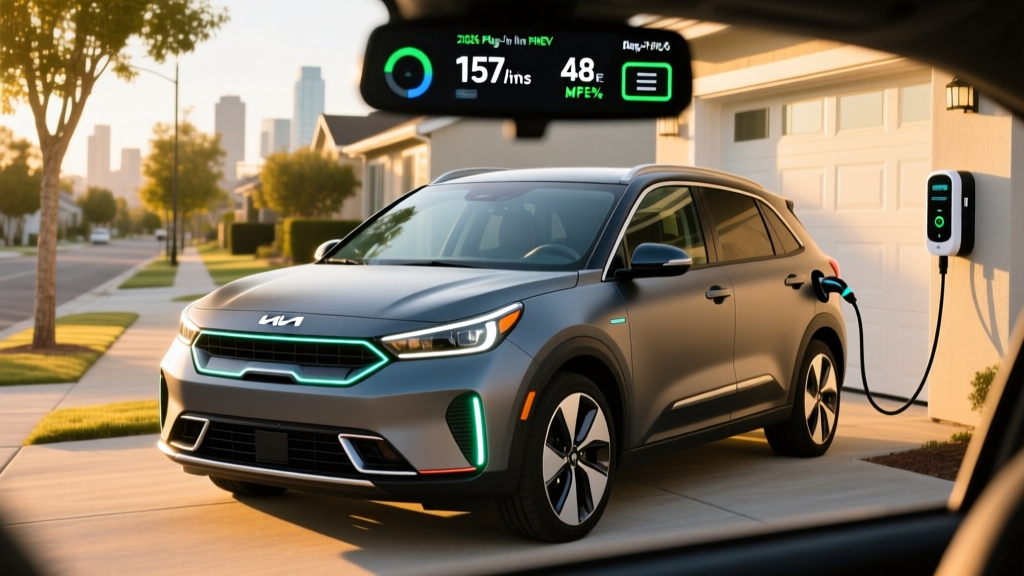
The 2026 Kia Niro Plug-In Hybrid (PHEV) targets buyers who want meaningful electric-only commuting without the range limitations of a full battery-electric vehicle. With an EPA-estimated 33 miles of electric-only range and 48 MPG combined once the gasoline engine kicks in, it covers most daily drives on electrons alone while keeping a 1.6-liter turbocharged engine in reserve for road trips. Starting at $35,090 (including destination), the Niro PHEV undercuts rivals like the Toyota RAV4 Prime while offering competitive interior space and Kia's generous warranty coverage. The question isn't whether it's a good PHEV — it is — but whether its specific blend of electric range, fuel economy, and price matches your driving pattern.
2026 Kia Niro PHEV Key Specifications
| Spec | Value |
|---|---|
| EPA Electric-Only Range | 33 miles |
| EPA Combined MPG (hybrid mode) | 48 MPG |
| EPA MPGe (electric + gas combined) | 108 MPGe |
| Total Combined Range | ~440 miles |
| Battery Capacity | 11.1 kWh (usable ~9.0 kWh, NMC lithium-ion) |
| Combined Horsepower | 180 hp |
| Engine | 1.6L turbocharged 4-cylinder (104 hp) + 62 kW electric motor |
| Transmission | 6-speed dual-clutch automatic |
| Level 2 Charge Time (0-100%) | ~2 hours 45 minutes at 3.3 kW |
| DC Fast Charging | Not available |
| 0-60 mph | ~7.2 seconds |
| Cargo Volume (rear seats up) | 20.4 cu ft |
| Base MSRP (EX trim) | $35,090 |
| Battery Warranty | 10 years / 100,000 miles |
HEV vs PHEV: Which Kia Niro Is Right for You?
Kia sells the Niro in three electrified flavors for 2026: the conventional Hybrid (HEV), the Plug-In Hybrid (PHEV), and the all-electric EV6-based Niro EV. The HEV and PHEV share the same basic platform but serve fundamentally different use cases.
| Attribute | Niro HEV (Conventional Hybrid) | Niro PHEV (Plug-In Hybrid) |
|---|---|---|
| Plug-in Required? | No — charges via regenerative braking and engine | Yes — plug in to access electric-only range |
| Battery Size | 1.56 kWh | 11.1 kWh |
| Electric-Only Range | ~1 mile at low speed | 33 miles (EPA) |
| EPA Combined MPG | 53 MPG | 48 MPG (hybrid mode) / 108 MPGe (combined) |
| Combined Horsepower | 139 hp | 180 hp |
| Starting MSRP | $28,390 | $35,090 |
| Federal Tax Credit | None | Eligible — see §30D rules below |
| Best For | No home charging access; want max MPG without plugging in | Home charging available; commute under 33 miles |
The conventional HEV actually returns higher gas-only MPG (53 vs 48) because it carries a smaller, lighter battery pack. But the PHEV's advantage is that many owners burn almost no gasoline on typical commutes. If you drive 25 miles round-trip and charge nightly, you might visit a gas station four times a year. The HEV is the pragmatic pick if you can't charge at home; the PHEV rewards those who can.
Fuel Economy: EPA Numbers and Real-World MPG
The EPA rates the 2026 Niro PHEV at 48 MPG combined in hybrid mode (after the battery is depleted), with a breakdown of 49 MPG city and 47 MPG highway. In electric mode, it achieves 108 MPGe. According to fueleconomy.gov, this places the Niro PHEV among the most efficient plug-in hybrids in its class, trailing only the Toyota Prius Prime in combined MPGe.
2026 Kia Niro PHEV — EPA Fuel Economy Breakdown
| Mode | City | Highway | Combined |
|---|---|---|---|
| Hybrid (charge-sustaining) | 49 MPG | 47 MPG | 48 MPG |
| Electric + Gas (MPGe) | 115 MPGe | 101 MPGe | 108 MPGe |
| Electric-only consumption | 31 kWh/100 mi | ||
Real-world expectations: PHEVs often exceed their EPA city MPG because regenerative braking recaptures more energy in stop-and-go traffic. Owners on forums and tracking apps routinely report 50-55 MPG in city hybrid mode during warm weather. Highway driving at 75+ mph reduces efficiency — expect 40-44 MPG on sustained interstate runs. Cold weather (below 35°F) impacts both the battery's usable capacity and the engine's warm-up fuel consumption; plan for a 15-25% reduction in electric-only range and a 5-10 MPG drop in hybrid mode during winter.
The electric-only range also varies. The EPA's 33-mile figure assumes moderate temperatures and mixed driving. In practice, expect 28-30 miles in summer highway conditions and as few as 22-25 miles in freezing temperatures when the cabin heater draws from the battery. Kia's heat pump (standard on PHEV trims) helps mitigate cold-weather losses compared to resistance-heater PHEVs, but physics still applies.
Charging: Level 2 Only, No DC Fast Charging
The Niro PHEV's 11.1 kWh battery pack charges exclusively via AC power. The onboard charger accepts up to 3.3 kW on a Level 2 (240V) connection, bringing the battery from empty to full in approximately 2 hours and 45 minutes. On a standard 120V household outlet (Level 1), a full charge takes roughly 9-10 hours — feasible for overnight top-ups if your daily electric commute is modest.
| Charging Level | Power | Time (0-100%) | Practical Use |
|---|---|---|---|
| Level 1 (120V household) | ~1.2 kW | ~9-10 hours | Overnight; recovers ~20-25 mi of range |
| Level 2 (240V home/public) | 3.3 kW (max) | ~2 hours 45 min | Full recharge during workday or evening |
| DC Fast Charging | N/A | N/A | Not supported on Niro PHEV |
The absence of DC fast charging is standard for PHEVs in this price class — the Toyota RAV4 Prime, Hyundai Tucson PHEV, and Ford Escape PHEV also lack it. For a vehicle with 33 miles of electric range, DC fast charging would add cost and complexity with minimal practical benefit. You'll charge at home or at work, not at highway rest stops.
Home charging setup: Most Niro PHEV owners install a basic Level 2 wallbox (16A or 32A, 240V). Even a 16A circuit delivers the full 3.3 kW the car can accept. Installation typically costs $500-$1,200 depending on panel proximity and local permit requirements — a modest investment that unlocks the PHEV's full value proposition.
Powertrain and Driving Impressions
The 2026 Niro PHEV pairs a 1.6-liter turbocharged four-cylinder engine (104 hp, 195 lb-ft) with a 62 kW (83 hp) permanent-magnet synchronous electric motor mounted in the 6-speed dual-clutch transmission. Combined output is 180 hp and 265 lb-ft of torque, a meaningful step up from the HEV's 139 hp.
The dual-clutch transmission deserves specific mention. Unlike the continuously variable transmissions (CVTs) found in the Toyota Prius Prime and RAV4 Prime, the Niro PHEV's DCT delivers distinct gear shifts that feel more natural to drivers accustomed to conventional automatics. There's no "rubber-band" effect under hard acceleration. The tradeoff is occasional low-speed hesitation — a common DCT trait — though Kia's calibration has improved noticeably over the previous generation.
In EV mode, the Niro PHEV accelerates briskly from the electric motor's instant torque, handling 0-45 mph freeway merges confidently. The gasoline engine engages seamlessly when you floor the throttle or deplete the battery, with the transition nearly imperceptible. At 7.2 seconds to 60 mph, it's quicker than the HEV (9.4 seconds) and competitive with the RAV4 Prime (7.1 seconds).
Ride quality is composed but firm — Kia tuned the Niro PHEV for European-road compliance rather than American-highway float. Road noise is well-managed at city speeds but becomes noticeable above 70 mph, a common trait in subcompact crossovers at this price point.
Pricing, Trims, and Federal Tax Credit Eligibility
The 2026 Kia Niro PHEV is offered in two trims:
- EX: $35,090 — includes 10.25-inch dual panoramic displays, heated front seats, wireless Apple CarPlay/Android Auto, Smart Power Liftgate, and Kia's full ADAS suite (Highway Driving Assist, Smart Cruise Control with Stop & Go, Lane Keeping Assist)
- X-Line: $37,490 — adds unique exterior styling, synthetic leather seats, heated steering wheel, and 18-inch alloy wheels
Federal tax credit (§30D): The Niro PHEV's eligibility for the federal Plug-In Electric Drive Vehicle Credit depends on several factors that change periodically. As of 2026, the credit can be worth up to $3,750 (not the full $7,500) because the Niro PHEV's battery sourcing and critical-mineral composition must meet specific thresholds defined under the Inflation Reduction Act. Key eligibility requirements include:
- MSRP cap: The Niro PHEV qualifies as a "van/SUV" under IRS rules, with a cap of $80,000 — both trims clear this easily
- Buyer income limits: Modified AGI must not exceed $150,000 (single), $225,000 (head of household), or $300,000 (joint filers)
- Battery sourcing: A percentage of critical minerals and battery components must be sourced from the US or free-trade-agreement countries — this determines whether you receive $3,750 or $7,500
- Point-of-sale transfer: Under current IRS rules, you can transfer the credit to the dealer at purchase, reducing your out-of-pocket cost immediately rather than waiting for tax filing
- New vehicle requirement: Must be purchased new; used PHEVs qualify under a separate §25E credit (up to $4,000, with lower income caps)
Because battery-sourcing requirements tighten annually, the exact credit amount can shift. Always verify current eligibility on IRS.gov or consult a tax professional before relying on a specific credit figure in your purchase decision. State and utility incentives may also apply — check the AFDC state incentive database for local programs.
Battery Warranty, Reliability, and Replacement Cost
Kia Niro PHEV Battery Coverage
High-voltage battery warranty: 10 years / 100,000 miles (whichever comes first)
Capacity retention threshold: Kia warrants the battery against falling below approximately 70% of original capacity during the warranty period
Hybrid system components: 10 years / 100,000 miles — covers the electric motor, inverter, onboard charger, and related control modules
Bumper-to-bumper: 5 years / 60,000 miles
Powertrain (engine + transmission): 10 years / 100,000 miles
Kia's 10-year/100,000-mile powertrain and hybrid-battery warranty is among the most comprehensive in the industry, matching Hyundai and exceeding Toyota's 8-year/100,000-mile hybrid battery coverage. The Niro PHEV's NMC (nickel-manganese-cobalt) lithium-ion battery is liquid-cooled, which significantly slows degradation compared to passively cooled packs. PHEV batteries generally experience less stress than full-EV batteries because they operate within a narrower state-of-charge window — the car's software maintains a buffer at both the top and bottom to protect cell longevity.
Real-world degradation data: Based on owner reports and fleet data from first-generation Niro PHEVs (2018-2022), most units retain 90-95% of original battery capacity after 5 years and 60,000 miles. Degradation curves flatten significantly after the initial 10-15% loss in the first two years. A 2020 Niro PHEV with 80,000 miles reporting 88% state-of-health is typical, not exceptional.
Battery replacement cost: If the high-voltage battery requires replacement outside of warranty, expect a dealer-installed cost between $4,500 and $6,500 including parts and labor. Independent hybrid specialists may offer refurbished packs for $2,500-$4,000. For context, this is considerably less than a full-EV battery replacement ($10,000-$20,000) because the PHEV pack is much smaller (11.1 kWh vs 60-80+ kWh).
Overall reliability: The Niro PHEV's powertrain has proven robust. The 1.6L turbocharged engine is shared across multiple Kia/Hyundai models with millions of units in service. The DCT transmission, which drew some complaints in early model years for hesitation, has been refined in this second-generation platform. IIHS has awarded the Niro top marks in crash testing, and standard Highway Driving Assist provides competent Level 2 driver assistance on divided highways.
Who Should Buy the Plug-In Kia Niro — and Who Shouldn't
Pros
- 33 miles electric-only covers most commutes without gasoline
- 48 MPG in hybrid mode eliminates range anxiety on road trips
- 180 hp combined — quick for the segment
- 10-year/100,000-mile battery and powertrain warranty
- Competitive starting price ($35,090) for a PHEV crossover
- Comprehensive ADAS suite standard on all trims
- Heat pump included — better cold-weather EV range retention
Cons
- Only 3.3 kW Level 2 charging — no DC fast charge option
- 20.4 cu ft cargo space is smaller than RAV4 Prime (37.6 cu ft)
- DCT transmission can hesitate at low-speed crawling
- Federal tax credit may be $3,750, not the full $7,500, depending on sourcing rules
- No all-wheel-drive option (FWD only)
- Road noise noticeable above 70 mph
Choose the Plug-In Kia Niro PHEV if:
- Your daily round-trip commute is under 30 miles and you can charge at home
- You want to drive electric most days but need gas-engine flexibility for road trips
- You prefer a car-like crossover over a larger SUV and don't need AWD
- You value a long powertrain warranty and lower starting price over maximum cargo space
- You want more power (180 hp) than a conventional hybrid offers
Look elsewhere if:
- You can't charge at home or at work — buy the Niro HEV instead (53 MPG, no plug needed)
- You need all-wheel drive — consider the Toyota RAV4 Prime or Hyundai Tucson PHEV
- You regularly haul cargo or passengers — the RAV4 Prime offers nearly double the cargo volume
- Your commute is under 10 miles and you rarely take road trips — a full EV like the Hyundai Ioniq 5 or Kia EV6 may save more over time
- You want DC fast charging for public charging flexibility — that's a BEV-only feature at this price
Frequently Asked Questions
How many MPG does the 2026 Kia Niro PHEV get?
The EPA rates the Niro PHEV at 48 MPG combined (49 city / 47 highway) in hybrid mode after the battery is depleted. In real-world driving, expect 50-55 MPG in city conditions thanks to regenerative braking, and 40-44 MPG on sustained highway drives at 75+ mph. Cold weather reduces efficiency by roughly 5-10 MPG.
How far can the Kia Niro PHEV go on electric only?
The EPA estimates 33 miles of electric-only range. Real-world range is typically 28-30 miles in warm weather mixed driving and 22-25 miles in freezing temperatures when the cabin heater and battery thermal management draw additional power. The total combined range (electric + gasoline) is approximately 440 miles.
Does the Kia Niro PHEV qualify for a federal tax credit?
The Niro PHEV is eligible for the federal §30D Plug-In Electric Drive Vehicle Credit, but the exact amount depends on battery-sourcing requirements, your income, and the vehicle's MSRP — all of which are subject to annual changes. As of 2026, the credit may be $3,750 or up to $7,500 depending on critical-mineral and battery-component sourcing thresholds. Verify current eligibility on IRS.gov before purchasing. The credit can be transferred to the dealer at point of sale.
Is the Kia Niro PHEV reliable, and what does a battery replacement cost?
The Niro PHEV's powertrain has demonstrated strong reliability since the second-generation redesign. Kia's 10-year/100,000-mile hybrid battery warranty is among the best in the industry. Real-world data shows most Niro PHEV batteries retain 88-95% capacity after 5-6 years. Out-of-warranty battery replacement costs $4,500-$6,500 at a dealer, or $2,500-$4,000 through independent hybrid specialists using refurbished packs.
Should I buy the Niro PHEV, the Niro HEV, or a full electric vehicle?
If you can charge at home and your commute is under 30 miles, the PHEV gives you electric daily driving with gas-engine backup — ideal if you take occasional road trips or lack reliable public charging. If you can't charge at home, the conventional Niro HEV delivers 53 MPG without any plug-in hassle. If your commute is short, you rarely drive long distances, and you have reliable home and public charging access, a full EV like the Kia EV6 or Hyundai Ioniq 5 will deliver lower per-mile fuel costs and zero tailpipe emissions — but at a higher purchase price.
Does the Niro PHEV come with all-wheel drive?
No. The 2026 Niro PHEV is front-wheel drive only across all trims. If AWD is a priority, look at the Toyota RAV4 Prime (302 hp, AWD standard) or the Hyundai Tucson PHEV (AWD standard). Both start at higher prices but offer more cargo space and all-weather traction.
How long does it take to charge the Niro PHEV at home?
On a Level 2 (240V) home charger, the Niro PHEV charges from empty to full in approximately 2 hours and 45 minutes at its maximum 3.3 kW acceptance rate. On a standard 120V outlet (Level 1), a full charge takes about 9-10 hours. Most owners plug in overnight and wake up to a full battery every morning.