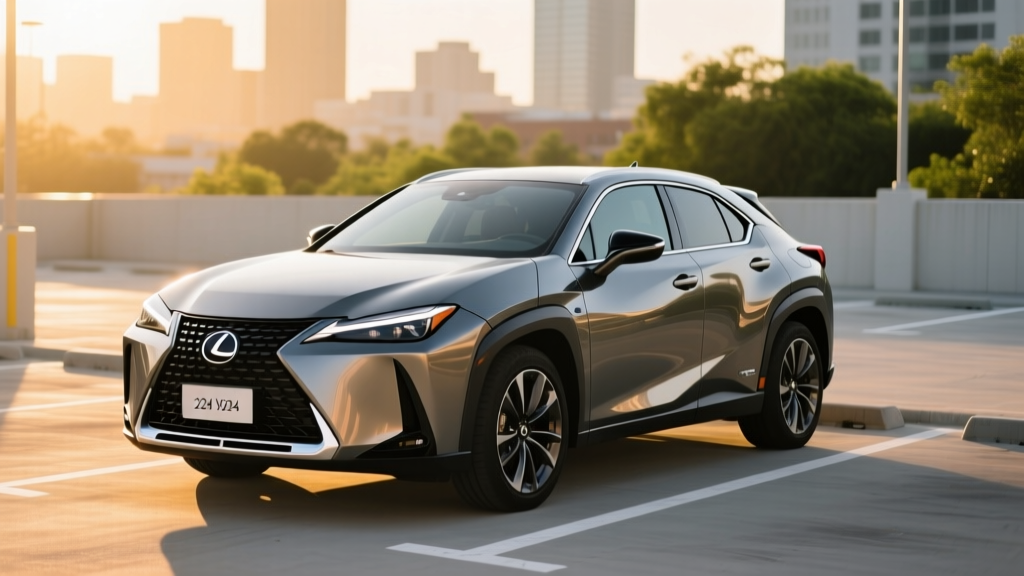
The 2024 Lexus UX 250h occupies a specific niche: a luxury subcompact crossover that prioritizes fuel efficiency and refinement over raw performance or cargo space. Now sold exclusively as a hybrid (Lexus dropped the gas-only UX 200 after 2022), it pairs a 2.0-liter four-cylinder with Toyota's proven hybrid system and standard all-wheel drive. For buyers weighing a premium commuter against fully electric alternatives, the UX 250h offers a compelling zero-plug-in proposition — but with caveats worth examining before you sign.
Quick Verdict: Who the UX 250h Is For
The UX 250h targets urban and suburban drivers who want Lexus refinement, standard AWD, and exceptional city fuel economy without ever plugging in. It's not a PHEV and not a full EV — it's a conventional self-charging hybrid (HEV). If your daily commute is under 40 miles and you lack home charging access, the UX 250h eliminates range anxiety entirely while still cutting fuel costs roughly in half compared to a gas-only competitor.
HEV vs PHEV vs EV: Where the UX 250h Fits
Before diving into specs, it's critical to understand what the UX 250h is — and what it isn't. Lexus does not offer a plug-in hybrid version of the UX.
| Feature | UX 250h (HEV) | PHEV Example (RAV4 Prime) | Full EV Example (Tesla Model Y) |
|---|---|---|---|
| Plugs in? | No — self-charging | Yes — Level 1/2 | Yes — Level 1/2/DC |
| Electric-only range | ~1 mile (low speed) | 42 miles EPA | 300+ miles EPA |
| Fuel/energy | Gasoline + regen | Gasoline + grid electricity | Grid electricity only |
| Federal tax credit (§30D) | Not eligible | Not eligible (PHEV rules vary) | Up to $7,500 (if eligible) |
| Home charger needed? | No | Recommended | Essential |
| Best for | No-charging-access commuters | Home chargers with short commutes | Home chargers, longer commutes |
Key distinction: The UX 250h is a conventional hybrid. It recovers energy through regenerative braking and uses a small 1.4 kWh nickel-metal-hydride (NiMH) battery to assist the gasoline engine. You never plug it in. If you want electric-only commuting from a Lexus, you'd need to look at the NX 450h+ (a PHEV) or wait for Lexus's expanding BEV lineup.
Fuel Economy: EPA Ratings and Real-World MPG
The UX 250h's headline number is its EPA-estimated fuel economy, which significantly outperforms most luxury crossovers in its class.
| Driving Condition | EPA Estimate | Real-World Expectation |
|---|---|---|
| City | 43 MPG | 44–48 MPG (hybrids excel in stop-and-go) |
| Highway | 41 MPG | 37–40 MPG (aero drag, sustained speeds) |
| Combined | 42 MPG | 40–44 MPG (mixed driving) |
Source: EPA Fuel Economy Guide.
Real-world context: Toyota/Lexus hybrids consistently match or exceed their EPA city ratings because regenerative braking captures energy that gas cars waste. On a 200-mile highway trip at 75 mph, expect closer to 38–40 MPG. In winter, the gasoline engine runs more frequently to provide cabin heat, dropping combined economy to roughly 36–39 MPG. These are still exceptional numbers for a luxury AWD crossover.
For comparison, the gas-powered BMW X1 xDrive28i rates 28 MPG combined, and the Audi Q3 manages 26 MPG combined. The UX 250h saves approximately 350–400 gallons of fuel per year at 15,000 miles, translating to roughly $1,200–$1,500 in annual savings at $3.50/gallon.
Powertrain and Performance Specs
| Specification | 2024 Lexus UX 250h |
|---|---|
| Engine | 2.0L inline-4 Atkinson-cycle |
| Hybrid System | Toyota Hybrid System II (THS II), 4th gen |
| Combined Horsepower | 181 hp (net system output) |
| Front Motor | 80 kW (107 hp), 150 lb-ft torque |
| Rear Motor (E-Four AWD) | 30 kW (40 hp), 89 lb-ft torque |
| Transmission | eCVT (planetary gearset, not belt-driven) |
| Drivetrain | Standard E-Four electronic AWD |
| 0–60 mph | ~7.0 seconds (est.) |
| Battery Type | 1.4 kWh NiMH (sealed, self-charging) |
| Cargo Volume | 21.7 cu ft (rear seats up) / 46.2 cu ft (folded) |
| Curb Weight | ~3,595 lbs |
The E-Four AWD system uses a dedicated rear electric motor rather than a mechanical driveshaft. It engages automatically during acceleration, low-traction conditions, and cornering, then disconnects during steady-state cruising to minimize losses. This is not a hardcore off-road system — ground clearance is just 6.1 inches — but it handles rain, snow, and light gravel confidently.
Performance is adequate rather than thrilling. The 181 combined horsepower propels the UX 250h to 60 mph in roughly 7.0 seconds. The eCVT delivers seamless, shift-free acceleration, though the engine drones noticeably under hard acceleration — a characteristic of Atkinson-cycle hybrid systems. Sport mode sharpens throttle response and steering weight but doesn't fundamentally change the car's comfort-oriented character.
Trim Levels and Pricing
The 2024 UX 250h is offered in a simplified lineup following Lexus's recent restructuring:
- UX 250h (base): ~$37,345 MSRP (includes destination)
- UX 250h Premium: ~$40,000 MSRP — adds heated/ventilated front seats, power moonroof, 10.3-inch navigation display
- UX 250h F SPORT Design: ~$41,500 MSRP — sport exterior/interior styling, unique 18-inch wheels
- UX 250h F SPORT Handling: ~$44,500 MSRP — adaptive variable suspension, sport-tuned steering
All trims come standard with Lexus Safety System+ 3.0 (pre-collision, lane tracing, adaptive cruise, road sign assist), 18-inch alloy wheels, an 8-inch or 12.3-inch touchscreen with wireless Apple CarPlay and Android Auto, and the E-Four AWD system.
Battery Warranty and Replacement Cost
Lexus covers the UX 250h's hybrid battery with a 10-year/150,000-mile warranty (in states that adopted the California emissions standard — which is most states). In non-CARB states, coverage is 8 years/100,000 miles. This warranty covers defects and capacity loss below a specified threshold.
Replacement cost: If the hybrid battery fails out of warranty, a new OEM NiMH battery pack costs approximately $3,000–$4,500 installed at a Lexus dealer. Third-party refurbished packs run $1,500–$2,500. However, Toyota/Lexus NiMH hybrid batteries have demonstrated exceptional longevity — many Prius and Camry Hybrid batteries exceed 200,000 miles with minimal degradation. The UX 250h's smaller, less stressed battery should prove equally durable.
The conventional 12V auxiliary battery is separate and carries a standard 4-year/50,000-mile warranty.
Federal and State Tax Credit Eligibility
The 2024 Lexus UX 250h does not qualify for the federal §30D Clean Vehicle Credit ($7,500). That credit is reserved for plug-in electric vehicles (BEVs and qualifying PHEVs with sufficient battery capacity). Conventional hybrids like the UX 250h are excluded under current IRS rules.
State-level incentives: A handful of states offer rebates or HOV-lane access for conventional hybrids, though these programs have largely shifted toward PHEVs and BEVs. Check your state's energy or environmental agency website for current programs. Some utility companies offer time-of-use rate discounts for hybrid owners, though this is more common for plug-in vehicles.
Bottom line on incentives: The UX 250h's value proposition rests on fuel savings and low maintenance costs rather than tax credits. At $37,345 base and 42 MPG combined, the total cost of ownership is competitive with more expensive PHEVs once you factor in the lack of home-charger installation costs.
Reliability and Long-Term Ownership
Lexus consistently ranks at or near the top of J.D. Power and Consumer Reports reliability studies, and the UX 250h benefits from one of the most proven hybrid powertrains in production. The THS II system has been in continuous refinement since 1997 (first-generation Prius), and the 2.0L Dynamic Force engine is shared across multiple Toyota/Lexus models with strong track records.
Maintenance advantages: The hybrid system reduces wear on several components:
- Regenerative braking significantly extends brake pad life (60,000–100,000+ miles is common)
- No traditional starter motor or alternator to fail
- The eCVT has no belts, clutches, or bands — it's a gearset that doesn't require fluid changes under normal use
- The gasoline engine shuts off frequently, reducing overall engine hours and oil degradation
Lexus includes 2 years/25,000 miles of complimentary scheduled maintenance. After that, expect oil changes every 10,000 miles at roughly $80–$120 at a dealer.
Driving Experience and Interior
The UX 250h prioritizes comfort over sportiness. Ride quality is composed and well-damped over most surfaces, though the 18-inch run-flat tires (no spare) transmit sharper impacts into the cabin. Noise isolation is excellent at city speeds; wind and tire noise become more noticeable above 70 mph.
The interior uses high-quality soft-touch materials, though the lower dash and door panels are harder plastics typical of the subcompact luxury segment. Front seats are supportive for long drives, but rear-seat legroom is tight at 33.1 inches — this is strictly a two-person car for adults on longer trips. Cargo space at 21.7 cubic feet is competitive with the BMW X1 and Audi Q3 but trails the Mercedes-Benz GLA.
The 12.3-inch touchscreen (Premium and above) runs Lexus's latest interface with native voice recognition, over-the-air updates, and a 4-year trial of Lexus Link Connected Services (remote start, vehicle status, stolen vehicle notification).
UX 250h vs. the Alternatives: Decision Framework
Pros
- 42 MPG combined — class-leading efficiency
- Standard AWD at no cost or fuel penalty
- No plug-in required — works anywhere
- 10-year/150,000-mile hybrid battery warranty (most states)
- Lexus reliability and resale value
- Comprehensive standard safety suite (LSS+ 3.0)
Cons
- No federal tax credit eligibility
- Tight rear-seat legroom (33.1 in)
- Modest cargo space (21.7 cu ft)
- Engine drone under hard acceleration
- Run-flat tires — no spare, firmer ride
- Not a PHEV — no meaningful electric-only range
Choose the UX 250h If:
- You lack access to home or workplace charging (apartment, street parking)
- Your commute is 20–50 miles round trip in mixed city/highway driving
- You want luxury-badge refinement with Prius-level fuel costs
- You live in a snowy or rainy climate and value standard AWD
Look Elsewhere If:
- You have home charging and want electric-only commuting → consider the Lexus NX 450h+ (PHEV, 37 mi electric range) or a full EV like the Tesla Model Y
- You regularly carry rear-seat passengers → the NX or RZ offers significantly more room
- You need to tow → the UX 250h is not rated for towing
- You want maximum federal incentives → only BEVs and qualifying PHEVs access the §30D credit
Frequently Asked Questions
How many MPG does the 2024 Lexus UX 250h get?
The EPA rates the UX 250h at 43 city / 41 highway / 42 combined MPG. In real-world city driving, owners frequently report 44–48 MPG thanks to aggressive regenerative braking. Highway driving at sustained speeds above 70 mph typically yields 37–40 MPG.
Does the UX 250h need to be plugged in?
No. The UX 250h is a conventional self-charging hybrid (HEV). It recharges its small 1.4 kWh battery through regenerative braking and the gasoline engine. There is no charging port and no electric-only commuting capability beyond very low-speed maneuvers (~1 mile at parking-lot speeds).
How far can the UX 250h go on electric only?
Effectively zero miles in practical terms. The hybrid system uses the electric motor to assist the gas engine and enable brief engine-off coasting, but it cannot sustain electric-only driving at meaningful speeds. If electric-only range is a priority, look at a PHEV like the NX 450h+ (37 miles EPA electric-only) or a full EV.
Is the Lexus UX 250h hybrid battery reliable?
Yes. Toyota/Lexus hybrid batteries have demonstrated exceptional durability over 25+ years of production. The NiMH chemistry in the UX 250h is conservative and well-managed thermally. Most hybrid batteries outlast 150,000+ miles without significant degradation. Lexus backs the battery with a 10-year/150,000-mile warranty in most states.
What does a replacement hybrid battery cost?
An OEM replacement NiMH battery for the UX 250h runs approximately $3,000–$4,500 installed at a Lexus dealer. Third-party refurbished units cost $1,500–$2,500. Given the battery's track record, most owners will never need a replacement during typical ownership.
Does the UX 250h qualify for any tax credit?
No. The federal §30D Clean Vehicle Credit applies only to plug-in electric vehicles (BEVs and qualifying PHEVs). The UX 250h, as a conventional hybrid, is not eligible. Some states may offer minor incentives for hybrids, but these are increasingly rare. Check your state's energy office for current programs.
How does the UX 250h compare to a full EV like the Tesla Model Y?
The Model Y offers far lower per-mile energy costs (~$0.04/mile on home electricity vs. ~$0.08/mile on gas for the UX 250h), stronger acceleration, access to the Supercharger network, and federal tax credit eligibility. However, the Model Y requires home charging infrastructure ($500–$2,000 installation), costs more upfront, and may not suit apartment dwellers or those in areas with unreliable public charging. The UX 250h is the pragmatic choice when plugging in isn't an option.
Is the UX 250h good in snow?
The standard E-Four AWD system provides confident traction in snow and rain. The rear electric motor engages automatically when front-wheel slip is detected. Combined with 6.1 inches of ground clearance and standard all-season tires, the UX 250h handles moderate winter conditions well. For severe snow, dedicated winter tires improve braking and cornering grip significantly.
Editorial note: Pricing and specifications reflect 2024 model-year data as published by Lexus. Federal and state incentive rules are subject to change. Verify current eligibility with the IRS and your state's energy office before purchasing.