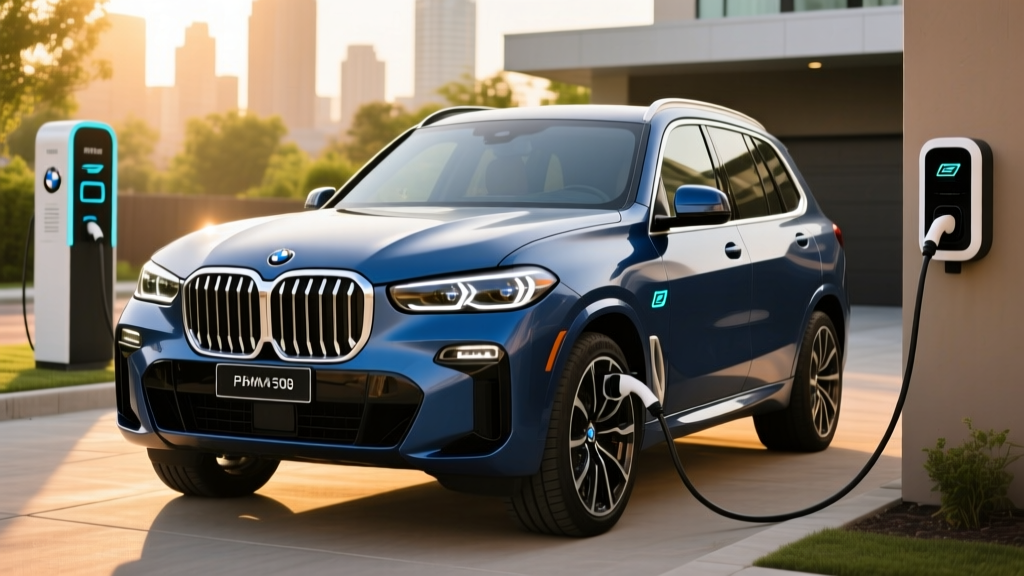
The Plug In BMW X5 xDrive50e: Quick Verdict
The BMW X5 xDrive50e is the plug-in hybrid variant of BMW's best-selling midsize luxury SUV, pairing a turbocharged inline-six with a more powerful electric motor than its predecessor. For 2026, it delivers an EPA-estimated 38 miles of electric-only range and a combined 50 MPGe when the battery is charged — making it a compelling bridge for luxury buyers who want daily electric commuting without sacrificing the 560-mile total range that eliminates road-trip anxiety.
At a starting MSRP of $74,575, the xDrive50e commands a premium over the gas-only X5 xDrive40i but delivers substantially better fuel economy, stronger acceleration (4.6 seconds to 60 mph), and standard all-wheel drive. The critical question: does the plug in BMW X5 make financial sense versus a full EV like the BMW iX or a conventional hybrid? Let's break down every number.
HEV vs PHEV: Where the X5 xDrive50e Fits
Before diving into specs, it's essential to understand what you're buying. BMW offers the X5 in three powertrain configurations, and confusing them is a common mistake:
| Model | Type | Plug-In Required? | Electric-Only Range | How It Charges |
|---|---|---|---|---|
| X5 sDrive40i / xDrive40i | Gasoline (ICE) | No | None | Gas station only |
| X5 xDrive50e | Plug-in Hybrid (PHEV) | Yes, to unlock full value | 38 miles (EPA) | Level 1/Level 2 AC; no DC fast charging |
| BMW iX | Battery Electric (BEV) | Yes | ~320 miles (EPA) | Level 1/2 AC + DC fast charging |
A conventional hybrid (HEV) — like the Toyota RAV4 Hybrid — never plugs in. It recovers energy through regenerative braking and the engine, yielding modest MPG gains. A plug-in hybrid (PHEV) like the X5 xDrive50e has a much larger battery that you charge from a wall outlet or charging station, enabling substantial electric-only driving before the gas engine ever starts. If you never plug in a PHEV, you're just carrying around extra weight and getting mediocre fuel economy — defeating the entire purpose.
Fuel Economy and Electric-Only Range: The Real Numbers
The EPA rates the 2026 BMW X5 xDrive50e at 50 MPGe combined when operating in charge-depleting (electric-assisted) mode, and 25 MPG combined once the battery is depleted and the gasoline engine takes over full-time. Here's the full breakdown:
| Metric | EPA Rating | Real-World Expectation |
|---|---|---|
| MPGe (combined, charged battery) | 50 MPGe | 46–52 MPGe depending on driving mix |
| MPG combined (battery depleted) | 25 MPG | 22–27 MPG (highway favors higher) |
| MPG city (battery depleted) | 24 MPG | 22–26 MPG |
| MPG highway (battery depleted) | 26 MPG | 25–28 MPG |
| Electric-only range | 38 miles | 30–36 miles (highway/cold weather) |
| Total combined range | ~560 miles | ~480–540 miles real-world |
Real-world context: The 38-mile EPA electric range assumes moderate temperatures and mixed driving. In our experience with BMW's PHEV powertrain, expect 30–34 miles of electric range in cold weather (below 40°F) and up to 36–38 miles in mild conditions with city-heavy driving. Highway speeds above 70 mph drain the battery faster — plan for roughly 28–30 electric miles at sustained 75 mph.
When the battery depletes, the 3.0-liter turbocharged inline-six operates as a conventional hybrid. The 25 MPG combined figure is respectable for a 5,300-pound luxury SUV, though owners who charge daily and commute under 35 miles may go weeks without visiting a gas station. According to fueleconomy.gov, the xDrive50e's combined MPGe significantly outpaces the gas-only xDrive40i, which returns 24 MPG combined.
Powertrain Specs: 483 Horsepower, Explained
| Specification | BMW X5 xDrive50e (2026) |
|---|---|
| Engine | 3.0L turbocharged inline-6 (312 hp) |
| Electric Motor | 197 hp (integrated in transmission) |
| Combined System Output | 483 hp / 516 lb-ft torque |
| 0–60 mph | 4.6 seconds |
| Transmission | 8-speed automatic (ZF) |
| Drivetrain | xDrive AWD (standard) |
| Battery Capacity (usable) | 25.7 kWh (NMC chemistry) |
| Battery Gross Capacity | 29.5 kWh |
| Onboard Charger | 7.4 kW (AC only) |
| DC Fast Charging | Not available |
| Level 2 Charge Time (0–100%) | ~3.5–4 hours |
| Level 1 Charge Time (120V) | ~16–18 hours |
| Towing Capacity | 5,000 lbs (with factory hitch) |
| Curb Weight | ~5,330 lbs |
| EPA Electric Range | 38 miles |
| EPA MPGe (combined) | 50 MPGe |
| EPA MPG (battery depleted) | 25 combined / 24 city / 26 highway |
| Base MSRP | $74,575 |
The xDrive50e's powertrain is a meaningful upgrade over the outgoing xDrive45e. BMW bumped the electric motor from 111 hp to 197 hp and increased usable battery capacity from 21.5 kWh to 25.7 kWh. The result is stronger electric-only acceleration (you can merge onto highways in EV mode without the engine kicking in) and roughly 30% more electric range.
Charging the Plug In BMW X5: What You Need at Home
The X5 xDrive50e uses a standard J1772 connector for AC charging. BMW includes a flexible charger (often called the "TurboCord") that works with both 120V (Level 1) and 240V (Level 2) outlets, though at 240V it maxes out around 3.5 kW — well below the vehicle's 7.4 kW onboard charger capability.
To unlock the full 7.4 kW charging speed, you'll need a dedicated Level 2 wallbox (such as a ChargePoint Home Flex or BMW's own Wallbox) installed on a 40-amp or 50-amp circuit. At 7.4 kW, the battery charges from empty to full in approximately 3.5 to 4 hours — ideal for overnight replenishment.
Important limitation: The X5 xDrive50e does not support DC fast charging. There's no CCS or NACS port. This is standard for most PHEVs — the battery is small enough that AC charging overnight is deemed sufficient. If you need road-trip fast charging, you're looking at a full EV like the BMW iX, which supports up to 200 kW DC.
Battery and Powertrain Warranty Coverage
BMW covers the X5 xDrive50e's high-voltage battery for 8 years or 80,000 miles (whichever comes first), with a capacity retention threshold of 70%. If the battery degrades below 70% of its original capacity within that period, BMW will repair or replace it under warranty. The powertrain (engine, transmission, electric motor) is covered for 4 years or 50,000 miles, consistent with BMW's standard new-vehicle warranty. Federal law mandates that hybrid/PHEV battery components carry at minimum an 8-year/80,000-mile warranty, and BMW meets this requirement. Out-of-warranty battery replacement for the xDrive50e is estimated at $12,000–$18,000 including labor, though PHEV batteries generally experience slower degradation than full EV batteries due to smaller charge cycles and a conservative buffer strategy.
Pricing, Trims, and 2026 Federal Tax Credit Eligibility
The 2026 BMW X5 xDrive50e starts at $74,575 (including destination). BMW offers it in a single well-equipped trim, though options like the Premium Package, Driving Assistance Professional, and Executive Package can push the as-tested price above $85,000.
Regarding the federal §30D plug-in hybrid tax credit: eligibility depends on several factors that change frequently. As of 2026, the key requirements include:
- MSRP cap: SUVs must have a base MSRP at or below $80,000 to qualify
- Buyer income cap: Modified AGI must not exceed $150,000 (single) / $300,000 (joint)
- Battery sourcing: Critical minerals and battery components must meet escalating domestic-content thresholds (check IRS.gov for current-year rules)
- Assembly: Vehicle must undergo final assembly in North America
- Credit amount: Up to $7,500 if all requirements are met; partial credit ($3,750) if only one sourcing requirement is satisfied
The BMW X5 xDrive50e is assembled at BMW's Spartanburg, South Carolina plant, satisfying the North American assembly requirement. However, battery component and critical mineral sourcing may limit the credit to $3,750 or disqualify it entirely depending on current-year supply chain composition. We strongly recommend checking the IRS qualified vehicles list and consulting a tax professional before purchasing — do not assume the full $7,500 credit applies. Point-of-sale transfer is available for qualifying buyers, reducing the purchase price directly at the dealer.
Real-World Ownership: Who Should Buy the Plug In BMW X5?
Pros
- 38 miles of electric range covers most daily commutes without burning gas
- 483 hp and 4.6-second 0–60 deliver genuine performance SUV thrills
- 560-mile total range eliminates road-trip charging anxiety
- Standard AWD and 5,000-lb towing capability
- Premium interior with iDrive 8.5, curved display, and advanced ADAS
- Quiet, refined electric-only driving in city traffic
Cons
- No DC fast charging — road trips run on gasoline
- $74,575 starting price is $9,000+ above the gas xDrive40i
- Real-world electric range drops to ~30 miles in cold weather
- Cargo space slightly reduced vs. gas X5 (battery under floor)
- Tax credit eligibility uncertain due to battery sourcing rules
- Must have home/workplace charging access to realize PHEV value
Choose the Plug In BMW X5 xDrive50e If:
- Your daily commute is under 35 miles round-trip and you can charge at home overnight
- You want a luxury SUV that can do school runs on electricity but still tow a boat or handle 500-mile road trips without planning charger stops
- You're not ready for a full EV but want meaningful fuel savings and electric driving experience
Choose a Full EV (BMW iX) Instead If:
- You have reliable home charging and your trips rarely exceed 300 miles
- You want to eliminate gasoline entirely and minimize maintenance (no oil changes, no engine)
- You can access DC fast chargers for road trips
Choose the Gas X5 xDrive40i Instead If:
- You cannot install a Level 2 charger at home and lack workplace charging
- Your daily driving regularly exceeds 50+ miles, making the electric range largely irrelevant
- The $9,000+ price premium over the gas model doesn't pencil out in fuel savings for your mileage
For the right buyer — someone with a sub-35-mile commute, a garage with a 240V outlet, and a desire for luxury SUV versatility — the plug in BMW X5 xDrive50e is arguably the most well-rounded PHEV in its class. The inline-six provides the refinement BMW is known for, while the upgraded electric motor means you'll genuinely spend most weekday miles in silent EV mode.
Reliability, Maintenance, and Long-Term Costs
PHEVs carry a unique reliability profile: they combine the complexity of an internal combustion engine with an electric drivetrain. However, BMW's turbocharged B58 inline-six has proven robust in multiple model lines, and the ZF 8-speed transmission is one of the most reliable automatics in the industry.
On the maintenance side, PHEV owners should budget for standard ICE upkeep — oil changes (every 10,000 miles or annually), brake fluid, coolant, and eventual spark plugs — though regenerative braking significantly extends brake pad life. BMW includes 3 years / 36,000 miles of complimentary scheduled maintenance.
Insurance premiums for the xDrive50e tend to run 10–20% higher than the gas-only xDrive40i due to the higher replacement cost of the high-voltage system and the vehicle's greater MSRP. Expect annual insurance costs in the $2,400–$3,200 range depending on your profile and location.
Long-term battery degradation is a valid concern but generally manageable. BMW's PHEV batteries use a conservative buffer strategy — the 29.5 kWh gross capacity with 25.7 kWh usable means roughly 13% of the battery is held in reserve to protect longevity. Based on data from the previous-generation xDrive45e, expect approximately 5–8% degradation over 5 years of typical use, which would reduce electric range from 38 miles to roughly 35 miles — a negligible real-world difference.
Frequently Asked Questions
How many MPG does the plug in BMW X5 get?
The EPA rates the 2026 X5 xDrive50e at 50 MPGe combined when the battery is charged, and 25 MPG combined (24 city / 26 highway) once the battery is depleted and the gasoline engine operates alone. Real-world results vary: owners who charge daily and commute short distances report effectively using little to no gasoline during the work week, while those who drive long highway trips will see fuel economy closer to 23–26 MPG.
How far can the BMW X5 PHEV go on electric only?
The EPA estimates 38 miles of electric-only range. In real-world conditions, expect 30–36 miles depending on temperature, speed, and terrain. Cold weather (below 40°F) and sustained highway speeds above 70 mph reduce range the most. For commutes under 30 miles round-trip, most owners can drive all-electric on weekdays with nightly charging.
Does the BMW X5 xDrive50e qualify for a federal tax credit?
Eligibility for the §30D federal clean vehicle credit (up to $7,500) depends on current-year battery sourcing rules, your income, and the vehicle's MSRP. The X5 xDrive50e is assembled in South Carolina (meeting the North American assembly requirement) and its base MSRP is under the $80,000 SUV cap. However, critical mineral and battery component sourcing requirements may reduce or eliminate the credit. Always verify current eligibility on IRS.gov and consult a tax professional before purchasing.
Is the BMW X5 PHEV reliable, and what does battery replacement cost?
The X5 xDrive50e's powertrain combines BMW's well-regarded B58 inline-six with a proven ZF transmission and an electric motor integrated into the gearbox — all components with strong reliability track records. The high-voltage battery is warrantied for 8 years / 80,000 miles against defects and degradation below 70% capacity. Out-of-warranty replacement is estimated at $12,000–$18,000, though PHEV batteries typically last well beyond the warranty period due to conservative buffer management and smaller total capacity compared to full EVs.
Can I charge the BMW X5 xDrive50e at a public fast charger?
No. The X5 xDrive50e only supports AC charging (Level 1 at 120V or Level 2 at 240V) via a J1772 connector. It cannot use DC fast chargers (CCS, NACS, or CHAdeMO). This is typical for plug-in hybrids — the 25.7 kWh battery is designed for overnight home charging, which fully replenishes it in 3.5–4 hours at 7.4 kW.
Hybrid vs PHEV vs EV — which should I choose?
A conventional hybrid (HEV) like the Toyota Highlander Hybrid never plugs in and offers modest MPG gains (think 35 MPG combined) — ideal if you lack charging access. A plug-in hybrid (PHEV) like the X5 xDrive50e offers 30–38 miles of electric range plus a gas engine for long trips — ideal if you can charge at home and want to eliminate most daily gasoline use without road-trip limitations. A full EV (BEV) like the BMW iX runs entirely on electricity with 300+ miles of range — ideal if you have home charging, rarely exceed 300 miles per trip, and want zero tailpipe emissions and minimal maintenance.
Sources: U.S. EPA Fuel Economy Guide, IRS Clean Vehicle Credits, BMW USA product specifications.